MCQ
Energy is not carried by which of the following waves
  • Stationary
  • B
    Progressive
  • C
    Transverse
  • D
    Electromagnetic

Answer

Correct option: A.
Stationary
a
(a)Energy is not carried by stationary waves

Need a full question paper?

Generate a complete, print-ready paper with questions like this in minutes — across 16+ boards, with answer keys.

Start Generating Free

Similar questions

A drop of liquid of radius $\mathrm{R}=10^{-2} \mathrm{~m}$ having surface tension $\mathrm{S}=\frac{0.1}{4 \pi} \mathrm{Nm}^{-1}$ divides itself into $\mathrm{K}$ identical drops. In this process the total change in the surface energy $\Delta U=10^{-3} \mathrm{~J}$. If $\mathrm{K}=10^\alpha$ then the value of $\alpha$. . . . is
A circular disc of mass $2 \,kg$ and radius $10 \,cm$ rolls without slipping with a speed $2 \,m / s$. The total kinetic energy of disc is .......... $J$
If a gas follows Boyle's law then what will be the form of the graph between PV and V?
For a body moving in a circular path, a condition for no skidding if $\mu $ is the coefficient of friction, is
The angle of projection at which the horizontal range and maximum height of projectile are equal is
The moment of inertia of semicircular ring about an axis, passing through the center and perpendicular to the plane of ring, is $\frac{1}{ x } MR ^2$, where $R$ is the radius and $M$ is the mass of semicircular ring. The value of $x$ will be $...........$
When a bus suddenly takes a turn, the passengers are thrown outwards because of
The average translational energy and the $r.m.s.$ speed of molecules in a sample of oxygen gas at $300 K$ are $6.21 \times {10^{ - 21}}\,J$ and $484\, m/s$ respectively. The corresponding values at $600 K$ are nearly (assuming ideal gas behaviour)
The velocity with which a projectile must be fired so that it escapes earth’s gravitation does not depend on
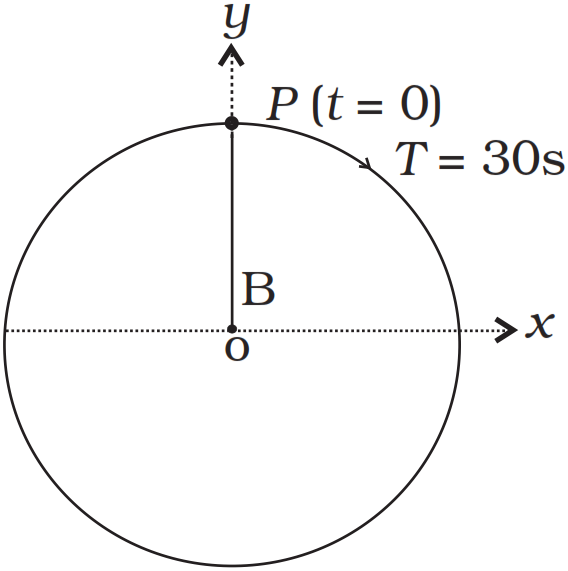
Figure shows the circular motion of a particle. The radius of the circle, the period, sense of revolution and the initial position are indicated on the figure. The simple harmonic motion of the x-projection of the radius vector of the rotating particle P is: