MCQ
Energy of a charged conductor is :
  • A
    $E=\frac{1}{2}CV$
  • $E=\frac{1}{2}CV^{2}$
  • C
    $E=\frac{1}{2}C^{2}V$
  • D
    $E=C.V$

Answer

Correct option: B.
$E=\frac{1}{2}CV^{2}$
B

Need a full question paper?

Generate a complete, print-ready paper with questions like this in minutes — across 16+ boards, with answer keys.

Start Generating Free

Similar questions

Electron volt is a unit of(a) Potential(b) Charge(c) Power   (d) Energy
       
A sinusoidal voltage $\text{V}=200\sin314\text{t}$ is applied to a $10\Omega$ resistor. Find the peak voltage.
Consider a photon of a continuous X-ray coming from a Coolidge tube. Its energy comes from:
The number 0 (zero) is required for:
If we increase the driving frequency in a circuit with a purely resistive load, then amplitude VR​.
Einstein was awarded Noble prize for:
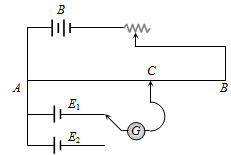
The circuit shown here is used to compare the $\text{e.m.f.}$ of two cells $E _1$ and $E _2\left( E _1> E _2\right)$. The null point is at $C$ when the galvanometer is connected to $E _1$. When the galvanometer is connected to $E _2$, the null point will be
A heavy ring of mass m is clamped on the periphery of al light circular disc. A small particle having equal mass is clamped at the centre of the disc. The system is rotated in such a way that the centre moves in a circle of radius r with a uniform speed v. We conclude that an external force:
  1. $\frac{\text{mv}^2}{\text{r}}$ must be acting on the central particle.
  2. $\frac{2\text{mv}^2}{\text{r}}$ must be acting on the central particle.
  3. $\frac{2\text{mv}^2}{\text{r}}$ must be acting on the system.
  4. $\frac{2\text{mv}^2}{\text{r}}$ must be acting on the ring.
Huygens' principle of secondary wavelets may be used to:
  1. Find the velocity of light in vacuum.
  2. Explain the particle behaviour of light.
  3. Find the new position of a wavefront.
  4. Explain Snell's law.
An ammeter reads upto $1$ ampere.  Its internal resistance is $0.81$ ohm.  To increase the range to $10\ A$ the value of the required shunt is