MCQ 11 MarkThe dielectric constant of a metal is :A-1B$0$C1✓infinityAnswerCorrect option: D. infinityDView full question & answer→
MCQ 21 MarkThe capacity of a spherical conductor is 1.0 µF. Its radius will be :A1.11 metreB10 metre✓9 kmD1.11 cmAnswerCorrect option: C. 9 kmCView full question & answer→
MCQ 31 MarkCapacity of any condenser does not depend upon :Ashape of platesBsize of plates✓charges on platesDdistance between platesAnswerCorrect option: C. charges on platesCView full question & answer→
MCQ 41 MarkPicofarad is the unit of :Aelectric chargeBintensity of electric field✓electric capacityDelectric fluxAnswerCorrect option: C. electric capacityCView full question & answer→
MCQ 51 MarkThe electrostatic energy of the system made by two electric dipoles kept at a distance 'r' is proportional to :A$r^{2}$✓$r^{-3}$C$r^{4}$DNone of theseAnswerCorrect option: B. $r^{-3}$BView full question & answer→
MCQ 61 MarkThe relation between electric field (E) and electric potential (V) is :✓$E=-(\frac{dV}{dr})$B$E=-(\frac{dr}{dV})$C$E=(\frac{dV}{dr})$D$E=(\frac{dr}{dV})$AnswerCorrect option: A. $E=-(\frac{dV}{dr})$AView full question & answer→
MCQ 71 MarkAn electron is accelerated to 5 volt potential difference. The energy gained by the electron will be :A5 joule✓5 eVC5 ergD5 wattAnswerCorrect option: B. 5 eVBView full question & answer→
MCQ 81 MarkIn broad-side-on position, the electric potential due to electric dipole is :A$\frac{1}{4\pi\in_{0}}\frac{P}{r}$B$\frac{1}{4\pi\in_{0}}\frac{P}{r^{2}}$✓zeroDinfiniteAnswerCorrect option: C. zeroCView full question & answer→
MCQ 91 Mark$n$ electric dipoles are situated in a closed surface. Total electric flux coming out from closed surface will be :A$q/\in_{0}$B$2q/\in_{0}$C$nq/\in_{0}$✓zeroAnswerCorrect option: D. zeroDView full question & answer→
MCQ 101 MarkOn moving from the surface of a charged metallic sphere to the centre of the sphere, the electric field :AdecreasesBincreasesCremains same as at the surface✓zero at all placesAnswerCorrect option: D. zero at all placesDView full question & answer→
MCQ 111 MarkTwo equal and opposite charges of 5 coulomb are kept mutually at a distance of 5.0 cm. The electric dipole moment of the system is :A$5\times10^{-2}$ coulomb-metre✓$25\times10^{-2}$ coulomb-metreC1 coulomb-metreDzeroAnswerCorrect option: B. $25\times10^{-2}$ coulomb-metreBView full question & answer→
MCQ 121 MarkNumber of electrons present in 8 coulomb negative charge is :✓$5\times10^{19}$B$2.5\times10^{19}$C$12.8\times10^{19}$D$1.6\times10^{19}$AnswerCorrect option: A. $5\times10^{19}$AView full question & answer→
MCQ 131 MarkThe dimensional formula of intensity of electric field is :A$[MLT^{2}A^{-1}]$✓$[MLT^{-3}A^{-1}]$C$[MLT^{-3}A]$D$[ML^{2}T^{-3}A^{-1}]$AnswerCorrect option: B. $[MLT^{-3}A^{-1}]$BView full question & answer→
MCQ 141 MarkUnit of linear charge density is :✓coulomb/ metreBcoulomb × metreCmetre / coulombDNone of theseAnswerCorrect option: A. coulomb/ metreAView full question & answer→
MCQ 151 MarkThree capacitors of capacitance $6~\mu F$ are available. The minimum and maximum capacitance obtained are :A$3~\mu F,$ $12~\mu F$B$2~\mu F,$ $12~\mu F$✓$2~\mu F,$ $18~\mu F$D$6~\mu F,$ $18~\mu F$AnswerCorrect option: C. $2~\mu F,$ $18~\mu F$CView full question & answer→
MCQ 161 Mark64 identical drops each of capacity $5~\mu F$ combine to form a big drop. What will be the capacity of the big drop ?A$25~\mu F$B$4~\mu F$C$164~\mu F$✓20 µFAnswerCorrect option: D. 20 µFDView full question & answer→
MCQ 171 MarkWhat is the angle between the electric dipole moment $\vec{p}$ and the electric field strength $\vec{E}$ when the dipole is in a stable equilibrium ?A$\frac{\pi}{4}$B$\pi$C$\frac{\pi}{2}$✓$0$AnswerCorrect option: D. $0$DView full question & answer→
MCQ 181 MarkWhich of the following physical quantities is a vector ?AElectric fluxBElectric potentialCElectric potential energy✓Electric intensityAnswerCorrect option: D. Electric intensityDView full question & answer→
MCQ 191 MarkThe ratio of electric force and gravitational force acting between two charges is in the order of :A$10^{42}$✓$10^{39}$C$10^{36}$D1AnswerCorrect option: B. $10^{39}$BView full question & answer→
MCQ 201 MarkThe law, governing the force acting between two electric charges is known as :AAmpere lawBOhm's lawCFaraday's law✓Coulomb's lawAnswerCorrect option: D. Coulomb's lawDView full question & answer→
MCQ 211 MarkIf n capacitors of equal capacity $C_{1}$ are connected in parallel the equivalent capacity will be :A$C=\frac{C_{1}}{n}$B$C=\frac{n}{C_{1}}$C$C=n^{2}C_{1}$✓$C=nC_{1}$AnswerCorrect option: D. $C=nC_{1}$DView full question & answer→
MCQ 221 MarkEnergy of a charged conductor is :A$E=\frac{1}{2}CV$✓$E=\frac{1}{2}CV^{2}$C$E=\frac{1}{2}C^{2}V$D$E=C.V$AnswerCorrect option: B. $E=\frac{1}{2}CV^{2}$BView full question & answer→
MCQ 231 MarkThe capacity of any conductor is :A$C=qV$B$C=\frac{V}{q}$C$C=\frac{1}{2}qV$✓$C=\frac{q}{V}$AnswerCorrect option: D. $C=\frac{q}{V}$DView full question & answer→
MCQ 241 MarkThe vecter term of coulomb's law is :✓$\vec{F}=\frac{1}{4\pi\in_{0}}\frac{q_{1}q_{2}}{|\vec{r}|^{3}}\vec{r}$B$\vec{F}=\frac{1}{4\pi\in_{0}}\frac{q_{1}q_{2}}{|\vec{r}|^{3}}$C$\overrightarrow{ F }=\frac{1}{4 \pi \varepsilon_0} \frac{q_1 q_2}{r^2}$D$\vec{F}=\frac{1}{4\pi\in_{0}}\frac{q_{1}q_{2}}{|\vec{r}|^{2}}\vec{r}$AnswerCorrect option: A. $\vec{F}=\frac{1}{4\pi\in_{0}}\frac{q_{1}q_{2}}{|\vec{r}|^{3}}\vec{r}$AView full question & answer→
MCQ 251 MarkThe S.I. unit of electric intensity is :ANC✓$NC^{-1}$C$NC^{2}$D$N/C^{2}$AnswerCorrect option: B. $NC^{-1}$BView full question & answer→
MCQ 261 MarkS.I. unit of electric depole moment is :AcmB$cm^{2}$✓$cm^{-1}$D$cm^{-2}$AnswerCorrect option: C. $cm^{-1}$CView full question & answer→
MCQ 271 MarkTwo capacitors each of capacity C are connected in parallel. The equivalent capacity is :✓2CBCC$\frac{c}{2}$D$\frac{1}{2C}$AnswerCorrect option: A. 2CAView full question & answer→
MCQ 281 MarkElectric potential is equal to :A$\frac{q}{W}$✓$\frac{W}{q}$CWqD$\sqrt{Wq}$AnswerCorrect option: B. $\frac{W}{q}$BView full question & answer→
MCQ 291 MarkThe value of electric potential of a distance $r$ from a point charge $q$ is :✓$\frac{1}{4\pi\in_{0}}\frac{q}{r}$B$\frac{1}{4\pi\in_{0}}\frac{q}{r^{2}}$C$\frac{qr}{4\pi\in_{0}}$D$\frac{1}{4\pi\in_{0}}\frac{q^{2}}{r}$AnswerCorrect option: A. $\frac{1}{4\pi\in_{0}}\frac{q}{r}$AView full question & answer→
MCQ 301 MarkOne farad (4F) is equal to :A1CV✓$1CV^{-1}$C$1CV^{-2}$D1CV2AnswerCorrect option: B. $1CV^{-1}$BView full question & answer→
MCQ 311 MarkWhich of the following is correct for the capacity of a parallel place capacitor ?✓$\frac{A\in_{0}}{d}$B$\frac{\in_{0}d}{A}$C$\frac{d}{\in_{0}A}$D$\frac{A}{\in_{0}d}$AnswerCorrect option: A. $\frac{A\in_{0}}{d}$AView full question & answer→
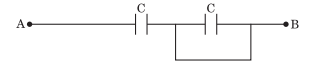
MCQ 321 MarkEquivalent capacity between A and B in figure is:✓CB$\frac{c}{2}$C2CD$\frac{2}{C}$AnswerCorrect option: A. CAView full question & answer→
MCQ 331 MarkThe value of $\frac{1}{4\pi\in_{0}}$✓$9\times10^{9}Nm^{2}C^{-2}$B$9\times10^{-9}Nm^{2}C^{-2}$C$9\times10^{12}Nm^{2}C^{-2}$D$9\times10^{-12}Nm^{2}C^{-2}$AnswerCorrect option: A. $9\times10^{9}Nm^{2}C^{-2}$AView full question & answer→
MCQ 341 MarkThe dielectric constant of water is :✓80B60C1D42.5AnswerCorrect option: A. 80AView full question & answer→
MCQ 351 MarkThe relative permittivity $(\in_{r})$ of a medium is :✓$\frac{\in}{\in_{0}}$B$\in\times\in_{0}$C$\in+\in_{0}$D$\in-\in_{0}$AnswerCorrect option: A. $\frac{\in}{\in_{0}}$AView full question & answer→
MCQ 361 MarkWhich of the following relations is correct ?✓$\vec{E}=\frac{\vec{F}}{q}$B$\vec{E}=q\vec{F}$C$\vec{E}=\frac{q}{\vec{F}}$D$\vec{E}=\frac{1}{4\pi\in_{0}}\frac{q}{\vec{F}}$AnswerCorrect option: A. $\vec{E}=\frac{\vec{F}}{q}$AView full question & answer→
MCQ 371 MarkThe electric potential of free space is :A$9\times10^{9}mF^{-1}$B$1.6\times10^{-19}C$✓$8.85\times10^{-12}Fm^{-1}$D$8.85\times10^{-9}Fm^{-1}$AnswerCorrect option: C. $8.85\times10^{-12}Fm^{-1}$CView full question & answer→
MCQ 381 MarkThe value of force along on a charged particle in electric tied is :✓qEB$q/E$C$\frac{E}{q}$D$\sqrt{qE}$AnswerCorrect option: A. qEAView full question & answer→