MCQ
Energy production in nuclear reactor is due to :
  • Nuclear fission
  • B
    Nucleus fusion
  • C
    Both (a) and (b)
  • D
    None of these

Answer

Correct option: A.
Nuclear fission
A

Need a full question paper?

Generate a complete, print-ready paper with questions like this in minutes — across 16+ boards, with answer keys.

Start Generating Free

Similar questions

To construct a barometer, a tube of length $1m$ is filled completely with mercury and is inverted in a mercury cup. The barometer reading on a particular day is $76\ cm.$ Suppose a $1m$ tube is filled with mercury up to $76\ cm$ and then closed by a cork. It is inverted in a mercury cup and the cork is removed. The height of mercury column in the tube over the surface in the cup will be.
If $E$ is the electric field intensity of an electrostatic field, then the electrostatic energy density is proportional to
In a step-up transformer the turn ratio is 1:10. A resistance of 200 ohm connected across the secondary is drawing a current of 0.5 A. What is the primary voltage and current
The transconductance of a triode amplifier is 2.5 mili mho having plate resistance of 20 KW, amplification 10. Find the load resistance(a) 5 kW  (b) 25 kW(c) 20 kW(d) 50 kW
       
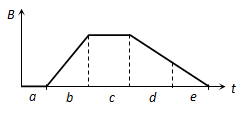
The graph gives the magnitude $B(t)$ of a uniform magnetic field that exists throughout a conducting loop, perpendicular to the plane of the loop. Rank the five regions of the graph according to the magnitude of the emf induced in the loop, greatest first
The diameter of each plate of an air capacitor is $4 \ cm$. To make the capacity of this plate capacitor equal to that of $20 \ cm$ diameter sphere, the distance between the plates will be
The mean intensity in the interference pattern obtained from two coherent sources of equal intensity $I _0$ will be :
Dielectric constant is the:
Two independent parallel wires in which the current is flowing in the same direction. They will:
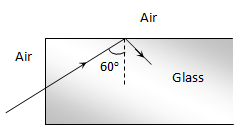
A light ray from air is incident $($as shown in figure$)$ at one end of a glass fiber $($refractive index $m = 1.5)$ making an incidence angle of $60^\circ$ on the lateral surface, so that it undergoes a total internal reflection. How much time would it take to traverse the straight fiber of length $1 \ km$