Question
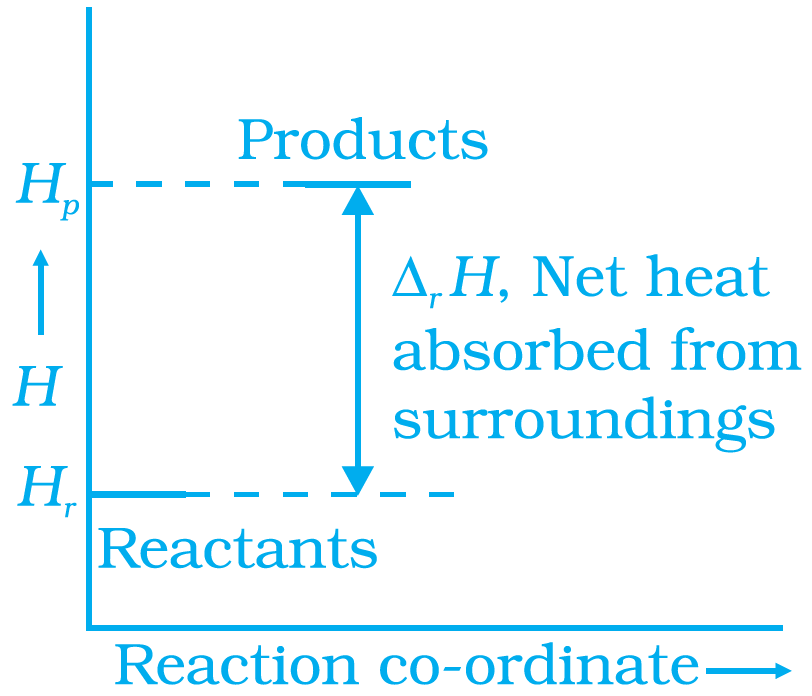
Enthalpy diagram for a particular reaction is given in Fig. Is it possible to decide spontaneity of a reaction from given diagram. Explain.
Answer

No. Enthalpy is one of the contributory factors in deciding spontaneity but it is not the only factor. One must look for contribution of another factor i.e., entropy also, for getting the correct result.

Need a full question paper?

Generate a complete, print-ready paper with questions like this in minutes — across 16+ boards, with answer keys.

Start Generating Free

Similar questions

Ethyl acetate is formed by the reaction of ethanol and acetic acid and the equilibrium is represented as:
$
CH_3 COOH(l)+C_5 H_5 OH(l) \rightleftharpoons CH_3 COOC_2 H_5(l)+H_2 O(l)
$
a. Write the concentration ratio (reaction quotient), $Q _{ C }$, for this reaction (note: water is not in excess and is not a solvent in this reaction)
b. At 293 K , if one starts with 1.00 mol of acetic acid and 0.18 mol of ethanol, there is 0.171 mol of ethyl acetate in the final equilibrium mixture. Calculate the equilibrium constant.
c. Starting with 0.5 mol of ethanol and 1.0 mol of acetic acid and maintaining it at $293 K, 0.214$ mol of ethyl acetate is found after some time. Has equilibrium been reached?
What are the various factors due to which the ionization enthalpy of the main group elements tends to decrease down a group?
Classify the following reactions in one of the reaction type studied in this unit.
  1. CH3CH2Br + HS- → CH3CH2SH + Br-
  2. (CH3)2 C = CH2 + HCl → (CH3)2 ClC-CH3
  3. CH3CH2Br + HO- → CH=CH2 + H2O + Br-
  4. (CH3)3 C-CH3OH + HBr → (CH3)2 CBrCH2CH2CH + H2O
Explain different types of oxidation reactions of alkenes with example.
Briefly describe the valence bond theory of covalent bond formation by taking an example of hydrogen. How can you interpret energy changes taking place in the formation of dihydrogen?
1. Describe the effect of
a. addition of $H _2$
b. addition of $CH _3 OH$
c. removal of CO
d. removal of $CH _3 OH$ on the equilibrium of the reaction,
$
2 H_2(g)+CO(g) \rightleftharpoons CH_3 OH(g)
$
2. What happens to an equilibrium in a reversible reaction if a catalyst is added to it?
Calculate the moles of NaOH required to neutralize the solution produced by dissolvingg 1.1gP4O6 in water. Use the following reactions:
P4O6 + 6H2O → 4H3PO3
2NaOH + H3PO3 → Na2HPO3 + 2H2O
(Atomic mass/ g mol-1; P = 31, O = 16)
First member of each group of representative elements (i.e., s and p-block elements) shows anomalous behaviour. Illustrate with two examples.
A mixture of 1.57 mol of N2, 1.92 mol of H2 and 8.13 mol of NH3 is introduced into a 20L reaction vessel at 500K. At this temperature, the equilibrium constant, Kc for the reaction $\text{N}_2\text{ (g) + }3\text{H}_2\text{ (g)}\rightleftharpoons2\text{NH}_3\text{ (g) is }1.7\times10^2.$ Is the reaction mixture at equilibrium? If not, what is the direction of the net reaction?
Answer the following:
  1. n + l value for 14th electron in an atom.
  2. Increasing order of filling electron in 4f, 5p and 6d subshells.
  3. 'm' and 'l' value for last electron of Mg atom [Atomic no. = 12].
  4. Subshell in which last electron is present in Ga[31].
  5. Sum of spin of all electron in element having atomic number 14.