28 questions · self-marked practice — reveal the answer and mark yourself.
Explanation:
According to the question,
$\Delta\text{H}=-890.3\text{kJ} \ \text{mol}^{-1}$
$\Delta\text{H}=-393.5\text{kJ} \ \text{mol}^{-1}$
$\Delta\text{H}=-285.8\text{kJ} \ \text{mol}^{-1}$
Thus, the desired equation is the one that represents the formation of CH4(g) i.e.,
$\text{C}_{(\text{s})}+2\text{H}_{{2(\text{g})}}\xrightarrow[]{\ \ \ \ \ \ \ }\text{CH}_{4(\text{g})}$
$\Delta_{\text{f}}\text{H}_{\text{CH}_4} \ =\Delta_{\text{c}}\text{H}_{\text{c}} + 2\Delta_{\text{c}}\text{H}_{\text{H}_2} - \Delta_{\text{c}}\text{H}_{\text{co}_2}$
$=[-393.5 +2(-258.8)-(-890.3)]\text{kJ} \ \text{mol}^{-1}$
$=-74.8\text{kJ} \ \text{mol}^{-1}$
$\therefore$ Enthalpy of formation of CH4(g) = –74.8kJ mol–1
$\therefore\log\text{K}=-\frac{-33.2\times10^3\text{J mol}^{-1}}{2.303\times(8.314\text{JK}^{-1}\text{mol}^{-1})\times(298\text{K})}$
$=5.82\ \text{or K}=6.6\times10^5$
$\log\text{K}=-\frac{-16.6\times10^3\text{J mol}^{-1}}{2.303\times(8.314\text{JK}^{-1}\text{mol}^{-1})\times(298\text{K})}$
$=2.91\ \text{or K}=8.1\times10^2$
$\Delta\text{G}^\circ=-[-16.6\text{kJ mol}^{-1}]=16.6\text{kJ mol}^{-1}$
$\log\text{K}=-\frac{16.6\times10^3\text{JK}^{-1}\text{mol}^{-1}}{2.303\times(8.314\text{JK}^{-1}\text{mol}^{-1})\times(298\text{K})}$
$=-2.91\text{ or K}=1.23\times10^{-3}$
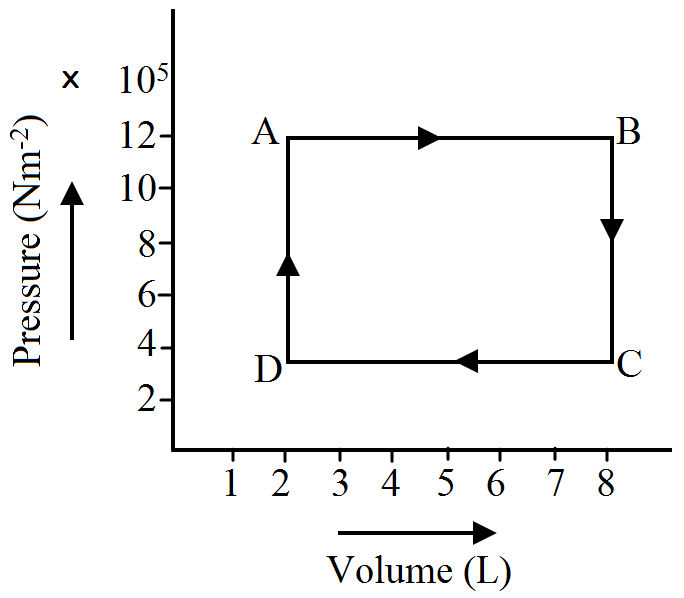
$\therefore$ Work done $=-\text{p}\Delta\text{V}$
= -(12 × 105) × (6 × 10-3)J = -7200J Process B → C. No change in volume, i.e., $\Delta\text{V}=0$$\therefore$ Work done = 0
Process C → D (contraction)$\Delta\text{V}=8-2=6\text{L}$
= 6 × 10⁻³m3, p = 4 × 10⁵Nm-2$\therefore$ Work done
$\text{p}\Delta\text{V}=(4\times10^5)(6\times10^{-3})=2400\text{J}$
Process D → A. No change in volume, i.e., $\Delta\text{V}=0$$\therefore$ Work done = 0
$\therefore$ Net work done in the complete cyclic process = -7200 + 2400J = -4800J
Minus sign shows that net work has been done by the gas.
= 125 × (296.5 - 286.4) × 4.184J = 5282J = 5.282kJ
Molar mass of CCl2F2 = 12 + 2 × 35.5 + 2 × 19
= 121g mol-1
$\therefore$ Heat evolved from 1.25g if the sample on being cooled from 320K to 293K at constant pressure $=\frac{80.7}{121}\times1.25\times27\text{J}=22.51\text{J}$
Further, $\Delta\text{H}=\Delta\text{U}+\text{p}\Delta\text{V}=-22.51\text{J}$
$\Big[\therefore\text{p}\Delta\text{V}=1\text{atm}\times\frac{(248-274)}{1000}\text{L}=-0.026\text{L atm}\Big]$
$=-0.026\times101.325\text{J}=-263\text{J}$
$\therefore-22.51=\Delta\text{U}-2.63\text{J}$
$\Delta\text{U}=-22.51+2.63\text{J}=-19.88\text{J}$
Given: R = 8.314JK-1mol-1
It is because strong acids and bases are completely ionised in aqueous solution.
$\Delta\text{n}=2-2-5=-5$
$\Delta\text{H}=-50.16\text{k}$
$\Delta\text{U}=?$
$\text{T}=273+27=300\text{K}$
$\Delta\text{H}=\Delta\text{U}+\Delta\text{nRT}$
$\Rightarrow\Delta\text{U}=\Delta\text{H}-\Delta\text{nRT}$
$\Rightarrow\Delta\text{U}=-50.16\text{kJ}-\frac{(-5)\times8.314\times300}{100}\text{kJ}$
$\Rightarrow\Delta\text{U}=-50.16\text{kJ}+\frac{12471}{1000}\text{kJ}$
$\Rightarrow\Delta\text{U}=-50.16\text{kJ}+12.471\text{kJ}$
$\Rightarrow\Delta\text{U}=-37.689\text{kJ}$
H2(g) + Br2(g) → 2HBr(g)
Bond enthalpy are given as, H-H = 436kJ mol-1, Br-Br = 192kJ mol-1 and H-Br = 368kJ mol-1
$\text{U}_2-\text{U}_1=\text{q}+\text{w}$
$\Delta\text{U}=\text{q}+\text{w}$
$\Delta_\text{r}\text{H}^\circ=\text{B}_{\text{H}-\text{H}}+\text{B}_{\text{Br}-\text{Br}}-2\text{B}_{\text{H}-\text{Br}}$
$=436+192-2\times368$
$\Delta_\text{r}\text{H}^\circ=628-736$
$=-108\text{kJ mol}^{-1}$
$\text{CH}_3\text{OH}(\text{I})+\frac{3}{2}\text{O}_2(\text{g})\xrightarrow{\ \ \ \ \ \ }\text{CO}_2(\text{g})+2\text{H}_2\text{O}(\text{I});\Delta_{\text{r}}\text{H}^\ominus=-726\text{kJ} \ \text{mol}^{-1}$
$\text{C}(\text{graphite})+\text{O}_{2(\text{g})}\xrightarrow{\ \ \ \ \ \ }\text{CO}_{2(\text{g})};\Delta_{\text{c}}\text{H}^\ominus=-393\text{kJ} \ \text{mol}^{-1}$
$\text{H}_2(\text{g})+\frac{1}{2}\text{O}_{2(\text{g})}\xrightarrow{\ \ \ \ \ \ }\text{H}_2\text{O}(\text{I});\Delta_{\text{f}}\text{H}^\ominus=-286\text{kJ} \ \text{mol}^{-1}$.
$\text{C}_\text{s}+2\text{H}_2\text{O}+^{\frac{1}{2}}\text{O}_{2(\text{g})}\xrightarrow{\ \ \ \ \ \ }\text{CH}_3\text{OH}_{(\text{I})}...(1)$
The reaction (1) can be obtained from the given reactions by following the algebraic calculations as:
Equation (ii) + 2 × equation (iii) – equation (i)
= (–393kJ mol–1) + 2(–286kJ mol–1) – (–726kJ mol–1)
= (–393 – 572 + 726)kJ mol–1
$\therefore\Delta_\text{f}\text{H}^\ominus[\text{CH}_3\text{OH}_{(\text{I})}]=-239\text{kJ} \ \text{mol}^{-1}$
Calculate enthalpy change for the reaction, using the following combustion data,
$\text{C}_2\text{H}_4(\text{g})+3\text{O}_2(\text{g})\overrightarrow{\ \ \ \ \ }\ 2\text{CO}_2(\text{g})+2\text{H}_2\text{O(l)};$ $\Delta_\text{c}\text{H}^\circ=-1401\text{kJ mol}^{-1}\dots(\text{i})$
$\text{C}_2\text{H}_6(\text{g})+\frac{7}{2}\text{O}_2(\text{g})\overrightarrow{ \ \ \ \ \ \ \ }\ 2\text{CO}_2(\text{g})+3\text{H}_2\text{O(l)}$ $\Delta_\text{c}\text{H}^\circ=-1550\text{kJ mol}^{-1}\dots(\text{ii})$
$\text{H}_2(\text{g})+\frac{1}{2}\text{O}_2(\text{g})\overrightarrow{ \ \ \ \ }\ \text{H}_2\text{O(l)};$ $\Delta_\text{c}\text{H}^\circ=-286.0\text{kJ mol}^{-1}\dots(\text{iii})$
Energy utilised in the event $=\frac{1560\times50}{100}=780$
Energy left unutilised = 1560 - 780 = 780kJ
Enthalpy of vaporisation of water = 44kJ/ mol $=\frac{44}{18}\text{kJ/ g}$
$\therefore$ Water needed to perspire $=\frac{44}{18}\times780=1906.66\text{g}$
$\text{C}_2\text{H}_4(\text{g})+3\text{O}_2(\text{g})+\text{H}_2(\text{g})+\frac{1}{2}\text{O}_2(\text{g})-\text{C}_2\text{H}_6(\text{g})\\-\frac{7}{2}\text{O}_2(\text{g})\overrightarrow{\ \ \ \ \ \ \ }\ 2\text{CO}_2(\text{g})+2\text{H}_2\text{O(l)}+\text{H}_2\text{O(l)}\\-2\text{CO}_2(\text{g})-3\text{H}_2\text{O(l)}$
and $\Delta_\text{r}\text{H}^\circ=-1401\text{kJ mol}^{-1}-286.0\text{kJ mol}^{-1}\\-(-1550\text{kJ mol}^{-1})$
These equations give,
$\text{C}_2\text{H}_2(\text{g})+\text{H}_2(\text{g})\overrightarrow{\ \ \ \ \ }\ \text{C}_2\text{H}_6(\text{g});$ $\Delta_\text{r}\text{H}^\circ=-137\text{kJ mol}^{-1}$
$\text{NH}_2\text{CN}(\text{g}) +\frac{3}{2}\text{O}_2 (\text{g})\xrightarrow{ \ \ \ \ \ \ } \text{N}_2(\text{g}) + \text{CO}_2(\text{g}) + \text{H}_2\text{O}(\text{l})$
$\Delta\text{H} = \Delta\text{U} + \Delta\text{n}_\text{g}\text{RT}$
Where,
$\Delta\text{U} =$ change in internal energy
$\Delta\text{n}_\text{g} =$ change in number of moles
For the given reaction,
$\Delta\text{n}_\text{g} = \sum\text{n}_\text{g} (\text{products}) – \sum\text{n}_\text{g} (\text{reactants})$
$= (2 – 1.5) \ \text{moles}$
$\Delta\text{n}_\text{g} =0.5 \ \text{moles}$
And,
$\Delta\text{U} = \ –742.7\text{kJ} \ \text{mol}^{–1}$
$\text{T} = 298\text{K}$
$\text{R} = 8.314 × 10^{–3}\text{kJ} \ \text{mol}^{–1} \ \text{K}^{–1}$
Substituting the values in the expression of $\Delta\text{H}:$
$\Delta\text{H} = (–742.7\text{kJ} \ \text{mol}^{–1}) + (0.5 \ \text{mol}) (298\text{K})\$8.314 × 10^{–3}\text{kJ} \ \text{mol}^{–1} \ \text{K}^{–1})$
$= –742.7 + 1.2$
$\Delta\text{H} = –741.5\text{kJ} \ \text{mol}^{–1}$
$\text{N}_2\text{O}_4(\text{g}) +3\text{CO} (\text{g})\xrightarrow{ \ \ \ \ \ \ } \text{N}_2\text{O}(\text{g}) + 3\text{CO}_2(\text{g})$
$\Delta_\text{r}\text{H} = \sum\Delta_\text{f}\text{H} (\text{products}) – \sum\Delta_\text{f}\text{H} (\text{reactants})$
For the given reaction,
$\text{N}_2\text{O}_{(\text{g})} +3\text{CO}_{ (\text{g})}\xrightarrow{ \ \ \ \ \ \ } \text{N}_2\text{O}_{(\text{g})} + 3\text{CO}_{2(\text{g})} $
$\Delta_\text{r}{\text{H}}=\big[\big\{\Delta_\text{f}\text{H}(\text{N}_2\text{O})+3\Delta_\text{f}\text{H}(\text{CO}_2)\big\}\\-\big\{\Delta_\text{f}\text{H}(\text{N}_2\text{O}_4)+3\Delta_\text{f}\text{H}(\text{CO})\big\}\big]$
Substituting the values of $\Delta_\text{f}\text{H}$ for N2O, CO2, N2O4, and CO from the question, we get:
$\Delta_\text{r}{\text{H}}=\big[\big\{81\text{kJ} \ \text{mol}^{-1}+3(-393)\text{kJ} \ \text{mol}^{-1}\big\}\\-\big\{9.7\text{kJ} \ \text{mol}^{-1}+3(-110)\text{kJ} \ \text{mol}^{-1}\big\}\big]$
$\Delta_{\text{r}}\text{H}=-777.7\text{kJ} \ \text{mol}^{-1}$
Hence, the value of $\Delta\text{r}\text{H}$ for the reaction is $-777.7\text{kJ} \ \text{mol}^{-1}.$
$\ \ \ \ \ \ \ \ \text{H}\\ \ \ \ \ \ \ \ \ \ |\\\text{H}-\text{C}-\text{H(g)}+2\text{O}=\text{O(g)}\overrightarrow{\ \ \ \ \ }\ \text{O}=\text{C}=\text{O(g)}\\ \ \ \ \ \ \ \ \ \ |\\ \ \ \ \ \ \ \ \ \text{H}\\+2\text{H}-\text{O}-\text{H(g)}$
Bond enthalpy $(\Delta\text{H}^\circ)/\text{kJ mol}^{-1}$ of C=O = 741; C-H = 414; H-O = 464; O=O = 498.
$\Delta\text{H}=$ Bond energy of reactants - Bond energy of products
$=2\text{B}_{\text{O}=\text{O}}+4\text{B}_{\text{C}-\text{H}}-2\text{B}_{\text{C}=\text{O}}-4\text{B}_{\text{O}-\text{H}}$
$=2\times498+4\times414-2\times741-4\times464$
$=(996+1656-1482-1856)$
$=-686\text{kJ mol}^{-1}$
OF2(g) + H2O(g) + O2(g) + 2HF(g)
Standard enthalpy of formation $(\Delta_\text{r}\text{H}^\theta)$ of e n various species are given below:
$\Delta_\text{f}\text{H}^\theta\text{kJ mol}^{-1}:$ OF2(g) = 23.0, H2O(g)= -241.8, HF(g) = -268.6, R = 8.314 JK-1mol-1.
'w' is not a state function because it depends upon path.
$\text{q}+\text{w}=\Delta\text{U}$ which is a state function because it is independent of path.
$\Delta\text{n}=1+2-2=1$
$\Delta_\text{r}\text{H}^\circ=\sum\Delta_\text{f}\text{H}^\circ(\text{products})-\sum\Delta_\text{f}\text{H}^\circ(\text{reactants})$
$=\Delta_\text{f}\text{H}^\circ(\text{O}_2)+2\Delta_\text{f}\text{H}^\circ(\text{HF})-\Delta_\text{f}\text{H}^\circ(\text{OF}_2)\\-\Delta_\text{f}\text{H}^\circ(\text{H}_2\text{O})$
$=0+2\times(-268.6)-23.0-(-241.8)$
$=537.2-23.0+241.8$
$=-318.4\text{kJ}$
$\Delta_\text{f}\text{H}^\circ=\Delta_\text{r}\text{U}^\circ+\Delta\text{nRT}$
$-318.4\text{kJ}=\Delta_\text{r}\text{U}^\circ+\frac{1\times8.314\times300}{1000}\text{kJ}$
$-318.4\text{kJ}=\Delta_\text{r}\text{U}^\circ+2.4942\text{kJ}$
$\Delta_\text{r}\text{U}^\circ=-320.8942\text{kJ}$
$\Delta\text{S}_\text{total}=\Delta\text{S}_\text{sys}+\Delta\text{S}_{\text{s}\omega\text{r}}$
If the system is in thermal equlibrium with the surroundings, then the tempreature of the surroundings is same as that of the system. Also increase in enthalpy of the surrounding is equal to decrease in the enthalpy of the system. Therefore, enthalpy change of surroundings,$\Delta\text{S}_{\text{s}\omega\text{r}}=\frac{\Delta\text{H}_{\text{s}\omega\text{r}}}{\text{T}}=\frac{\Delta\text{H}_\text{sys}}{\text{T}}$
$\Delta\text{S}_\text{total}=\Delta\text{S}_\text{sys}=\Big(-\frac{\Delta\text{H}_\text{sys}}{\text{T}}\Big)$
Rearranging the above equation:$\text{T}\Delta\text{S}_\text{total}=\text{T}\Delta\text{S}_\text{sys}-\Delta\text{H}_\text{sys}$
For spontaneus process,$\Delta\text{S}_\text{total}>0,\text{so}$
$\text{T}\Delta\text{S}_\text{sys}-\Delta\text{H}_\text{sys}>0$
$\Rightarrow-\big(\Delta\text{H}_\text{sys}-\text{T}\Delta\text{S}_\text{sys}\big)>0$
The above equation can be written as$-\Delta\text{G}>0$
$\Delta\text{H}_\text{sys}$ is the enthalpy change of a reaction, $\text{T}\Delta\text{S}_\text{sys}$ is the energy which is not available to do useful work, so, $\Delta\text{G}$ is the net energy available to do useful work and is thus a measure of the 'free energy'. For this reason, it is also known as the free energy of the reaction.
$\Delta\text{G}$ gives a criteria for spontaneity at constant pressure and temperature,
• Unit of $\Delta\text{G}$ is Joule.
• The reaction will be spontaneous at high temperature.
$\Delta\text{U}^\ominus=-10.5\text{kJ} \ \text{and} \ \Delta\text{S}^\ominus=-44.1\text{kJ}^{-1}.$
Calculate $\Delta\text{G}^\ominus$ for the reaction, and predict whether the reaction may occur spontaneously.$\Delta\text{n}_\text{g}=2-(3)$
= –1 mole Substituting the value of $\Delta\text{U}^\ominus$ in the expression of $\Delta\text{H}:$$\Delta\text{H}^\ominus=\Delta\text{U}^\ominus+\Delta\text{n}_{\text{g}}\text{RT}$
= (–10.5kJ) – (–1) (8.314 × 10⁻³kJ K–1 mol–1) (298K) = –10.5kJ – 2.48kJ$\Delta\text{G}^\ominus=+0.16\text{kJ}$
Since $\Delta\text{G}^\ominus$for the reaction is positive, the reaction will not occur spontaneously.$\Delta\text{H}=\Delta\text{U}+\text{P}\Delta\text{V}$
$\Delta\text{H}=\Delta\text{U}+\text{P}(0)$
$\Delta\text{H}=\Delta\text{U}$
The difference between the change in internal energy and enthalpy becomes significant when gases are involved in the reaction. Consider a chemical reaction occurring at constant temperature, T and constant pressure, P. Now, let’s say that the volume of the reactants is VA and the number of moles in the reactants is nA. Similarly, the volume of the products is VB and the number of moles in the product is nB. We know that according to the ideal gas equation,$\text{Pv}=\text{nRT}$
$\text{pv}_\text{A}=\text{n}_\text{A}\text{RT}$
$\text{pv}_\text{B}=\text{n}_\text{B}\text{RT}$
Thus $\text{pv}_\text{B}-\text{pv}_\text{B}=\text{n}_\text{B}\text{RT}-\text{n}_\text{A}\text{RT}$$\text{p}(\text{v}_\text{B}-\text{v}_\text{A})=\text{RT}(\text{n}_\text{B}-\text{n}_\text{A})$
$\text{p}\Delta\text{v}=\Delta\text{n}_\text{g}\text{RT}$
$\Delta\text{H}=\Delta\text{U}+\text{p}\Delta\text{v}$
$\Delta\text{H}=\Delta\text{U}+\Delta\text{n}_\text{g}\text{RT}$
| | NaHCO3(s) | Na2CO3(s) | CO2(g) | H2O(g) |
| $\ \ \ \ \Delta_\text{f}\text{H}^\circ\$\text{kJ mol}^{-1})$ | -947.7 | -1130.9 | -393.51 | -241.82 |
| $\ \ \ \ \ \text{S}^\circ_\text{m}\$\text{J mol}^{-1})$ | 102.1 | 136 | 188.83 | 213.74 |
$\Delta_\text{r}\text{H}^\circ=\Delta_\text{f}\text{H}^\circ(\text{Na}_2\text{CO}_3)+\Delta_\text{f}\text{H}^\circ(\text{CO}_2)\\+\Delta_\text{r}\text{H}^\circ(\text{H}_2\text{O})-2\Delta_\text{f}\text{H}^\circ(\text{NaHCO}_3)$
= -1130.9 + (-393.51) + (-241.82) - 2 × (-947.7) = -1766.23 + 1895.4 = 129.17kJ mol-1$\Delta_\text{r}\text{S}^\circ=\Delta_\text{r}\text{S}^\circ_\text{m}(\text{Na}_2\text{CO}_3)+\text{S}^\circ_\text{m}(\text{CO}_2)\\+\text{S}^\circ_\text{m}(\text{H}_2\text{O})-2\text{S}^\circ_\text{m}(\text{NaHCO}_3)$
= 136.0 + 188.83 + 213.74 - 2 × 102.1 = 538.57 - 204.2 = 334.37JK-1 mol-1 From second law of thermodynamics$\Delta_\text{r}\text{S}^\circ=\frac{\Delta_\text{r}\text{H}^\circ}{\text{T}}$
$\therefore\text{T}=\frac{\Delta_\text{r}\text{H}^\circ}{\Delta_\text{r}\text{S}^\circ}=\frac{129.17}{334.37\times10^{-3}}=386.3\text{K}$
$\therefore$ Reaction will be spontaneous above 386.3K.
$\text{CCI}_4(\text{g})\xrightarrow{ \ \ \ \ \ }\text{C}(\text{g})+4\text{CI}(\text{g})$
and calculate bond enthalpy of C – Cl in CCl4(g).$\Delta_\text{vap}\text{H}^\ominus(\text{CCI}_4)=30.5\text{kJ} \ \text{mol}^{-1}.$
$\Delta_\text{f}\text{H}^\ominus(\text{CCI}_4)=-135.5\text{kJ} \ \text{mol}^{-1}.$
$\Delta_\text{a}\text{H}^\ominus(\text{C})=-715.0\text{kJ} \ \text{mol}^{-1},$ where $\Delta_\text{a}\text{H}^\ominus$ is enthalpy of atomisation
$\Delta_\text{a}\text{H}^\ominus(\text{CI}_2)=242\text{kJ} \ \text{mol}^{-1}$
$\text{CCl}_{4(\text{l})}\xrightarrow{ \ \ \ \ \ }\text{CCl}_{4(\text{g})}\Delta_\text{vap}\text{H}^\ominus=30.5\text{kJ} \ \text{mol}^{-1}$
$\text{C}_{(\text{s})}\xrightarrow[]{\ \ \ \ \ \ \ }\text{C}_{(\text{g})} \ \Delta_{\text{a}}\text{H}^\ominus=715.0\text{kJ} \ \text{mol}^{-1}$
$\text{Cl}_{2(\text{g})}\xrightarrow[]{\ \ \ \ \ \ \ }2\text{Cl}_{(\text{g})} \ \Delta_{\text{a}}\text{H}^\ominus=242\text{kJ} \ \text{mol}^{-1}$
$\text{C}_{(\text{g})}+4\text{Cl}_{(\text{g})}\xrightarrow[]{\ \ \ \ \ \ \ }\text{CCl}_{4(\text{g})} \ \Delta_{\text{f}}\text{H}=-135.5\text{kJ} \ \text{mol}^{-1}$
Enthalpy change for the given process $\text{CCI}_{4(\text{g})}\xrightarrow{ \ \ \ \ \ }\text{C}_{(\text{g})}+4\text{Cl}_{(\text{g})}$, can be calculated
using the following algebraic calculations as:
Equation (ii) + 2 × Equation (iii) – Equation (i) – Equation (iv)
$\Delta\text{H}=\Delta_\text{a}\text{H}^\ominus(\text{C})+2\Delta_\text{a}\text{H}^\ominus(\text{Cl}_2)-\Delta_\text{vap}\text{H}^\ominus-\Delta_\text{f}\text{H} $
$= (715.0\text{kJ} \ \text{mol}^{–1}) + 2(242\text{kJ} \ \text{mol}^{–1}) – (30.5\text{kJ} \ \text{mol}^{–1}) – (–135.5\text{kJ} \ \text{mol}^{–1})$
$\therefore\Delta\text{H}=1304\text{kJ} \ \text{mol}^{-1}$
Bond enthalpy of C–Cl bond in CCl4(g)
$=\frac{1304}{4}\text{kJ} \ \text{mol}^{-1}$
$=326\text{kJ} \ \text{mol}^{-1}$
Dividing in half a tank of air at a given T,P and mass yields two smalller tanks containing air, but the mass of the air in each new, smaller tank is half as it was initially in the one big tank.
Internal energy: Extensive
Dividing in half a tank of water at a given T,P with a given total internal energy yields two smalller tank containing water at the same T and P, but the internal energy of the water in each new, smaller tank is half as it was initially in the one big tank.
Pressure: Intensive
The ratio of two extensive properties is also intensive
$\text{Pressure}=\frac{\text{Force}}{\text{Area}}=\frac{\text{Extensive}}{\text{Extensive}}=\text{Intensive}$
Heat capacity: Extensive
A sample containing twice the amount of substance as another sample requires the transfer of twice the amount of heat to achieve the same change in temperature.
Density: Intensive
$\text{Density}=\frac{\text{Mass}}{\text{Volume}}=\frac{\text{Extensive}}{\text{Extensive}}=\text{Intensive}$
Mole fraction: Intensive
$\text{Mole}\ \text{fraction}=\frac{\text{Moles}}{\text{Total}\ \text{moles}}=\frac{\text{Extensive}}{\text{Extensive}}=\text{Intensive}$
Specific heat: Intensive
$\text{Specific}\ \text{heat}=\frac{\text{Heat}\ \text{capacity}}{\text{Mass}}=\frac{\text{Extensive}}{\text{Extensive}}=\text{Intensive}$
Temperature: Intensive
Dividing in half a tank of water at a given temperature yields two smaller tanks containing water at the same temperature as that in the big tank.
Molarity: Intensive
$\text{Molarity}=\frac{\text{Moles}}{\text{Volume}}=\frac{\text{Extensive}}{\text{Extensive}}=\text{Intensive}$
$\text{G}=\text{H}-\text{TS}$
$\Delta\text{G}=\Delta\text{H}-\text{T}\Delta\text{S}$
$\Delta\text{G}=-\text{ve}$ for spontaneous process
Standard enthalpy of combustion: Standard enthalpy of combustion is the amount of heat evolved when one mole of a substance under standard condition is completely burnt to form product also under standard conditions.
Standard enthalpy of formation: Standard enthalpy of formation is the enthalpy change accompanying the formation of one mole of a substance from its constituent element in their standard state, e.g. standard enthalpy of formation of CO2 may be represented as C(s) + O2(g) → CO2(g)
Molecular mass of butane = 4 × 12 + 10 × 1 = 58
Heat of combustion of butane = 2658kJ mol-1
1 mole or 58g of butane on complete combustion gives heat = 2658kJ
$\therefore$ 14 × 103g of butane on complete combustion will gives heat $=\frac{2658\times14\times10^3}{58}=641586$
The family needs 20000kJ of heat per day.
$\because$ 20000kJ of heat is used for cooking by a family in 1 day.
$\therefore$ 641586 kJ of heat will be used for cooking by a family in $=\frac{641586}{20000}=32\text{days}$
The cylinder will last for 32 days.
$\therefore$ The number of days the cylinder will last.

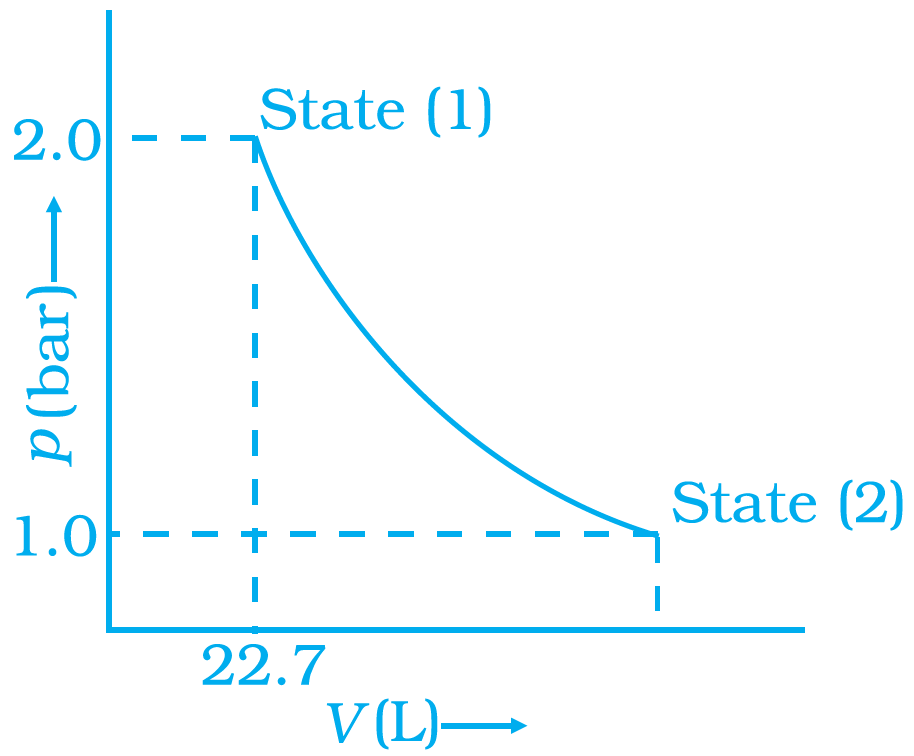
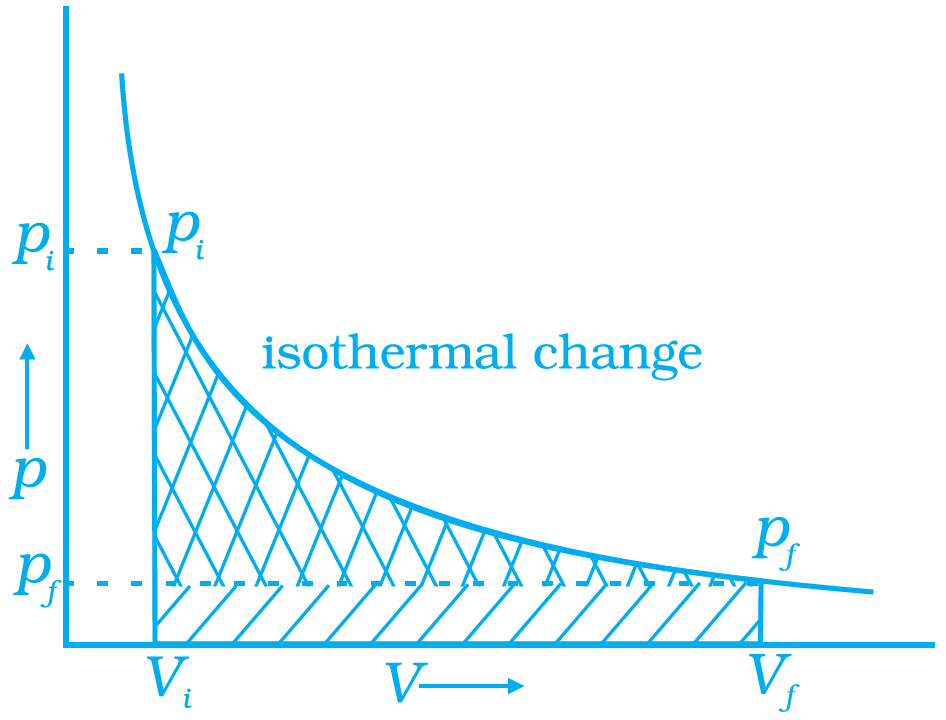
$\text{w}=-2.303\text{nRT}\log\frac{\text{V}_2}{\text{V}_1}$
But, $\text{p}_1\text{V}_1=\text{P}_2\text{V}_2\Rightarrow\frac{\text{V}_2}{\text{V}_2}=\frac{\text{p}_1}{\text{p}_2}=\frac{2}{1}=2$ carried out in infinite no. of steps$\therefore\ \text{w}=-2.303\text{nRT}\log\frac{\text{p}_1}{\text{p}_2}$
$=-2.303\times1\text{mol}\times8.314\text{J}\ \text{mol}^{-1}\text{K}^{-1}\times298\text{K}^{-1}\times\log2$
$=-2.303\times8.314\times298\times0.3010\text{J}=-1717.46\text{J}$