Question
Equal torqueses are applied on a cylinder and a sphere. Both have same mass and radius. The cylinder rotates about its axis and the sphere rotates about one of its diameters. Which will acquire greater speed? Explain why.

Answer

We know, $\tau=\text{l}\alpha\text{ or }\alpha=\frac{\tau}{\text{l}}$ $\therefore$ Angular acceleration produced in the rylinder is $\alpha_\text{c}=\frac{\tau}{\text{I}_\text{c}}$ Similarly, acceleration produced in the sphere is $\alpha_\text{s}=\frac{\tau}{\text{I}_\text{s}}$ $\therefore\frac{\alpha_\text{c}}{\alpha_\text{s}}=\frac{\text{I}_\text{s}}{\text{I}_\text{c}}$ Now $\text{I}_\text{s}=\frac{2}{3}\text{MR}^2$ and $\text{I}_\text{}C=\frac{1}{2}\text{MR}^2$ $\therefore\frac{\alpha_\text{c}}{\alpha_\text{s}}=\frac{4}{3}$ or $\alpha_\text{c}=\frac{4}{3}\alpha_\text{s}\text{ and }\alpha_\text{c}>\alpha_\text{s}.$ Thus cylinder will acquire greater speed than that of the sphere.

Need a full question paper?

Generate a complete, print-ready paper with questions like this in minutes — across 16+ boards, with answer keys.
Start Generating Free

Similar questions

An electric bulb, connected to a make and break power supply, switches off and on every second in its rest frame. What is the frequency of its switching off and on as seen from a spaceship travelling at a speed 0.8c?
Suppose the platform with the kid in the previous problem is rotating in anticlockwise direction at an angular speed $\omega.$ The kid starts walking along the rim with a speed v relative to the platform also in the anticlockwise direction. Find the new angular speed of the platform.
A stationary object is released from a point P a distance 3R from the centre of the moon which has radius R and mass M. Calculate the speed of the object on hitting the moon.
Briefly explain Magnus effect.
The bob of a pendulum is released from a horizontal position. If the length of the pendulum is 1m. What is the speed with which the bob arrives at the lower most point given that it dissipates $10\%$ of it initial energy against air resistance. $(g = 10m/ s^{-2})$.
A rough inclined plane is placed on a cart moving with a constant velocity u on horizontal ground. A block of mass M rests on the incline. Is any work done by force of friction between the block and incline? Is there then a dissipation of energy?
A police van moving on a highway with a speed of $30km h^{–1}$ fires a bullet at a thief’s car speeding away in the same direction with a speed of $192km h^{–1}​​​​​​​$. If the muzzle speed of the bullet is $150m s^{–1}​​​​​​​$, with what speed does the bullet hit the thief’s car? (Note: Obtain that speed which is relevant for damaging the thief’s car).
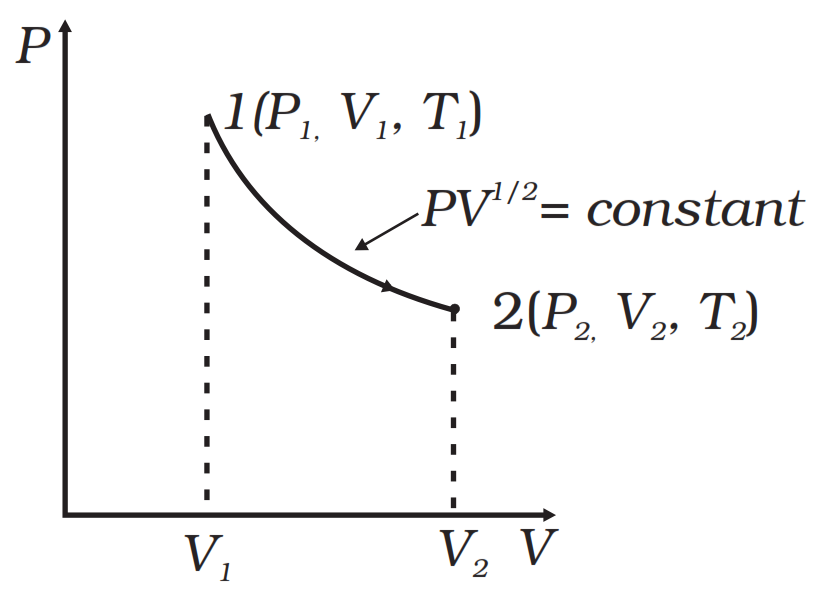
Consider a P-V diagram in which the path followed by one mole of perfect gas in a cylindrical container is shown in Fig.

Given the internal energy for one mole of gas at temperature T is (3/2) RT, find the heat supplied to the gas when it is taken from state (1) to (2) with $V_2 = 2V_{1.}$​​​​​​​
Find the speed of the electron in the ground state of a hydrogen atom. The description of ground state is given in the previous problem.
Theory of relativity reveals that mass can be converted into energy. The energy E so obtained is proportional to certain powers of mass m and the speed c of light. Guess a relation among the quantities using the method of dimensions.