MCQ
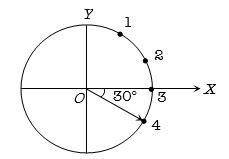
Equation of the hour hand at $4$ O’ clock is
  • A
    $x - \sqrt 3 \;y = 0$
  • B
    $\sqrt 3 \;x - y = 0$
  • $x + \sqrt 3 \;y = 0$
  • D
    $\sqrt 3 \;x + y = 0$

Answer

Correct option: C.
$x + \sqrt 3 \;y = 0$
c
(c) Since the hour, minute and second hands always pass through origin because one end of these hands is always at origin. Now at $4$ O’ clock, the hour hand makes ${30^o}$angle in fourth quadrant. So the equation of hour hand is

$y = mx \Rightarrow y = - \frac{1}{{\sqrt 3 }}x$

$ \Rightarrow x + \sqrt 3 y = 0$.
Need a full question paper?

Generate a complete, print-ready paper with questions like this in minutes — across 16+ boards, with answer keys.

Start Generating Free

Similar questions

If $\frac{\pi}{2}<\text{x}<\frac{3\pi}{2},$ then $\sqrt{\frac{1-\sin\text{x}}{1+\sin\text{x}}}$ is equal to:
The equation of straight line passing through $( - a,\;0)$ and making the triangle with axes of area ‘$T$’ is
Let $X = \{ 1,\,2,\,3,\,4,\,5\} $ and $Y = \{ 1,\,3,\,5,\,7,\,9\} $. Which of the following is/are relations from $X$ to $Y$
A line cutting off intercept $-3$ from the $y-$axis and the tengent at angle to the xaxis is $\frac{3}{5},$ its equation is:
If $A, B$ and $C$ are three sets such that  $A \cap B = A \cap C$ and $A \cup B = A \cup C$ then
The probability that two randomly selected subsets of the set $\{1,2,3,4,5\}$ have exactly two elements in their intersection, is :
If the points $(x + 1,\,2),\;(1,x + 2),\;\left( {\frac{1}{{x + 1}},\frac{2}{{x + 1}}} \right)$ are collinear, then x is
$\frac{{{{( - 1 + i\sqrt 3 )}^{15}}}}{{{{(1 - i)}^{20}}}} + \frac{{{{( - 1 - i\sqrt 3 )}^{15}}}}{{{{(1 + i)}^{20}}}}$ is equal to
A quadratic polynomial $ y = f (x)$  with absolute term  $3$  neither touches nor intersects the abscissa axis and is symmetric about the line $x = 1$ . The coefficient of the leading term of the polynomial is unity. A point $A(x_1, y_1)$  with abscissa $x_1 = 1$  and a point $B(x_2, y_2) $ with ordinate $y_2 = 11 $ are given in a cartisian rectangular system of co-ordinates $OXY $ in the first quadrant on the curve $y = f (x)$  where $ 'O'$  is the origin. The graph of $y = f(x)$ represents a parabola whose focus has the co-ordinates
Suppose a population $A $ has $100$ observations $ 101,102, . . .,200 $ and another population $B $ has $100$ observation $151,152, . . .,250$ .If $V_A$ and $V_B$ represent the variances of the two populations , respectively then $V_A / V_B$ is