MCQ 11 Mark
If the coordinates of the points $A $ and $B$ be $ (3, 3) $ and $(7, 6)$, then the length of the portion of the line $AB$ intercepted between the axes is
AnswerCorrect option: A. $\frac{5}{4}$
a
(a) Equation of line $AB$is $y - 3 = \frac{{6 - 3}}{{7 - 3}}(x - 3)$
==> $3x - 4y + 3 = 0 \Rightarrow \frac{x}{{ - 1}} + \frac{y}{{3/4}} = 1$
Hence required length is $\sqrt {{{( - 1)}^2} + {{\left( {\frac{3}{4}} \right)}^2}} = \frac{5}{4}$.
View full question & answer→MCQ 21 Mark
If the transversal $y = m_r\, x;\, r = \,1,\, 2, \,3$ cut off equal intercepts on the transversal $x + y = 1,$ then $1 + {m_1},$ $1 + {m_2},$ $1 + {m_3}$ are in
- A
$A. P.$
- B
$G. P.$
- ✓
$H. P.$
- D
AnswerCorrect option: C. $H. P.$
c
(c) Solving $y = {m_r}x$and $x + y = 1$, we get $x = \frac{1}{{1 + {m_r}}}$ and $y = \frac{{{m_r}}}{{1 + {m_r}}}$.
Thus the points of intersection of the three lines on the transversal are $\left( {\frac{1}{{1 + {m_1}}},\frac{{{m_1}}}{{1 + {m_1}}}} \right),$ $\left( {\frac{1}{{1 + {m_2}}},\frac{{{m_2}}}{{1 + {m_2}}}} \right)$ and$\left( {\frac{1}{{1 + {m_3}}},\frac{{{m_3}}}{{1 + {m_3}}}} \right)$
By hypothesis, ${\left( {\frac{1}{{1 + {m_1}}} - \frac{1}{{1 + {m_2}}}} \right)^2} + {\left( {\frac{{{m_1}}}{{1 + {m_1}}} - \frac{{{m_2}}}{{1 + {m_2}}}} \right)^2}$
= ${\left( {\frac{1}{{1 + {m_2}}} - \frac{1}{{1 + {m_3}}}} \right)^2} + {\left( {\frac{{{m_2}}}{{1 + {m_2}}} - \frac{{{m_3}}}{{1 + {m_2}}}} \right)^2}$
==> $\frac{{{m_2} - {m_1}}}{{1 + {m_1}}} = \frac{{{m_3} - {m_2}}}{{1 + {m_3}}}$or $\frac{{1 + {m_2}}}{{1 + {m_1}}} - 1 = 1 - \frac{{1 + {m_2}}}{{1 + {m_3}}}$
==> $\frac{{1 + {m_2}}}{{1 + {m_1}}} + \frac{{1 + {m_2}}}{{1 + {m_3}}} = 2$==> $1 + {m_2} = \frac{{2(1 + {m_1})(1 + {m_3})}}{{(1 + {m_1}) + (1 + {m_3})}}$
==> $1 + {m_1},1 + {m_2},1 + {m_3}$ are in $H.P.$
View full question & answer→MCQ 31 Mark
A line passes through the point $(3, 4)$ and cuts off intercepts from the coordinates axes such that their sum is $14.$ The equation of the line is
- A
$4x - 3y = 24$
- ✓
$4x + 3y = 24$
- C
$3x - 4y = 24$
- D
$3x + 4y = 24$
AnswerCorrect option: B. $4x + 3y = 24$
b
(b) Given $a + b = 14 \Rightarrow a = 14 - b$
Hence the equation of straight line is $\frac{x}{{14 - b}} + \frac{y}{b} = 1$.
Also, it passes through $(3,4)$
$\therefore $ $\frac{3}{{14 - b}} + \frac{4}{b} = 1 \Rightarrow b = 8$ or $7$
Therefore equations are $4x + 3y = 24$ and $x + y = 7$.
Trick : This question can be checked with the options as the line $4x + 3y = 24$ passes through $(3, 4)$ and also cuts the intercepts from the axes whose sum is $14$.
View full question & answer→MCQ 41 Mark
The equations of the lines which pass through the origin and are inclined at an angle ${\tan ^{ - 1}}m$ to the line $y = mx + c,$ are
- A
$x = 0,\;\;2mx + ({m^2} - 1)\;y = 0$
- ✓
$y = 0,\;\;2mx + ({m^2} - 1)\;y = 0$
- C
$y = 0,\;\;2mx + (1 - {m^2})\;y = 0$
- D
AnswerCorrect option: B. $y = 0,\;\;2mx + ({m^2} - 1)\;y = 0$
b
(b) Angle between both the lines is
.${\tan ^{ - 1}}m \pm {\tan ^{ - 1}}m = {\tan ^{ - 1}}\frac{{2m}}{{1 - {m^2}}}$ or ${\tan ^{ - 1}}0$
Therefore equation of lines are $y = 0$, $y = \frac{{2mx}}{{1 - {m^2}}}$.
View full question & answer→MCQ 51 Mark
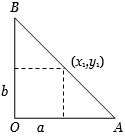
A line meets $x$-axis and y-axis at the points $A$ and $B$ respectively. If the middle point of $AB$ be $({x_1},\;{y_1}),$ then the equation of the line is
- ✓
${y_1}x + {x_1}y = 2{x_1}{y_1}$
- B
${x_1}x + {y_1}y = 2{x_1}{y_1}$
- C
${y_1}x + {x_1}y = {x_1}{y_1}$
- D
${x_1}x + {y_1}y = {x_1}{y_1}$
AnswerCorrect option: A. ${y_1}x + {x_1}y = 2{x_1}{y_1}$
a
(a) Obviously, ${x_1} = \frac{a}{2}$and ${y_1} = \frac{b}{2}$.
Therefore the equation of line $AB$ is $\frac{x}{a} + \frac{y}{b} = 1$
==> $\frac{x}{{2{x_1}}} + \frac{y}{{2{y_1}}} = 1 $
$\Rightarrow x{y_1} + y{x_1} = 2{x_1}{y_1}$.
View full question & answer→MCQ 61 Mark
The equations of the lines passing through the point $(1, 0)$ and at a distance $\frac{{\sqrt 3 }}{2}$ from the origin, are
- ✓
$\sqrt 3 x + y - \sqrt 3 = 0,\;\;\sqrt 3 x - y - \sqrt 3 = 0$
- B
$\sqrt 3 x + y + \sqrt 3 = 0,\;\;\sqrt 3 x - y + \sqrt 3 = 0$
- C
$x + \sqrt 3 y - \sqrt 3 = 0,\;\;x - \sqrt 3 y - \sqrt 3 = 0$
- D
AnswerCorrect option: A. $\sqrt 3 x + y - \sqrt 3 = 0,\;\;\sqrt 3 x - y - \sqrt 3 = 0$
a
(a) The equation of lines passing through $(1, 0)$ are given by $y = m(x - 1)$. Its distance from origin is $\frac{{\sqrt 3 }}{2}$.
$⇒$$\left| {\frac{{ - m}}{{\sqrt {1 + {m^2}} }}} \right| = \frac{{\sqrt 3 }}{2}$
$⇒$ $m = \pm \sqrt 3 $.
Hence the lines are $\sqrt 3 x + y - \sqrt 3 = 0$ and $\sqrt 3 x - y - \sqrt 3 = 0$.
View full question & answer→MCQ 71 Mark
The equation of line, which bisect the line joining two points $(2, -19)$ and $(6, 1)$ and perpendicular to the line joining two points $(-1, 3)$ and $(5, -1)$, is
- ✓
$3x - 2y = 30$
- B
$2x - y - 3 = 0$
- C
$2x + 3y = 20$
- D
AnswerCorrect option: A. $3x - 2y = 30$
a
(a) Mid point $ \equiv (4, - \,9);$ Slope $ = \frac{{ - 1}}{{\frac{{3 + 1}}{{ - 1 - 5}}}} = \frac{3}{2}$
Hence the required line is $3x - 2y = 30$.
View full question & answer→MCQ 81 Mark
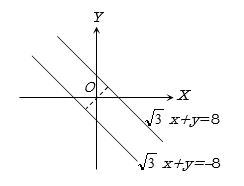
Equation of a straight line on which length of perpendicular from the origin is four units and the line makes an angle of ${120^o}$ with the $x$-axis, is
AnswerCorrect option: A. $x\sqrt 3 + y + 8 = 0$
a
(a) Slope $ = - \sqrt 3 $
$\therefore $ Line is $y = - \sqrt 3 x + c$
==> $\sqrt 3 x + y = c$
Now $\frac{c}{2} = |4|$
$\Rightarrow c = \pm {\rm{ }}8 $
$\Rightarrow x\sqrt 3 + y = \pm \,8$.
View full question & answer→MCQ 91 Mark
Equations of the two straight lines passing through the point $(3, 2)$ and making an angle of ${45^o}$ with the line $x - 2y = 3,$ are
- A
$3x + y + 7 = 0$ and $x + 3y + 9 = 0$
- ✓
$3x - y - 7 = 0$ and $x + 3y - 9 = 0$
- C
$x + 3y - 7 = 0$ and $x + 3y - 9 = 0$
- D
AnswerCorrect option: B. $3x - y - 7 = 0$ and $x + 3y - 9 = 0$
b
(b) Slope of given line is $\frac{1}{2}.$
Thus $\tan {45^o} = \pm \frac{{m - \frac{1}{2}}}{{1 + m.\frac{1}{2}}}$ ==> $m = \pm 3$.
Hence option $(b)$ is correct.
View full question & answer→MCQ 101 Mark
The equations of two lines through $(0,\;a)$ which are at distance ‘$a$’ from the point $(2a,\;2a)$ are
- A
$y - a = 0$ and $4x - 3y - 3a = 0$
- B
$y - a = 0$ and $3x - 4y + 3a = 0$
- ✓
$y - a = 0$ and $4x - 3y + 3a = 0$
- D
AnswerCorrect option: C. $y - a = 0$ and $4x - 3y + 3a = 0$
c
(c) Equation of any line through $(0,a)$is
$y - a = m{\rm{ }}(x - 0)$ or $mx - y + a = 0$ …..$(i)$
If the length of perpendicular from $(2a, 2a)$ to the line $(i)$ is ‘a’, then $a = \pm\frac{{m(2a) - 2a + a}}{{\sqrt {{m^2} + 1} }} \Rightarrow m = 0,\frac{4}{3}$.
Hence the required equations of lines are $y - a = 0$, $4x - 3y + 3a = 0$.
View full question & answer→MCQ 111 Mark
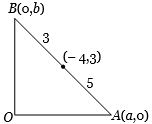
Equation of the line which passes through the point $( - 4,\;3)$ and the portion of the line intercepted between the axes is divided internally in the ratio $5 : 3$ by this point, is
- A
$9x + 20y + 96 = 0$
- B
$20x + 9y + 96 = 0$
- ✓
$9x - 20y + 96 = 0$
- D
AnswerCorrect option: C. $9x - 20y + 96 = 0$
c
(c) By the section formula, we get $a = - \frac{{32}}{3}$ and $b = \frac{{24}}{5}$. Hence the required equation is given by
$\frac{x}{{ - (32/3)}} + \frac{y}{{(24/5)}} = 1$
$ \Rightarrow 9x - 20y + 96 = 0$.
View full question & answer→MCQ 121 Mark
The equations of the lines through the origin making an angle of ${60^o}$ with the line $x + y\sqrt 3 + 3\sqrt 3 = 0$ are
- A
$y = 0,\;x - y\sqrt 3 = 0$
- ✓
$x = 0,\;x - y\sqrt 3 = 0$
- C
$x = 0,\;x + y\sqrt 3 = 0$
- D
$y = 0,\;x + y\sqrt 3 = 0$
AnswerCorrect option: B. $x = 0,\;x - y\sqrt 3 = 0$
b
(b) Since the line $x + y\sqrt 3 + 3\sqrt 3 = 0$makes an angle of ${150^o}$with $x$-axis.
Therefore, the required lines will make angles of ${90^o}$and ${210^o}$ i.e., ${30^o}$with the positive direction of $x$-axis.
Hence the lines are $x = 0$ and $y = \frac{1}{{\sqrt 3 }}x$.
View full question & answer→MCQ 131 Mark
The point $P\,(a,\;b)$ lies on the straight line $3x + 2y = 13$ and the point $Q\;(b,\;a)$ lies on the straight line $4x - y = 5,$ then the equation of line $PQ$ is
- A
$x - y = 5$
- ✓
$x + y = 5$
- C
$x + y = - \;5$
- D
$x - y = - \;5$
AnswerCorrect option: B. $x + y = 5$
b
(b) Point $P(a,b)$ is on $3x + 2y = 13$
So, $3a + 2b = 13$.....$(i)$
Point $Q(b,a)$is on $4x - y = 5$
So, $4b - a = 5$.....$(ii)$
By solving $(i)$ and $(ii)$, $a = 3,b = 2$
$P(a,b) \to (3,\,2)$and $Q(b,a) \to (2,\,3)$
Now, equation of $PQ$ $y - {y_1} = \frac{{{y_2} - {y_1}}}{{{x_2} - {x_1}}}(x - {x_1}) $
$\Rightarrow y - 2 = \frac{{3 - 2}}{{2 - 3}}(x - 3)$
==> $y - 2 = - (x - 3)$
$\Rightarrow x + y = 5$.
View full question & answer→MCQ 141 Mark
For what values of $a$ and $b$ the intercepts cut off on the coordinate axes by the line $ax + by + 8 = 0$ are equal in length but opposite in signs to those cut off by the line $2x - 3y + 6 = 0$ on the axes
- A
$a = \frac{8}{3},\;b = - \;4$
- B
$a = - \frac{8}{3},\;b = - \;4$
- C
$a = \frac{8}{3},\;b = 4$
- ✓
$a = - \frac{8}{3},\;b = 4$
AnswerCorrect option: D. $a = - \frac{8}{3},\;b = 4$
d
(d) The equation of lines in intercept form are $\frac{x}{{ - 8/a}} + \frac{y}{{ - 8/b}} = 1$ .....$(i)$
$\frac{x}{{ - 3}} + \frac{y}{2} = 1$....$.(ii)$
According to the condition, $ - \frac{8}{a} = - ( - 3)$
$ \Rightarrow a = - \frac{8}{3}$ and $ - \frac{8}{b} = - (2) \Rightarrow b = 4$.
View full question & answer→MCQ 151 Mark
The point of intersection of the lines $\frac{x}{a} + \frac{y}{b} = 1$ and $\frac{x}{b} + \frac{y}{a} = 1$ lies on the line
Answerd
(d) Intersection point of the line is $\left( {\frac{{ab}}{{a + b}},\frac{{ab}}{{a + b}}} \right)$, which is satisfying all the equations given in options $(a)$,$(b)$ and $ (c)$. Hence $(d)$ is correct.
View full question & answer→MCQ 161 Mark
The equations $(b - c)x + (c - a)y + (a - b) = 0$ and $({b^3} - {c^3})x + ({c^3} - {a^3})y + {a^3} - {b^3} = 0$ will represent the same line, if
- A
$b = c$
- B
$c = a$
- C
$a = b$
- ✓
Answerd
(d) The two lines will be identical if there exists some real number k such that
${b^3} - {c^3} = k(b - c),$ ${c^3} - {a^3} = k(c - a)$,${a^3} - {b^3} = k(a - b)$
==> $b - c = 0$or ${b^2} + {c^2} + bc = k$
==> $c - a = 0$or ${c^2} + {a^2} + ac = k$
==> $a - b = 0$or ${a^2} + {b^2} + ab = k$
==> $b = c,c = a,a = b$ or ${b^2} + {c^2} + bc = {c^2} + {a^2} + ca$
==> ${b^2} - {a^2} = c(a - b)$
$\Rightarrow b = a$ or $a + b + c = 0$.
View full question & answer→MCQ 171 Mark
The line which is parallel to $x$-axis and crosses the curve $y = \sqrt x $ at an angle of ${45^o}$ is equal to
- A
$x = \frac{1}{4}$
- B
$y = \frac{1}{4}$
- ✓
$y = \frac{1}{2}$
- D
$y = 1$
AnswerCorrect option: C. $y = \frac{1}{2}$
c
(c) Let the equation of line parallel to x-axis be
$y = \lambda $ .....$(i)$
Solving $(i)$ with the cuve $y = \sqrt x $ .....$(ii)$
We get $P({\lambda ^2},\,\,\lambda )$ the point of intersection at $P$
$\therefore $ Slope of $(ii)$ is, m= ${\left( {\frac{{dy}}{{dx}}} \right)_{{\rm{at }}P}} = \frac{1}{{2\lambda }}$
$\therefore $ $(i)$ and $(ii)$ intersect at $P$, at $45^\circ $
$\therefore $ ${\tan ^{ - 1}}\,\left( {\frac{{m - 0}}{{1 + m.0}}} \right) = \pm 45^\circ $.
==> $m = \left( {\frac{1}{{2\lambda }}} \right) = \pm \,1$ ==> $\lambda = \pm \,\frac{1}{2}$
$\therefore $ The equation of line is $y = \frac{1}{2}$ or $y = \frac{{ - 1}}{2}$ but $y = \frac{{ - 1}}{2}$ is not given, hence the required line is $y = \frac{1}{2}$.
View full question & answer→MCQ 181 Mark
In what ratio the line $y - x + 2 = 0$ divides the line joining the points $(3, -1)$ and $(8, 9)$
- A
$1 : 2$
- B
$2 : 1$
- ✓
$2 : 3$
- D
$3 : 4$
AnswerCorrect option: C. $2 : 3$
c
(c) Given, equation of line $y - x + 2 = 0$ and co-ordinates of points $({x_1},\,{y_1}) = (3,\, - 1)$ and $({x_2},\,{y_2}) = (8,\,9)$. We know that if the ratio in which a line $ax + by + c = 0$ is divided by points $({x_1},\,{y_1})$ and $({x_2},\,{y_2})$ is $\lambda :1$,
then intersecting point $\left( {\frac{{\lambda {x_2} + {x_1}}}{{\lambda + 1}},\,\frac{{\lambda {y_2} + {y_1}}}{{\lambda + 1}}} \right)$ lies on $ax + by + c = 0$.
Thus any point on the line joining $(3,\, - 1)$ and $(8,\,9)$ dividing it in the ratio $\lambda :1$ is $\left( {\frac{{8\lambda + 3}}{{\lambda + 1}},\,\frac{{9\lambda - 1}}{{\lambda + 1}}} \right)$ and if it lies on $y - x + 2 = 0,$ then $\frac{{9\lambda - 1}}{{\lambda + 1}} - \frac{{8\lambda + 3}}{{\lambda + 1}} + 2 = 0$
or $9\lambda - 1 - (8\lambda + 3) + 2(\lambda + 1) = 0$
or $3\lambda - 2 = 0,\,\lambda = \frac{2}{3}$ i.e. ratio is $2:3$.
View full question & answer→MCQ 191 Mark
The straight line passing through the point of intersection of the straight lines $x - 3y + 1 = 0$ and $2x + 5y - 9 = 0$ and having infinite slope and at a distance of $2\, units$ from the origin, has the equation
- ✓
$x = 2$
- B
$3x + y - 1 = 0$
- C
$y = 1$
- D
AnswerCorrect option: A. $x = 2$
a
(a) The intersection point of $x - 3y + 1 = 0$ and $2x + 5y - 9 = 0$ is $(2, 1)$ and $m = \frac{1}{0}$. So the required line is $y - 1 = \frac{1}{0}(x - 2) \Rightarrow x = 2$.
View full question & answer→MCQ 201 Mark
If straight lines $\alpha^2x + \alpha y = 9$ and $3x + 2y = 5$ are perpendicular, then the value of $\alpha$ is
AnswerCorrect option: A. $-2/3$
View full question & answer→MCQ 211 Mark
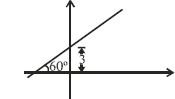
Graph is drawn between $y-x$ axis. Which of the following equation is correct for graph
- A
$y = - \sqrt 3 x + 3$
- ✓
$y = \sqrt 3 x + 3$
- C
$y = \sqrt 3 x - 3$
- D
$\sqrt 3 y = x + 3$
AnswerCorrect option: B. $y = \sqrt 3 x + 3$
View full question & answer→MCQ 221 Mark
If the coordinates of the vertices $ A, B, C$ of the triangle $ABC$ be $( - \;4,\;2),$ $(12,\; - 2)$ and $(8,\;6)$ respectively, then $\angle \;B$=
- A
${\tan ^{ - 1}}\left( { - \frac{6}{7}} \right)$
- B
${\tan ^{ - 1}}\left( {\frac{6}{7}} \right)$
- C
${\tan ^{ - 1}}\left( { - \frac{7}{6}} \right)$
- ✓
${\tan ^{ - 1}}\left( {\frac{7}{6}} \right)$
AnswerCorrect option: D. ${\tan ^{ - 1}}\left( {\frac{7}{6}} \right)$
d
(d) Here equation of $AB$ is $x + 4y - 4 = 0$ .....$(i)$
and equation of $BC$ is $2x + y - 22 = 0$.....$(ii)$
Thus angle between $(i)$ and $(ii)$ is given by
${\tan ^{ - 1}}\frac{{ - \frac{1}{4} + 2}}{{1 + \left( { - \frac{1}{4}} \right){\rm{ }}( - 2)}} = {\tan ^{ - 1}}\frac{7}{6}$.
View full question & answer→MCQ 231 Mark
If the lines $y = 3x + 1$ and $2y = x + 3$ are equally inclined to the line $y = mx + 4,$ then m =
- A
$\frac{{1 + 3\sqrt 2 }}{7}$
- B
$\frac{{1 - 3\sqrt 2 }}{7}$
- C
$\frac{{1 \pm 3\sqrt 2 }}{7}$
- ✓
$\frac{{1 \pm 5\sqrt 2 }}{7}$
AnswerCorrect option: D. $\frac{{1 \pm 5\sqrt 2 }}{7}$
d
(d) ${m_1} = 3,{m_2} = \frac{1}{2}$and ${m_3} = m$
Let the angle between first and third line is ${\theta _1}$and between second and third is ${\theta _2}$, then
$\tan {\theta _1} = \frac{{3 - m}}{{1 + 3m}}$ and $\tan {\theta _2} = \frac{{m - \frac{1}{2}}}{{1 + \frac{m}{2}}}$
But ${\theta _1} = {\theta _2} \Rightarrow \frac{{3 - m}}{{1 + 3m}} = \frac{{m - \frac{1}{2}}}{{1 + \frac{m}{2}}}$
==> $7{m^2} - 2m - 7 = 0$
==> $m = \frac{{1 \pm 5\sqrt 2 }}{7}$.
View full question & answer→MCQ 241 Mark
The ratio in which the line $3x + 4y + 2 = 0$ divides the distance between $3x + 4y + 5 = 0$ and $3x + 4y - 5 = 0$, is
AnswerCorrect option: B. $3 : 7$
b
(b)Lines $3x + 4y + 2 = 0$and $3x + 4y + 5 = 0$ are on the same side of the origin. The distance between these lines is ${d_1} = \left| {\frac{{2 - 5}}{{\sqrt {{3^2} + {4^2}} }}} \right| = \frac{3}{5}$.
Lines $3x + 4y + 2 = 0$ and $3x + 4y - 5 = 0$are on the opposite sides of the origin. The distance between these lines is ${d_2} = \left| {\frac{{2 + 5}}{{\sqrt {{3^2} + {4^2}} }}} \right| = \frac{7}{5}$.
Thus $3x + 4y + 2 = 0$ divides the distance between $3x + 4y + 5 = 0$ and $3x + 4y - 5 = 0$ in the ratio ${d_1}:{d_2}$ i.e., $3:7$.
View full question & answer→MCQ 251 Mark
A point equidistant from the lines $4x + 3y + 10 = 0$, $5x - 12y + 26 = 0$ and $7x + 24y - 50 = 0$ is
- A
$(1,\, - 1)$
- B
$(1,\,1)$
- ✓
$(0,0)$
- D
$(0,\,1)$
AnswerCorrect option: C. $(0,0)$
c
(c)Trick : Clearly, lengths of perpendicular from $(0,0)$ on the given lines are each equal to $2$.
View full question & answer→MCQ 261 Mark
$(\sin \theta ,\cos \theta )$ and $(3,\,2)$ lies on the same side of the line $x + y = 1$, then $\theta $ lies between
- A
$(0,\,\,\pi /2)$
- B
$(0,\,\pi )$
- C
$(\pi /4,\pi /2)$
- ✓
$(0,\,\,\pi /4)$
AnswerCorrect option: D. $(0,\,\,\pi /4)$
d
(d)As $(\sin \theta ,\cos \theta )$and (3, 2) lie on the same side of $x + y - 1 = 0$, they should be of same sign.
$\sin \theta + \cos \theta - 1 > $as $3 + 2 - 1 > 0$
==> $\sqrt 2 \sin \left( {\theta + \frac{\pi }{4}} \right) > 1$
==> $\sin \left( {\theta + \frac{\pi }{4}} \right) > \frac{1}{{\sqrt 2 }} $
$\Rightarrow 0 < \theta < \frac{\pi }{4}$.
View full question & answer→MCQ 271 Mark
Which pair of points lie on the same side of $3x - 8y - 7 = 0$
- A
$(0, -1)$ and $(0, 0)$
- B
$(4, -3)$ and $(0, 1)$
- C
$(-3, -4)$ and $(1, 2)$
- ✓
$(-1, -1)$ and $(3, 7)$
AnswerCorrect option: D. $(-1, -1)$ and $(3, 7)$
d
(d) ${L_{( - 1, - 1)}} = 3( - 1) - 8( - 1) - 7 < 0$
${L_{(3,7)}} = 3 \times 3 - 8 \times 7 - 7 < 0$
Hence $(-1, -1)$ and $(3, 7)$ lie on the same side of line.
View full question & answer→MCQ 281 Mark
Let $\alpha $ be the distance between the lines $ - x + y = 2$ and $x - y = 2$, and $\beta $ be the distance between the lines $4x - 3y = 5$ and $6y - 8x = 1$, then
- ✓
$20\sqrt 2 \beta = 11\alpha $
- B
$20\sqrt 2 \alpha = 11\beta $
- C
$11\sqrt 2 \beta = 20\alpha $
- D
AnswerCorrect option: A. $20\sqrt 2 \beta = 11\alpha $
a
(a) Distance between lines $ - x + y = 2$ and $x - y = 2$ is , $\alpha = \frac{2}{{\sqrt 2 }} + \frac{2}{{\sqrt 2 }} = 2\sqrt 2 $
Distance between lines $4x - 3y = 5$ and $6y - 8x = 1$ is,
$\beta = \frac{1}{{10}} + \frac{5}{5} = \frac{{11}}{{10}}$
Therefore $\frac{\alpha }{\beta } = \frac{{2\sqrt 2 }}{{11/10}} \Rightarrow 20\sqrt 2 \beta = 11\alpha $.
View full question & answer→MCQ 291 Mark
If $a$ and $b$ are two arbitrary constants, then the straight line $(a - 2b)x + (a + 3b)y + 3a + 4b = 0$ will pass through
- ✓
$( - 1,\; - 2)$
- B
$(1, 2)$
- C
$( - 2,\; - 3)$
- D
$(2, 3)$
AnswerCorrect option: A. $( - 1,\; - 2)$
a
(a) $(a - 2b)x + (a + 3b)y + 3a + 4b = 0$
or $a{\rm{ }}(x + y + 3) + b{\rm{ }}( - 2x + 3y + 4) = 0$, which represents a family of straight lines through point of intersection of $x + y + 3 = 0$ and $ - 2x + 3y + 4 = 0 $i.e $, (-1, -2).$
Trick :Point $(-1, -2)$ satisfies the given equation of straight line.
View full question & answer→MCQ 301 Mark
If the lines $ax + 2y + 1 = 0,bx + 3y + 1 = 0$ and $cx + 4y + 1 = 0$ are concurrent, then $a, \,b, \,c$ are in
AnswerCorrect option: A. $A. P.$
a
(a) It is given that the lines $ax + 2y + 1 = 0$, $bx + 3y + 1 = 0$ and $cx + 4y + 1 = 0$ are concurrent, therefore $\left| {\,\begin{array}{*{20}{c}}a&2&1\\b&3&1\\c&4&1\end{array}\,} \right| = 0$
==> $ - a + 2b - c = 0 $.
$\Rightarrow 2b = a + c$
==> $a,b,c$ are in $A. P.$
View full question & answer→MCQ 311 Mark
The solution of equations $x + y = 10,2x + y = 18$ and $4x - 3y = 26$ will be
Answera
(a) $x + y = 10$.....$(i)$
$2x + y = 18$.....$(ii)$
and $4x - 3y = 26$....$(iii)$
are equations of three lines respectively
Solving of equation $(i)$ and $(ii)$, we get $x = 8$ and $y = 2$
Put the values of $x$ and $y$ in equation $(iii)$,
L.H.S $ = 4x - 2y$ $ = 4 \times 8 - 3 \times 2$ $ = 32 - 6$= 26 = R.H.S.
$\therefore $ Point $(8,2)$ lies on line $4x - 3y = 26$, so these three lines are concurrent. Hence, these three equations have one and only one solution.
View full question & answer→MCQ 321 Mark
The equation of the line joining the point $(3, 5)$ to the point of intersection of the lines $4x + y - 1 = 0$ and $7x - 3y - 35 = 0$ is equidistant from the points $(0, 0)$ and $(8, 34)$
Answera
(a) By $P + \lambda Q = 0$, the required line is $12x - y - 31 = 0$ and its distance from both the points is $\frac{{31}}{{\sqrt {145} }}$.
View full question & answer→MCQ 331 Mark
The coordinates of the foot of the perpendicular from the point $(2, 3)$ on the line $y = 3x + 4$ are given by
- A
$\left( {\frac{{37}}{{10}}, - \frac{1}{{10}}} \right)$
- ✓
$\left( { - \frac{1}{{10}},\frac{{37}}{{10}}} \right)$
- C
$\left( {\frac{{10}}{{37}}, - 10} \right)$
- D
$\left( {\frac{2}{3}, - \frac{1}{3}} \right)$
AnswerCorrect option: B. $\left( { - \frac{1}{{10}},\frac{{37}}{{10}}} \right)$
b
(b)$ - y + 3x + 4 = 0$and perpendicular is $\frac{{y - 3}}{{x - 2}} = \frac{{ - 1}}{3}$ or $3y + x - 11 = 0$. Therefore foot is $x = \frac{{ - 1}}{{10}},y = \frac{{37}}{{10}}$.
View full question & answer→MCQ 341 Mark
The coordinates of the foot of the perpendicular from $({x_1},{y_1})$to the line $ax + by + c = 0$ are
- ✓
$\left( {\frac{{{b^2}{x_1} - ab{y_1} - ac}}{{{a^2} + {b^2}}},\frac{{{a^2}{y_1} - ab{x_1} - bc}}{{{a^2} + {b^2}}}} \right)$
- B
$\left( {\frac{{{b^2}{x_1} + ab{y_1} + ac}}{{{a^2} + {b^2}}},\frac{{{a^2}{y_1} + ab{x_1} + bc}}{{{a^2} + {b^2}}}} \right)$
- C
$\left( {\frac{{a{x_1} + b{y_1} + ab}}{{a + b}},\frac{{a{x_1} - b{y_1} - ab}}{{a + b}}} \right)$
- D
AnswerCorrect option: A. $\left( {\frac{{{b^2}{x_1} - ab{y_1} - ac}}{{{a^2} + {b^2}}},\frac{{{a^2}{y_1} - ab{x_1} - bc}}{{{a^2} + {b^2}}}} \right)$
a
(a)It is a fundamental concept.
View full question & answer→MCQ 351 Mark
The foot of the coordinates drawn from $(2, 4)$ to the line $x + y = 1$ is
- A
$\left( {\frac{1}{3},\frac{3}{2}} \right)$
- ✓
$\left( { - \frac{1}{2},\frac{3}{2}} \right)$
- C
$\left( {\frac{4}{3},\frac{1}{2}} \right)$
- D
$\left( {\frac{3}{4},\,\, - \frac{1}{2}} \right)$
AnswerCorrect option: B. $\left( { - \frac{1}{2},\frac{3}{2}} \right)$
b
(b) Applying the formula, the required foot is
$\left( {\frac{{{1^2} \times 2 - 1 \times 1 \times 4 + 1}}{{{1^2} + {1^2}}},\frac{{{1^2} \times 4 - 1 \times 1 \times 2 + 1}}{{{1^2} + {1^2}}}} \right) = \,\left( { - \frac{1}{2},\frac{3}{2}} \right)$.
Trick : Here, in options only point $\left( { - \frac{1}{2},\frac{3}{2}} \right)$ is satisfying the given equation of line.
View full question & answer→MCQ 361 Mark
The co-ordinates of the foot of perpendicular from the point $(2, 3)$ on the line $x + y - 11 = 0$are
- A
$( - 6,\,5)$
- ✓
$(5,\,6)$
- C
$( - 5,\,6)$
- D
$(6,\,5)$
AnswerCorrect option: B. $(5,\,6)$
b
(b) Equation of perpendicular on the line $x + y - 11 = 0$ is $x - y + \lambda = 0$, but it passes through $(2, 3)$, so $\lambda = 1$.
Equation of perpendicular is $x - y + 1 = 0$. Now the coordinates of the foot of the perpendicular are the intersection point of the lines, hence point is $(5, 6)$.
Aliter : Apply the formula given in the theory part of this book, we get required foot as
$\left( {\frac{{{1^2} \times 2 - 1 \times 1 \times 3 - 1 \times ( - 11)}}{{{1^2} + {1^2}}},\frac{{{1^2} \times 3 - 1 \times 1 \times 2 - 1( - 11)}}{{{1^2} + {1^2}}}} \right)$
$ = \left( {\frac{{2 - 3 + 11}}{2},\frac{{3 - 2 + 11}}{2}} \right) = (5,\,6)$.
View full question & answer→MCQ 371 Mark
The image of a point $A(3,\,8)$ in the line $x + 3y - 7 = 0$, is
- ✓
$( - 1, - 4)$
- B
$( - 3\,,\,\, - 8)$
- C
$(1, - 4)$
- D
$(3,\,8)$
AnswerCorrect option: A. $( - 1, - 4)$
a
(a) Equation of the line passing through $(3, 8)$ and perpendicular to $x + 3y - 7 = 0$is $3x - y - 1 = 0$. The intersection point of both the lines is $(1, 2)$.
Now let the image of $A(3,8)$ be $A'({x_1},{y_1}),$then point $(1, 2)$ will be the mid point of $AA'$.
==> $\frac{{{x_1} + 3}}{2} = 1$
$\Rightarrow {x_1} = - 1$ and $\frac{{{y_1} + 8}}{2} = 2$
==> ${y_1} = - 4$.
Hence the image is $(-1, -4)$.
View full question & answer→MCQ 381 Mark
The reflection of the point $(4,-13)$ in the line $5x + y + 6 = 0$ is
- ✓
$( - 1, - 14)$
- B
$(3 ,4)$
- C
$(1, 2)$
- D
$(-4, 13)$
AnswerCorrect option: A. $( - 1, - 14)$
a
(a) Let $Q(a,b)$ be the reflection of $P(4, - 13)$ in the line $5x + y + 6 = 0$.
Then the mid-point $R{\rm{ }}\left( {\frac{{a + 4}}{2},\frac{{b - 13}}{2}} \right)$ lies on $5x + y + 6 = 0$.
$5\left( {\frac{{a + 4}}{2}} \right) + \frac{{b - 13}}{2} + 6 = 0$
$\Rightarrow 5a + b + 19 = 0$ ......$(i)$
Also $PQ$is perpendicular to $5x + y + 6 = 0$.
Therefore $\frac{{b + 13}}{{a - 4}} \times \left( { - \frac{5}{1}} \right) = - 1$
$\Rightarrow a - 5b - 69 = 0$ .....$(ii)$
Solving $(i)$ and $(ii)$, we get $a = - 1,\,\,b = - 14$.
View full question & answer→MCQ 391 Mark
If $(-2, 6)$ is the image of the point $(4, 2)$ with respect to line $L = 0$, then $ L =$
- ✓
$3x -2y + 5$
- B
$3x -2y + 10$
- C
$2x + 3y -5$
- D
$6x -4y -7$
AnswerCorrect option: A. $3x -2y + 5$
a
(a) The mid point of $P( - 2,\,6)$ and $Q(4,\,2)$ is $\left( {\frac{{ - 2 + 4}}{2},\,\frac{{6 + 2}}{2}} \right)$ i.e., $(1,\,4)$ and the gradient of line
$PQ = \frac{{2 - 6}}{{4 + 2}} = \frac{{ - 2}}{3}$
The slope of $L = \frac{3}{2}$
Hence the equation of line which passes through point $(1,\,4)$ is $y - 4 = \frac{3}{2}(x - 1)$
==> $3x - 2y + 5 = 0$ .
View full question & answer→MCQ 401 Mark
A straight line passes through a fixed point $(h,k)$. The locus of the foot of perpendicular on it drawn from the origin is
- ✓
${x^2} + {y^2} - hx - ky = 0$
- B
${x^2} + {y^2} + hx + ky = 0$
- C
$3{x^2} + 3{y^2} + hx - ky = 0$
- D
AnswerCorrect option: A. ${x^2} + {y^2} - hx - ky = 0$
a
(a) $y - k = m{\rm{ }}(x - h)$ and $y - 0 = - \frac{1}{m}(x - 0)$. Eliminate $m$ and replace $(h,k)$ by $(x,\,y)$, we get
${x^2} + {y^2} - hx - ky = 0$, which is the required locus of the point.
View full question & answer→MCQ 411 Mark
The image of the point $(4, \,-3)$ with respect to the line $y = x$ is
- A
$(-4, \,-3)$
- B
$(3, \,4)$
- C
$(-4,\, 3)$
- ✓
$(-3, \,4)$
AnswerCorrect option: D. $(-3, \,4)$
d
The image of $(4,-3)$ w.r.t. the line mirror $x=y$ is $(-3,4)$ (When $(x, y)$ is reflected in $x=y$, we get $(y, x)$
View full question & answer→MCQ 421 Mark
If the coordinates of the points $A,\, B,\, C$ be $(-1, 5),\, (0, 0)$ and $(2, 2)$ respectively and $D$ be the middle point of $BC$, then the equation of the perpendicular drawn from $B$ to the line $AD$ is
- A
$x + 2y = 0$
- B
$2x + y = 0$
- ✓
$x - 2y = 0$
- D
$2x - y = 0$
AnswerCorrect option: C. $x - 2y = 0$
c
(c) Here $D(1, 1)$ therefore equation of line $AD$ is given by $2x + y - 3 = 0$. Thus the line perpendicular to $AD$ is $x - 2y + k = 0$and it passes through $B$, so $k = 0$. Hence required equation is $x - 2y = 0$.
View full question & answer→MCQ 431 Mark
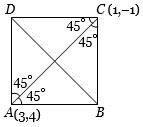
The opposite angular points of a square are $(3,\;4)$ and $(1,\; - \;1)$. Then the co-ordinates of other two points are
- A
$D\,\left( {\frac{1}{2},\,\,\frac{9}{2}} \right)\,,\,\,B\,\left( { - \frac{1}{2},\,\,\frac{5}{2}} \right)$
- B
$D\,\left( {\frac{1}{2},\,\,\frac{9}{2}} \right)\,,\,\,B\,\left( {\frac{1}{2},\,\,\frac{5}{2}} \right)$
- ✓
$D\,\left( {\frac{9}{2},\,\,\frac{1}{2}} \right)\,,\,\,B\,\left( { - \frac{1}{2},\,\,\frac{5}{2}} \right)$
- D
AnswerCorrect option: C. $D\,\left( {\frac{9}{2},\,\,\frac{1}{2}} \right)\,,\,\,B\,\left( { - \frac{1}{2},\,\,\frac{5}{2}} \right)$
c
(c) Obviously, slope of $AC = 5/2$.
Let m be the slope of a line inclined at an angle of ${45^o}$ to $AC$, then $\tan {45^o} = \pm \frac{{m - \frac{5}{2}}}{{1 + m.\frac{5}{2}}} \Rightarrow m = - \frac{7}{3},\frac{3}{7}$.
Thus, let the slope of $AB$ or $DC$ be $3/7$ and that of $AD$ or $BC$ be $ - \frac{7}{3}$ . Then equation of $AB$ is $3x - 7y + 19 = 0$.
Also the equation of $BC$ is $7x + 3y - 4 = 0$.
On solving these equations, we get, $B\,\,\,\left( { - \frac{1}{2},\frac{5}{2}} \right)$.
Now let the coordinates of the vertex $D$ be $(h, k)$. Since the middle points of $AC$ and $BD$ are same,
therefore $\frac{1}{2}\left( {h - \frac{1}{2}} \right)\, = \frac{1}{2}(3 + 1) \Rightarrow h = \frac{9}{2}$, $\frac{1}{2}\left( {k + \frac{5}{2}} \right) = \frac{1}{2}(4 - 1)$
==> $k = \frac{1}{2}$. Hence, $D = \left( {\frac{9}{2},\,\frac{1}{2}} \right)$.
View full question & answer→MCQ 441 Mark
The equation of the lines on which the perpendiculars from the origin make ${30^o}$ angle with $x$-axis and which form a triangle of area $\frac{{50}}{{\sqrt 3 }}$ with axes, are
- A
$x + \sqrt 3 y \pm 10 = 0$
- ✓
$\sqrt 3 x + y \pm 10 = 0$
- C
$x \pm \sqrt 3 y - 10 = 0$
- D
AnswerCorrect option: B. $\sqrt 3 x + y \pm 10 = 0$
b
(b) Let $p$ be the length of the perpendicular from the origin on the given line. Then its equation in normal form is $x\cos {30^o} + y\sin {30^o} = p$ or $\sqrt 3 x + y = 2p$
This meets the coordinate axes at $A\left( {\frac{{2p}}{{\sqrt 3 }},0} \right)$ and $B(0,\,2p)$.
Area of $\Delta OAB = \frac{1}{2}\left( {\frac{{2p}}{{\sqrt 3 }}} \right){\rm{ }}2p = \frac{{2{p^2}}}{{\sqrt 3 }}$
By hypothesis $\frac{{2{p^2}}}{{\sqrt 3 }} = \frac{{50}}{{\sqrt 3 }} \Rightarrow p = \pm 5$.
Hence the lines are $\sqrt 3 x + y \pm 10 = 0$.
View full question & answer→MCQ 451 Mark
The base $BC$ of a triangle $ABC$ is bisected at the point $(p, q)$ and the equations to the sides $AB$ and $AC$ are respectively $px+qy= 1$ and $qx + py = 1.$ Then the equation to the median through $A$ is
- ✓
$(2pq - 1)(px + qy - 1) = ({p^2} + {q^2} - 1)(qx + py - 1)$
- B
$({p^2} + {q^2} - 1)(px + qy - 1) = (2p - 1)(qx + py - 1)$
- C
$(pq - 1)(px + qy - 1) = ({p^2} + {q^2} - 1)(qx + py - 1)$
- D
AnswerCorrect option: A. $(2pq - 1)(px + qy - 1) = ({p^2} + {q^2} - 1)(qx + py - 1)$
a
(a) Since the median passes through $A$, the intersection of the given lines. Its equation is given by $(px + qy - 1) + \lambda (qx + py - 1) = 0$, where $\lambda $ is some real number. Also, since the median passes through the point $(p, q)$, we have $({p^2} + {q^2} - 1) + \lambda (qp + pq - 1) = 0$
==> $\lambda = - \frac{{{p^2} + {q^2} - 1}}{{2pq - 1}}$ and the equation of median through $A$ is $(px + qy - 1) - \frac{{{p^2} + {q^2} - 1}}{{2pq - 1}}(qx + py - 1) = 0$
==> $(2pq - 1)(px + qy - 1) = ({p^2} + {q^2} - 1)(qx + py - 1)$.
View full question & answer→MCQ 461 Mark
The equation of the line which makes right angled triangle with axes whose area is $6$ sq. units and whose hypotenuse is of $5$ units, is
- ✓
$\frac{x}{4} + \frac{y}{3} = \pm \;1$
- B
$\frac{x}{4} - \frac{y}{3} = \pm \;3$
- C
$\frac{x}{6} + \frac{y}{1} = \pm \;1$
- D
$\frac{x}{1} - \frac{y}{6} = \pm \;1$
AnswerCorrect option: A. $\frac{x}{4} + \frac{y}{3} = \pm \;1$
a
(a) If the line is $\frac{x}{a} + \frac{y}{b} = 1$, then the intercepts on the axes are $a$ and $b$.
Therefore the area is $\frac{1}{2}|a \times b| = 6 \Rightarrow |ab| = 12$ …..$(i)$
and hypotenuse is $5$, therefore ${a^2} + {b^2} = 25$ …..$(ii)$
On solving $(i)$ and $(ii)$, we get
$a = \pm 4$or $ \pm 3$and $b = \pm 3$or $ \pm 4$
Hence equation of line is $ \pm \frac{x}{4} \pm \frac{y}{3} = 1$or $ \pm \frac{x}{3} \pm \frac{y}{4} = 1$.
Trick: Check with options. Obviously, the line $\frac{x}{4} + \frac{y}{3} = \pm 1$ satisfies both the conditions.
View full question & answer→MCQ 471 Mark
$A(-1, 1)$, $B(5, 3)$ are opposite vertices of a square in $xy$-plane. The equation of the other diagonal (not passing through $(A, B)$ of the square is given by
- A
$x - 3y + 4 = 0$
- B
$2x - y + 3 = 0$
- ✓
$y + 3x - 8 = 0$
- D
$x + 2y - 1 = 0$
AnswerCorrect option: C. $y + 3x - 8 = 0$
c
(c) The required diagonal passes through the mid-point of $AB$ and is perpendicular to $AB$. So its equation is $y - 2 = - 3(x - 2)$ or $3x + y - 8 = 0$.
View full question & answer→MCQ 481 Mark
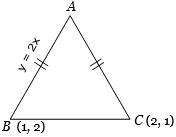
In an isosceles triangle $ABC$, the coordinates of the points $B$ and $C$ on the base $BC$ are respectively $(1, 2)$ and $(2, 1)$. If the equation of the line $AB$ is $y = 2x$, then the equation of the line $AC$ is
- A
$y = \frac{1}{2}(x - 1)$
- ✓
$y = \frac{x}{2}$
- C
$y = x - 1$
- D
$2y = x + 3$
AnswerCorrect option: B. $y = \frac{x}{2}$
b
(b) $\angle ABC = \tan \theta = \frac{{\frac{1}{2} - 1}}{{1 + \frac{1}{2}}} = - \frac{1}{3}$ (Here ${m_1} = \frac{1}{2},\,{m_2} = 1)$
$AB = AC$; $\angle ABC = \angle ACB$
Hence $ - \frac{1}{3} = \frac{{m - 1}}{{1 + m}}$ ==> $m = \frac{1}{2}$
(Here m is the gradient of line $AC$)
Equation of line AC is,$y - 1 = \frac{1}{2}(x - 2)$ ==> $y = \frac{x}{2}$.
View full question & answer→MCQ 491 Mark
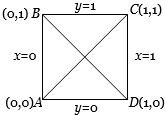
Equations of diagonals of square formed by lines $x = 0,$ $y = 0,$$x = 1$ and $y = 1$are
AnswerCorrect option: A. $y = x,\;y + x = 1$
a
(a)Co-ordinates of the vertices of the square are $A(0,\,0),$ $B(0,\,1),$ $C(1,\,1)$ and $D(0,\,1)$.
Now the equation of $AC$ is $y = x$ and of $BD$ is $y - 1 = - \frac{1}{1}(x - 0)$ $ \Rightarrow x + y = 1$.
View full question & answer→MCQ 501 Mark
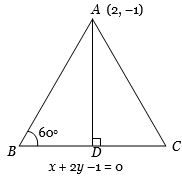
The vertex of an equilateral triangle is $(2,-1)$ and the equation of its base in $x + 2y = 1$. The length of its sides is
- A
$4/\sqrt {15} $
- ✓
$2/\sqrt {15} $
- C
$4/3\sqrt 3 $
- D
$1/\sqrt 5 $
AnswerCorrect option: B. $2/\sqrt {15} $
b
(b) $|AD|\, = \left| {\frac{{2 - 2 - 1}}{{\sqrt {{1^2} + {2^2}} }}} \right| = \frac{1}{{\sqrt 5 }}$
$\tan 60^\circ = \frac{{AD}}{{BD}}$
==> $\sqrt 3 = \frac{{1\,/\sqrt 5 }}{{BD}}$
==> $BD = \frac{1}{{\sqrt {15} }}$
$BC = 2BD = 2\,/\sqrt {15} $.
View full question & answer→MCQ 511 Mark
The equation to the sides of a triangle are $x - 3y = 0$, $4x + 3y = 5$ and $3x + y = 0$. The line $3x - 4y = 0$ passes through
- A
- B
- C
- ✓
The orthocentre of the triangle
AnswerCorrect option: D. The orthocentre of the triangle
d
(d) Two sides $x - 3y = 0$and $3x + y = 0$of the given triangle are perpendicular to each other. Therefore its orthocentre is the point of intersection of $x - 3y = 0$ and $3x + y = 0$ i.e, $(0, 0)$. Clearly satisfies $3x - 4y = 0$.
View full question & answer→MCQ 521 Mark
Two lines are drawn through $(3, 4)$, each of which makes angle of $45^\circ$ with the line $x - y = 2$, then area of the triangle formed by these lines is
- A
$9$
- ✓
$9\over2$
- C
$2$
- D
$2\over9$
AnswerCorrect option: B. $9\over2$
b
(b) The equation of lines are $y - {y_1} = \frac{{m \pm \tan \alpha }}{{1 \mp m\tan \alpha }}(x - {x_1})$
==> $y - 4 = \frac{{1 \pm \tan 45^\circ }}{{1 \mp \tan 45^\circ }}(x - {x_1})$
==> $y - 4 = \frac{{1 \pm 1}}{{1 \mp 1}}(x - 3)$ ==> $y = 4$ or $x = 3$
Hence, the lines which make the triangle are $x - y = 2,$ $x = 3$ and $y = 4$. The intersection points of these lines are $(6,\,4),\,(3,\,1)$ and $(3,\,4)$
$\Delta = \frac{1}{2}[6( - 3) + 3(0) + 3(3)]$ $ = \frac{9}{2}$.
View full question & answer→MCQ 531 Mark
A point moves so that square of its distance from the point $(3, -2)$ is numerically equal to its distance from the line $5x - 12y = 13$. The equation of the locus of the point is
- ✓
$13{x^2} + 13{y^2} - 83x + 64y + 182 = 0$
- B
${x^2} + {y^2} - 11x + 16y + 26 = 0$
- C
${x^2} + {y^2} - 11x + 16y = 0$
- D
AnswerCorrect option: A. $13{x^2} + 13{y^2} - 83x + 64y + 182 = 0$
a
(a) ${(h - 3)^2} + {(k + 2)^2} = \left| {\frac{{5h - 12k - 13}}{{\sqrt {25 + 144} }}} \right|$.
Replace $(h,k)$ by $(x,\,y)$, we get
$13{x^2} + 13{y^2} - 83x + 64y + 182 = 0$, which is the required equation of the locus of the point.
View full question & answer→MCQ 541 Mark
A point moves such that its distance from the point $(4,\,0)$is half that of its distance from the line $x = 16$. The locus of this point is
- ✓
$3{x^2} + 4{y^2} = 192$
- B
$4{x^2} + 3{y^2} = 192$
- C
${x^2} + {y^2} = 192$
- D
AnswerCorrect option: A. $3{x^2} + 4{y^2} = 192$
a
(a)$\sqrt {{{(h - 4)}^2} + {k^2}} = \frac{1}{2}\left( {\frac{{h - 16}}{{\sqrt {{1^2} + 0} }}} \right)$
Replace $(h,k)$ by $(x,\,y)$, we get $3{x^2} + 4{y^2} = 192.$
View full question & answer→MCQ 551 Mark
If $A$ is $(2, 5)$, $B$ is $(4, -11)$ and $ C$ lies on $9x + 7y + 4 = 0$, then the locus of the centroid of the $\Delta ABC$ is a straight line parallel to the straight line is
- A
$7x - 9y + 4 = 0$
- B
$9x - 7y - 4 = 0$
- ✓
$9x + 7y + 4 = 0$
- D
$7 + 9y + 4 = 0$
AnswerCorrect option: C. $9x + 7y + 4 = 0$
c
(c) According to question , ${x_1} = \frac{{2 + 4 + x}}{3} \Rightarrow x = 3{x_1} - 6$
${y_1} = \frac{{5 - 11 + y}}{3} \Rightarrow y = 3{y_1} + 6$
$\therefore $ $9(3{x_1} - 6) + 7(3{y_1} + 6) + 4 = 0$
Hence locus is $27x + 21y - 8 = 0$, which is parallel to $9x+7y+4 = 0.$
View full question & answer→MCQ 561 Mark
The medians $AD$ and $BE$ of a triangle with vertices $A\;(0,\;b),\;B\;(0,\;0)$ and $C\;(a,\;0)$ are perpendicular to each other, if
- A
$a = \sqrt 2 \;b$
- B
$a = - \sqrt 2 \;b$
- ✓
- D
Answerc
(c) From figure,
$\left( {\frac{{b/2}}{{a/2}}} \right){\rm{ }}\left( {\frac{b}{{ - a/2}}} \right) = - 1 $
$\Rightarrow {a^2} = 2{b^2}$
$\Rightarrow a = \pm \sqrt 2 b$.
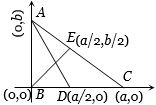
View full question & answer→MCQ 571 Mark
The equation of straight line passing through $( - a,\;0)$ and making the triangle with axes of area ‘$T$’ is
- A
$2Tx + {a^2}y + 2aT = 0$
- ✓
$2Tx - {a^2}y + 2aT = 0$
- C
$2Tx - {a^2}y - 2aT = 0$
- D
AnswerCorrect option: B. $2Tx - {a^2}y + 2aT = 0$
b
(b) If the line cuts off the axes at $A$ and $B$, then area of triangle is $\frac{1}{2} \times OA \times OB = T$
==> $\frac{1}{2}.a.OB = T \Rightarrow OB = \frac{{2T}}{a}$
Hence the equation of line is $\frac{x}{{ - a}} + \frac{y}{{2T/a}} = 1$
$ \Rightarrow 2Tx - {a^2}y + 2aT = 0$.
View full question & answer→MCQ 581 Mark
If the equation of base of an equilateral triangle is $2x - y = 1$ and the vertex is $(-1, 2)$, then the length of the side of the triangle is
- ✓
$\sqrt {\frac{{20}}{3}} $
- B
$\frac{2}{{\sqrt {15} }}$
- C
$\sqrt {\frac{8}{{15}}} $
- D
$\sqrt {\frac{{15}}{2}} $
AnswerCorrect option: A. $\sqrt {\frac{{20}}{3}} $
a
(a) $AD = \left| {\,\frac{{ - 2 - 2 - 1}}{{\sqrt {{{(2)}^2} + {{( - 1)}^2}} }}\,} \right| = \left| {\,\frac{{ - 5}}{{\sqrt 5 }}\,} \right| = \sqrt 5 $
$\tan {60^o}$ $ = \frac{{AD}}{{BD}} \Rightarrow \sqrt 3 = \frac{{\sqrt 5 }}{{BD}}$==> $BD = \sqrt {\frac{5}{3}} $
$\therefore $ $BC = 2BD = 2\sqrt {\frac{5}{3}} = \sqrt {\frac{{20}}{3}} $.
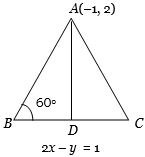
View full question & answer→MCQ 591 Mark
The sides $AB,BC,CD$ and $DA$ of a quadrilateral are $x + 2y = 3,\,x = 1,$ $x - 3y = 4,\,$ $\,5x + y + 12 = 0$ respectively. The angle between diagonals $AC$ and $BD$ is ......$^o$
- A
${45}$
- B
${60}$
- ✓
${90}$
- D
${30}$
AnswerCorrect option: C. ${90}$
c
(c) The four vertices on solving are $A( - 3,\,3)$, $B(1,\,1),$ $C(1,\, - 1)$ and $D( - 2, - 2)$.${m_1}$= slope of $AC = - 1$, ${m_2}$= slope of $BD = 1$; ${m_1}{m_2} = - 1$.
Hence the angle between diagonals $AC$ and $BD$ is $90^\circ $.
View full question & answer→MCQ 601 Mark
A line $L$ passes through the points $(1, 1)$ and $(2, 0)$ and another line $L'$ passes through $\left( {\frac{1}{2},0} \right)$ and perpendicular to $L$. Then the area of the triangle formed by the lines $L,L'$ and $y$- axis, is
- A
$15\over8$
- B
$25\over4$
- C
$25\over8$
- ✓
$25\over16$
AnswerCorrect option: D. $25\over16$
d
(d) Here $L \equiv x + y = 2$and $L' \equiv 2x - 2y = 1$.
Equation of $y$-axis is $x = 0$
Hence the vertices of the triangle are $A(0,\,2),B\left( {0, - \frac{1}{2}} \right)$ and $C\left( {\frac{5}{4},\frac{3}{4}} \right)$. Therefore, the area of the triangle is $\frac{1}{2}\left| {\,\begin{array}{*{20}{c}}0&2&1\\0&{ - \frac{1}{2}}&1\\{\frac{5}{4}}&{\frac{3}{4}}&1\end{array}\,} \right| = \frac{{25}}{{16}}$.
View full question & answer→MCQ 611 Mark
The diagonals of the parallelogram whose sides are $lx + my + n = 0,$ $lx + my + n' = 0$,$mx + ly + n = 0$, $mx + ly + n' = 0$ include an angle
AnswerCorrect option: B. $\frac{\pi }{2}$
b
(b) Since the distance between the parallel line $lx + my + n = 0$and $lx + my + n' = 0$ is same as the distance between parallel lines $mx + ly + n = 0$ and $mx + ly + n' = 0$. Therefore the parallelogram is a rhombus. Since the diagonals of a rhombus are at right angles, therefore the required angle is $\frac{\pi }{2}$.
View full question & answer→MCQ 621 Mark
The area of triangle formed by the lines $x + y - 3 = 0 , x - 3y + 9 = 0$ and $3x - 2y + 1= 0$
- A
$\frac{{10}}{7}\,$ sq. units
- ✓
$\frac{{16}}{7}\,$ sq. units
- C
$4$ sq. units
- D
$9$ sq. units
AnswerCorrect option: B. $\frac{{16}}{7}\,$ sq. units
b
To find $B$
$3 x-2 y=-1$ and $x+y=3$
solving above two equations we get $y=2$ and $x=1$
$B=(1,2)$
To find $C$
$3 x-2 y=-1$ and $x-3 y=-9$
solving above two equations we get $y=27 / 6$ and $x=15 / 7$
$C=\left(\frac{15}{7}, \frac{27}{6}\right)$
$s=\frac{\text {perimeteroftriangle}}{2}$
$a=A B=\sqrt{(1-0)^{2}+(2-3)^{2}}$
$=\sqrt{1+1}$
$=\sqrt{2}$
$b=B C=\sqrt{\left(\frac{15}{7}-1\right)^{2}+\left(\frac{26}{7}-2\right)^{2}}$
$=\sqrt{\left(\frac{8}{7}\right)^{2}+\left(\frac{12}{7}\right)^{2}}$
$\frac{4 \sqrt{13}}{7}$
$c=C A=\sqrt{\left(\frac{15}{7}-0\right)^{2}+\left(\frac{26}{7}-3\right)^{2}}$
$=\sqrt{\left(\frac{15}{7}\right)^{2}+\left(\frac{5}{7}\right)^{2}}$
$=\frac{5 \sqrt{10}}{7}$
$s=\frac{a+b+c}{2}$
$s=\frac{\sqrt{2}+\frac{4 \sqrt{13}}{7}+\frac{5 \sqrt{10}}{7}}{2}$
$s=\frac{14 \sqrt{2}+4 \sqrt{13}+5 \sqrt{10}}{14}$
$s-a=\frac{-7 \sqrt{2}+4 \sqrt{13}+5 \sqrt{10}}{14}$
$s-b=\frac{14 \sqrt{2}-4 \sqrt{13}+5 \sqrt{10}}{14}$
$s-c=\frac{14 \sqrt{2}+4 \sqrt{13}-5 \sqrt{10}}{14}$
$A=\sqrt{s(s-a)(s-b)(s-c)}$
$A=\sqrt{\left(\frac{-7 \sqrt{2}+4 \sqrt{13}+5 \sqrt{10}}{14}\right)\left(\frac{14 \sqrt{2}-4 \sqrt{13}+5 \sqrt{10}}{14}\right)\left(\frac{14 \sqrt{2}+4 \sqrt{13}-5 \sqrt{10}}{14}\right)}$
Multiplying and solving
$A=\frac{16}{7}$ sq unit
View full question & answer→MCQ 631 Mark
A straight line passing through $P(3, 1)$ meet the coordinates axes at $A$ and $B$. It is given that distance of this straight line from the origin $'O'$ is maximum. Area of triangle $OAB$ is equal to
AnswerCorrect option: A. $\frac{50}{3} sq. units$
a
Line $\mathrm{AB}$ will be farthest from the origin if $\mathrm{OP}$ is right angled to loine drawn $m_{O P}=\frac{1}{3} \Rightarrow m_{A B}=-3$
Thus, the equation of $A B$ is $(y-1)=-3(x-3)$ $\Rightarrow A=\left(\frac{10}{3}, 0\right), B=(0,10)$
$\Rightarrow \Delta O A B=\frac{1}{2}(O A)(O B)=\frac{1}{2} \times \frac{10}{3} \times 10=\frac{100}{6}=\frac{50}{3}$
View full question & answer→MCQ 641 Mark
The equation to the line bisecting the join of $(3, -4)$ and $(5, 2)$ and having its intercepts on the $x$-axis and the $y$-axis in the ratio $2 : 1$ is
- A
$x + y - 3 = 0$
- B
$2x - y = 9$
- ✓
$x + 2y = 2$
- D
$2x + y = 7$
AnswerCorrect option: C. $x + 2y = 2$
c
(c) Given equation of line having it intercepts on the $x$- axis and $y$-axis in the ratio $2:1$ i.e., $2a$ and $a$
$\frac{x}{{2a}} + \frac{y}{a} = 1 \Rightarrow x + 2y = 2a$.....$(i)$
According to question,
Line $(i)$ also passes through midpoint of $(3, - 4)$ and $(5,2)$ i.e., $(4, - 1)$.
$4 + 2( - 1) = 2a \Rightarrow a = 1$
Hence the equation of required line is, $x + 2y = 2$.
View full question & answer→MCQ 651 Mark
Equation of angle bisector between the lines $3x + 4y - 7 = 0$ and $12x + 5y + 17 = 0$are
- ✓
$\frac{{3x + 4y - 7}}{{\sqrt {25} }} = \pm \frac{{12x + 5y + 17}}{{\sqrt {169} }}$
- B
$\frac{{3x + 4y + 7}}{{\sqrt {25} }} = \frac{{12x + 5y + 17}}{{\sqrt {169} }}$
- C
$\frac{{3x + 4y + 7}}{{\sqrt {25} }} = \pm \frac{{12x + 5y + 17}}{{\sqrt {169} }}$
- D
AnswerCorrect option: A. $\frac{{3x + 4y - 7}}{{\sqrt {25} }} = \pm \frac{{12x + 5y + 17}}{{\sqrt {169} }}$
a
(a) By direct formulae $\frac{{{a_1}x + {b_1}y + {c_1}}}{{\sqrt {a_1^2 + b_1^2} }} = \pm \frac{{{a_2}x + {b_2}y + {c_2}}}{{\sqrt {a_2^2 + b_2^2} }}$
$\frac{{3x + 4y - 7}}{{\sqrt {{3^2} + {4^2}} }} = \pm \frac{{12x + 5y + 17}}{{\sqrt {{{(12)}^2} + {{(5)}^2}} }}$
$\frac{{3x + 4y - 7}}{5} = \pm \frac{{12x + 5y + 17}}{{13}}$.
View full question & answer→MCQ 661 Mark
The bisector of the acute angle formed between the lines $4x - 3y + 7 = 0$and $3x - 4y + 14 = 0$has the equation
- A
$x + y + 3 = 0$
- B
$x - y - 3 = 0$
- ✓
$x - y + 3 = 0$
- D
$3x + y - 7 = 0$
AnswerCorrect option: C. $x - y + 3 = 0$
c
(c)The equation of bisector of acute angle formed between the lines $4x - 3y + 7 = 0$ and $3x - 4y + 14 = 0$ is $\frac{{4x - 3y + 7}}{{\sqrt {16 + 9} }} = - \frac{{3x - 4y + 14}}{{\sqrt {16 + 9} }}$
==>$7x - 7y + 21 = 0$
==> $x - y + 3 = 0$.
View full question & answer→MCQ 671 Mark
The equation of bisectors of the angles between the lines $|x|\, = \,|y|$ are
AnswerCorrect option: C. $y = 0$ and $x = 0$
c
(c)The equation of lines are $x + y = 0$ and $x - y = 0$
$\therefore$ The equation of bisectors of the angles between these lines are $\frac{{x + y}}{{\sqrt {1 + 1} }} = \pm \frac{{x - y}}{{\sqrt {1 + 1} }}$ ==> $x + y = \pm (x - y)$
Taking + ve sign, we get $y = 0$
Taking -ve sign, we get $x = 0$
Hence the equation of bisectors are$x = 0,\,y = 0$.
View full question & answer→MCQ 681 Mark
The pedal points of a perpendicular drawn from origin on the line $3x + 4y - 5 = 0$, is
- A
$\left( {\frac{3}{5},2} \right)$
- ✓
$\left( {\frac{3}{5},\frac{4}{5}} \right)$
- C
$\left( { - \frac{3}{5}, - \frac{4}{5}} \right)$
- D
$\left( {\frac{{30}}{{17}},\frac{{19}}{{17}}} \right)$
AnswerCorrect option: B. $\left( {\frac{3}{5},\frac{4}{5}} \right)$
b
(b)$d = \frac{5}{{\sqrt {{3^2} + {4^2}} }} = 1$
Slope of perpendicular = $\frac{4}{3}$
==> $x = \pm 1.\cos \theta = \pm \frac{3}{5}$and $y = \pm 1.\sin \theta = \pm \frac{4}{5}$
Hence $\left( {\frac{3}{5},\frac{4}{5}} \right)$ lies on straight line.
View full question & answer→MCQ 691 Mark
If $u = {a_1}x + {b_1}y + {c_1} = 0,$ $v = {a_2}x + {b_2}y + {c_2} = 0$ and $\frac{{{a_1}}}{{{a_2}}} = \frac{{{b_1}}}{{{b_2}}} = \frac{{{c_1}}}{{{c_2}}},$ then the curve $u + kv = 0$is
AnswerCorrect option: A. The same straight line $u$
a
(a) $u = {a_1}x + {b_1}y + {c_1} = 0,v = {a_2}x + {b_2}y + {c_2} = 0$
and $\frac{{{a_1}}}{{{a_2}}} = \frac{{{b_1}}}{{{b_2}}} = \frac{{{c_1}}}{{{c_2}}} = c$ (Let)
==> ${a_2} = \frac{{{a_1}}}{c},{b_2} = \frac{{{b_1}}}{c},{c_2} = \frac{{{c_1}}}{c}$
Given that $u + kv = 0$
==> ${a_1}x + {b_1}y + {c_1} + k({a_2}x + {b_2}y + {c_2}) = 0$
==> ${a_1}x + {b_1}y + {c_1} + k\frac{{{a_1}}}{c}x + k\frac{{{b_1}}}{c}y + k\frac{{{c_1}}}{c} = 0$
==> ${a_1}x\left( {1 + \frac{k}{c}} \right) + {b_1}y\left( {1 + \frac{k}{c}} \right) + {c_1}\left( {1 + \frac{k}{c}} \right) = 0$
==> ${a_1}x + {b_1}y + {c_1} = 0 = u$.
View full question & answer→MCQ 701 Mark
If $a + b + c = 0$ and $p \ne 0,$ the lines $ax + (b + c)y = p,$ $bx + (c + a)y = p$ and $cx + (a + b)y = p$
Answera
(a) By the help of given condition of $a + b + c = 0$, the three lines reduce to $x - y = \frac{p}{a}$ or $\frac{p}{b}{\rm{or}}\frac{p}{c}(p \ne 0)$.
All these lines are parallel. Hence they do not intersect in finite plane.
View full question & answer→MCQ 711 Mark
The symmetry in curve ${x^3} + {y^3} = 3axy$ along
- A
$x$-axis
- B
$y$-axis
- ✓
Line $y = x$
- D
AnswerCorrect option: C. Line $y = x$
c
(c) By putting $y = x$or$x = y$, the equation remains unchanged. Hence it is symmetric to the line $y = x$.
View full question & answer→MCQ 721 Mark
A line passing through origin and is perpendicular to two given lines $2x + y + 6 = 0$ and $4x + 2y - 9 = 0$, then the ratio in which the origin divides this line is
- A
$1 : 2$
- B
$2 : 1$
- ✓
$4 : 3$
- D
$3 : 4$
AnswerCorrect option: C. $4 : 3$
c
(c) Equation of line Perpendicular to $2x + y + 6 = 0$ passes through $(0, 0)$ is $x - 2y = 0$
Now point of intersection of $x - 2y = 0$ and $2x + y + 6 = 0$is $\left( {\frac{{ - 12}}{5},\frac{{ - 6}}{5}} \right)$ and point of intersection of $x - 2y = 0$ and $4x + 2y - 9 = 0$ is $\left( {\frac{9}{5},\frac{9}{{10}}} \right)$.
Now say origin divide the line $x - 2y = 0$ in the ratio $\lambda :1$
$x = \frac{{\frac{9}{5}\lambda - \frac{{12}}{5}}}{{\lambda + 1}} = 0 \Rightarrow \frac{9}{5}\lambda = \frac{{12}}{5}$, $\therefore \lambda = \frac{4}{3}$
Thus origin divides the line $x = 2y$, in the ratio $4 : 3$.
View full question & answer→MCQ 731 Mark
If $2p$ is the length of perpendicular from the origin to the lines $\frac{x}{a} + \frac{y}{b} = 1$, then ${a^2},8{p^2},{b^2}$are in
AnswerCorrect option: C. $H. P.$
c
(c) We have $2p = \left| {\,\frac{{0 + 0 - 1}}{{\sqrt {\frac{1}{{{a^2}}} + \frac{1}{{{b^2}}}} }}\,} \right| \Rightarrow \frac{1}{{{a^2}}} + \frac{1}{{{b^2}}} = \frac{1}{{4{p^2}}}$
==> $\frac{1}{{{a^2}}} + \frac{1}{{{b^2}}} = \frac{2}{{8{p^2}}} \Rightarrow \frac{1}{{{a^2}}},\frac{1}{{8{p^2}}},\frac{1}{{{b^2}}}$are in A. P.
==> ${a^2},8{p^2},{p^2}$are in H.P .
View full question & answer→MCQ 741 Mark
If the straight line through the point $P(3,\,4)$ makes an angle $\frac{\pi }{6}$with the $x$-axis and meets the line $12x + 5y + 10 = 0$ at $Q$, then the length $PQ$ is
- ✓
$\frac{{132}}{{12\sqrt 3 + 5}}$
- B
$\frac{{132}}{{12\sqrt 3 - 5}}$
- C
$\frac{{132}}{{5\sqrt 3 + 12}}$
- D
$\frac{{132}}{{5\sqrt 3 - 12}}$
AnswerCorrect option: A. $\frac{{132}}{{12\sqrt 3 + 5}}$
a
(a) The equation of any line passing through the given point $P(3, 4)$ and making an angle $\frac{\pi }{6}$with $x$-axis is $\frac{{x - 3}}{{\cos {{30}^o}}} = \frac{{y - 4}}{{\sin {{30}^o}}} = r$ (say) ......$(i)$
Where $‘r$’ represents the distance of any point $Q$ on this line from the given point $P \,(3, 4)$.
The coordinates $(x, y)$ of any point $Q$ on line $(i)$ are $(3 + r\cos {30^o},4 + r\sin {30^o})\,\,{\rm{ }}i.e.,\,{\rm{ }}\left( {3 + \frac{{r\sqrt 3 }}{2},4 + \frac{r}{2}} \right)$
If the point lies on the line $12x + 5y + 10 = 0$, then
$12\left( {3 + \frac{{r\sqrt 3 }}{2}} \right) + 5\left( {4 + \frac{r}{2}} \right) + 10 = 0$
$\Rightarrow r = \frac{{132}}{{12\sqrt 3 + 5}}$.
View full question & answer→MCQ 751 Mark
Let $m, n$ be real numbers such that $0 \leq m \leq \sqrt{3}$ and $-\sqrt{3} \leq n \leq 0$. The minimum possible area of the region of the plane consisting of points $(x, y)$ satisfying in inequalities $y \geq 0, y-3 \leq m x$, $y -3 \leq nx$, is
- A
$0$
- B
$\frac{3 \sqrt{3}}{2}$
- ✓
$3 \sqrt{3}$
- D
$6 \sqrt{3}$
AnswerCorrect option: C. $3 \sqrt{3}$
c
(c)
$y = mx +3$,$m \in[0, \sqrt{3}]$
$y = nx +3$,$n \in[-\sqrt{3}, 0]$
min area $=$ are $(\Delta PAB )=\frac{1}{2} \times 2 \sqrt{3} \times 3=3 \sqrt{3}$
View full question & answer→MCQ 761 Mark
Let $P Q R$ be an acute-angled triangle in which $P Q < Q R$. From the vertex $Q$ draw the altitude $Q Q_1$, the angle bisector $Q Q_2$ and the median $Q Q_3$, with $Q_1, Q_2, Q_3$ lying on $P R$. Then,
- ✓
$P Q_1 < P Q_2 < P Q_3$
- B
$P Q_2 < P Q_1 < P Q_3$
- C
$P Q_1 < P Q_3 < P Q_2$
- D
$P Q_3 < P Q_1 < P Q_2$
AnswerCorrect option: A. $P Q_1 < P Q_2 < P Q_3$
a
(a)
Given, $P Q R$ is an acute angle triangle.
$\angle Q R P < \angle Q P R$
$P Q_3 =\frac{1}{2} P R$
$P Q_2: Q_2 R=r: p$
$P Q_2=\left(\frac{r}{r+p}\right) P R$
$r < p$
$P Q_2 < \frac{1}{2} P R$
Comparison between altitude and angle bisector
$\angle Q P Q_2+\angle P Q \cdot Q+\angle P Q Q_2=\angle R Q Q_2 +\angle Q Q_2 R+\angle Q R Q_2$
$\therefore \angle P Q Q_2=\angle R Q Q_2$
[ since, $Q Q_2$ is angle bisector of $\angle Q$ ]
$\angle Q P Q_2+\angle P Q_2 Q=\angle Q Q_2 R+\angle Q R Q_2$
$\therefore P Q$
Hence, $\angle Q Q_2 P<\angle Q Q_2 R$
But $\angle Q Q_2 P+\angle Q Q_2 R=180^{\circ}$
Hence, $\angle Q Q_2 P<90^{\circ}$ and $\angle Q Q_2 R>90^{\circ}$
$\because$ Foot from $Q$ to side $P R$ lie inside $\triangle P Q Q_2$
$P Q_1 < P Q_2 < P Q_3$
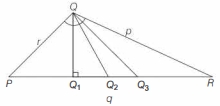
View full question & answer→MCQ 771 Mark
Let $O=(0,0)$ : let $A$ and $B$ be points respectively on $X$-axis and $Y$-axis such that $\angle O B A=60^{\circ}$. Let $D$ be a point in the first quadrant such that $A D$ is an equilateral triangle. Then, the slope of $D B$ is
- A
$\sqrt{3}$
- B
$\sqrt{2}$
- C
$\frac{1}{\sqrt{2}}$
- ✓
$\frac{1}{\sqrt{3}}$
AnswerCorrect option: D. $\frac{1}{\sqrt{3}}$
d
(d)
$\angle O B A=60^{\circ}$
$\angle O A B=30^{\circ}$
$O A D$ is an equilateral triangle.
$\therefore \quad \angle A O D=\angle O D A=\angle O A D=60^{\circ}$
$O A=A D=O D$
Let $B(0, e )$
$\therefore \quad A(\sqrt{3} a, 0)$
D $\left(\frac{\sqrt{3}}{2} a, \frac{3}{2} a\right)$
Slope of $B D=\frac{\frac{3}{2}-a}{\frac{\sqrt{3}}{2} a}=\frac{1}{\sqrt{3}}$
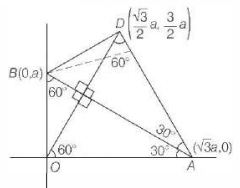
View full question & answer→MCQ 781 Mark
There are two candles of same length and same size. Both of them burn at uniform rate. The first one burns in $5\,hr$ and the second one burns in $3\,h$. Both the candles are lit together. After how many minutes the length of the first candle is $3$ times that of the other?
Answerd
(d)
We have, length and size of two candles are same. Let $L$ be the length of candles.
Given, first candle burns in $5 h$ and second candle burns in $3 h$.
In one hours length of candles are $\frac{L}{5}$ and $\frac{L}{3}$, respectively.
Let after time $t h$ the length of candles are $L_1$ and $L_2$
$\therefore \quad L_1=L-\frac{L}{5} t$ and $L_2=L-\frac{L}{3} t$
According to the problem,
$L_1=3 L_2$
$\therefore \quad L-\frac{L}{5} t=3\left(L-\frac{L}{3} t\right)$
$\Rightarrow 1-\frac{1}{5} t=3-t \Rightarrow t\left(1-\frac{1}{5}\right)=3-1$
$\Rightarrow \quad \frac{4 t}{5}=2 \Rightarrow t=\frac{5}{2} h$
$\Rightarrow \quad t=\frac{5}{2} \times 60=150\,min$
View full question & answer→MCQ 791 Mark
In a $\triangle A B C$, points $X$ and $Y$ are on $A B$ and $A C$, respectively, such that $X Y$ is parallel to $B C$. Which of the two following equalities always hold? (Here $[P Q R]$ denotes the area of $\triangle P Q R)$.
$I$. $[B C X]=[B C Y]$
$II$. $[A C X] \cdot[A B Y]=[A X Y] \cdot[A B C]$
- A
Neither $I$ nor $II$
- B
Only $I$
- C
Only $II$
- ✓
Both $I$ and $II$
AnswerCorrect option: D. Both $I$ and $II$
d
(d)
$A B C$ is a triangle points $X$ and $Y$ on $A B$ and $A C$ respectively.
$X Y$ is parallel to $B C$.
$I$. Area of $B C X:$ Area of $B C Y$
It is true because same base between same parallels.
$II$. Area of $\triangle A C X=\frac{1}{2}(A X)(A C) \sin A$
Area of $\triangle A B Y=\frac{1}{2}(A Y)(A B) \sin A$
$\therefore$ (Area of $\triangle A C X)$ (Area of $\triangle A B Y)$
$=\frac{1}{2}(A X)(A C) \sin A \times \frac{1}{2}(A Y)(A B) \sin A$
$=\frac{1}{2}(A X)(A Y) \sin A \times \frac{1}{2}(A B)(A C) \sin A$
$=(\text { Area of } \triangle A X Y) \text { (Area of } \triangle A B C)$
Hence,$I$ and $II$ both are true.
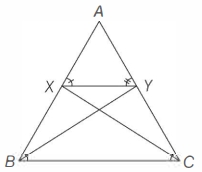
View full question & answer→MCQ 801 Mark
Let $A B C D$ be a square of side length $1$ . Let $P, Q, R, S$ be points in the interiors of the sides $A D, B C, A B, C D$ respectively, such that $P Q$ and $R S$ intersect at right angles. If $P Q=\frac{3 \sqrt{3}}{4}$, then $R S$ equals
- A
$\frac{2}{\sqrt{3}}$
- ✓
$\frac{3 \sqrt{3}}{4}$
- C
$\frac{\sqrt{2}+1}{2}$
- D
$4-2 \sqrt{2}$
AnswerCorrect option: B. $\frac{3 \sqrt{3}}{4}$
b
(b)
$A B C D$ is square
$A B=B C=C D=A D=1$
$P Q$ is perpendicular to $R S$
$\because$ Slope of $P Q \times$ Slope of $R S=-1$
$\therefore \quad q-p \times 1-0=-1$
$ \Rightarrow q-p =r-s $$ \Rightarrow (P Q)^2 =(1-0)^2+(q-p)^2 $
$\Rightarrow \quad(P Q)^2=(1-0)^2+(q-p)^2$
$\Rightarrow \quad\left(\frac{3 \sqrt{3}}{4}\right)^2=1+(q-p)^2$
$\Rightarrow \quad(q-p)^2=\frac{27}{16}-1=\frac{11}{16}$
$\Rightarrow \quad(r-s)^2=\frac{11}{16} \quad[\because q-p=r-s]$
$\Rightarrow \quad R S=\sqrt{(1-0)^2+(r-s)^2}$
$\Rightarrow \quad R S=\sqrt{1+\frac{11}{16}}$
$\therefore \quad R S=\sqrt{\frac{27}{16}}=\frac{3 \sqrt{3}}{4}$
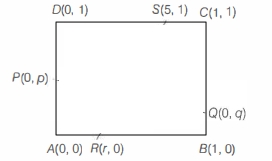
View full question & answer→MCQ 811 Mark
Let $b, d>0$. The locus of all points $P(r, \theta)$ for which the line $P$ (where, $O$ is the origin) cuts the line $r \sin \theta=b$ in $Q$ such that $P Q=d$ is
AnswerCorrect option: B. $(r \pm d) \sin \theta=b$
b
(b)
We have, $P \cdot(r, \theta)=(x, y)$
Equation of line $O P$ is
$y=x \tan \theta$
$O P$ cut the line $r \sin \theta=b$
i.e. $y=b$
Given $P Q=d$
$\therefore$ point $P$ is $y=b \pm d \sin \theta$
$\Rightarrow r \sin \theta=b \pm d \sin \theta \Rightarrow(r \pm d) \sin \theta=b$
Hence, locus of $P(r, \theta)$ is $(r \pm d) \sin \theta=b$
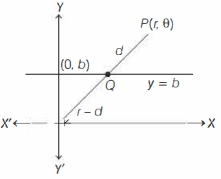
View full question & answer→MCQ 821 Mark
In a rectangle $A B C D$, the coordinates of $A$ and $B$ are $(1,2)$ and $(3,6)$ respectively and some diameter of the circumscribing circle of $A B C D$ has equation $2 x-y+4=0$. Then, the area of the rectangle is
- ✓
$16$
- B
$2 \sqrt{10}$
- C
$2 \sqrt{5}$
- D
$20$
Answera
$(a)$
Given,
$A B C D$ is a rectangle $A(1,2)$ and $B(3,6)$ equation of one of the diameter of circle circumscribing the rectangle is
$2 x-y+4=0 \text {. }$
Slope of diameter $=2$
and slope of line $A B=\frac{6-2}{3-1}=\frac{4}{2}=2$
$\therefore$ Side $A B$ is parallel to diameter of circle equation of line $A B$
$y-2=2(x-1) \Rightarrow 2 x-y=0$
Distance between diameter of circle and line $A B$
$d=\left|\frac{4}{\sqrt{2^2+1}}\right|=\frac{4}{\sqrt{5}}$
$\therefore \quad B C=2 d=\frac{8}{\sqrt{5}}$
Now, $\quad A B=\sqrt{(3-1)^2+(6-2)^2}$
$=\sqrt{4+16}=2 \sqrt{\overline{5}}$
Area of rectangle $=A B \times B C$
$=2 \sqrt{5} \times \frac{8}{\sqrt{5}}=16$
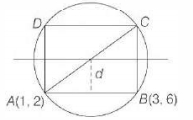
View full question & answer→MCQ 831 Mark
Let the line $2 x+3 y=18$ intersect the $Y$-axis at $B$. Suppose $C(\neq B)$, with coordinates $(a, b)$, is a point on the line such that $P B=P C$, where $P=(10,10)$. Then, $8 a+2 b$ equals
Answera
(a)
The line $2 x+3 y=18$
Cut the $Y$-axis at $B$
$\therefore \quad B=(0,6), C=(a, b)$
$\because P D$ is perpendicular bisector of line
segment $B C$
Equation of line $P D$ is perpendicular to $B C$.
$\therefore \quad 3 x-2 y=\lambda$ Since, $P D$ is passing through $P(10,10)$.
Since, $P D$ is passing through $F$ $\therefore \quad 30-20=\lambda \Rightarrow \lambda=10$
Equation of line $P D$ is $3 x-2 y=10$
Solving the equation $2 x+3 y=18$ and
$3 x-2 y=10$
we get $D\left(\frac{66}{13}, \frac{34}{13}\right)$
$D$ is mid-point of $B C$
$\therefore \frac{a+0}{2} =\frac{66}{13}, \frac{b+6}{2}=\frac{34}{13}$
$\Rightarrow \quad =\frac{132}{13}, b=\frac{-10}{13}$
$\therefore \quad 3 a+2 b =\frac{8 \times 132}{13}-\frac{20}{13}$
$= \frac{1056-20}{13}=\frac{1036}{13}$
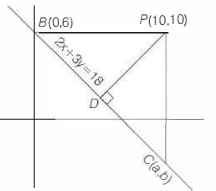
View full question & answer→MCQ 841 Mark
A line passing through the point $A(9,0)$ makes an angle of $30^{\circ}$ with the positive direction of $\mathrm{x}$-axis. If this line is rotated about $A$ through an angle of $15^{\circ}$ in the clockwise direction, then its equation in the new position is
- ✓
$\frac{y}{\sqrt{3}-2}+x=9$
- B
$\frac{x}{\sqrt{3}-2}+y=9$
- C
$\frac{x}{\sqrt{3}+2}+y=9$
- D
$\frac{y}{\sqrt{3}+2}+x=9$
AnswerCorrect option: A. $\frac{y}{\sqrt{3}-2}+x=9$
a
$\mathrm{Eq}^2: y-0=\tan 15^{\circ}(x-9) \Rightarrow y=(2-\sqrt{3})(x-9)$
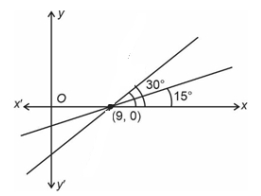
View full question & answer→MCQ 851 Mark
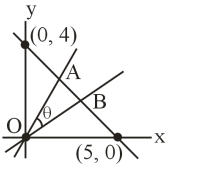
The portion of the line $4 x+5 y=20$ in the first quadrant is trisected by the lines $\mathrm{L}_1$ and $\mathrm{L}_2$ passing through the origin The tangent of an angle between the lines $\mathrm{L}_1$ and $\mathrm{L}_2$ is:
- A
$\frac{8}{5}$
- B
$\frac{25}{41}$
- C
$\frac{2}{5}$
- ✓
$\frac{30}{41}$
AnswerCorrect option: D. $\frac{30}{41}$
d
Co-ordinates of $A=\left(\frac{5}{3}, \frac{8}{3}\right)$
Co-ordinates of $\mathrm{B}=\left(\frac{10}{3}, \frac{4}{3}\right)$
Slope of $O A=m_1=\frac{8}{5}$
Slope of $O B=m_2=\frac{2}{5}$
$\tan \theta=\left|\frac{m_1-m_2}{1+m_1 m_2}\right| $
$ \tan \theta=\frac{\frac{6}{5}}{1+\frac{16}{25}}=\frac{30}{41} $
$\tan \theta=\frac{30}{41}$
View full question & answer→MCQ 861 Mark
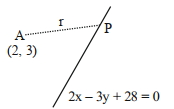
The distance of the point $(2,3)$ from the line $2 \mathrm{x}-$ $3 \mathrm{y}+28=0$, measured parallel to the line $\sqrt{3} \mathrm{x}-\mathrm{y}+1=0$, is equal to
- A
$4 \sqrt{2}$
- B
$6 \sqrt{3}$
- C
$3+4 \sqrt{2}$
- ✓
$4+6 \sqrt{3}$
AnswerCorrect option: D. $4+6 \sqrt{3}$
d
Writing $\mathrm{P}$ in terms of parametric co-ordinates $2+r$
$ \cos \theta, 3+\mathrm{r} \sin \theta \text { as } \tan \theta=\sqrt{3} $
$ \mathrm{P}\left(2+\frac{\mathrm{r}}{2}, 3+\frac{\sqrt{3} \mathrm{r}}{2}\right)$
$P$ must satisfy $2 \mathrm{x}-3 \mathrm{y}+28=0$
So, $2\left(2+\frac{\mathrm{r}}{2}\right)-3\left(3+\frac{\sqrt{3} \mathrm{r}}{2}\right)+28=0$
We find $\mathrm{r}=4+6 \sqrt{3}$
View full question & answer→MCQ 871 Mark
Let $A$ be the point of intersection of the lines $3 x+$ $2 y=14,5 x-y=6$ and $B$ be the point of intersection of the lines $4 x+3 y=8,6 x+y=5$ The distance of the point $P(5,-2)$ from the line $\mathrm{AB}$ is
- A
$\frac{13}{2}$
- B
$8$
- C
$\frac{5}{2}$
- ✓
$6$
Answerd
Solving lines $L_1(3 x+2 y=14)$ and $L_2(5 x-y=6)$ to get $A(2,4)$ and solving lines $L_3(4 x+3 y=8)$ and $L_4(6 x+y=5)$ to get $B\left(\frac{1}{2}, 2\right)$.
Finding Eqn. of $A B: 4 x-3 y+4=0$
Calculate distance $PM$
$\Rightarrow\left|\frac{4(5)-3(-2)+4}{5}\right|=6$
View full question & answer→MCQ 881 Mark
If the image of the point $(-4,5)$ in the line $x+2 y=2$ lies on the circle $(x+4)^2+(y-3)^2=r^2$, then $r$ is equal lo:
Answerb
Image of point $(-4,5)$
$\frac{\mathrm{x}-\mathrm{x}_1}{\mathrm{a}}=\frac{\mathrm{y}-\mathrm{y}_1}{\mathrm{~b}}=-2\left(\frac{\mathrm{ax_{1 } + \mathrm { by } _ { 1 } + \mathrm { c }}}{\mathrm{a}^2+\mathrm{b}^2}\right)$
Line : $x+2 y-2=0$
$ \frac{x+4}{1}=\frac{y-5}{2}=-2\left(\frac{-4+10-2}{1^2+2^2}\right) $
$ =\frac{-8}{5} $
$ \mathrm{x}=-4-\frac{8}{5}=-\frac{28}{5} $
$ y=-\frac{16}{5}+5=\frac{9}{5} $
Point lies on circle $(x+4)^2+(y-3)^2=r^2$
$ \frac{64}{25}+\left(\frac{9}{5}-3\right)^2=r^2 $
$ \frac{100}{25}=r^2, r=2$
View full question & answer→MCQ 891 Mark
In a $\triangle A B C$, suppose $y=x$ is the equation of the bisector of the angle $B$ and the equation of the side $A C$ is $2 x-y=2$. If $2 A B=B C$ and the point $A$ and $B$ are respectively $(4,6)$ and $(\alpha, \beta)$, then $\alpha+2 \beta$ is equal to
Answera
$ \mathrm{AD}: \mathrm{DC}=1: 2 $
$ \frac{4-\alpha}{6-\alpha}=\frac{10}{8} $
$ \alpha=\beta $
$ \alpha=14 \text { and } \beta=14$
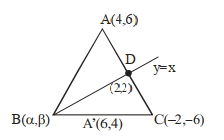
View full question & answer→MCQ 901 Mark
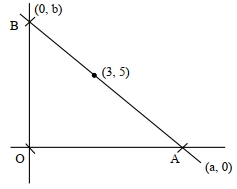
A variable line $\mathrm{L}$ passes through the point $(3,5)$ and intersects the positive coordinate axes at the points $\mathrm{A}$ and $\mathrm{B}$. The minimum area of the triangle $\mathrm{OAB}$, where $\mathrm{O}$ is the origin, is :
Answera
$ \frac{x}{a}+\frac{y}{b}=1 $
$ \frac{3}{a}+\frac{5}{b}=1 \Rightarrow b=\frac{5 a}{a-3}, a>3$
$Image$
$\mathrm{A}=\frac{1}{2} \mathrm{ab}=\frac{1}{2} \mathrm{a} \frac{5 \mathrm{a}}{(\mathrm{a}-3)}=\frac{5}{2} \cdot \frac{\mathrm{a}^2}{\mathrm{a}-3}$
$ =\frac{5}{2}\left(\frac{a^2-9+9}{a-3}\right) $
$ =\frac{5}{2}\left(a+3+\frac{9}{a-3}\right) $
$ =\frac{5}{2}\left(a-3+\frac{9}{a-3}+6\right) \geq 30$
View full question & answer→MCQ 911 Mark
Let a variable line of slope $m>0$ passing through the point $(4,-9)$ intersect the coordinate axes at the points $A$ and $B$. the minimum value of the sum of the distances of $\mathrm{A}$ and $\mathrm{B}$ from the origin is
Answera
equation of line is
$ y+9=m(x-4) $
$ \therefore \quad A=\left(\frac{9+4 m}{m}, 0\right) $
$ \quad B=(0,-9-4 m) $
$ \therefore \quad O A+O B=\frac{9+4 m}{m}+9+4 m$
$ \because \mathrm{m}>0 $
$ =13+\frac{9}{\mathrm{~m}}+4 \mathrm{~m} $
$ \because \frac{4 \mathrm{~m}+\frac{9}{\mathrm{~m}}}{2} \geq \sqrt{36} \Rightarrow 4 \mathrm{~m}+\frac{9}{\mathrm{~m}} \geq 12 $
$ \therefore \mathrm{OA}+\mathrm{OB} \geq 25$
View full question & answer→MCQ 921 Mark
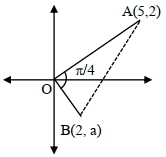
If the line segment joining the points $(5,2)$ and $(2, a)$ subtends an angle $\frac{\pi}{4}$ at the origin, then the absolute value of the product of all possible values of $a$ is:
Answerd
$Image$
$ \mathrm{m}_{\mathrm{OA}}=\frac{2}{5} $
$ \mathrm{~m}_{\mathrm{OB}}=\frac{\mathrm{a}}{2}$
$\tan \frac{\pi}{4}=\left|\frac{2}{5}-\frac{a}{2}\right|$
$1=\left|\frac{4-5 a}{10+2 a}\right|$
$4-5 \mathrm{a}= \pm(10+2 \mathrm{a}) $
$4-5 \mathrm{a}=10+2 \mathrm{a} $ $ 4-5 \mathrm{a}=-10-2 \mathrm{a} $
$\Rightarrow 7 \mathrm{a}+6=0 $ $ 3 \mathrm{a}=14 $
$\Rightarrow \mathrm{a}=-\frac{6}{7} $ $ \mathrm{a}=+\frac{14}{3}$
$-\frac{6}{7} \times \frac{14}{3}=-4$
View full question & answer→MCQ 931 Mark
If $x^2-y^2+2 h x y+2 g x+2 f y+c=0$ is the locus of a point, which moves such that it is always equidistant from the lines $x+2 y+7=0$ and $2 x-y$ $+8=0$, then the value of $\mathrm{g}+\mathrm{c}+\mathrm{h}-\mathrm{f}$ equals
Answera
Cocus of point $\mathrm{P}(\mathrm{x}, \mathrm{y})$ whose distance from
Gives
$\mathrm{X}+2 \mathrm{y}+7=0 \& 2 \mathrm{x}-\mathrm{y}+8=0$ are equal is
$\frac{x+2 y+7}{\sqrt{5}}= \pm \frac{2 x-y+8}{\sqrt{5}}$
$(x+2 y+7)^2-(2 x-y+8)^2=0$
Combined equation of lines
$(x-3 y+1)(3 x+y+15)=0$
$3 x^2-3 y^2-8 x y+18 x-44 y+15=0$
$x^2-y^2-\frac{8}{3}xy+6x-\frac{44}{3} y+5=0$
$x^2-y^2+2 h x y+2 g x 2+2 f y+c=0$
$h=\frac{4}{3}, g=3, f=-\frac{22}{3}, c=5$
$g+c+h-f=3+5-\frac{4}{3}+\frac{22}{3}=8+6=14$
View full question & answer→MCQ 941 Mark
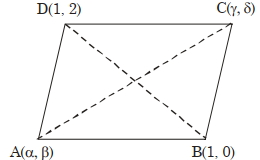
Let $\alpha, \beta, \gamma, \delta \in \mathrm{Z}$ and let $\mathrm{A}(\alpha, \beta), \mathrm{B}(1,0), \mathrm{C}(\gamma, \delta)$ and $D(1,2)$ be the vertices of a parallelogram $\mathrm{ABCD}$. If $\mathrm{AB}=\sqrt{10}$ and the points $\mathrm{A}$ and $\mathrm{C}$ lie on the line $3 y=2 x+1$, then $2(\alpha+\beta+\gamma+\delta)$ is equal to
Answerd
Let $\mathrm{E}$ is mid point of diagonals
$\begin{array}{ll}\frac{\alpha+\gamma}{2}=\frac{1+1}{2} & \& \frac{\beta+\delta}{2}=\frac{2+0}{2} \\ \alpha+\gamma=2 & \beta+\delta=2 \\ 2(\alpha+\beta+\gamma+\delta)=2(2+2)=8\end{array}$
View full question & answer→MCQ 951 Mark
Let $A(a, b), B(3,4)$ and $(-6,-8)$ respectively denote the centroid, circumcentre and orthocentre of a triangle. Then, the distance of the point $P(2 a+3,7 b+5)$ from the line $2 x+3 y-4=0$ measured parallel to the line $x-2 y-1=0$ is
- A
$\frac{15 \sqrt{5}}{7}$
- B
$\frac{17 \sqrt{5}}{6}$
- ✓
$\frac{17 \sqrt{5}}{7}$
- D
$\frac{\sqrt{5}}{17}$
AnswerCorrect option: C. $\frac{17 \sqrt{5}}{7}$
c
$\mathrm{A}(\mathrm{a}, \mathrm{b}), \quad \mathrm{B}(3,4), \quad \mathrm{C}(-6,-8)$
$\Rightarrow \mathrm{a}=0, \mathrm{~b}=0 \quad \Rightarrow \mathrm{P}(3,5)$
Distance from $P$ measured along $x-2 y-1=0$
$\Rightarrow x=3+r \cos \theta, \quad y=5+r \sin \theta$
Where $ \tan \theta=\frac{1}{2} $
$ r(2 \cos \theta+3 \sin \theta)=-17 $
$ \Rightarrow r=\left|\frac{-17 \sqrt{5}}{7}\right|=\frac{17 \sqrt{5}}{7}$
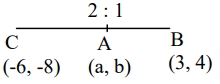
View full question & answer→MCQ 961 Mark
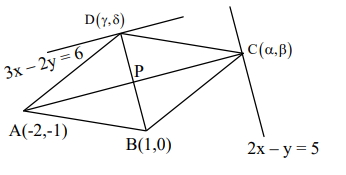
Let $\mathrm{A}(-2,-1), \mathrm{B}(1,0), \mathrm{C}(\alpha, \beta)$ and $\mathrm{D}(\gamma, \delta)$ be the vertices of a parallelogram $A B C D$. If the point $C$ lies on $2 x-y=5$ and the point $D$ lies on $3 x-2 y=6$, then the value of $|\alpha+\beta+\gamma+\delta|$ is equal to_____.
Answerc
$\mathrm{P} \equiv\left(\frac{\alpha-2}{2}, \frac{\beta-1}{2}\right) \equiv\left(\frac{\gamma+1}{2}, \frac{\delta}{2}\right) $
$ \frac{\alpha-2}{2}=\frac{\gamma+1}{2} \text { and } \frac{\beta-1}{2}=\frac{\delta}{2} $
$\Rightarrow \alpha-\gamma=3 \ldots . .(1), \beta-\delta=1 \ldots ....(2)$
Also, $(\gamma, \delta)$ lies on $3 x-2 y=6$
$3 \gamma-2 \delta=6$
and $(\alpha, \beta)$ lies on $2 x-y=5$
$\Rightarrow 2 \alpha-\beta=5 \text {......(4) }$
Solving $(1), (2), (3), (4)$
$\alpha=-3, \beta=-11, \gamma=-6, \delta=-12$
$|\alpha+\beta+\gamma+\delta|=32$
View full question & answer→MCQ 971 Mark
Let $A B C$ be an isosceles triangle in which $A$ is at $(-1,0), \angle A=\frac{2 \pi}{3}, A B=A C$ and $B$ is on the positive $\mathrm{x}$-axis. If $\mathrm{BC}=4 \sqrt{3}$ and the line $\mathrm{BC}$ intersects the line $y=x+3$ at $(\alpha, \beta)$, then $\frac{\beta^4}{\alpha^2}$ is :
Answerb
$\frac{\mathrm{c}}{\sin 30^{\circ}}=\frac{4 \sqrt{3}}{\sin 120^{\circ}}$ [By sine rule]
$2 c=8 \Rightarrow c=4$
$ \mathrm{AB}=|(\mathrm{b}+1)|=4 $
$ \mathrm{~b}=3, \mathrm{~m}_{\mathrm{AB}}=0 $
$ \mathrm{~m}_{\mathrm{BC}}=\frac{-1}{\sqrt{3}} $
$ B C:-y=\frac{-1}{\sqrt{3}}(x-3) $
$ \sqrt{3} \mathrm{y}+\mathrm{x}=3 $
$ \text { Point of intersection : } y=x+3, \sqrt{3} y+x=3 $
$ (\sqrt{3}+1) \mathrm{y}=6 $
$ \mathrm{y}=\frac{6}{\sqrt{3}+1} $
$ x=\frac{6}{\sqrt{3}+1}-3 $
$ =\frac{6-3 \sqrt{3}-3}{\sqrt{3}+1} $
$ =3 \frac{(1-\sqrt{3})}{(1+\sqrt{3})}=\frac{-6}{(1+\sqrt{3})^2} $
$ \frac{\beta^4}{\alpha^2}=36 $
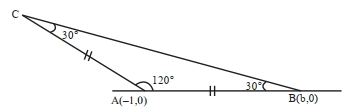
View full question & answer→MCQ 981 Mark
The vertices of a triangle are $\mathrm{A}(-1,3), \mathrm{B}(-2,2)$ and $\mathrm{C}(3,-1)$. $A$ new triangle is formed by shifting the sides of the triangle by one unit inwards. Then the equation of the side of the new triangle nearest to origin is :
AnswerCorrect option: C. $x+y-(2-\sqrt{2})=0$
c
$Image$
equation of $\mathrm{AC} \rightarrow \mathrm{x}+\mathrm{y}=2$
equation of line parallel to $\mathrm{AC} \mathrm{x}+\mathrm{y}=\mathrm{d}$
$ \left|\frac{\mathrm{d}-2}{\sqrt{2}}\right|=1 $
$ \mathrm{~d}=2-\sqrt{2}$
$\mathrm{eq}^{\mathrm{n}}$ of new required line
$x+y=2-\sqrt{2}$
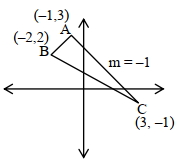
View full question & answer→MCQ 991 Mark
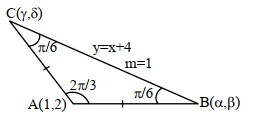
Consider a triangle $\mathrm{ABC}$ having the vertices $\mathrm{A}(1,2), \mathrm{B}(\alpha, \beta)$ and $\mathrm{C}(\gamma, \delta)$ and angles $\angle \mathrm{ABC}=\frac{\pi}{6}$ and $\angle \mathrm{BAC}=\frac{2 \pi}{3}$. If the points $\mathrm{B}$ and $\mathrm{C}$ lie on the line $\mathrm{y}=\mathrm{x}+4$, then $\alpha^2+\gamma^2$ is equal to....................
Answerd
Equation of line passes through point $\mathrm{A}(1,2)$ which makes angle $\frac{\pi}{6}$ from $y=x+4$ is
$ \mathrm{y}-2=\frac{1 \pm \tan \frac{\pi}{6}}{1 \mp \tan \frac{\pi}{6}}(\mathrm{x}-1) $
$ \mathrm{y}-2=\frac{\sqrt{3} \pm 1}{\sqrt{3} \mp 1}(\mathrm{x}-1)$
$\oplus$
$y-2=(2+\sqrt{3})(x-1) $
solve with $ y=x+4 $
$x+2=(2+\sqrt{3}) x-2-\sqrt{3} $
$x=\frac{4+\sqrt{3}}{1+\sqrt{3}}$
$\Theta$
$y-2=(2-\sqrt{3})(x-1)$
solve with $\mathrm{y}=\mathrm{x}+4$
$x+2=(2-\sqrt{3}) x-2+\sqrt{3} $
$x=\frac{4-\sqrt{3}}{1-\sqrt{3}}$
$ \alpha^2+\gamma^2=\left(\frac{4+\sqrt{3}}{1+\sqrt{3}}\right)^2+\left(\frac{4-\sqrt{3}}{1-\sqrt{3}}\right)^2 $
$ \alpha^2+\gamma^2=14$
View full question & answer→MCQ 1001 Mark
If the locus of the point, whose distances from the point $(2,1)$ and $(1,3)$ are in the ratio $5: 4$, is $a x^2+b y^2+c x y+d x+e y+170=0$, then the value of $\mathrm{a}^2+2 \mathrm{~b}+3 \mathrm{c}+4 \mathrm{~d}+\mathrm{e}$ is equal to:
Answerc
$ \text { let } P(x, y) $
$ \frac{(x-2)^2+(y-1)^2}{(x-1)^2+(y-3)^2}=\frac{25}{16} $
$ 9 x^2+9 y^2+14 x-118 y+170=0 $
$ a^2+2 b+3 c+4 d+e $
$ =81+18+0+56-118 $
$ =155-118 $
$ =37$
View full question & answer→MCQ 1011 Mark
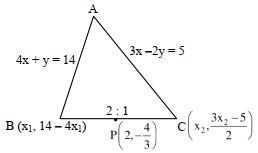
The equations of two sides $\mathrm{AB}$ and $\mathrm{AC}$ of a triangle $\mathrm{ABC}$ are $4 \mathrm{x}+\mathrm{y}=14$ and $3 \mathrm{x}-2 \mathrm{y}=5$, respectively. The point $\left(2,-\frac{4}{3}\right)$ divides the third side $\mathrm{BC}$ internally in the ratio $2: 1$. The equation of the side $\mathrm{BC}$ is :
- A
$x-6 y-10=0$
- B
$x-3 y-6=0$
- ✓
$x+3 y+2=0$
- D
$x+6 y+6=0$
AnswerCorrect option: C. $x+3 y+2=0$
c
$ \frac{2 x_2+x_1}{3}=2, \frac{2\left(\frac{3 x_2-5}{2}\right)+\left(14-4 x_1\right)}{3}=\frac{-4}{3} $
$ 2 x_2+x_1=6,3 x_2-4 x_1=-13 $
$ x_2=1, x_1=4$
So, $\mathrm{C}(1,-1), \mathrm{B}(4,-2)$
$\mathrm{m}=\frac{-1}{3}$
Equation of $B C: y+1=\frac{-1}{3}(x-1)$
$ 3 y+3=-x+1$
$ x+3 y+2=0$
View full question & answer→MCQ 1021 Mark
Let a rectangle $A B C D$ of sides $2$ and $4$ be inscribed in another rectangle $P Q R S$ such that the vertices of the rectangle $A B C D$ lie on the sides of the rectangle $P Q R S$. Let $a$ and $b$ be the sides of the rectangle $P Q R S$ when its area is maximum. Then $(a+b)^2$ is equal to :
Answera
$Image$
$ \text { Area }=(4 \cos \theta+2 \sin \theta)(2 \cos \theta+4 \sin \theta) $
$ =8 \cos ^2 \theta+16 \sin \theta \cos \theta+4 \sin \theta \cos \theta+8 \sin ^2 \theta $
$ =8+20 \sin \theta \cos \theta $
$ =8+10 \sin 2 \theta $
$ \text { Max Area }=8+10=18(\sin 2 \theta=1) \theta=45^{\circ} $
$ (a+b)^2=(4 \cos \theta+2 \sin \theta+2 \cos \theta+4 \sin \theta)^2 $
$ =(6 \cos \theta+6 \sin \theta)^2 $
$ =36(\sin \theta+\cos \theta)^2 $
$ =36(\sqrt{2})^2 $
$ =72$
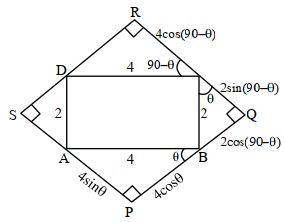
View full question & answer→MCQ 1031 Mark
Let two straight lines drawn from the origin $O$ intersect the line $3 x+4 y=12$ at the points $P$ and $\mathrm{Q}$ such that $\triangle \mathrm{OPQ}$ is an isosceles triangle and $\angle \mathrm{POQ}=90^{\circ}$. If $l=\mathrm{OP}^2+\mathrm{PQ}^2+\mathrm{QO}^2$, then the greatest integer less than or equal to $l$ is :
Answerc
$ 3 \mathrm{x}+4 \mathrm{y}=12 $
$ 3(\mathrm{r} \cos \theta)+4(\mathrm{r} \sin \theta)=12 $
$ \mathrm{r}(3 \cos \theta+4 \sin \theta)=12 \ldots(1) $
$ 3(-\mathrm{r} \sin \theta)+4(\mathrm{r} \cos \theta)=12 $
$ \mathrm{r}(-3 \sin \theta+4 \cos \theta)=12 \ldots(2) $
$ \left(\frac{12}{\mathrm{r}}\right)^2+\left(\frac{12}{\mathrm{r}}\right)^2=(3 \cos \theta+4 \sin \theta)^2+(-3 \sin \theta+4 \cos \theta)^2 $
$ 2\left(\frac{12}{\mathrm{r}}\right)^2=9+16 $
$ \frac{2 \times 144}{\mathrm{r}^2}=25 \Rightarrow 288=25 \mathrm{r}^2 $
$ \Rightarrow \frac{288}{25}=\mathrm{r}^2 $
$ \Rightarrow \sqrt{2}\left(\frac{12}{5}\right)=\mathrm{r} $
$ \ell=\mathrm{OP}^2+\mathrm{PQ}^2+\mathrm{QO} \mathrm{O}^2 $
$ \ell=\mathrm{r}^2+\mathrm{r}^2 \quad+\mathrm{r}^2(\cos \theta+\sin \theta)^2+\mathrm{r}^2(\sin \theta+\cos \theta)^2 $
$ =2 \mathrm{r}^2+\mathrm{r}^2(1+\sin 2 \theta+1-2 \sin 2 \theta) $
$ =2 \mathrm{r}^2+2 \mathrm{r}^2 $
$ =4 \mathrm{r}^2 $
$ =4\left(\frac{288}{25}\right)=\frac{1152}{25}=46.08 $
$ {[\ell]=46}$
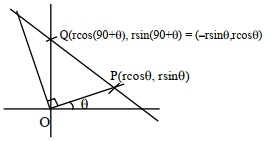
View full question & answer→MCQ 1041 Mark
A circle in inscribed in an equilateral triangle of side of length $12$. If the area and perimeter of any square inscribed in this circle are $\mathrm{m}$ and $\mathrm{n}$, respectively, then $m+n^2$ is equal to
Answerb
$\because r=\frac{\Delta}{s}=\frac{\sqrt{3} a^2}{4 \cdot \frac{3 a}{2}}=\frac{a}{2 \sqrt{3}}=\frac{12}{2 \sqrt{3}}=2 \sqrt{3}$
$Image$
$ \therefore A=r \sqrt{2}=2 \sqrt{6} $
Area $=m=A^2=24 $
Perimeter $=n=4 A=8 \sqrt{6} $
$ \therefore m+n^2=24+384 $
$ =408$
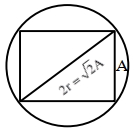
View full question & answer→MCQ 1051 Mark
Let a ray of light passing through the point $(3,10)$ reflects on the line $2 x+y=6$ and the reflected ray passes through the point $(7,2)$. If the equation of the incident ray is $a x+$ by $+1=0$, then $a^2+b^2+3 a b$ is equal to..................
Answerc
$\text { For } B^{\prime} \quad $$ \frac{x-7}{2}=\frac{y-2}{1}=-2\left(\frac{14+2-6}{5}\right) $
$ \frac{x-7}{2}=\frac{y-2}{1}=-4 $
$ x=-1 \quad y=-2 \quad B^{\prime}(-1,-2)$
incident ray $\mathrm{AB}^{\prime}$
$ \mathrm{M}_{\mathrm{AB}^{\prime}}=3 $
$ \mathrm{y}+2=3(\mathrm{x}+1) $
$ 3 \mathrm{x}-\mathrm{y}+1=0 $
$ \mathrm{a}=3 \mathrm{~b}=-1 $
$ \mathrm{a}^2+\mathrm{b}^2+3 \mathrm{ab}=9+1-9=1$
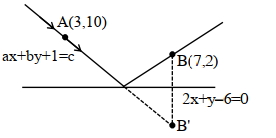
View full question & answer→MCQ 1061 Mark
A ray of light coming from the point $P(1,2)$ gets reflected from the point $\mathrm{Q}$ on the $\mathrm{x}$-axis and then passes through the point $R(4,3)$. If the point $S(h$, $\mathrm{k})$ is such that $\mathrm{PQRS}$ is a parallelogram, then $\mathrm{hk}^2$ is equal to :
Answerd
Image of $\mathrm{P}$ wrt $\mathrm{x}$-axis will be $\mathrm{P}^{\prime}(1,-2)$ equation of line joining P'R will be
$\mathrm{y}-3=\frac{5}{3}(\mathrm{x}-4)$
Above line will meet $\mathrm{x}$-axis at $\mathrm{Q}$ where
$ \mathrm{y}=0 \Rightarrow \mathrm{x}=\frac{11}{5} $
$ \therefore \mathrm{Q}\left(\frac{11}{5}, 0\right)$
$\because \mathrm{PQRS}$ is parallelogram so their diagonals will bisects each other
$ \Rightarrow \frac{4+1}{2}=\frac{\frac{11}{5}+h}{2} \& \frac{2+3}{2}=\frac{\mathrm{k}+0}{2} $
$ \Rightarrow \mathrm{h}=\frac{14}{5} \& \mathrm{k}=5 $
$ \therefore \mathrm{hk}^2=\frac{14}{5} \times 5^2=70$
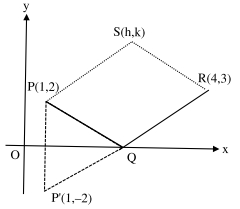
View full question & answer→MCQ 1071 Mark
Two vertices of a triangle $\mathrm{ABC}$ are $\mathrm{A}(3,-1)$ and $\mathrm{B}(-2,3)$, and its orthocentre is $\mathrm{P}(1,1)$. If the coordinates of the point $\mathrm{C}$ are $(\alpha, \beta)$ and the centre of the circle circumscribing the triangle $\mathrm{PAB}$ is $(h, k)$, then the value of $(\alpha+\beta)+2(h+k)$ equals :
Answerc
$\mathrm{M}_{\mathrm{AB}}=\frac{4}{-5} \Rightarrow \mathrm{M}_{\mathrm{DP}}=\frac{5}{4}$
Equation of $PC$ is $y-1=\frac{5}{4}(x-1)$...............($1$)
$\mathrm{M}_{\mathrm{AP}}=\frac{2}{-2}=-1 \Rightarrow \mathrm{M}_{\mathrm{BC}}=+1$
Equation of $\mathrm{BC}$ is $\mathrm{y}-3=(\mathrm{x}+2)$............($2$)
On solving ($1$) and ($2$)
$ x+4=\frac{5}{4}(x-1) \Rightarrow 4 x+16=5 x-5 \Rightarrow \alpha=21 $
$ \Rightarrow \beta=y=x+5=26 $
$ \alpha+\beta=47$
Equation of $\perp$ bisector of $AP$
$y-0=(x-2) $................($3$)
Equation of $\perp$ bisector of $A B$
$\mathrm{y}-1=\frac{5}{4}\left(\mathrm{x}-\frac{1}{2}\right)$.................($4$)
On solving ($3$) & ($4$)
$ (x-3) 4=5 x-\frac{5}{2} $
$ x=\frac{-19}{2}=h $
$ y=\frac{-23}{2}=k $
$ \Rightarrow 2(h+k)=-42$
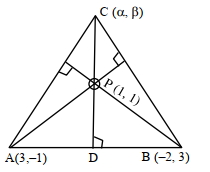
View full question & answer→MCQ 1081 Mark
The straight lines $l_1$ and $l_2$ pass through the origin and trisect the line segment of the line $L: 9 x+5 y=$ 45 between the axes. If $m_1$ and $m_2$ are the slopes of the lines $l_1$ and $1_2$,then the point of intersection of the line $y =\left( m _1+ m _2\right) x$ with $L$ lies on
- A
$6 x + y =10$
- B
$6 x-y=15$
- ✓
$y-x=5$
- D
$y-2 x=5$
AnswerCorrect option: C. $y-x=5$
c
$m _{ L _1}=\frac{3.3}{10}=\frac{9}{10}$
$m _{ L _2}=\frac{6.3}{5}=\frac{18}{5}$
$y =\left( m _1+ m _2\right) x$
$y =\frac{9}{2} x$
Point of intersection with $L$ is $\left(\frac{10}{7}, \frac{45}{7}\right)$
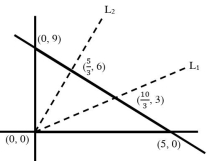
View full question & answer→MCQ 1091 Mark
A light ray emits from the origin making an angle $30^{\circ}$ with the positive $x$-axis. After getting reflected by the line $x + y =1$, if this ray intersects $x$-axis at $Q$, then the abscissa of $Q$ is
AnswerCorrect option: B. $\frac{2}{3+\sqrt{3}}$
b
Slope of reflected ray $=\tan 60^{\circ}=\sqrt{3}$
Line $y=\frac{x}{\sqrt{3}}$ intersect $y+x=1$ at $\left(\frac{\sqrt{3}}{\sqrt{3}+1}, \frac{1}{\sqrt{3}+1}\right)$
Equation of reflected ray is
$y-\frac{1}{\sqrt{3}+1}=\sqrt{3}\left(x-\frac{\sqrt{3}}{\sqrt{3}+1}\right)$
Put $y=0 \Rightarrow x=\frac{2}{3+\sqrt{3}}$
View full question & answer→MCQ 1101 Mark
A triangle is formed by $X -$ axis, $Y$ - axis and the line $3 x+4 y=60$. Then the number of points $P ( a, b)$ which lie strictly inside the triangle, where $a$ is an integer and $b$ is a multiple of $a$, is $...........$
Answera
If $x=1, y=\frac{57}{4}=14.25$
$(1,1)(1,2)-(1,14) \quad \Rightarrow 14$ pts.
If $x =2, y =\frac{27}{2}=13.5$
$(2,2)(2,4) \ldots(2,12) \quad \Rightarrow 6$ pts.
If $x=3, y=\frac{51}{4}=12.75$
$(3,3)(3,6)-(3,12) \quad \Rightarrow 4$ pts.
If $x=4, y=12$
$(4,4)(4,8) \quad \Rightarrow 2$ pts.
If $x=5 . y=\frac{45}{4}=11.25$
$(5,5),(5,10) \quad \Rightarrow 2$ pts.
If $x=6, y=\frac{21}{2}=10.5$
$(6,6) \quad \Rightarrow 1 pt$.
If $x=7, y=\frac{39}{4}=9.75$
$(7,7) \quad \Rightarrow 1 pt$.
If $x=8, y=9$
$(8,8) \quad \Rightarrow 1 pt$.
If $x =9 y =\frac{33}{4}=8.25 \Rightarrow$ no pt.
Total $=31$ pts.
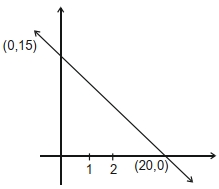
View full question & answer→MCQ 1111 Mark
Let $B$ and $C$ be the two points on the line $y+x=0$ such that $B$ and $C$ are symmetric with respect to the origin. Suppose $A$ is a point on $y -2 x =2$ such that $\triangle ABC$ is an equilateral triangle. Then, the area of the $\triangle ABC$ is
- A
$3 \sqrt{3}$
- B
$2 \sqrt{3}$
- ✓
$\frac{8}{\sqrt{3}}$
- D
$\frac{10}{\sqrt{3}}$
AnswerCorrect option: C. $\frac{8}{\sqrt{3}}$
c
At A $x=y$
$Y-2 x=2$
$(-2,-2)$
Height from line $x + y =0$
$h=\frac{4}{\sqrt{2}}$
Area of $\Delta=\frac{\sqrt{3}}{4} \frac{ h ^2}{\sin ^2 60}=\frac{8}{\sqrt{3}}$
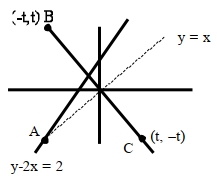
View full question & answer→MCQ 1121 Mark
A straight line cuts off the intercepts $OA = a$ and $OB = b$ on the positive directions of $x$-axis and $y -$ axis respectively. If the perpendicular from origin $O$ to this line makes an angle of $\frac{\pi}{6}$ with positive direction of $y$-axis and the area of $\triangle OAB$ is $\frac{98}{3} \sqrt{3}$, then $a ^2- b ^2$ is equal to:
- ✓
$\frac{392}{3}$
- B
$196$
- C
$\frac{196}{3}$
- D
$98$
AnswerCorrect option: A. $\frac{392}{3}$
a
Equation of straight line : $\frac{ x }{ a }+\frac{ y }{ b }=1$
Or $x \cos \frac{\pi}{3}+y \sin \frac{\pi}{3}=p$
$\frac{x}{2}+\frac{y \sqrt{3}}{2}=p$
$\frac{x}{3 p}+\frac{y}{2 p}=1$
Comparing both $: a =2 p , b =\frac{2 p }{\sqrt{3}}$
Now area of $\triangle OAB =\frac{1}{2} \cdot ab =\frac{98}{3} \cdot \sqrt{3}$
$\frac{1}{2} \cdot 2 p \cdot \frac{2 p }{\sqrt{3}}=\frac{98}{3} \cdot \sqrt{3}$
$p^2=49$
$a^2-b^2=4 p^2-\frac{4 p^2}{3}=\frac{2}{3} 4 p^2$
$=\frac{8}{3} \cdot 49=\frac{392}{3}$
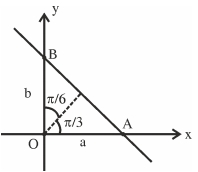
View full question & answer→MCQ 1131 Mark
Let the equations of two adjacent sides of a parallelogram $A B C D$ be $2 x-3 y=-23$ and $5 x+4 y$ $=23$. If the equation of its one diagonal $AC$ is $3 x +$ $7 y=23$ and the distance of A from the other diagonal is $d$, then $50 d ^2$ is equal to $........$.
Answerc
$A$ and $C$ point will be $(-4,5)$ and $(3,2)$ mid point of $AC$ will be $\left(-\frac{1}{2}, \frac{7}{2}\right)$ equation of diagonal $BD$ is
$y-\frac{7}{2}=\frac{\frac{7}{2}}{-\frac{1}{2}} \quad\left(x+\frac{1}{2}\right)$
$7 x+y=0$
Distance of $A$ from diagonal $BD$
$= d =\frac{23}{\sqrt{50}}$
$50 d ^2=(23)^2$
$50 d ^2=529$
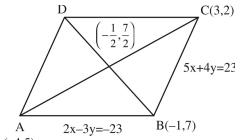
View full question & answer→MCQ 1141 Mark
If the point $\left(\alpha, \frac{7 \sqrt{3}}{3}\right)$ lies on the curve traced by the mid-points of the line segments of the lines $x$ $\cos \theta+ y \sin \theta=7, \theta \in\left(0, \frac{\pi}{2}\right)$ between the coordinates axes, then $\alpha$ is equal to
- ✓
$7$
- B
$-7$
- C
$-7 \sqrt{3}$
- D
$7 \sqrt{3}$
Answera
$\operatorname{pt}\left(\alpha, \frac{7 \sqrt{3}}{3}\right)$
$x -\text { intercept }=\frac{7}{\cos \theta}$
$y -\text { intercept }=\frac{7}{\sin \theta}$
$A:\left(\frac{7}{\cos \theta}, 0\right) B :\left(0, \frac{7}{\sin \theta}\right)$
Locus of mid pt $M :( h , k )$
$h =\frac{7}{2 \cos \theta}, k =\frac{7}{2 \sin \theta}$
$\frac{7}{2 \sin \theta}=\frac{7 \sqrt{3}}{3} \Rightarrow \sin \theta=\frac{\sqrt{3}}{2} \Rightarrow \theta=\frac{\pi}{3}$
$\alpha=\frac{7}{2 \cos \theta}=7$
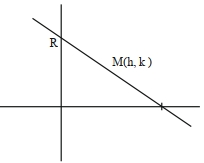
View full question & answer→MCQ 1151 Mark
If the line $l_1: 3 y -2 x =3$ is the angular bisector of the lines $l_2: x - y +1=0$ and $l_3: \alpha x +\beta y +17=0$, then $\alpha^2+\beta^2-\alpha-\beta$ is equal to
Answera
Sol. Point of intersection of $\ell_1: 3 y -2 x =3$
$\ell_2: x - y +1=0 \text { is } P \equiv(0,1)$
Which lies on $\ell_3: \alpha x +\beta y +17=0$,
$\Rightarrow \beta=-17$
Consider a random point $Q \equiv(-1,0)$ on $\ell_2: x - y +1=0$, image of $Q$ about
$\ell_2: x-y+1=0 \quad$ is $\quad Q^{\prime} \equiv\left(\frac{-17}{13}, \frac{6}{13}\right)$
which is calculated by formulae
$\frac{x-(-1)}{2}=\frac{y-0}{-3}=-2\left(\frac{-2+3}{13}\right)$
Now, $Q^{\prime}$ lies on $\ell_3: \alpha x +\beta y +17=0$
$\Rightarrow \alpha=7$
Now, $\alpha^2+\beta^2-\alpha-\beta=348$
View full question & answer→MCQ 1161 Mark
Consider the triangles with vertices $A (2,1) B (0,0)$ and $C ( t , 4), t \in[0,4]$. It the maximum and the minimum perimeters of such triangles are obtained at $t=\alpha$ and $t=\beta$ respectively, then $6 \alpha+21 \beta$ is equal to $.........$.
Answera
$A (2,1), B (0,0), C ( t , 4): t \in[0,4]$
$B _1(0,8) \equiv \text { image of } B \text { w.r.t. } y=4$
for $AC + BC + AB$ to be minimum.
$m _{ AB ^{\prime}}=\frac{-7}{2}$
$\text { line } AB _1 \equiv 7 x +2 y =16$
$C\left(\frac{8}{7}, 4\right)$
$\beta=\frac{8}{7}$
For max. perimeter
$AB =\sqrt{5}: BC =4 \sqrt{2}, AC =\sqrt{13}$
$6 \alpha+21 \beta=24+24=48$
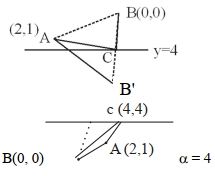
View full question & answer→MCQ 1171 Mark
Let the point $(p, p+1)$ lie inside the region $E=\left\{(x, y): 3-x \leq y \leq \sqrt{9-x^2}, 0 \leq x \leq 3\right\}$ If the set of all values of $p$ is the interval $(a, b)$. then $b^2+b-a^2$ is equal to $.................$.
Answerd
$3-x \leq y \leq \sqrt{9-x^2}$
Points $( p , p +1)$ lies on $y = x +1$
So point of intersection between
$y = x +1 y =3- x \text { is } x =1, y =2$
and point of intersection between
$x+1=\sqrt{9-x^2}$ is $x=\frac{-1+\sqrt{17}}{2}$
Hence $p \in\left(1, \frac{-1+\sqrt{17}}{2}\right)$
Hence $b ^2+ b - a ^2=3$
View full question & answer→MCQ 1181 Mark
The distance between the two points $A$ and $A ^{\prime}$ which lie on $y =2$ such that both the line segments $AB$ and $A ^{\prime} B$ (where $B$ is the point $(2,3)$ ) subtend angle $\frac{\pi}{4}$ at the origin, is equal to
- A
$10$
- B
$\frac{48}{5}$
- ✓
$\frac{52}{5}$
- D
$3$
AnswerCorrect option: C. $\frac{52}{5}$
c
$M_{1}=3 / 2 \quad M_{2}=2 / x$
$\tan \pi / 4=\left|\frac{3 / 2-2 / x}{1+6 / 2 x}\right|=1$
$\Rightarrow x_{1}=10, \quad x_{2}=-2 / 5$
$\Rightarrow AA ^{1}=52 / 5$
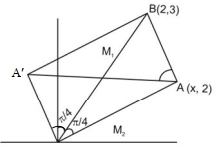
View full question & answer→MCQ 1191 Mark
A line, with the slope greater than one, passes through the point $A (4,3)$ and intersects the line $x -$ $y-2=0$ at the point $B$. If the length of the line segment $AB$ is $\frac{\sqrt{29}}{3}$, then $B$ also lies on the line..
- A
$2 x+y=9$
- B
$3 x -2 y =7$
- ✓
$x+2 y=6$
- D
$2 x-3 y=3$
AnswerCorrect option: C. $x+2 y=6$
c
Let $B\left(x_{1}, x_{1}-2\right)$
$\sqrt{\left(x_{1}-4\right)^{2}+\left(x_{1}-2-3\right)^{2}}=\frac{\sqrt{29}}{3}$
Squaring on both side
$18 x_{1}^{2}-162 x_{1}+340=0$
$x_{1}=\frac{51}{9} \text { or } x_{1}=\frac{10}{3}$ $y_{1}=\frac{33}{9} \text { or } y_{1}=\frac{4}{3}$
Option $(C)$ will satisfy $\left(\frac{10}{3}, \frac{4}{3}\right)$
View full question & answer→MCQ 1201 Mark
Let a triangle be bounded by the lines $L _{1}: 2 x +5 y =10$; $L _{2}:-4 x +3 y =12$ and the line $L _{3}$, which passes through the point $P (2,3)$, intersect $L _{2}$ at $A$ and $L _{1}$ at $B$. If the point $P$ divides the line-segment $A B$, internally in the ratio $1: 3$, then the area of the triangle is equal to
- A
$\frac{110}{13}$
- ✓
$\frac{132}{13}$
- C
$\frac{142}{13}$
- D
$\frac{151}{13}$
AnswerCorrect option: B. $\frac{132}{13}$
b
Points $A$ lies on $L _{2}$
$A \left(\alpha, 4+\frac{4}{3} \alpha\right)$
Points $B$ lies on $L _{1}$
$B \left(\beta, 2-\frac{2}{5} \beta\right)$
Points $P$ divides $AB$ internally in the ratio $1: 3$
$\Rightarrow P(2,3)=P\left(\frac{3 \alpha+\beta}{4}, \frac{3\left(4+\frac{4}{3} \alpha\right)+1\left(2-\frac{2}{5} \beta\right)}{4}\right)$
$\Rightarrow \alpha=\frac{3}{13}, \beta=\frac{95}{13}$
Point $A \left(\frac{3}{13}, \frac{56}{13}\right), B \left(\frac{95}{13},-\frac{12}{13}\right)$
Vertex $C$ of triangle is the point of intersection of $L _{1} and L _{2}$
$\Rightarrow C \left(-\frac{15}{13}, \frac{32}{13}\right)$
area $\triangle ABC =\frac{1}{2}\left\|\begin{array}{ccc}\frac{3}{13} & \frac{56}{13} & 1 \\ \frac{95}{13} & -\frac{12}{13} & 1 \\ -\frac{15}{13} & \frac{32}{13} & 1\end{array}\right\|$
$\frac{1}{2 \times 13^{3}}\left\|\begin{array}{ccc} 3 & 56 & 13 \\ 95 & -12 & 13 \\ -15 & 32 & 13 \end{array}\right\|$
area $\triangle ABC =\frac{132}{13}$ sq. units.
View full question & answer→MCQ 1211 Mark
Let the circumcentre of a triangle with vertices $A ( a , 3), B ( b , 5)$ and $C ( a , b ), ab >0$ be $P (1,1)$. If the line $AP$ intersects the line $BC$ at the point $Q \left( k _{1}, k _{2}\right)$, then $k _{1}+ k _{2}$ is equal to.
- A
$2$
- ✓
$\frac{4}{7}$
- C
$\frac{2}{7}$
- D
$4$
AnswerCorrect option: B. $\frac{4}{7}$
b
$m _{ AC } \longrightarrow \infty$
$m _{ PD }=0$
$D \left(\frac{ a + a }{2}, \frac{ b +3}{2}\right)$
$D \left( a , \frac{ b +3}{2}\right)$
$m _{ PD }=0$
$\frac{ b +3}{2}-1=0$
$b +3-2=0$
$b =-1$
$E \left(\frac{ b + a }{2}, \frac{5+ b }{2}\right)=\left(\frac{ af }{2}, 2\right)$
$m_{C B} \cdot m_{E P}=-1$
$\left(\frac{5-b}{b-a}\right)=\left(\frac{2-1}{\frac{a-1}{2}-1}\right)=-1$
$\left(\frac{6}{-1-a}\right)=\left(\frac{2}{a-3}\right)=-1$
$12=(1+a)(a-3)$
$12=a^{2}-3 a+a-3$
$a^{2}-2 a-15=0$
$(a-5)(a+3)=0$
$a=5$ or $a=-3$
Given $a b > 0$
$a (-1) > 0$
$- a > 0$
$a < 0$
$a=-3$ Accept
AP line $A (-3,3) P (1,1)$
$y-1=\left(\frac{3-1}{-3-1}\right)(x-1)$
$-2 y+2=x-1$
$x+2 y=3 \quad$ Appling $\ldots . .(1)$
Line $BC B(-1,5)$
$C (-3,-1)$
$( y -5)=\frac{6}{2}( x +1)$
$y-5=3 x+3$
$y=3 x+8$
Solving (1) \& (2)
$x+2(3 x+8)=3$
$7 x+16=3$
$7 x=-13$
$x=-\frac{13}{7}$
$y=3\left(-\frac{13}{7}\right)+8$
$=\frac{-39+56}{7}$
$y=\frac{17}{7}$
$x+y=\frac{-13+17}{7}=\frac{4}{7}$
View full question & answer→MCQ 1221 Mark
Let the point $P(\alpha, \beta)$ be at a unit distance from each of the two lines $L_{1}: 3 x-4 y+12=0$, and $L _{2}: 8 x+6 y+11=0$. If $P$ lies below $L _{1}$ and above $L_{2}$, then $100(\alpha+\beta)$ is equal to
Answerd
$L_{1}: 3 x-4 y+12=0$
$L_{2}: 8 x+6 y+11=0$
Equation of angle bisector of $L_{1}$ and $L_{2}$ of angle containing origin
$2(3 x-4 y+12)=8 x+6 y+11$
$2 x+14 y-13=04$
$\frac{3 \alpha-4 \beta+12}{5}=14$
$3 \alpha-4 \beta+7=0$
Solution of $2 x+14 y-13=0$ and $3 x-4 y+7=0$ gives the required point $P(\alpha, \beta), \alpha=\frac{-23}{25}, \beta=\frac{53}{50}$
$100(\alpha+\beta)=14$
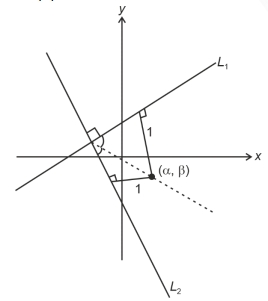
View full question & answer→MCQ 1231 Mark
A ray of light passing through the point $P (2,3)$ reflects on the $x-$axis at point $A$ and the reflected ray passes through the point $Q(5,4)$. Let $R$ be the point that divides the line segment $AQ$ internally into the ratio $2: 1$. Let the co-ordinates of the foot of the perpendicular $M$ from $R$ on the bisector of the angle $PAQ$ be $(\alpha, \beta)$. Then, the value of $7 \alpha+3 \beta$ is equal to.......
Answera
By observation we see that $A (\alpha, 0)$.
And $\beta= y$-cordinate of $R$
$=\frac{2 \times 4+1 \times 0}{2+1}=\frac{8}{3} \ldots(1)$
Now $P'$ is image of $P$ in $y =0$ which will be $P ^{\prime}(2,-3)$
Equation of $P ^{\prime} Q$ is $( y +3)=\frac{4+3}{5-2}( x -2)$
i.e. $3 y +9=7 x -14$
$A \equiv\left(\frac{23}{7}, 0\right)$ by solving with $y =0$
$\therefore \alpha=\frac{23}{7}.........(2)$
By $(1), \,\,(2)$
$7 \alpha+3 \beta=23+8=31$
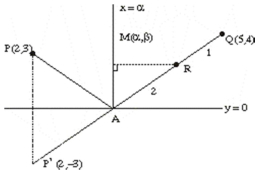
View full question & answer→MCQ 1241 Mark
Let $m_{1}, m_{2}$ be the slopes of two adjacent sides of a square of side a such that $a^{2}+11 a+3\left(m_{2}^{2}+m_{2}^{2}\right)=220$. If one vertex of the square is $(10(\cos \alpha-\sin \alpha), 10(\sin \alpha+\cos \alpha))$, where $\alpha \in\left(0, \frac{\pi}{2}\right)$ and the equation of one diagonal is $(\cos \alpha-\sin \alpha) x +(\sin \alpha+\cos \alpha) y =10$, then $72 \left(\sin ^{4} \alpha+\cos ^{4} \alpha\right)+a^{2}-3 a+13$ is equal to.
Answerb
$m_{1} m_{2}=-1$
$a^{2}+11 a+3\left(m_{1}^{2}+\frac{1}{m_{1}^{2}}\right)=220$
Eq. of $AC$
$AC =(\cos \alpha-\sin \alpha)+(\sin \alpha+\cos \alpha) y =10$
$BD =(\sin \alpha-\cos \alpha) x +(\sin \alpha-\cos \alpha) y =0$
$(10(\cos \alpha-\sin \alpha), 10(\sin \alpha-\cos \alpha))$
$\text { Slope of } AC =\left(\frac{\sin \alpha-\cos \alpha}{\sin \alpha+\cos \alpha}\right)=\tan \theta= M$
Eq. of line making an angle $\pi_{4}$ with $AC$
$m _{1}, m _{2}=\frac{ m \pm tan }{1 \pm m \operatorname{ta}}$
$=\frac{ m +1}{1- m }$ or $\frac{ m -1}{1+ m }$
$\frac{\frac{\sin \alpha-\cos \alpha}{\sin \alpha+\cos \alpha}+1}{1-\left(\frac{\sin \alpha-\cos \alpha}{\sin \alpha+\cos \alpha}\right)}, \frac{\frac{\sin \alpha-\cos \alpha}{\sin \alpha+\cos \alpha}-1}{1+\frac{\sin \alpha-\cos \alpha}{\sin \alpha+\cos \alpha}}$
$m_{1}, m_{2}=\tan \alpha, \cot \alpha$
mid point of $AC \& BD$
$= M (5(\cos \alpha-\sin \alpha), 5(\cos \alpha+\sin \alpha))$
$B (10(\cos \alpha-\sin \alpha), 10(\cos \alpha+\sin \alpha))$
$a = AB =\sqrt{2} BM =\sqrt{2}(5 \sqrt{2})=10$
$a =10$
$\because a^{2}+11 a+3\left(m_{1}^{2}+\frac{1}{m_{1} 2}\right)=220$
$100+110+3\left(\tan ^{2} \alpha+\cot ^{2} \alpha\right)=220$
Hence $\tan ^{2} \alpha=3, \tan ^{2} \alpha=\frac{1}{3} \Rightarrow \alpha=\frac{\pi}{3}$ or $\frac{\pi}{6}$
Now $72\left(\sin ^{4} \alpha+\cos ^{4} \alpha\right)+a^{2}-3 a+13$
$=72\left(\frac{9}{16}+\frac{1}{16}\right)+100-30+13$
$=72\left(\frac{5}{8}\right)+83=45+83=128$
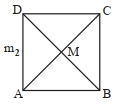
View full question & answer→MCQ 1251 Mark
The image of the point $(3,5)$ in the line $x-y+1=0$, lies on
- A
$(x-2)^{2}+(y-2)^{2}=12$
- B
$(x-4)^{2}+(y+2)^{2}=16$
- C
$(x-4)^{2}+(y-4)^{2}=8$
- ✓
$(x-2)^{2}+(y-4)^{2}=4$
AnswerCorrect option: D. $(x-2)^{2}+(y-4)^{2}=4$
d
$\frac{x-3}{1}=\frac{y-5}{-1}=-2\left(\frac{3-5+1}{1+1}\right)$
So, $x=4, y=4$
Hence, $(x-2)^{2}+(y-4)^{2}=4$
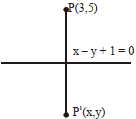
View full question & answer→MCQ 1261 Mark
A man is walking on a straight line. The arithmetic mean of the reciprocals of the intercepts of this line on the coordinate axes is $\frac{1}{4}$. Three stones $A , B$ and $C$ are placed at the points $(1,1),(2,2)$ and $(4,4)$ respectively. Then which of these stones is $/$ are on the path of the man ?
- A
$A$ only
- B
માત્ર $C$
- C
- ✓
$B$ only
AnswerCorrect option: D. $B$ only
d
Let the line be $y=m x+c$
$x-$intercept : $-\frac{ c }{ m }$
$y-$intercept : $C$
$A.M$ of reciprocals of the intercepts :
$\frac{-\frac{ m }{ c }+\frac{1}{ c }}{2}=\frac{1}{4} \Rightarrow 2(1- m )= c$
line $: y=m x+2(1-m)=c$
$\Rightarrow \quad(y-2)-m(x-2)=0$
$\Rightarrow$ line always passes through $(2,2)$
View full question & answer→MCQ 1271 Mark
The intersection of three lines $x-y=0, x+2 y=3$ and $2 x+y=6$ is a
Answerc
$L_{1}: x-y=0$
$L_{2}: x+2 y=3$
$L _{3}: x + y =6$
on solving $L _{1}$ and $L _{2}$ :
$y = L$ and $x =1$
$L _{1}$ and $L _{3}$ :
$x=2$
$y=2$
$L _{2}$ and $L _{3}$ :
$x+y=3$
$2 x+y=6$
$x =3$
$y =0$
$AC =\sqrt{4+1}=\sqrt{5}$
$BC =\sqrt{4+1}=\sqrt{5}$
$AB =\sqrt{1+1}=\sqrt{2}$
so its an isosceles triangle
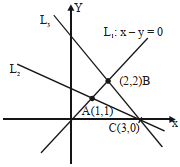
View full question & answer→MCQ 1281 Mark
If $\mathrm{p}$ and $\mathrm{q}$ are the lengths of the perpendiculars from the origin on the lines,
$x \operatorname{cosec} \alpha-y \sec \alpha=\operatorname{kcot} 2 \alpha$ and $x \sin \alpha+y \cos \alpha=k \sin 2 \alpha$
respectively, then $\mathrm{k}^{2}$ is equal to :
- ✓
$4 \mathrm{p}^{2}+\mathrm{q}^{2}$
- B
$2 \mathrm{p}^{2}+\mathrm{q}^{2}$
- C
$\mathrm{p}^{2}+2 \mathrm{q}^{2}$
- D
$\mathrm{p}^{2}+4 \mathrm{q}^{2}$
AnswerCorrect option: A. $4 \mathrm{p}^{2}+\mathrm{q}^{2}$
a
First line is $\frac{\mathrm{x}}{\sin \alpha}-\frac{\mathrm{y}}{\cos \alpha}=\frac{\mathrm{k} \cos 2 \alpha}{\sin 2 \alpha}$
$\Rightarrow x \cos \alpha-\operatorname{ysin} \alpha=\frac{\mathrm{k}}{2} \cos 2 \alpha$
$\Rightarrow \mathrm{p}=\left|\frac{\mathrm{k}}{2} \cos \alpha\right| \Rightarrow 2 \mathrm{p}=|\mathrm{k} \cos 2 \alpha| \quad \ldots(i)$
second line is $x\, \sin \alpha+y \,\cos \alpha=\operatorname{k\,sin} 2 \alpha$
$\Rightarrow \mathrm{q}=|\mathrm{k\,sin} 2 \alpha|\ldots(ii)$
Hence $4 \mathrm{p}^{2}+\mathrm{q}^{2}=\mathrm{k}^{2}$ (From $(i)\, \&\, (ii))$
View full question & answer→MCQ 1291 Mark
Let the points of intersections of the lines $x-y+1=0$, $x-2 y+3=0$ and $2 x-5 y+11=0$ are the mid points of the sides of a triangle $A B C$. Then the area of the triangle $\mathrm{ABC}$ is .... .
Answerd
intersection point of give lines are $(1,2),(7,5)$, $(2,3)$
$\Delta=\frac{1}{2}\left|\begin{array}{lll}1 & 2 & 1 \\ 7 & 5 & 1 \\ 2 & 3 & 1\end{array}\right|$
$=\frac{1}{2}[1(5-3)-2(7-2)+1(21-10)]$
$=\frac{1}{2}[2-10+11]$
$\Delta \mathrm{DEF}=\frac{1}{2}(3)=\frac{3}{2}$
$\Delta \mathrm{ABC}=4 \Delta \mathrm{DEF}=4\left(\frac{3}{2}\right)=6$
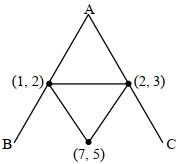
View full question & answer→MCQ 1301 Mark
Two sides of a parallelogram are along the lines $4 x+5 y=0$ and $7 x+2 y=0$. If the equation of one of the diagonals of the parallelogram is $11 \mathrm{x}+7 \mathrm{y}=9$, then other diagonal passes through the point:
- A
$(1,3)$
- B
$(1,2)$
- ✓
$(2,2)$
- D
$(2,1)$
AnswerCorrect option: C. $(2,2)$
c
Both the lines pass through origin.
point $D$ is equal of intersection of $4 x+5 y=0\, \,11 x+7 y=9$
So, coordinates of point $D=\left(\frac{5}{3},-\frac{4}{3}\right)$
Also, point $B$ is point of intersection of $7 x+2 y=0\, \, 11 x+7 y=9$
So, coordinates of point $B=\left(-\frac{2}{3}, \frac{7}{3}\right)$
diagonals of parallelogram intersect at middle let middle point of $B,D$
$\Rightarrow\left(\frac{\frac{5}{3}-\frac{2}{3}}{2}, \frac{-4}{3}+\frac{7}{3}\right)=\left(\frac{1}{2}, \frac{1}{2}\right)$
equation of diagonal $AC$
$\Rightarrow(y-0)=\frac{\frac{1}{2}-0}{\frac{1}{2}-0}(x-0)$
$y=x$
diagonal $AC$ passes through $(2,2)$
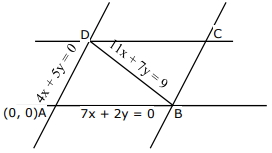
View full question & answer→MCQ 1311 Mark
For $p\,>\,0$, a vector $\vec{v}_{2}=2 \hat{i}+(p+1) \hat{j}$ is obtained by rotating the vector $\vec{v}_{1}=\sqrt{3} p \hat{i}+\hat{j}$ by an angle $\theta$ about origin in counter clockwise direction. If $\tan \theta=\frac{(\alpha \sqrt{3}-2)}{4 \sqrt{3}+3}$, then the value of $\alpha$ is equal to $....$
Answera
$\left|\vec{V}_{1}\right|=\left|\overrightarrow{\mathrm{V}}_{2}\right|$
$3 \mathrm{P}^{2}+1=4+(\mathrm{P}+1)^{2}$
$2 \mathrm{P}^{2}-2 P-4=0$
$\Rightarrow \mathrm{P}^{2}-\mathrm{P}-2=0$
$\mathrm{P}=2,-1$ (rejected)
$\cos \theta=\frac{\overline{V}_{1} \cdot \vec{V}_{2}}{\left|\overrightarrow{\mathrm{V}}_{1}\right| \cdot \overrightarrow{\mathrm{V}_{2}} \mid}$
$\cos \theta=\frac{4 \sqrt{3}+3}{\sqrt{13} \sqrt{13}}=\frac{4 \sqrt{3}+3}{13}$
$\tan \theta=\frac{\sqrt{112-24 \sqrt{3}}}{4 \sqrt{3}+\sqrt{3}}=\frac{6 \sqrt{3}-2}{4 \sqrt{3}+3}=\frac{\alpha \sqrt{3}-2}{4 \sqrt{3}+3}$
$\Rightarrow \alpha=6$
View full question & answer→MCQ 1321 Mark
The equation of one of the straight lines which passes through the point $(1,3)$ and makes an angles $\tan ^{-1}(\sqrt{2})$ with the straight line, $y+1=3 \sqrt{2} x$ is
- ✓
$4 \sqrt{2} x+5 y-(15+4 \sqrt{2})=0$
- B
$5 \sqrt{2} x +4 y -(15+4 \sqrt{2})=0$
- C
$4 \sqrt{2} x+5 y-4 \sqrt{2}=0$
- D
$4 \sqrt{2} x-5 y-(5+4 \sqrt{2})=0$
AnswerCorrect option: A. $4 \sqrt{2} x+5 y-(15+4 \sqrt{2})=0$
a
$y=m x+c$
$3= m + c$
$\sqrt{2}=\left|\frac{m-3 \sqrt{2}}{1+3 \sqrt{2} m}\right|$
$=6 m+\sqrt{2}=m-3 \sqrt{2}$
$=\sin =-4 \sqrt{2} \rightarrow m =\frac{-4 \sqrt{2}}{5}$
$=6 m-\sqrt{2}=m-3 \sqrt{2}$
$=7 m -2 \sqrt{2} \rightarrow m =\frac{2 \sqrt{2}}{7}$
According to options take $m =\frac{-4 \sqrt{2}}{5}$
So $y=\frac{-4 \sqrt{2} x}{5}+\frac{3+4 \sqrt{2}}{5}$
$4 \sqrt{2} x+5 y-(15+4 \sqrt{2})=0$
View full question & answer→MCQ 1331 Mark
Let $\mathrm{ABC}$ be a triangle with $\mathrm{A}(-3,1)$ and $\angle \mathrm{ACB}=\theta, 0<\theta<\frac{\pi}{2} .$ If the equation of the median through $\mathrm{B}$ is $2 \mathrm{x}+\mathrm{y}-3=0$ and the equation of angle bisector of $\mathrm{C}$ is $7 \mathrm{x}-4 \mathrm{y}-1=0$ then $\tan\, \theta$ is equal to:
- A
$\frac{1}{2}$
- B
$\frac{3}{4}$
- ✓
$\frac{4}{3}$
- D
$2$
AnswerCorrect option: C. $\frac{4}{3}$
c
$\therefore \quad \mathrm{M}\left(\frac{\mathrm{a}-3}{2}, \frac{\mathrm{b}+1}{2}\right)$ lies on $2 \mathrm{x}+\mathrm{y}-3=0$
$\Rightarrow 2 \mathrm{a}+\mathrm{b}=11 \ldots \ldots \ldots . . (i)$
$\because \mathrm{C}$ lies on $7 \mathrm{x}-4 \mathrm{y}=1$
$\Rightarrow 7 \mathrm{a}-4 \mathrm{~b}=1 \quad \ldots \ldots (ii)$
$\therefore$ by $(i)$ and $(ii) :$ $\mathrm{a}=3, \mathrm{~b}=5$
$\Rightarrow \mathrm{C}(3,5)$
$\therefore \quad \mathrm{m}_{\mathrm{AC}}=2 / 3$
Also, $m_{C D}=7 / 4$
$\Rightarrow \tan \frac{\theta}{2}=\left|\frac{\frac{2}{3}-\frac{4}{4}}{1+\frac{14}{12}}\right| \Rightarrow \tan \frac{\theta}{2}=\frac{1}{2}$
$\Rightarrow \tan \theta=\frac{2 \cdot \frac{1}{2}}{1-\frac{1}{4}}=\frac{4}{3}$
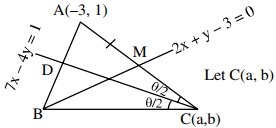
View full question & answer→MCQ 1341 Mark
Let $\mathrm{A}$ be a fixed point $(0,6)$ and $\mathrm{B}$ be a moving point $(2 \mathrm{t}, 0)$. Let $\mathrm{M}$ be the mid-point of $\mathrm{AB}$ and the perpendicular bisector of $\mathrm{AB}$ meets the $\mathrm{y}$-axis at $\mathrm{C}$. The locus of the mid-point $\mathrm{P}$ of $\mathrm{MC}$ is :
AnswerCorrect option: C. $2 \mathrm{x}^{2}+3 \mathrm{y}-9=0$
c
$\mathrm{A}(0,6)$ and $\mathrm{B}(2 \mathrm{t}, 0)$
Perpendicular bisector of $\mathrm{AB}$ is
$(y-3)=\frac{t}{3}(x-t)$
So, $C=\left(0,3-\frac{t^{2}}{3}\right)$
Let $\mathrm{P}$ be $(\mathrm{h}, \mathrm{k})$
$\mathrm{h}=\frac{\mathrm{t}}{2} ; \mathrm{k}=\left(3-\frac{\mathrm{t}^{2}}{6}\right)$
$\Rightarrow \mathrm{k}=3-\frac{4 \mathrm{~h}^{2}}{6} \Rightarrow 2 \mathrm{x}^{2}+3 \mathrm{y}-9=0$
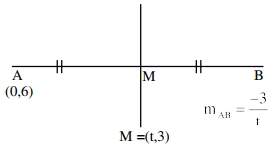
View full question & answer→MCQ 1351 Mark
Let $\mathrm{A}$ be the set of all points $(\alpha, \beta)$ such that the area of triangle formed by the points $(5,6),(3,2)$ and $(\alpha, \beta)$ is $12\, square\, units.$ Then the least possible length of a line segment joining the origin to a point in $A,$ is :
- A
$\frac{4}{\sqrt{5}}$
- B
$\frac{16}{\sqrt{5}}$
- ✓
$\frac{8}{\sqrt{5}}$
- D
$\frac{12}{\sqrt{5}}$
AnswerCorrect option: C. $\frac{8}{\sqrt{5}}$
c
$\left|\frac{1}{2}\right| \begin{array}{lll}5 & 6 & 1 \\ 3 & 2 & 1 \\ \alpha & \beta & 1\end{array}||=12$
$4 \alpha-2 \beta=\pm 24+8$
$\Rightarrow 4 \alpha-2 \beta=+24+8 \Rightarrow 2 \alpha-\beta=16$
$2 \mathrm{x}-\mathrm{y}-16=0...(1)$
$\Rightarrow 4 \alpha-2 \beta=-24+8 \Rightarrow 2 \alpha-\beta=-8$
$2 \mathrm{x}-\mathrm{y}+8=0...(2)$
perpendicular distance of $(1)$ from $(0,0)$
$\left|\frac{0-0-16}{\sqrt{5}}\right|=\frac{16}{\sqrt{5}}$
perpendicular distance of $(2)$ from $(0,0)$ is
$\left|\frac{0-0+8}{\sqrt{5}}\right|=\frac{8}{\sqrt{5}}$
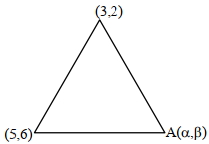
View full question & answer→MCQ 1361 Mark
Consider a triangle having vertices $A(-2,3), B(1,9)$ and $C(3,8)$. If a line $L$ passing through the circum-center of triangle $\mathrm{ABC}$, bisects line $\mathrm{BC}$, and intersects $\mathrm{y}$-axis at point $\left(0, \frac{\alpha}{2}\right)$, then the value of real number $\alpha$ is $.....$
Answerc
$(\sqrt{50})^{2}=(\sqrt{45})^{2}+(\sqrt{5})^{2}$
$\angle \mathrm{B}=90^{\circ}$
$\text { Circum-center }=\left(\frac{1}{2}, \frac{11}{2}\right)$
Mid point of $B C=\left(2, \frac{17}{2}\right)$
Line $:\left(y-\frac{11}{2}\right)=2\left(x-\frac{1}{2}\right) \Rightarrow y=2 x+\frac{9}{2}$
Passing through $\left(0, \frac{\alpha}{2}\right)$
$\frac{\alpha}{2}=\frac{9}{2} \Rightarrow \alpha=9$
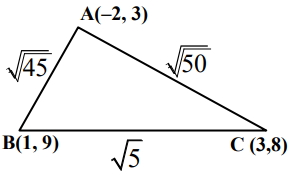
View full question & answer→MCQ 1371 Mark
If the line, $2 x-y+3=0$ is at a distance $\frac{1}{\sqrt{5}}$ and $\frac{2}{\sqrt{5}}$ from the lines $4 x-2 y+\alpha=0$ and $6 x-3 y+\beta=0,$ respectively, then the sum of all possible values of $\alpha$ and $\beta$ is
Answerb
Apply distance between parallel line formula $4 x-2 y+\alpha=0$
$4 x-2 y+6=0$
$\left|\frac{\alpha-6}{255}\right|=\frac{1}{55}$
$|\alpha-6|=2 \Rightarrow \alpha=8,4$
$\operatorname{sum}=12$
again $6 x-3 y+\beta=0$
$6 x-3 y+9=0$
$\left|\frac{\beta-9}{3 \sqrt{5}}\right|=\frac{2}{\sqrt{5}}$
$|\beta-9|=6 \Rightarrow \beta=15,3$
$\operatorname{sum}=18$
sum of all values of $\alpha$ and $\beta$ is $=30$
View full question & answer→MCQ 1381 Mark
If the perpendicular bisector of the line segment joining the points $P (1,4)$ and $Q ( k , 3)$ has $y$- intercept equal to $-4,$ then a value of $k$ is
- A
$\sqrt{15}$
- B
$-2$
- C
$\sqrt{14}$
- ✓
$-4$
Answerd
Slope $= m =\frac{1}{1- k }$
Equation of $\perp^{ r }$ bisector is
$y+4=(k-1)(x-0)$
$\Rightarrow y +4= x ( k -1)$
$\Rightarrow \frac{7}{2}+4=\frac{ k +1}{2}( k -1)$
$\Rightarrow \frac{15}{2}=\frac{ k ^{2}-1}{2} \Rightarrow k ^{2}=16 \Rightarrow k =4,-4$
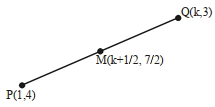
View full question & answer→MCQ 1391 Mark
The set of all possible values of $\theta$ in the interval $(0, \pi)$ for which the points $(1,2)$ and $(\sin \theta,$ $\cos \theta)$ lie on the same side of the line $x+y= 1$ is
- A
$\left(0, \frac{\pi}{4}\right)$
- B
$\left(0, \frac{3 \pi}{4}\right)$
- C
$\left(\frac{\pi}{4}, \frac{3 \pi}{4}\right)$
- ✓
$\left(0, \frac{\pi}{2}\right)$
AnswerCorrect option: D. $\left(0, \frac{\pi}{2}\right)$
d
Given that both points (1,2)$\&(\sin \theta, \cos \theta)$ lie on same side of the line $x+y-1=0$
So, $($ Put $(1,2)$ in given line $)(\operatorname{Put}(\sin \theta, \cos \theta)$ in given line$)>0$
$\Rightarrow(1+2-1)(\sin \theta+\cos \theta-1)>0$
$\Rightarrow \sin \theta+\cos \theta>1\{\div \operatorname{by} \sqrt{2}\}$
$\Rightarrow \frac{1}{\sqrt{2}} \sin \theta+\frac{1}{\sqrt{2}} \cos \theta>\frac{1}{\sqrt{2}}$
$\Rightarrow \quad \sin \left(\theta+\frac{\pi}{4}\right)>\frac{1}{\sqrt{2}}$
$\Rightarrow \frac{\pi}{4}<\theta+\frac{\pi}{4}<\frac{3 \pi}{4}$
$\Rightarrow \quad 0<\theta<\frac{\pi}{2}$
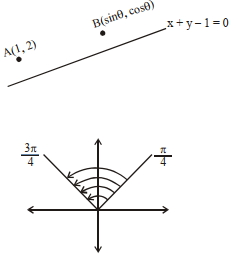
View full question & answer→MCQ 1401 Mark
Let $L$ denote the line in the $xy$-plane with $x$ and $y$ intercepts as $3$ and $1$ respectively. Then the image of the point $(-1,-4)$ in this line is
- A
$\left(\frac{8}{5}, \frac{29}{5}\right)$
- B
$\left(\frac{29}{5}, \frac{11}{5}\right)$
- ✓
$\left(\frac{11}{5}, \frac{28}{5}\right)$
- D
$\left(\frac{29}{5}, \frac{8}{5}\right)$
AnswerCorrect option: C. $\left(\frac{11}{5}, \frac{28}{5}\right)$
c
$L: \frac{x}{3}+\frac{y}{1}=1 \Rightarrow x+3 y-3=0$
Image of point (-1,-4)
$\frac{x+1}{1}=\frac{y+4}{3}=-2\left(\frac{-1-12-3}{10}\right)$
$\frac{x+1}{1}=\frac{y+4}{3}=\frac{16}{5}$
$( x , y ) \equiv\left(\frac{11}{5}, \frac{28}{5}\right)$
View full question & answer→MCQ 1411 Mark
The locus of the mid-points of the perpendiculars drawn from points on the line, $\mathrm{x}=2 \mathrm{y}$ to the line $\mathrm{x}=\mathrm{y}$ is
- A
$2 x-3 y=0$
- B
$7 x-5 y=0$
- ✓
$5 x-7 y=0$
- D
$3 x-2 y=0$
AnswerCorrect option: C. $5 x-7 y=0$
c
$\frac{\alpha-\beta}{2 \alpha-\beta}=-1$
$3 \alpha=2 \beta$
$\mathrm{h}=\frac{2 \alpha+\beta}{2}$
$2 \mathrm{h}=\frac{7 \alpha}{2}$
$\mathrm{k}=\frac{\alpha+\beta}{2}$
$2 \mathrm{k}=\frac{5 \alpha}{2}$
$\frac{\mathrm{h}}{\mathrm{k}}=\frac{7}{5}$
$5 x=7 y$
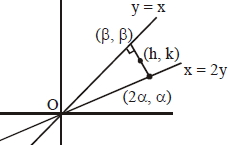
View full question & answer→MCQ 1421 Mark
Let two points be $\mathrm{A}(1,-1)$ and $\mathrm{B}(0,2) .$ If a point $\mathrm{P}\left(\mathrm{x}^{\prime}, \mathrm{y}^{\prime}\right)$ be such that the area of $\Delta \mathrm{PAB}=5\; \mathrm{sq}$ units and it lies on the line, $3 x+y-4 \lambda=0$ then a value of $\lambda$ is
Answerc
$\overline{A B}: 3 x+y-2=0$
Also, $\frac{1}{2} \times \sqrt{10} \times h=5$
$\Rightarrow h=\sqrt{10}$
$\Rightarrow \frac{|4 \lambda-2|}{\sqrt{10}}=\sqrt{10} \Rightarrow \lambda=3,-2$
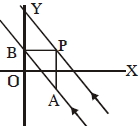
View full question & answer→MCQ 1431 Mark
Let $\mathrm{C}$ be the centroid of the triangle with vertices $(3,-1),(1,3)$ and $(2,4) .$ Let $P$ be the point of intersection of the lines $x+3 y-1=0$ and $3 \mathrm{x}-\mathrm{y}+1=0 .$ Then the line passing through the points $\mathrm{C}$ and $\mathrm{P}$ also passes through the point
- A
$(7, 6)$
- ✓
$(-9, -6)$
- C
$(-9, -7)$
- D
$(9, 7)$
AnswerCorrect option: B. $(-9, -6)$
b
Centroid of $\Delta=(2,2)$
line passing through intersection of $x+3 y-1=0$ and
$3 x-y+1=0,$ be given by
$(x+3 y-1)+\lambda(3 x-y+1)=0$
$\because$ It passes through $(2,2)$
$\Rightarrow \quad 7+5 \lambda=0 \Rightarrow \lambda=-\frac{7}{5}$
$\therefore \quad$ Required line is $8 x-11 y+6=0$
$(-9,-6)$ satisfies this equation
View full question & answer→MCQ 1441 Mark
A ray of light coming from the point $(2,2 \sqrt{3})$ is incident at an angle $30^{\circ}$ on the line $x=1$ at the point $A$. The ray gets reflected on the line $x =1$ and meets $x$ -axis at the point $B$. Then, the line $AB$ passes through the point
- A
$\left(3,-\frac{1}{\sqrt{3}}\right)$
- ✓
$(3,-\sqrt{3})$
- C
$\left(4,-\frac{\sqrt{3}}{2}\right)$
- D
$(4,-\sqrt{3})$
AnswerCorrect option: B. $(3,-\sqrt{3})$
b
For point A
$\tan 60^{\circ}=\frac{2 \sqrt{3}- k }{2-1}$
$\sqrt{3}=2 \sqrt{3}- k$
$\therefore \quad k=\sqrt{3}$
so point $A (1, \sqrt{3})$
Now slope of line $AB$ is $m _{ AB }=\tan 120^{\circ}$
$m m _{ AB }=-\sqrt{3}$
Now equation of line $AB$ is
$y-\sqrt{3}=-\sqrt{3}(x-1)$
$\sqrt{3} x+y=2 \sqrt{3}$
Now satisfy options
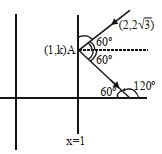
View full question & answer→MCQ 1451 Mark
If the straight line, $2x -3y + 17 = 0$ is perpendicular to the line passing through the points $(7, 17)$ and $(15, \beta )$, then $\beta $ equals:
- A
$\frac{35}{3}$
- B
$-5$
- C
$-\frac{35}{3}$
- ✓
$5$
Answerd
Line perpendicular to $2x-3y+5=0$ is $3x+2y+c=0$
Which is satisified by point $(7,17)$
$ \Rightarrow 3\left( 7 \right) + 2\left( {17} \right) + c = 0$
$ \Rightarrow c = - 55$
$ \Rightarrow $ equation of line is $3x+2y-55=0$
$ \Rightarrow 3\left( {15} \right) + 2\left( \beta \right) - 55 = 0$
$ \Rightarrow 2\beta = 55 - 45 \Rightarrow \beta = 5$
View full question & answer→MCQ 1461 Mark
A point on the straight line, $3x + 5y = 15$ which is equidistant from the coordinate, axes will lie only in
AnswerCorrect option: D. $1^{st}$ and $2^{nd}$ quadrants
d
Now, $\left| {\frac{{15 - 3t}}{5}} \right| = \left| t \right|$
$ \Rightarrow \frac{{15 - 3t}}{5} = t\,\,$ or $\frac{{15 - 3t}}{5} = - t$
$\therefore t = \frac{{15}}{8}\,$ or $t = \frac{{ - 15}}{2}$
So, $P\left( {\frac{{15}}{8}.\frac{{15}}{8}} \right) \in {I^{st}}$ quadrant
or $P\left( {\frac{{ - 15}}{2}.\frac{{15}}{2}} \right) \in I{I^{st}}$ Quadrant
View full question & answer→MCQ 1471 Mark
If the two lines $x + \left( {a - 1} \right)\,y = 1$ and $2x + {a^2}y = 1\,\left( {a \in R - \left\{ {0,1} \right\}} \right)$ are perpendicular, then the distance of their point of intersection from the origin is
- A
$\frac{2}{5}$
- B
$\frac{{\sqrt 2 }}{5}$
- C
$\frac{2}{{\sqrt 5 }}$
- ✓
$\sqrt {\frac{2}{5}} $
AnswerCorrect option: D. $\sqrt {\frac{2}{5}} $
d
Two lines are perpendicular
$\therefore {m_1}{m_2} = - 1$
$ \Rightarrow \left( {\frac{{ - 1}}{{a - 1}}} \right)\left( {\frac{{ - 2}}{{{a^2}}}} \right) = - 1$
$ \Rightarrow {a^3} - {a^2} + 2 = 0$
$ \Rightarrow \left( {a + 1} \right)\left( {{a^2} - 2a + 2} \right) = 0$
$\therefore a = - 1$
So line are $\left. \begin{array}{l}
{L_1}:x - 2y + 1 = 0\\
{L_2}:2x + y - 1 = 0
\end{array} \right\}$
Solving these equation we get point of intersection
$P\left( {\frac{1}{5},\frac{3}{6}} \right)$
Now distance of $P$ from origin
$OP = \sqrt {\frac{1}{{25}} + + \frac{9}{{25}}} = \sqrt {\frac{2}{5}} $
View full question & answer→MCQ 1481 Mark
Lines are drawn parallel to the line $4x -3y + 2 = 0$ at a distance $\frac {3}{5}$ from the origin. Then which one of the following points lies on any of these lines?
- ✓
$\left( { - \frac{1}{4},\frac{2}{3}} \right)$
- B
$\left( { \frac{1}{4},\frac{1}{3}} \right)$
- C
$\left( { \frac{1}{4},-\frac{1}{3}} \right)$
- D
$\left( { - \frac{1}{4}, - \frac{2}{3}} \right)$
AnswerCorrect option: A. $\left( { - \frac{1}{4},\frac{2}{3}} \right)$
a
Required line is $4x - 3y + \lambda = 0$
$\left| {\frac{\lambda }{5}} \right| = \frac{3}{5}$
$ \Rightarrow \lambda \pm 3$
So, required equation of the line is
$4x - 3y + 3 = 0$ and $4x - 3y - 3 = 0$
$\left( 1 \right)\,4\left( { - \frac{1}{4}} \right) - 3\left( {\frac{2}{3}} \right) + 3 = 0$
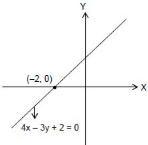
View full question & answer→MCQ 1491 Mark
Consider the set of all lines $px + qy + r = 0$ such that $3p + 2q + 4r = 0$ . Which one of the following statements is true?
AnswerCorrect option: A. The lines are concurrent at the point $\left( {\frac{3}{4},\frac{1}{2}} \right)$
a
$px + qy + r = 0$
$px + qy + \left( {\frac{{ - 3p - 2q}}{4}} \right) = 0$
$p\left( {x - \frac{3}{4}} \right) + q\left( {y - \frac{2}{4}} \right) = 0$
$x = \frac{3}{4}\,\,$ and $y = \frac{1}{2}$
View full question & answer→MCQ 1501 Mark
Let the equation of two sides of a triangle be $3x\,-\,2y\,+\,6\,=\,0$ and $4x\,+\,5y\,-\,20\,=\,0.$ If the orthocentre of this triangle is at $(1, 1),$ then the equation of its third side is
- A
$122y\, - \,26x\, - 1675\, = \,0$
- B
$26x\, + \,61y\, + \,1675\, = \,0$
- C
$122y\, + \,26x\, + 1675\, = \,0$
- ✓
$26x\, - \,122y\, - \,1675\, = \,0$
AnswerCorrect option: D. $26x\, - \,122y\, - \,1675\, = \,0$
d
Equation of $AB$ is $3x-2y+6=0$
Equation of $AC$ is $4x+5y-20=0$.
Equation of $BE$ is $2x+3y-5=0$
Equation of $CF$ is $5x-4y-1=0$
$ \Rightarrow $ Equation of $BC$ is
$26x-122y=1675$
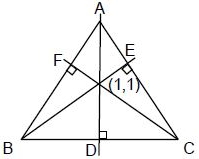
View full question & answer→MCQ 1511 Mark
A point $P$ moves on the line $2x -3y + 4 = 0$. If $Q(1, 4)$ and $R(3, -2)$ are fixed points, then the locus of the centroid of $\Delta PQR$ is a line
- A
with slope $\frac{3}{2}$
- B
parallel to $x-$ axis
- ✓
with slope $\frac{2}{3}$
- D
parallel to $y-$ axis
AnswerCorrect option: C. with slope $\frac{2}{3}$
c
Let point $P$ is $\left( {\alpha ,\beta } \right)\,$ and center of $\Delta PQR$ is $(h,k)$, then $3h = \alpha + 1 + 3\,\,$ and $3k = \beta + 4 - 2$
$ \Rightarrow \alpha = 3h - 4$ and $\beta = 3k - 2$
Because $\left( {\alpha ,\beta } \right)$ lies on $2x-3y+4=0$
$ \Rightarrow 2\left( {3h - 4} \right) - 3\left( {k - 2} \right) + 4 = 0$
$ \Rightarrow $ losus is $6x-9y+2=0$ whose slope is $\frac{2}{3}$
View full question & answer→MCQ 1521 Mark
If the line $3x + 3y -24 = 0$ intersects the $x-$ axis at the point $A$ and the $y-$ axis at the point $B$, then the incentre of the triangle $OAB$, where $O$ is the origin, is
- A
$(3, 4)$
- ✓
$(2, 2)$
- C
$(4, 3)$
- D
$(4, 4)$
AnswerCorrect option: B. $(2, 2)$
b
$I = \left( {\frac{{a{x_1} + b{x_2} + c{x_3}}}{{a + b + c}},\frac{{a{y_1} + b{y_2} + c{y_3}}}{{a + b + c}}} \right)$
$ = \left( {\frac{{8\left( {60} \right) + 6\left( 0 \right) + 10\left( 0 \right)}}{{24}},\frac{{10\left( 0 \right) + 6\left( 8 \right) + 8\left( 0 \right)}}{{24}}} \right) = \left( {2,2} \right)$
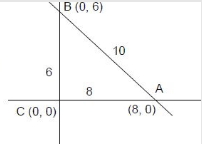
View full question & answer→MCQ 1531 Mark
Two sides of a parallelogram are along the lines, $x + y = 3$ and $x -y + 3 = 0$. If its diagonals intersect at $(2, 4)$, then one of its vertex is
- A
$(3, 5)$
- B
$(2, 1)$
- C
$(2, 6)$
- ✓
$(3, 6)$
AnswerCorrect option: D. $(3, 6)$
d
Intersection point is $A(0,3)$
$M=(4,6)$
$B \Rightarrow \left( {1,2} \right),D \to \left( {3,6} \right)$
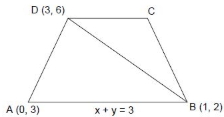
View full question & answer→MCQ 1541 Mark
If in a parallelogram $ABDC$, the coordinates of $A, B$ and $C$ are respectively $(1, 2), (3, 4)$ and $(2, 5)$, then the equation of the diagonal $AD$ is
- ✓
$5x - 3y +1 = 0$
- B
$5x + 3y -11 = 0$
- C
$3x - 5y + 7 = 0$
- D
$3x + 5y -13 = 0$
AnswerCorrect option: A. $5x - 3y +1 = 0$
a
$E$ is $\left( {\frac{5}{2},\frac{9}{2}} \right)$
Slope of $AD = \frac{5}{3}$
Equation of $AD$ is $y - 2 = \frac{5}{3}\left( {x - 1} \right)$
$ \Rightarrow 5x - 3y + 1 = 0$
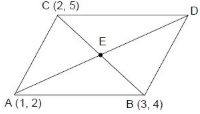
View full question & answer→MCQ 1551 Mark
The shortest distance between the point $\left( {\frac{3}{2},0} \right)$ and the curve $y = \sqrt x ,\left( {x > 0} \right)$, is
- ✓
$\frac{{\sqrt 5 }}{2}$
- B
$\frac{{\sqrt 3 }}{2}$
- C
$\frac{3}{2}$
- D
$\frac{5}{4}$
AnswerCorrect option: A. $\frac{{\sqrt 5 }}{2}$
a
Let $P$ be the point nearest to $\left( {\frac{3}{2},0} \right)$, then normal
at $P$ will pass through $\left( {\frac{3}{2},0} \right)$.
Let Co-ordinates of $P$ be $s\left( {\frac{{{t^2}}}{4},\frac{t}{2}} \right)$
Hence equation of normal is $y + tx = \frac{t}{2} + \frac{{{t^2}}}{4}$
The line passes through $\left( {\frac{3}{2},0} \right)$
$\frac{{3{t^2}}}{2} = \frac{t}{2} + \frac{{{t^3}}}{4} \Rightarrow t = 2$ ($-2,0$ are rejected)
hence nearest point is $(1,1)$
distance $\sqrt {{{\left( {\frac{3}{2} - 1} \right)}^2} + {{\left( {1 - 0} \right)}^2}} = \frac{{\sqrt 5 }}{2}$
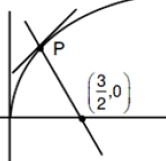
View full question & answer→MCQ 1561 Mark
If a straight line passing through the point $P(-3, 4)$ is such that its intercepted portion between the coordinate axes is bisected at $P,$ then its equation is
- A
$3x-4y+25=0$
- ✓
$4x-3y+24=0$
- C
$x-y+7=0$
- D
$4x+3y=0$
AnswerCorrect option: B. $4x-3y+24=0$
b
Let the line be $\frac{x}{a} + \frac{y}{b} = 1$
$\left( { - 3,4} \right) = \left( {\frac{a}{2},\frac{b}{2}} \right)$
$a=-6, b=8$
equation of line is
$4x-3y+24=0$
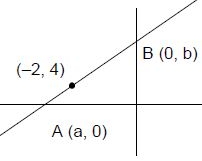
View full question & answer→MCQ 1571 Mark
Suppose that the points $(h, k), (1, 2)$ and $(-3, 4)$ lie on the line $L_1$. If a line $L_2$ passing through the points $(h, k)$ and $(4, 3)$ is perpendicular to $L_1$, then $\frac{k}{h}$ equals
- A
$-\frac{1}{7}$
- ✓
$\frac{1}{3}$
- C
$3$
- D
$0$
AnswerCorrect option: B. $\frac{1}{3}$
b
equation of ${L_1}$ is $x + 2y = 5$ and equation
or ${L_2}$ is $2x - y = 5$
Their point of intersection is $(3,1)$
$ \Rightarrow \frac{k}{h} = \frac{1}{3}$
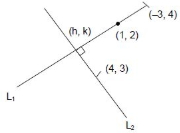
View full question & answer→MCQ 1581 Mark
Slope of a line passing through $P(2, 3)$ and intersecting the line, $x + y = 7$ at a distance of $4$ units from $P,$ is
- A
$\frac{{\sqrt 5 - 1}}{{\sqrt 5 + 1}}$
- B
$\frac{{1 - \sqrt 5 }}{{1 + \sqrt 5 }}$
- C
$\frac{{\sqrt 7 - 1}}{{\sqrt 7 + 1}}$
- ✓
$\frac{{1 - \sqrt 7 }}{{1 + \sqrt 7 }}$
AnswerCorrect option: D. $\frac{{1 - \sqrt 7 }}{{1 + \sqrt 7 }}$
d
$x = 2 + r\,\cos \theta $
$y = 3 + r\,\sin \theta $
$ \Rightarrow 2 + r\,\cos \theta + 3 + r\,\sin \theta = 7$
$ \Rightarrow r\left( {\cos \theta + \,\sin \theta } \right) = 2$
$ \Rightarrow \sin \theta + \cos \theta = \frac{2}{r} = \frac{2}{{ \pm 4}} = \pm \frac{1}{2}$
$ \Rightarrow 1 + \sin \,2\theta = \frac{1}{4}$
$ \Rightarrow \sin \,2\theta = - \frac{3}{4}$
$ \Rightarrow \frac{{2m}}{{1 + {m^2}}} = - \frac{3}{4}$
$ \Rightarrow 3{m^2} + 8m + 3 = 0$
$ \Rightarrow m = \frac{{ - 4 \pm \sqrt 7 }}{{1 - 7}}$
$\frac{{1 - \sqrt 7 }}{{1 + \sqrt 7 }} = \frac{{{{\left( {1 - \sqrt 7 } \right)}^2}}}{{1 - 7}} = \frac{{8 - 2\sqrt 7 }}{{ - 6}} = \frac{{ - 4 + \sqrt 7 }}{3}$
View full question & answer→MCQ 1591 Mark
The equation $y = \sin \,x\,\sin \,\left( {x + 2} \right) - {\sin ^2}\,\left( {x + 1} \right)$ represents a straight line lying in
- A
first, third and fourth quadrants
- B
first, second and fourth quadrants
- ✓
third and fourth quadrants only
- D
second and third quadrants only
AnswerCorrect option: C. third and fourth quadrants only
c
$2y = 2\,\sin \,x\,\sin \,\left( {x + 2} \right) - \,{\sin ^2}\left( {x + 1} \right)$
$2y = \cos \,2 - \cos \,\left( {2x + 2} \right) - \,\left( {1 - \cos \left( {2x + 2} \right)} \right)$
$ = \cos \,2 - 1$
$2y = - 2{\sin ^2}\frac{1}{2}$
$y = - {\sin ^2}\frac{1}{2} \le 0$
View full question & answer→MCQ 1601 Mark
A straight line $L$ at a distance of $4$ units from the origin makes positive intercepts on the coordinate axes and the perpendicular from the origin to this line makes an angle of $60^o$ with the line $x + y = 0$. Then an equation of the line $L$ is
AnswerCorrect option: D. $\left( {\sqrt 3 + 1} \right)x + \left( {\sqrt 3 - 1} \right)y = 8\sqrt 2 $
d
$OP = 4$
given $OP$ makes ${60^o}$ with $x+y=0$
Let slope of $OP=m$
$ \Rightarrow \tan \,{60^o} = \left| {\frac{{m + 1}}{{1 - m}}} \right|$
$ \Rightarrow \frac{{m + 1}}{{1 - m}} = \sqrt 3 $ or $ - \sqrt 3 $
$m + 1 = \sqrt {3m} - 3$ or $ \Rightarrow m + 1 = \sqrt {3 - } \sqrt {3m} $
$ \Rightarrow m\left( {\sqrt 3 - 1} \right) = \sqrt 3 + 1$ or $m\left( {1 + \sqrt 3 } \right) = \sqrt 3 - 1$
$ \Rightarrow m = \frac{{\sqrt 3 + 1}}{{\sqrt 3 - 1}}$ or $\,\,m = \frac{{\sqrt 3 - 1}}{{\sqrt 3 + 1}}$
$ \Rightarrow \tan \,\alpha = \frac{{\sqrt 3 + 1}}{{\sqrt 3 - 1}}\,\,$ or $\tan \,\alpha = \frac{{\sqrt 3 - 1}}{{\sqrt 3 + 1}}$
$ \Rightarrow $ equation of line $x\,\cos \,\alpha + y\,\sin \,\alpha = P$
$ \Rightarrow \left( {\sqrt 3 + 1} \right)x + \left( {\sqrt 3 - 1} \right)y = 8\sqrt 2 $ or $\left( {\sqrt 3 - 1} \right)x + \left( {\sqrt 3 + 1} \right)y = 8\sqrt 2 $
View full question & answer→MCQ 1611 Mark
A straight the through a fixed point $(2, 3)$ intersects the coordinate axes at distinct points $P$ and $Q.$ If $O$ is the origin and the rectangle $OPRQ$ is completed, then the locus of $R$ is:
- A
$2x + 3y = xy$
- ✓
$3x + 2y = xy$
- C
$3x + 2y = 6xy$
- D
$3x + 2y = 6$.
AnswerCorrect option: B. $3x + 2y = xy$
b
Equation of $PQ$ is
$\frac{x}{h} + \frac{y}{k} = 1\,\,\,\,\,\,\,......\left( 1 \right)$
Since, $(1)$ passes through the fixed point $(2,3)$ Then,
$\frac{2}{h} + \frac{3}{k} = 1\,$
Then, the locus of $R$ is $\frac{2}{x} + \frac{3}{y} = 1$ or $3x + 2y = xy$.
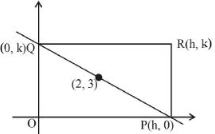
View full question & answer→MCQ 1621 Mark
In a triangle $ABC$, coordianates of $A$ are $(1, 2)$ and the equations of the medians through $B$ and $C$ are $x + y = 5$ and $x = 4$ respectively. Then area of $\Delta ABC$ (in sq. units) is
Answerb
Median through $C$ is $x=4$
So the $x$ coordianate of $C$ is $4$. let $C \equiv \left( {4,y} \right)$
then the midpoint of $A(1,2)$ and $C(4,y)$ is $D$
which lies on the median through $B$.
$D \equiv \left( {\frac{{1 + 4}}{2},\frac{{2 + y}}{2}} \right)$
Now, $\frac{{1 + 4 + 2 + y}}{2} = 5 \Rightarrow y = 3$
So, $C \equiv \left( {4,3} \right)$.
The centroid of the triangle is the intersection of the mesians. Here the medians $x=4$ and $x+4$ and $x+y=5$ intersect
at $G(4,1)$.
The area of triangle $\Delta ABC = 3 \times \Delta AGC$
$ = 3 \times \frac{1}{2}\left[ {1\left( {1 - 3} \right) + 4\left( {3 - 2} \right) + 4\left( {2 - 1} \right)} \right] = 9$
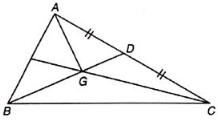
View full question & answer→MCQ 1631 Mark
The sides of a rhombus $ABCD$ are parallel to the lines, $x - y + 2\, = 0$ and $7x - y + 3\, = 0$. If the diagonals of the rhombus intersect at $P( 1, 2)$ and the vertex $A$ ( different from the origin) is on the $y$ axis, then the ordinate of $A$ is
- A
$2$
- B
$\frac{7}{4}$
- C
$\frac{7}{2}$
- ✓
$\frac{5}{2}$
AnswerCorrect option: D. $\frac{5}{2}$
d
Let the coordinate $A$ be $(0,c)$
Equations of the given lines are
$x-y+2=0$
$7x-y+3=0$
we know that the diagonals of the rhombus will be parallel to the angle bisectors of the two given lines; $y=x+2$ and $y=7x+3$
$\therefore $ equation of angle bisectors is given as:
$\frac{{x - y + 2}}{{\sqrt 2 }} = \pm \frac{{7x - y + 3}}{{5\sqrt 2 }}$
$5x - 5y + 10 = \pm \left( {7x - y + 3} \right)$
$\therefore $Parallel equation of the diagonals are $2x+4y-7=0$ and $12x-6y+13=0$
$\therefore $ slopes of diagonals are $\frac{{ - 1}}{2}$ and $2$.
Now, slope of the diagonal from $A(0,c)$ and passing through $P(1,2)$ is $(2-c)$
$\therefore 2 - c = 2 \Rightarrow c = 0$ (not possible)
$\therefore 2 - c = \frac{{ - 1}}{2} \Rightarrow c = \frac{5}{2}$
View full question & answer→MCQ 1641 Mark
The foot of the perpendicular drawn from the origin, on the line, $3x + y = \lambda \,\left( {\lambda \ne 0} \right)$ is $P$. If the line meets $x-$ axis at $A$ and $y-$ axis at $B$, then the ratio $BP : PA$ is
- A
$9: 1$
- B
$1 : 3$
- C
$1 : 9$
- ✓
$3 : 1$
AnswerCorrect option: D. $3 : 1$
d
Equation of the lien, which is perpendicular to the line, $3x + y = \lambda \,\left( {\lambda \ne 0} \right)$ and passing through origin, is given by
$\frac{{x - 0}}{3} = \frac{{y - 0}}{1} = r$
For foot of perpendicular
$r = \frac{{ - \left( {\left( {3 \times 0} \right) + \left( {1 \times 0} \right) - \lambda } \right)}}{{{3^2} + {1^2}}} = \frac{\lambda }{{10}}$
So, food of perpendicular $P = \left( {\frac{{3\lambda }}{{10}},\frac{\lambda }{{10}}} \right)$
Given the line meets $X$-asix at $A = \left( {\frac{\lambda }{3},0} \right)$
and meets $Y$-axis at $B = \left( {o,\lambda } \right)$
So,
$BP = \sqrt {{{\left( {\frac{{3\lambda }}{{10}}} \right)}^2} + {{\left( {\frac{\lambda }{{10}} - \lambda } \right)}^2}} \Rightarrow BP = \sqrt {\frac{{9{\lambda ^2}}}{{100}} + \frac{{81{\lambda ^2}}}{{100}}} $
$ \Rightarrow BP = \sqrt {\frac{{90{\lambda ^2}}}{{100}}} $
Now,$PA = \sqrt {{{\left( {\frac{\lambda }{3} - \frac{{3\lambda }}{{10}}} \right)}^2} + {{\left( {0 + \frac{\lambda }{{10}}} \right)}^2}} $
$PA = \sqrt {\frac{{{\lambda ^2}}}{{900}} + \frac{{{\lambda ^2}}}{{100}}} \Rightarrow PA = \sqrt {\frac{{10{\lambda ^2}}}{{900}}} $
Therefore $BP:PA = 3:1$
View full question & answer→MCQ 1651 Mark
Two sides of a rhombus are along the lines, $x -y+ 1 = 0$ and $7x-y-5 =0.$ If its diagonals intersect at $(-1,-2),$ then which one of the following is a vertex of this rhombus?
- ✓
$\left( {\frac{1}{3}, - \frac{8}{3}} \right)$
- B
$\left( { - \frac{{10}}{3}, - \frac{7}{3}} \right)$
- C
$\left( { - 3, - 9} \right)$
- D
$\;\left( { - 3, - 8} \right)$
AnswerCorrect option: A. $\left( {\frac{1}{3}, - \frac{8}{3}} \right)$
a
Equation of angle bisector of the lines $x-y+1=0$ and $7 \mathrm{x}-\mathrm{y}-5=0$ is given by
$\frac{x-y+1}{\sqrt{2}}=\pm \frac{7 x-y-5}{5 \sqrt{2}}$
$\Rightarrow 5(\mathrm{x}-\mathrm{y}+1)=7 \mathrm{x}-\mathrm{y}-5$
and
$5(x-y+1)=-7 x+y+5$
$\therefore 2 \mathrm{x}+4 \mathrm{y}-10=0 \Rightarrow \mathrm{x}+2 \mathrm{y}-5=0$ and
$12 x-6 y=0 \Rightarrow 2 x-y=0$
Now equation of diagonals are
$(x+1)+2(y+2)=0 \Rightarrow x+2 y+5=0$ .......$(1)$
and
$2(x+1)-(y+2)=0 \Rightarrow 2 x-y=0$ ....$(2)$
Clearly $\left(\frac{1}{3},-\frac{8}{3}\right)$ lies on $( 1)$
View full question & answer→MCQ 1661 Mark
If a variable line drawn through the intersection of the lines $\frac{x}{3} + \frac{y}{4} = 1$ and $\frac{x}{4} + \frac{y}{3} = 1$ , meets the coordinate axes at $A$ and $B,$ $(A \ne B),$ then the locus of the midpoint of $AB$ is
AnswerCorrect option: A. $7xy=6 (x+y)$
a
${L_1}:4x + 3y - 12 = 0$
${L_2}:3x + 4y - 12 = 0$
${L_1} + \lambda {L_2} = 0$
$\left( {4x + 3y - 12} \right) + \lambda \left( {3x + 4y - 12} \right) = 0$
$x\left( {4 + 3\lambda } \right) + y\left( {3 + 4\lambda } \right) - 12\left( {1 + \lambda } \right) = 0$
Point $A\left( {\frac{{12\left( {1 + \lambda } \right)}}{{4 + 3\lambda }},0} \right)$
Point $B\left( {0,\frac{{12\left( {1 + \lambda } \right)}}{{3 + 4\lambda }}} \right)$
mid point $ \Rightarrow h = \frac{{6\left( {1 + \lambda } \right)}}{{4 + 3\lambda }}\,\,\,\,\,\,\,....\left( i \right)$
$k = \frac{{6\left( {1 + \lambda } \right)}}{{3 + 4\lambda }}\,\,\,\,\,\,\,........\left( {ii} \right)$
Eliminate $\lambda $ from $(i)$ and $(ii)$, then
$6\left( {h + k} \right) = 7hk$
$6\left( {x + y} \right) = 7xy$
View full question & answer→MCQ 1671 Mark
The point $(2, 1 )$ is translated parallel to the line $L$ $: x - y= 4$ by $2\sqrt 3\,units$ . If the new points $Q$ lies in the third quadrant, then the equation of the line passing through $Q$ and perpendicular to $L$ is
- A
$x + y = 2 -\sqrt 6$
- B
$2x +2y = 1 -\sqrt 6$
- C
$x + y = 3 -3\sqrt 6$
- ✓
$x + y = 3 -2\sqrt 6$
AnswerCorrect option: D. $x + y = 3 -2\sqrt 6$
d
$x-y=4$
To find equation of $R$
slop of $L=0$ is $1$
$ \Rightarrow $slop of $QR=-1$
Let $QR$ is $y=mx+c$
$y=-x+c$
$x+y-c=o$
distance of $QR$ from $(2,1)$ is $2\sqrt 3 $
$2\sqrt 3 = \frac{{\left| {2 + 1 - c} \right|}}{{\sqrt 2 }}$
$2\sqrt 6 = \left| {3 - c} \right|$
$c - 3 = \pm 2\sqrt 6 \,\,\,c = 3 \pm 2\sqrt 6 $
Line can be $x + y = 3 \pm 2\sqrt 6 $
$x + y = 3 - 2\sqrt 6 $
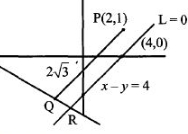
View full question & answer→MCQ 1681 Mark
A straight line through origin $O$ meets the lines $3y= 10 - 4x$ and $8x + 6y+ 5 = 0$ at points$ A$ and $B$ respectively. Then $O$ divides the segment $AB$ in the ratio
Answerc
Length of $ \bot $ to $4x+3y=10$ from origin $(0,0)$
${P_1} = \frac{{10}}{5} = 2$
Length of $ \bot $ to $8x+6y+5=0$ from origin $(0,0)$
${P_2} = \frac{5}{{10}} = \frac{1}{2}$
Lines are parallel to each other $ \Rightarrow $ ratio will be $4:1$ or $1:4$
View full question & answer→MCQ 1691 Mark
A ray of light is incident along a line which meets another line, $7x- y+ 1 =0$, at the point $(0, 1)$ . The ray is then reflected from this point along the line, $y + 2x = 1$ . Then the equation of the line of incidence of the ray of light is
- A
$41x - 25y+25=0$
- B
$41x + 25y- 25=0$
- ✓
$41x - 38y+ 38=0$
- D
$41x+38y- 38=0$
AnswerCorrect option: C. $41x - 38y+ 38=0$
c
Let slope of incident ray be $m$
$\therefore $ angle of incidence =angle of reflection
$\therefore \left| {\frac{{m - 7}}{{1 + 7m}}} \right| = \left| {\frac{{ - 2 - 7}}{{1 - 14}}} \right| = \frac{9}{{13}}$
$ \Rightarrow \frac{{m - 7}}{{1 + 7m}} = \frac{9}{{13}}\,\,\,\,$ or $\frac{{m - 7}}{{1 + 7m}} = - \frac{9}{{13}}\,\,\,\,$
$ \Rightarrow 13m - 91 = 9 + 63m\,\,\,\,\,\,\,\,\,13m - 91 = - 9 - 63m\,\,$
$ \Rightarrow 5m = - 100 \Rightarrow 76m = 82$
$ \Rightarrow m = - \frac{1}{2}\,\,\,\,\,\,\,\,\,\,m = \frac{{41}}{{38}}$
$ \Rightarrow y - 1 = - \frac{1}{2}\left( {x - 0} \right)$
$ \Rightarrow y - 1 = \frac{{41}}{{38}}\left( {x - 0} \right)$
i.e $x + 2y - 2 = 0$
$ \Rightarrow 38y - 38 - 41x = 0$
$ \Rightarrow 41x - 38y + 38 = 0$
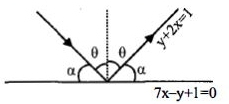
View full question & answer→MCQ 1701 Mark
The points $\left( {0,\frac{8}{3}} \right),\,(1,3)$ and $(82,30)$
- A
form an acute angled triangle.
- B
form a right angled triangle.
- ✓
- D
form an obtuse angled triangle.
Answerc
$A\left( {0,\frac{8}{3}} \right)B\left( {1,3} \right)C\left( {89,30} \right)$
Slope of $AB = \frac{1}{3}$
Slope of $BC = \frac{1}{3}$
so, lies on same line
View full question & answer→MCQ 1711 Mark
Locus of the image of point $ (2,3)$ in the line $\left( {2x - 3y + 4} \right) + k\left( {x - 2y + 3} \right) = 0,k \in R$ is a:
- A
circle of radius $\sqrt 3 $
- B
straight line parallel to $x- $ axis
- C
straight line parallel to $y- $ axis
- ✓
circle of radius $\;\sqrt 2 $
AnswerCorrect option: D. circle of radius $\;\sqrt 2 $
d
Let $M$ be mid-point of $B B^{\prime}$ and $A M$ is $\perp$ bisector of $B B^{\prime}$
(where $A$ is the point of intersection of the given lines)
$(x-2)(x-1)+(y-2)(y-3)=0$
$\Rightarrow\left(\frac{h+2}{2}-2\right)\left(\frac{h+2}{2}-1\right)+\left(\frac{k+3}{2}-2\right)\left(\frac{k+3}{2}-3\right)=0$
$\Rightarrow(h-2)(h)+(k-1)(k-3)=0$
$\Rightarrow \quad x^{2}-2 x+y^{2}-4 y+3=0$
$\Rightarrow \quad(x-1)^{2}+(y-2)^{2}=2$
View full question & answer→MCQ 1721 Mark
Let $L$ be the line passing through the point $P( 1, 2)$ such that its intercepted segment between the co-ordinate axes is bisected at $P$. If $L_1$ is the line perpendicular to $L$ and passing through the point $(-2 , 1),$ then the point of intersection of $L$ and $L_1$ is
- ✓
$\left( {\frac{4}{5},\frac{{12}}{5}} \right)$
- B
$\left( {\frac{3}{5},\frac{{23}}{{10}}} \right)$
- C
$\left( {\frac{11}{20},\frac{{29}}{{10}}} \right)$
- D
$\left( {\frac{3}{10},\frac{{17}}{{5}}} \right)$
AnswerCorrect option: A. $\left( {\frac{4}{5},\frac{{12}}{5}} \right)$
a
Equation of line $L$
$\frac{x}{2} + \frac{y}{4} = 1$
$2x + y = 4\,\,\,\,\,\,\,\,\,\,.....\left( 1 \right)$
For line
$x - 2y = - 4\,\,\,\,\,.......\left( 2 \right)$
solving equation $(1)$ and $(2)$; we get point of intersection
$\left( {4/5,\frac{{12}}{5}} \right)$
View full question & answer→MCQ 1731 Mark
A straight line $L$ through the point $(3, - 2)$ is inclined at an angle of $60^o$ to the line $\sqrt 3 x + y = 1$ . If $L$ also intersects the $x-$ axis, then the equation of $L$ is
- A
$y + \sqrt 3 x + 2 - 3\sqrt 3 = 0$
- B
$\sqrt 3 y + x - 3 + 2\sqrt 3 = 0$
- ✓
$y - \sqrt 3 x + 2 + 3\sqrt 3 = 0$
- D
$\sqrt 3 y - x + 3 + 2\sqrt 3 = 0$
AnswerCorrect option: C. $y - \sqrt 3 x + 2 + 3\sqrt 3 = 0$
c
Given eqn of line is $y + \sqrt 3 x - 1 = 0$
$ \Rightarrow y = - \sqrt 3 x + 1$
$ \Rightarrow $ (slope) ${m_2} = - \sqrt 3 $
Let the other slope be ${m_1}$
$\therefore \tan {60^o} = \left| \begin{array}{l}
{m_1} - \left( { - \sqrt 3 } \right).\\
1 + \left( { - \sqrt 3 {m_1}} \right)
\end{array} \right.$
$ \Rightarrow {m_1} = 0,{m_2} = \sqrt 3 $
Since line $L$ is passing through $(3,-2)$
$\therefore y - \left( { - 2} \right) = + \sqrt 3 \left( {x - 3} \right)$
$ \Rightarrow y + 2 = \sqrt 3 \left( {x - 3} \right)$
$y - \sqrt 3 x + 2 + 3\sqrt 3 = 0$
View full question & answer→MCQ 1741 Mark
Let $PS$ be the median of the triangle with vertices $P(2,2) , Q(6,-1) $ and $R(7,3) $. The equation of the line passing through $(1,-1) $ and parallel to $PS $ is :
- A
$4x + 7y + 3 = 0$
- B
$\;2x - 9y - 11 = 0$
- C
$\;4x - 7y - 11 = 0$
- ✓
$\;2x + 9y + 7 = 0$
AnswerCorrect option: D. $\;2x + 9y + 7 = 0$
d
Mld point of $OR$ is $\left(\frac{13}{2}, 1\right)$
Slope of $\mathrm{PS}=\frac{-1}{\frac{9}{2}}=\frac{-2}{9}$
and line passes through $(1,-1)$
$\frac{y+1}{x-1}=\frac{-2}{9}$
$2 x+9 y+7=0$
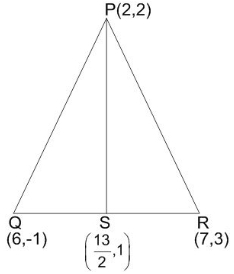
View full question & answer→MCQ 1751 Mark
If the three distinct lines $x + 2ay + a = 0, x + 3by+ b = 0$ and $x + 4ay + a = 0$ are concurrent, then the point $(a, b)$ lies on a
Answerc
$x + 2ay + a = 0\,\,\,\,\,\,\,\,\,......\left( 1 \right)$
$x + 3by + b = 0\,\,\,\,\,\,\,\,\,......\left( 2 \right)$
$x + 4ay + a = 0\,\,\,\,\,\,\,\,\,......\left( 3 \right)$
Subtracting equation $(3)$ from $(1)$
$ - 2y = 0$
$ay = 0 \Rightarrow y = 0$
Putting value of $y$ in equation $(1)$, we get
$x + 0 + a = 0$
$x = - a$
Putting value of $x$ and $y$ in equation $(2)$, we get
$ - a + b = 0$
$a=b$
Thus, $(a,b)$ lies on astraight line
View full question & answer→MCQ 1761 Mark
Given three points $P, Q, R$ with $P(5, 3)$ and $R$ lies on the $x-$ axis. If equation of $RQ$ is $x - 2y = 2$ and $PQ$ is parallel to the $x-$ axis, then the centroid of $\Delta PQR$ lies on the line
- A
$2x+y- 9 = 0$
- B
$x - 2y+ 1 = 0$
- C
$5x - 2y= 0$
- ✓
$2x-5y = 0$
AnswerCorrect option: D. $2x-5y = 0$
d
Equation of $RQ$ is $x-2y=2$ .....(1)
at $Y=0$,$X=2$ $[R (2,0)]$
as $PQ$ is parallel to $x,y$-coordinates of $Q$ is also $3$
putting value of $y$ in equation $(1)$, we get $Q(8,3)$
Centroid of $\Delta PQR = \left( {\frac{{8 + 5 + 2}}{3},\frac{{3 + 3}}{3}} \right)$
$=(5,2)$
Only $(2x - 5y = 0)$ satisfy the given coordinates.
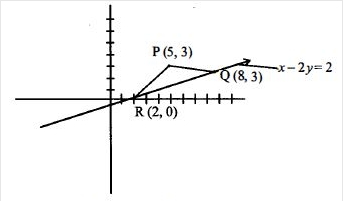
View full question & answer→MCQ 1771 Mark
The base of an equilateral triangle is along the line given by $3x + 4y\,= 9$. If a vertex of the triangle is $(1, 2)$, then the length of a side of the triangle is
- A
$\frac{{2\sqrt 3 }}{{15}}$
- ✓
$\frac{{4\sqrt 3 }}{{15}}$
- C
$\frac{{4\sqrt 3 }}{{5}}$
- D
$\frac{{2\sqrt 3 }}{{5}}$
AnswerCorrect option: B. $\frac{{4\sqrt 3 }}{{15}}$
b
Shortes distance of a point $\left( {{x_1},{y_1}} \right)$ from line $ax + by = c$ is
$d = \frac{{a{x_1} + b{y_1} - c}}{{\sqrt {{a^2} + {b^2}} }}$
Now shortest distance of $P(1,2)$ from $3x+4y=9$ is
$PC = d = \frac{{3\left( 1 \right) + 4\left( 2 \right) - 9}}{{\sqrt {{3^2} + {4^2}} }} = \frac{2}{5}$
Given that $\Delta APB$ is equilateral triangle
Let $'a'$ be its side
then $PB = a,Cb = \frac{a}{2}$
Now,In $\Delta PCB,{\left( {PB} \right)^2} = {\left( {PC} \right)^2} + {\left( {CB} \right)^2}$
(By Pythagoras theorem )
${a^2} = {\left( {\frac{2}{5}} \right)^2} + \frac{{{a^2}}}{4}$
${a^2} - \frac{{{a^2}}}{4} = \frac{4}{{25}} \Rightarrow \frac{{3{a^2}}}{4} = \frac{4}{{25}}$
${a^2} = \frac{{16}}{{75}} \Rightarrow a = \sqrt {\frac{{16}}{{75}}} = \frac{4}{{5\sqrt 3 }} \times \frac{{\sqrt 3 }}{{\sqrt 3 }} = \frac{{4\sqrt 3 }}{{15}}$
$\therefore $ Lengh of Equilateral triangle $(a) = \frac{{4\sqrt 3 }}{5}$
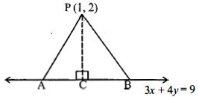
View full question & answer→MCQ 1781 Mark
The circumcentre of a triangle lies at the origin and its centroid is the mid point of the line segment joining the points $(a^2 + 1 , a^2 + 1 )$ and $(2a, - 2a)$, $a \ne 0$. Then for any $a$ , the orthocentre of this triangle lies on the line
AnswerCorrect option: D. $(a - 1)^2x - (a + 1)^2y\, = 0$
d
Circumcentre $=(0,0)$
Centroid $ = \left( {\frac{{{{\left( {a + 1} \right)}^2}}}{2},\frac{{{{\left( {a - 1} \right)}^2}}}{2}} \right)$
We know the circumcenter $(O)$,
Centroid $(G)$ and orthocentre $(H)$ of a
triangle lie on the line joining the $O$ and $G$
Also, $\frac{{HG}}{{GO}} = \frac{2}{1}$
$ \Rightarrow $ Coordinate of orthocentre
$ = \frac{{3{{\left( {a + 1} \right)}^2}}}{2},\frac{{3{{\left( {a - 1} \right)}^2}}}{2}$
Now, these coordinates satisfies eqn given in option $(d)$
Hence, required eqn of line is
${\left( {a - 1} \right)^2}x - {\left( {a + 1} \right)^2}y = 0$
View full question & answer→MCQ 1791 Mark
lf a line $L$ is perpendicular to the line $5x - y\,= 1$ , and the area of the triangle formed by the line $L$ and the coordinate axes is $5$, then the distance of line $L$ from the line $x + 5y\, = 0$ is
AnswerCorrect option: B. $\frac{5}{{\sqrt {13} }}$
b
Let equation of line $L$, perpendicular to $5x-y=1$ be $x+5y=c$
Given that are of $\Delta AOB$ is $5$.
We know
$\left\{ {are,A = \frac{1}{2}\left[ {{x_1}\left( {{y_2} - {y_2}} \right) + {x_2}\left( {{y_3} - {y_1}} \right) + {x_3}\left( {{y_1} - {y_2}} \right)} \right]} \right\}$
$ \Rightarrow 5 = \frac{1}{2}\left[ {c\left( {\frac{c}{5}} \right)} \right]$
$\because \left ( \begin{array}{l}
\left( {{x_1},{y_1}} \right) = \left( {10,0} \right)\left( {{x_3},{y_3}} \right) = \left( {0,\frac{c}{5}} \right)\\
\left( {{x_2},{y_2}} \right) = \left( {c,0} \right)
\end{array} \right)$
$ \Rightarrow c = \pm \sqrt {50} $
$\therefore $ Equation of line $L$ is $x + 5y = \pm \sqrt {50} $
Distance betwween $L$ and line $x+5y=0$ is
$d = \left. {\frac{{ \pm \sqrt {50} - 0}}{{\sqrt {{1^2} + {5^2}} }}} \right| = \frac{{\sqrt {50} }}{{\sqrt {26} }} = \frac{5}{{\sqrt {13} }}$
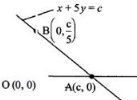
View full question & answer→MCQ 1801 Mark
Let $a, b, c$ and $d$ be non-zero numbers. If the point of intersection of the lines $4ax + 2ay + c = 0$ and $5bx + 2by + d =0$ lies in the fourth quadrant and is equidistant from the two axes then
- ✓
$3bc-2ad=0$
- B
$3bc+2ad=0$
- C
$2bc-3ad=0$
- D
$2bc+3ad=0$
AnswerCorrect option: A. $3bc-2ad=0$
a
Let coordinate of the intersection point in the fourth quadrant be
$(\alpha,-\alpha)$ lies on both lines $4 a x+2 a y+c=0$ and $5 b x+2 b y+d=0$
$\therefore 4 a \alpha-2 a \alpha+c=0 \Rightarrow \alpha=\frac{-c}{2 a} \ldots \ldots(i)$
$5 b \alpha-2 b \alpha+d=0 \Rightarrow \alpha=\frac{-d}{3 b} \ldots \ldots(i i)$
From Eqs. $(i)$ and $(ii),$
we get $\frac{-c}{2 a}=\frac{-d}{3 b}$
$\Rightarrow 3 b c=2 a d$
$\Rightarrow 2 a d-3 b c=0$
View full question & answer→MCQ 1811 Mark
If a line intercepted between the coordinate axes is trisected at a point $A( 4, 3 ),$ which is nearer to $x-$ axis, then its equation is
- A
$4x -3y =7$
- ✓
$3x+2y= 18$
- C
$3x+8y = 36$
- D
$x+3y= 13$
AnswerCorrect option: B. $3x+2y= 18$
b
A divides $CB$ in $2:1$
$ \Rightarrow 4 = \left( {\frac{{1 \times 0 + 2 \times a}}{{1 + 2}}} \right) = \frac{{2a}}{3}$
$ \Rightarrow a = 6 \Rightarrow $ coordinnate of $B$ is $B(6,0)$
$3 = \left( {\frac{{1 \times b + 2 \times 0}}{{1 + 2}}} \right) = \frac{b}{3}$
$ \Rightarrow b = 9 \Rightarrow $ and $C(0,9)$
Slope of line passing through $(6,0),(0,9)$
slop, $m = \frac{9}{{ - 6}} = - \frac{3}{2}$
Aquation of line $y - 0 = - \frac{3}{2}\left( {x - 6} \right)$
$2y = - 3x + 18$
$3x + 2y = 18$
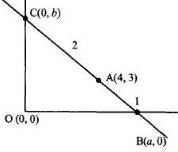
View full question & answer→MCQ 1821 Mark
Let $\theta_1$ be the angle between two lines $2x + 3y + c_1\, = 0$ and $-x+5y + c_2\, = 0$ and $\theta_2$ be the angle between two lines $2x+ 3y + c_1\, = 0$ and $-x+ 5y + c_3\, = 0$, where $c_1, c_2, c_3$ are any real numbers
Statement $-1$ : If $c_2$ and $c_3$ are proportional, then $\theta_1\, = \theta_2$
Statement $-2$ : $\theta_1\, = \theta_2$ for all $c_2$ and $c_3$
- ✓
Statement $- 1$ is true, Statement $-2$ is true;
Statement $-2$ is a correct explanation of Statement $-1$
- B
Statement $- 1$ is true, Statement $-2$ is true;
Statement $-2$ is not a correct explanation of Statement $-1$ .
- C
Statement $- 1$ is false; Statement $-2$ is true.
- D
Statement $- 1$ is true; Staternent $-2$ is false .
AnswerCorrect option: A. Statement $- 1$ is true, Statement $-2$ is true;
Statement $-2$ is a correct explanation of Statement $-1$
a
Two lines $-x + 5y + c_2\, = 0$ and $-x + 5y+c_3\, = 0$ are parallel to each other . Hence statement $- 1$ is true, statement $-2$ is true and statement $-2$ is the correct explanation of statement $-1$
View full question & answer→MCQ 1831 Mark
A ray of light along $x + \sqrt 3 y = \sqrt 3 $ gets reflected upon reaching $x- $ axis , the equation of the reflected ray is
AnswerCorrect option: B. $\;\sqrt 3 y = x - \sqrt 3 $
b
Take any point $\mathrm{B}(0,1)$ on given line.
Equation of $\mathrm{AB}^{\prime}$ is
$ y-0=\frac{-1-0}{0-\sqrt{3}}(x-\sqrt{3}) $
$ \Rightarrow -\sqrt{3} y=-x+\sqrt{3}$
$ \Rightarrow x-\sqrt{3} y=\sqrt{3} $
$ \Rightarrow \sqrt{3} y=x-\sqrt{3} $
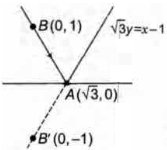
View full question & answer→MCQ 1841 Mark
If the image of point $P( 2, 3)$ in a line $L$ is $Q( 4, 5)$, then the image of point $R(0, 0)$ in the same line is
- A
$(2,2)$
- B
$(4 , 5)$
- C
$(3 ,4)$
- ✓
$(7, 7)$
AnswerCorrect option: D. $(7, 7)$
d
Mid-point of $P(2,3)$ and $Q(4,3)=(3,4)$
Slope of $PQ=1$
Slope of the line $L=-1$
Mid-point $(3,4)$ line on the line $L$.
equation of line $L$,
$y - 4 = - 1\left( {x - 3} \right) \Rightarrow x + y - 7 = 0\,\,\,\,\,.....\left( i \right)$
Let image of point $R(0,0)$ be $S\left( {{x_1},{y_1}} \right)$
Mid-point of $RS = \left( {\frac{{{x_1}}}{2},\frac{{{y_1}}}{2}} \right)$
Mid-point $\left( {\frac{{{x_1}}}{2},\frac{{{y_1}}}{2}} \right)$ line on the line $(i)$
$\therefore {x_1} + {y_1} = 14\,\,\,\,\,\,\,\,.....\left( {ii} \right)$
Slope of $RS = \frac{{{y_1}}}{{{x_1}}}$
Since $RS \bot $ line $L$
$\therefore \frac{{{y_1}}}{{{x_1}}} \times \left( { - 1} \right) = - 1$
$\therefore {x_1} = {y_1}\,\,\,\,\,\,\,\,\,\,\,.......\left( {iii} \right)$
From $(ii)$ and $(iii)$
${x_1} = {y_1} = 7\,\,$
Hence the image of $R=(7,7)$
View full question & answer→MCQ 1851 Mark
If the extremities of the base of an isosceles triangle are the points $(2a,0)$ and $(0,a)$ and the equation of one of the sides is $x = 2a$, then the area of the triangle is
AnswerCorrect option: B. $\frac{5}{2}{a^2}sq.$units
b
(b) Let the co-ordinates of the third vertex be $(2a,\,\,t)$.
$AC = BC \Rightarrow t = \sqrt {4{a^2} + {{(a - t)}^2}} \Rightarrow $$t = \frac{{5a}}{2}$
So the coordinates of third vertex $C$ are $\left( {2a,\frac{{5a}}{2}} \right)$
Therefore area of the triangle
$ = \pm \frac{1}{2}\left| {\,\begin{array}{*{20}{c}}{2a}&{\frac{{5a}}{2}}&1\\{2a}&0&1\\0&a&1\end{array}\,} \right| = \left| {\,\begin{array}{*{20}{c}}a&{\frac{{5a}}{2}}&1\\0&{ - \frac{{5a}}{2}}&0\\0&a&1\end{array}\,} \right| = \frac{{5{a^2}}}{2}sq.$units.
View full question & answer→MCQ 1861 Mark
If the three lines $x - 3y = p, ax + 2y = q$ and $ax + y = r$ form a right-angled triangle then
- ✓
$a^2 -9a + 18 =0$
- B
$a^2 -6a-12=0$
- C
$a^2 -6a- 18=0$
- D
$a^2 -9a+ 12 =0$
AnswerCorrect option: A. $a^2 -9a + 18 =0$
a
Since three lines $x-3y=p$,
$ax+2y=q$ and $ax+y=r$
from aright angled triangle
$\therefore $ product of sloper of any two lines $=-1$
Suppose $ax+2y=q$ and $x-3y=p$ are $ \bot $ to each other.
$\therefore \frac{{ - a}}{2} \times \frac{1}{3} = - 1 \Rightarrow a = 6$
Now, consider option one by one $a=6$ satisfies noly option $(a)$
$\therefore $ Required answer is ${a^2} - 9a + 18 = 0$
View full question & answer→MCQ 1871 Mark
Let $A (-3, 2)$ and $B (-2, 1)$ be the vertices of a triangle $ABC$. If the centroid of this triangle lies on the line $3x + 4y + 2 = 0$, then the vertex $C$ lies on the line
- A
$4x +3y+5= 0$
- ✓
$3x +4y+3=0$
- C
$4x +3y+3=0$
- D
$3x + 4y + 5 = 0$
AnswerCorrect option: B. $3x +4y+3=0$
b
Let $C\left( {{x_1},{y_1}} \right)$
Centroid, $E = \left( {\frac{{{x_1} - 5}}{3},\frac{{{x_1} - 3}}{3}} \right)$
Since centroid lies on the line
$3x + 4y + 2 = 0$
$\therefore 3\left( {\frac{{{x_1} - 5}}{3}} \right) + 4\left( {\frac{{{x_1} - 3}}{3}} \right) + 2 = 0$
$ \Rightarrow 3{x_1} + 4{y_1} + 3 = 0$
Hence vertex $\left( {{x_1},{y_1}} \right)$ lies on the line
$3x + 4y + 3 = 0$
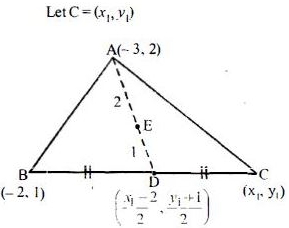
View full question & answer→MCQ 1881 Mark
A light ray emerging from the point source placed at $P( 1, 3)$ is reflected at a point $Q$ in the axis of $x$. If the reflected ray passes through the point $R$ ($6, 7)$, then the abscissa of $Q$ is
- A
$1$
- B
$3$
- C
$\frac{7}{2}$
- ✓
$\frac{5}{2}$
AnswerCorrect option: D. $\frac{5}{2}$
d
Let abcissa of $Q=x$
$\therefore $ $Q=(x,0)$
$\tan \,\theta = \frac{{0 - 7}}{{x - 6}},\tan \left( {{{180}^o} - \theta } \right) = \frac{{0 - 3}}{{x - 1}}$
Now, $\tan \left( {{{180}^o} - \theta } \right) = - \tan \,\theta $
$\therefore \frac{{ - 3}}{{x - 1}} = \frac{{ - 7}}{{x - 6}} \Rightarrow x = \frac{5}{2}$
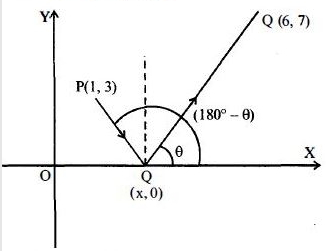
View full question & answer→MCQ 1891 Mark
If the $x-$ intercept of some line $L$ is double as that of the line, $3x + 4y = 12$ and the $y-$ intercept of $L$ is half as that of the same line, then the slope of $L$ is
- A
$-3$
- B
$-3/8$
- C
$-3/2$
- ✓
$-3/16$
AnswerCorrect option: D. $-3/16$
d
Given line $3x+4y=12$ can be rewritten as
$\frac{{3x}}{{12}} + \frac{{4y}}{{12}} = 1 \Rightarrow \frac{x}{4} + \frac{y}{3} = 1$
$ \Rightarrow $ $x$ -intercept $=4$ and $y$-intercept $=3$
Let the required line be
$L:\frac{x}{a} + \frac{y}{b} = 1$ where
$a=x$ -interceptand $b=y$ intercept
According to the question
$a = 4 \times 2 = 8$ and $b = 3/2$
$\therefore $ Required line is $\frac{x}{8} + \frac{{2y}}{3} = 1$
$ \Rightarrow 3x + 16y = 24$
$ \Rightarrow y = \frac{{ - 3}}{{16}}x + \frac{{25}}{{16}}$
Hence, required slop $ = \frac{{ - 3}}{{16}}$
View full question & answer→MCQ 1901 Mark
Consider the lines $L_1$ and $L_2$ defined by
$L _1: x \sqrt{2}+ y -1=0$ and $L _2: x \sqrt{2}- y +1=0$
For a fixed constant $\lambda$, let $C$ be the locus of a point $P$ such that the product of the distance of $P$ from $L_1$ and the distance of $P$ from $L_2$ is $\lambda^2$. The line $y=2 x+1$ meets $C$ at two points $R$ and $S$, where the distance between $R$ and $S$ is $\sqrt{270}$.
Let the perpendicular bisector of $RS$ meet $C$ at two distinct points $R ^{\prime}$ and $S ^{\prime}$. Let $D$ be the square of the distance between $R ^{\prime}$ and $S ^{\prime}$.
($1$) The value of $\lambda^2$ is
($2$) The value of $D$ is
- A
$9,77.15$
- ✓
$9,77.14$
- C
$9,90.14$
- D
$8,77.15$
AnswerCorrect option: B. $9,77.14$
b
$P(x, y) \quad\left|\frac{\sqrt{2} x+y-1}{\sqrt{3}}\right|\left|\frac{\sqrt{2} x-y+1}{\sqrt{3}}\right|=\lambda^2$
$\left|\frac{2 x^2-(y-1)^2}{3}\right|=\lambda^2, C :\left|2 x^2-(y-1)^2\right|=3 \lambda^2$
$\text { line } y =2 x +1, RS =\sqrt{\left( x _1- x _2\right)^2+\left( y _1- y _2\right)^2}, R \left( x _1, y _1\right) \text { and } S\left( x _2, y _2\right)$
$y _1=2 x _1+1 \text { and } y _2=2 x _2+1 \Rightarrow\left( y _1- y _2\right)=2\left( x _1- x _2\right)$
$\text { RS }=\sqrt{5\left( x _1- x _2\right)^2}=\sqrt{5}\left| x _1- x _2\right|$
solve curve $C$ and line $y=2 x+1$ we get
$\left|2 x^2-(2 x)^2\right|=3 \lambda^2 \Rightarrow x^2=\frac{3 \lambda^2}{2}$
$\text { RS }=\sqrt{5}\left|\frac{2 \sqrt{3} \lambda}{\sqrt{2}}\right|=\sqrt{30 \lambda}$$=\sqrt{270} \Rightarrow 30 \lambda^2=270 \Rightarrow \lambda^2=9$
$\perp$ bisector of $RS$
$T \equiv\left(\frac{ x _1+ x _2}{2}, \frac{y_1+y_2}{2}\right)$
Here $x _1+ x _2=0$
$T=(0,1)$
Equation of
$R^{\prime} S^{\prime}:(y-1)=-\frac{1}{2}(x-0) \Rightarrow x+2 y=2$
$R^{\prime}\left(a_1, b_1\right) S^{\prime}\left(a_2, b_2\right)$
$D=\left(a_1-a_2\right)^2+\left(b_1-b_2\right)^2=5\left(b_1-b_2\right)^2$
solve $x+2 y=2$ and $\left|2 x^2-(y-1)^2\right|=3 \lambda^2$
$\left|8(y-1)^2-(y-1)^2\right|=3 \lambda^2 \Rightarrow(y-1)^2=\left(\frac{\sqrt{3} \lambda}{\sqrt{7}}\right)^2$
$y-1= \pm \frac{\sqrt{3} \lambda}{\sqrt{7}} \Rightarrow b_1=1+\frac{\sqrt{3 \lambda}}{\sqrt{7}}, b_2=1-\frac{\sqrt{3} \lambda}{\sqrt{17}}$
$D =5\left(\frac{2 \sqrt{3} \lambda}{\sqrt{7}}\right)^2=\frac{5 \times 4 \times 3 \lambda^2}{7}=\frac{5 \times 4 \times 27}{7}=77.14$
View full question & answer→MCQ 1911 Mark
Let $P$ be a point in the first octant, whose image $Q$ in the plane $x+y=3$ (that is, the line segment $P Q$ is perpendicular to the plane $x+y=3$ and the mid-point of $P Q$ lies in the plane $x+y=3$ ) lies on the $z$-axis. Let the distance of $P$ from the $x$-axis be $5$ . If $R$ is the image of $P$ in the xy-plane, then the length of $P R$ is. . . . . .
Answera
Let $P \equiv\left( x _0, y _0, z _0\right)$
$\frac{x-x_0}{1}=\frac{y-y_0}{1}=\frac{z-z_0}{0}=\frac{-2\left(x_0+y_0-3\right)}{1^2+1^2}$
$\Rightarrow x=3-y_0$
$y=3-x_0$
Since, mirror images lies on $z$-axis
$3- y _0=0,3- x _0=0$
$\Rightarrow x _0=3, y _0=3$
Also, $\sqrt{ z _0^2+ y _0^2}=5 \Rightarrow z _0=4$
$\therefore P R=4-(-4)=8$
View full question & answer→MCQ 1921 Mark
For a point $P$ in the plane, let $d_1(P)$ and $d_2(P)$ be the distance of the point $P$ from the lines $x-y=0$ and $x+y=0$ respectively. The area of the region $R$ consisting of all points $P$ lying in the first quadrant of the plane and satisfying $2 \leq d_1(P)+d_2(P) \leq 4$, is
Answerc
let $ p(h, k) $
$2 \leq\left|\frac{h-k}{\sqrt{2}}\right|+\left|\frac{h+k}{\sqrt{2}}\right| \leq 4 $
$\Rightarrow \quad 2 \sqrt{2} \leq|h-k|+|h+k| \leq 4 \sqrt{2} $
$\text { if } \quad h \geq k$
$\Rightarrow \quad 2 \sqrt{2} \leq x-y+x+y \leq 4 \sqrt{2} \quad$ or $\quad \sqrt{2} \leq x \leq 2 \sqrt{2}$
similarly when $k > h$
we have $\sqrt{2} \leq y \leq 2 \sqrt{2}$
The required area $=(2 \sqrt{2})^2-(\sqrt{2})^2=6$.
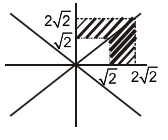
View full question & answer→MCQ 1931 Mark
For $a > b > c > 0$, the distance between $(1,1)$ and the point of intersection of the lines $a x+b y+c=0$ and $b x+a y+c=0$ is less than $2 \sqrt{2}$. Then
- A
$a + b - c > 0$
- B
$a - b + c < 0$
- ✓
$a - b + c > 0$
- D
$a + b - c < 0$
AnswerCorrect option: C. $a - b + c > 0$
c
As $\quad a > b > c > 0 \quad \Rightarrow \quad a-c > 0$ and $b > 0$
$\Rightarrow \quad a-c > 0$ and $b > 0$
$\Rightarrow \quad a + b - c > 0 \quad \Rightarrow \quad$ option $( A )$ is correct
Further $a > b$ and $c > 0$
$\Rightarrow \quad a-b > 0 \quad \text { and } \quad c>0 $
$\Rightarrow \quad a-b > 0 \quad \text { and } \quad c>0 $
$\Rightarrow \quad a-b+c > 0 \quad \Rightarrow \quad$ option $(c)$ is correct
Aliter
$(a-b) x+(b-a) y=0 $
$\Rightarrow x=y $
$\Rightarrow \text { Point of intersection }\left(\frac{-c}{a+b}, \frac{-c}{a+b}\right)$
$\Rightarrow$ Point of intersection $\left(\frac{-c}{a+b}, \frac{-c}{a+b}\right)$
Now $\sqrt{\left(1+\frac{c}{a+b}\right)^2+\left(1+\frac{c}{a+b}\right)^2} < 2 \sqrt{2}$
$\Rightarrow \sqrt{2}\left(\frac{a+b+c}{a+b}\right) < 2 \sqrt{2} $
$\Rightarrow a+b-c > 0$
View full question & answer→MCQ 1941 Mark
A straight line $L$ through the point $(3,-2)$ is inclined at an angle $60^{\circ}$ to the line $\sqrt{3} x+y=1$. If $L$ also intersects the $x$-axis, then the equation of $L$ is
- A
$y+\sqrt{3} x+2-3 \sqrt{3}=0$
- ✓
$y-\sqrt{3} x+2+3 \sqrt{3}=0$
- C
$\sqrt{3} y-x+3+2 \sqrt{3}=0$
- D
$\sqrt{3} y+x-3+2 \sqrt{3}=0$
AnswerCorrect option: B. $y-\sqrt{3} x+2+3 \sqrt{3}=0$
b
$\tan 60^{\circ}=\left|\frac{m-(-\sqrt{3})}{1+(-\sqrt{3} m)}\right|$
$\Rightarrow m=0, m=\sqrt{3}$
$\text { line } y+2=\sqrt{3}(x-3)$
$y-\sqrt{3} x+2+3 \sqrt{3}=0$
View full question & answer→MCQ 1951 Mark
The locus of the orthocentre of the triangle formed by the lines
$ (1+p) x-p y+p(1+p)=0, $
$ (1+q) x-q y+q(1+q)=0,$
and $y=0$, where $p \neq q$, is
Answerd
The correct option is $D y=-x$
Let $L_1:(1+p) x-p y+p(1+p)=0$,
$L_2:(1+q) x-q y+q(1+q)=0$ and
$L_3: y=0$
The coordinates of vertices are
$A(-p, 0), B(-q, 0), C(p q,(1+p)(1+q))$
The equation of the altitude through $C$ is $x=p q \cdots(1)$
The equation of the altitude through $B$ is $px +(1+ p ) y +\lambda=0$
Putting $B(-q, 0)$, we get
$-p q+\lambda=0 \Rightarrow \lambda=p q$
Now, equation of altitude through $B$
$p x+(1+p) y+p q=0 \cdots$
Solving equation $(1)$ and $(2)$, we get
$p^2 q+(1+p) y+p q=0$
$\Rightarrow y=-p q$
Let $(h, k)$ be the coordinates of the orthocentre
$h=p q, k=-p q$
$\Rightarrow k=-h$
Hence, the locus of orthocentre is $y=-x$.
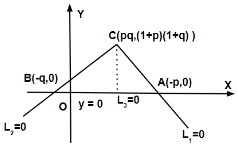
View full question & answer→MCQ 1961 Mark
Let $A B C$ and $A B C^{\prime}$ be two non-congruent triangles with sides $A B=4$, $A C=A C^{\prime}=2 \sqrt{2}$ and angle $B=30^{\circ}$. The absolute value of the difference between the areas of these triangles is
Answerc
$\text { Using cosine rule } \cos B=\frac{a^2+c^2-b^2}{2 a c}=\frac{a^2+16-8}{2 \times a \times 4}$
$\Rightarrow \frac{\sqrt{3}}{2}=\frac{a^2+8}{8 a}$
$\Rightarrow a^2-4 \sqrt{3} a+8=0$
$\Rightarrow a_1+a_2=4 \sqrt{3}, a_1 a_2=8$
$\Rightarrow\left|a_1-a_2\right|^2=\left(a_1+a_2\right)^2-4 a_1 a_2=48-32=16$
$\Rightarrow\left|a_1-a_2\right|=4$
$\therefore\left|\Delta_1-\Delta_2\right|=\frac{1}{2}\left|a_1-a_2\right| \cdot c \sin$ $B=\frac{1}{2} \times 4 \sin 30^{\circ} \times 4=4$
View full question & answer→MCQ 1971 Mark
Consider the lines given by $ \mathrm{L}_1: \mathrm{x}+3 \mathrm{y}-5=0 $ $ \mathrm{~L}_2: 3 \mathrm{x}-\mathrm{ky}-1=0 $ $ \mathrm{~L}_3: 5 \mathrm{x}+2 \mathrm{y}-12=0$
Match the Statements / Expressions in Column $I$ with the Statements / Expressions in Column $II$ and indicate your answer by darkening the appropriate bubbles in the $4 \times 4$ matrix given in the $ORS.$
| Column $I$ |
Column $II$ |
| $(A)$ $ \mathrm{L}_1, \mathrm{~L}_2, \mathrm{~L}_3$ are concurrent, if |
$(p)$ $\mathrm{k}=-9$ |
| $(B)$ One of $\mathrm{L}_1, \mathrm{~L}_2, \mathrm{~L}_3$ is parallel to at least one of the other two, if |
$(q)$ $\mathrm{k}=-\frac{6}{5}$ |
| $(C)$ $\mathrm{L}_1, \mathrm{~L}_2, \mathrm{~L}_3$ form a triangle, if |
$(r)$ $\mathrm{k}=\frac{5}{6}$ |
| $(D)$ $ \mathrm{L}_1, \mathrm{~L}_2, \mathrm{~L}_3$ do not form a triangle, if |
$(s)$ $\mathrm{k}=5$ |
- A
$(A) \rightarrow(q) ;(B) \rightarrow(r, s) ;(C) \rightarrow(r) ;(D) \rightarrow(r, p, s)$
- ✓
$(A) \rightarrow(s) ;(B) \rightarrow(p, q) ;(C) \rightarrow(r) ;(D) \rightarrow(p, q, s)$
- C
$(A) \rightarrow(s) ;(B) \rightarrow(s, q) ;(C) \rightarrow(r) ;(D) \rightarrow(s, q, p)$
- D
$(A) \rightarrow(s) ;(B) \rightarrow(p, r) ;(C) \rightarrow(r) ;(D) \rightarrow(s, r, s)$
AnswerCorrect option: B. $(A) \rightarrow(s) ;(B) \rightarrow(p, q) ;(C) \rightarrow(r) ;(D) \rightarrow(p, q, s)$
b
$x+3 y-5=0$ and $5 x+2 y-12=0$ intersect at $(2,1)$
Hence $6-\mathrm{k}-1=0 \quad \mathrm{k}=5$
for $\mathrm{L}_1, \mathrm{~L}_2$ to be parallel
$\frac{1}{3}=\frac{3}{-k} \Rightarrow \mathrm{k}=-9$
for $\mathrm{L}_2, \mathrm{~L}_3$ to be parallel
$\frac{3}{5}=\frac{-\mathrm{k}}{2} \Rightarrow \mathrm{k}=\frac{-6}{5} \text {. }$
for $k \neq 5,-9, \frac{-6}{5}$ they will form triangle
for $\mathrm{k}=5 \mathrm{k}=-9, \frac{-6}{5}$ they will not form triangle
View full question & answer→MCQ 1981 Mark
Lines $L_1: y-x=0$ and $L_2: 2 x+y=0$ intersect the line $L_3: y+2=0$ at $P$ and $Q$, respectively. The bisector of the acute angle between $L_1$ and $L_2$ intersects $L_3$ at $R$.
$STATEMENT -1$ : The ratio $PR$: $RQ$ equals $2 \sqrt{2}: \sqrt{5}$. because
$STATEMENT -2$ : In any triangle, bisector of an angle divides the triangle into two similar triangles.
- A
Statement -$1$ is True, Statement -$2$ is true; Statement-$2$ is a correct explanation for Statement-$1$
- B
Statement -$1$ is True, Statement -$2$ is True; Statement-$2$ is $NOT$ a correct explanation for Statement-$1$
- ✓
Statement -$1$ is True, Statement -$2$ is False
- D
Statement -$1$ is False, Statement -$2$ is True
AnswerCorrect option: C. Statement -$1$ is True, Statement -$2$ is False
c
In $\triangle \mathrm{OPQ}$
Clearly $\frac{P R}{R Q}=\frac{O P}{O Q}=\frac{2 \sqrt{2}}{\sqrt{5}}$
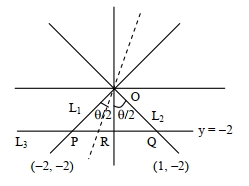
View full question & answer→MCQ 1991 Mark
The number of integral points (integral point means both the coordinates should be integer) exactly in the interior of the triangle with vertices $(0, 0), (0, 21)$ and $(21, 0)$, is
Answerb
(b) $x + y = 21$
The number of integral solutions to the equation $x + y < 21$ i.e., $x < 21 - y$
$\therefore$ Number of integral co-ordinate
$ = 19 + 18 + .... + 1 = \frac{{19 \times 20}}{2} = 190$.
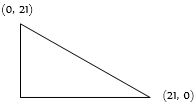
View full question & answer→MCQ 2001 Mark
If the equation of the locus of a point equidistant from the points $({a_1},{b_1})$ and $({a_2},{b_2})$ is $({a_1} - {a_2})x + ({b_1} - {b_2})y + c = 0$, then the value of $‘c’$ is
- ✓
$\frac{1}{2}(a_2^2 + b_2^2 - a_1^2 - b_1^2)$
- B
$a_1^2 - a_2^2 + b_1^2 - b_2^2$
- C
$\frac{1}{2}(a_1^2 + a_2^2 + b_1^2 + b_2^2)$
- D
$\sqrt {a_1^2 + b_1^2 - a_2^2 - b_2^2} $
AnswerCorrect option: A. $\frac{1}{2}(a_2^2 + b_2^2 - a_1^2 - b_1^2)$
a
(a) Let the point be $(h,\,k)$
${(h - {a_1})^2} + {(k - {b_1})^2} = {(h - {a_2})^2} + {(k - {b_2})^2}$
Replace $(h,\,k)$ by $(x,\,y)$, we get
$({a_1} - {a_2})x + ({b_1} - {b_2})y + \frac{1}{2}(a_2^2 + b_2^2 - a_1^2 - b_1^2) = 0$
$c = \frac{1}{2}(a_2^2 + b_2^2 - a_1^2 - b_1^2)$.
View full question & answer→MCQ 2011 Mark
Let $P( - 1,\,0),\,$ $Q(0,\,0)$ and $R\,(3,\,3\sqrt 3 )$ be three points. Then the equation of the bisector of the angle$PQR$ is
AnswerCorrect option: C. $\sqrt 3 x + y = 0$
c
(c) Slope of $QR$ = $\frac{{3\sqrt 3 - 0}}{{3 - 0}} = \sqrt 3 $ i.e., $\theta = {60^o}$
Clearly, $\angle PQR = {120^o}$
$OQ$ is the angle bisector of the angle, so line $OQ$ makes $120^o$ with the positive direction of $x$-axis.
Therefore equation of the bisector of $\angle PQR$ is $y = \tan {120^o}x$ or $y = - \sqrt 3 x$i.e.,$\sqrt 3 x + y = 0$.
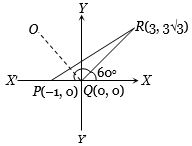
View full question & answer→MCQ 2021 Mark
The number of integral values of $m$, for which the $x$-co-ordinate of the point of intersection of the lines $3x + 4y = 9$ and $y = mx + 1$ is also an integer is
Answera
(a) Solving $3x + 4y = 9,\,y = mx + 1$ we get $x = \frac{5}{{3 + 4m}}$
$x$ is an integer if $3 + 4m = 1,\, - 1,\,5,\, - 5$
$m = \frac{{ - 2}}{4},\,\frac{{ - 4}}{4},\,\frac{2}{4},\,\frac{{ - 8}}{4}$. So, $m$ has two integral values.
View full question & answer→MCQ 2031 Mark
The area of the parallelogram formed by the lines $y = mx,\,y = mx + 1,\,y = nx$ and $y = nx + 1$ equals
AnswerCorrect option: D. $\frac{1}{{|m - n|}}$
d
(d) Solving $y = nx$ and $y = mx + 1,$ we get $P = \left( {\frac{1}{{n - m}},\,\frac{n}{{n - m}}} \right)$
$\therefore $ Area of parallelogram $= 2 ×$ (area of $\Delta $ $POQ$)
$ = 2 \times \left| {\frac{1}{2} \times OQ \times \frac{1}{{n - m}}} \right|$ $ = \frac{1}{{|n - m|}} = \frac{1}{{|m - n|}}.$
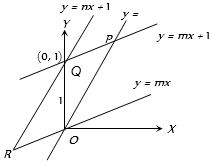
View full question & answer→MCQ 2041 Mark
The triangle $PQR$ is inscribed in the circle ${x^2} + {y^2} = 25$. If $Q$ and $R$ have co-ordinates $(3,4)$ and $(-4, 3)$ respectively, then $\angle QPR$ is equal to
- A
$\frac{\pi }{2}$
- B
$\frac{\pi }{3}$
- ✓
$\frac{\pi }{4}$
- D
$\frac{\pi }{6}$
AnswerCorrect option: C. $\frac{\pi }{4}$
c
(c) Here the centre $0\,(0,0)$. So ‘$m$’ of $OQ$ is $\frac{4}{3}$and ‘$m$’ of $OR$ is $\frac{{ - 3}}{4}$, $\angle QOR = \frac{\pi }{2}$
Hence $\angle QPR = \frac{1}{2} \times \frac{\pi }{2} = \frac{\pi }{4}$.
View full question & answer→MCQ 2051 Mark
The diagonals of a parallelogram $PQRS$ are along the lines $x + 3y = 4$ and $6x - 2y = 7$. Then $PQRS$ must be a
Answerd
(d) ${m_1} = - 1/3$ and ${m_2} = 3$.
Hence lines $x + 3y = 4$ and $6x - 2y = 7$ are perpendicular to each other.
Therefore the paralellogram is rhombus.
View full question & answer→MCQ 2061 Mark
The graph of the function $\cos x\;\cos (x + 2) - {\cos ^2}(x + 1)$ is
- A
A straight line passing through $(0,\,\, - {\sin ^2}1)$ with slope $2$
- B
A straight line passing through $(0, 0)$
- C
A parabola with vertex ${75^o}$
- ✓
A straight line passing through the point $\left( {\frac{\pi }{2}, - {{\sin }^2}1} \right)$ and parallel to the $x$-axis
AnswerCorrect option: D. A straight line passing through the point $\left( {\frac{\pi }{2}, - {{\sin }^2}1} \right)$ and parallel to the $x$-axis
d
(d) $y = \cos (x + 1 - 1)\cos (x + 1 + 1) - {\cos ^2}(x + 1)$
$ = {\cos ^2}(x + 1) - {\sin ^2}1 - {\cos ^2}(x + 1) = - {\sin ^2}1$,
which represents a straight line parallel to $x$-axis with $y = - {\sin ^2}1$ for all $x$ and so
also for $x = \pi /2$.
View full question & answer→MCQ 2071 Mark
The orthocentre of the triangle formed by the lines $xy = 0$ and $x + y = 1$ is
- ✓
$(0,0)$
- B
$\left( {\frac{1}{2},\frac{1}{2}} \right)$
- C
$\left( {\frac{1}{3},\frac{1}{3}} \right)$
- D
$\left( {\frac{1}{4},\frac{1}{4}} \right)$
AnswerCorrect option: A. $(0,0)$
a
(a) Since the triangle is right angled at $O(0,0)$, therefore $(0,0)$ is its orthocentre.
View full question & answer→MCQ 2081 Mark
A line through $A( - 5, - \;4)$ meets the lines $x + 3y + 2 = 0,$ $2x + y + 4 = 0$ and $x - y - 5 = 0$ at $B, \,C$ and $D$ respectively. If ${\left( {\frac{{15}}{{AB}}} \right)^2} + {\left( {\frac{{10}}{{AC}}} \right)^2} = {\left( {\frac{6}{{AD}}} \right)^2},$ then the equation of the line is
- ✓
$2x + 3y + 22 = 0$
- B
$5x - 4y + 7 = 0$
- C
$3x - 2y + 3 = 0$
- D
AnswerCorrect option: A. $2x + 3y + 22 = 0$
a
(a) $\frac{{x + 5}}{{\cos \theta }} = \frac{{y + 4}}{{\sin \theta }} = \frac{{{r_1}}}{{AB}} = \frac{{{r_2}}}{{AC}} = \frac{{{r_3}}}{{AD}}$
$({r_1}\cos \theta - 5,{r_1}\sin \theta - 4)$ lies on $x + 3y + 2 = 0$.
${r_1} = \frac{{15}}{{\cos \theta + 3\sin \theta }}$
Similarly $\frac{{10}}{{AC}} = 2\cos \theta + \sin \theta $ and $\frac{6}{{AD}} = \cos \theta - \sin \theta $
Putting in the given relation, we get ${(2\cos \theta + 3\sin \theta )^2} = 0$
$\tan \theta = - \frac{2}{3} \Rightarrow y + 4 = - \frac{2}{3}(x + 5)$==>$2x + 3y + 22 = 0.$
View full question & answer→MCQ 2091 Mark
If the sum of the distances of a point from two perpendicular lines in a plane is $1$, then its locus is
Answera
(a) Required locus of the point $(x,y)$ is the curve $|x| + |y| = 1$. If the point lies in the first quadrant, then $x > 0,y > 0$ and so $|x| + |y| = 1 \Rightarrow x + y = 1$, which is straight line $AB$. If the point $(x,\,y)$lies in second quadrant then $x < 0$, $y > 0$ and so $|x| + |y| = 1$ ==> $ - x + y = 1$
Similarly for third and fourth quadrant, the equations are $ - x - y = 1$and $x - y = 1$.
Hence the required locus is the curve consisting of the sides of the square $ABCD.$
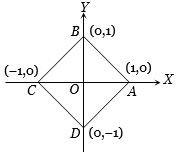
View full question & answer→MCQ 2101 Mark
A line passes through $(2, 2)$ and is perpendicular to the line $3x + y = 3.$ Its y-intercept is
Answerd
(d) The equation of a line passing through $(2, 2)$ and perpendicular to $3x + y = 3$ is $y - 2 = \frac{1}{3}(x - 2)$ or $x - 3y + 4 = 0$.
Putting $x = 0$in this equation, we obtain $y = 4/3$.
So, $y$-intercept $ = 4/3$.
View full question & answer→MCQ 2111 Mark
A variable line passes through a fixed point $P$. The algebraic sum of the perpendicular drawn from $(2,0)$, $(0, 2)$ and $(1, 1)$ on the line is zero, then the coordinates of the $P$ are
- A
$(1,\, -1)$
- ✓
$(1, \,1)$
- C
$(2, \,1)$
- D
$(2,\, 2)$
AnswerCorrect option: B. $(1, \,1)$
b
(b) Let $P({x_1},{y_1}),$ then the equation of line passing through $P$ and whose gradient is $m$, is $y - {y_1} = m(x - {x_1})$
Now according to the condition
$\frac{{ - 2m + (m{x_1} - {y_1})}}{{\sqrt {1 + {m^2}} }} + \frac{{2 + (m{x_1} - {y_1})}}{{\sqrt {1 + {m^2}} }} + \frac{{1 - m + (m{x_1} - {y_1})}}{{\sqrt {1 + {m^2}} }} = 0$
==> $3 - 3m + 3m{x_1} - 3{y_1} = 0 \Rightarrow {y_1} - 1 = m({x_1} - 1)$
Since it is a variable line, so hold for every value of $m$. Therefore ${y_1} = 1,{x_1} = 1 \Rightarrow P(1,\,1)$.
View full question & answer→MCQ 2121 Mark
Line $L$ has intercepts $a$ and $b$ on the co-ordinate axes. When the axes are rotated through a given angle keeping the origin fixed, the same line $L$ has intercepts $p$ and $q$, then
- A
${a^2} + {b^2} = {p^2} + {q^2}$
- ✓
$\frac{1}{{{a^2}}} + \frac{1}{{{b^2}}} = \frac{1}{{{p^2}}} + \frac{1}{{{q^2}}}$
- C
${a^2} + {p^2} = {b^2} + {q^2}$
- D
$\frac{1}{{{a^2}}} + \frac{1}{{{p^2}}} = \frac{1}{{{b^2}}} + \frac{1}{{{q^2}}}$
AnswerCorrect option: B. $\frac{1}{{{a^2}}} + \frac{1}{{{b^2}}} = \frac{1}{{{p^2}}} + \frac{1}{{{q^2}}}$
b
(b) Suppose we rotate the coordinate axes in the anti clockwise direction through an angle $\alpha $.
The equation of the line $L$ with respect to old axes is $\frac{x}{a} + \frac{y}{b} = 1$.
In this question replacing $x$ by $x\cos \alpha - y\sin \alpha $ and $y$ by $x\sin \alpha + y\cos \alpha $, the equation of the line with respect to new axes is $\frac{{x\cos \alpha - y\sin \alpha }}{a} + \frac{{x\sin \alpha + y\cos \alpha }}{b} = 1$
==> $x\left( {\frac{{\cos \alpha }}{a} + \frac{{\sin \alpha }}{b}} \right) + y\left( {\frac{{\cos \alpha }}{b} - \frac{{\sin \alpha }}{a}} \right) = 1$ .....$(i)$
The intercepts made by $(i)$ on the co-ordinate axes are given as $p$ and $q$.
Therefore $\frac{1}{p} = \frac{{\cos \alpha }}{a} + \frac{{\sin \alpha }}{b}$and $\frac{1}{q} = \frac{{\cos \alpha }}{b} - \frac{{\sin \alpha }}{a}$
Squaring and adding, we get $\frac{1}{{{p^2}}} + \frac{1}{{{q^2}}} = \frac{1}{{{a^2}}} + \frac{1}{{{b^2}}}$.
View full question & answer→MCQ 2131 Mark
The locus of a point $P$ which divides the line joining $(1, 0)$ and $(2\cos \theta ,2\sin \theta )$ internally in the ratio $2 : 3$ for all $\theta $, is a
Answerb
(b) Let the coordinates of the point $P$ which divides the line joining $(1, 0)$ and $(2\cos \theta ,\,2\sin \theta )$in the ratio $2:3$ be $(h,k)$. Then, $h = \frac{{4\cos \theta + 3}}{5}$and $k = \frac{{4\sin \theta }}{5}$
==> $\cos \theta = \frac{{5h - 3}}{4}$and $\sin \theta = \frac{{5k}}{4}$
==>${\left( {\frac{{5h - 3}}{4}} \right)^2} + {\left( {\frac{{5k}}{4}} \right)^2} = 1$==>${(5h - 3)^2} + (5{k^2}) = 16$
Therefore locus of $(h,k)$ is ${(5x - 3)^2} + {(5y)^2} = 16$,which is $a$ circle.
View full question & answer→MCQ 2141 Mark
Coordinates of the vertices of a quadrilateral are $(2, -1), (0, 2), (2, 3)$ and $(4, 0)$. The angle between its diagonals will be
AnswerCorrect option: C. ${\tan ^{ - 1}}(2)$
c
(c)${m_1} = \frac{{3 - ( - 1)}}{{2 - 2}} = \infty ,{m_2} = \frac{{0 - 2}}{{4 - 0}} = \frac{{ - 1}}{2}$
==> $\theta = {\tan ^{ - 1}}\left( {\frac{{ - 1}}{2}} \right) - {90^o}$
$\tan \theta = - \cot \left[ {{{\tan }^{ - 1}}\left( {\frac{{ - 1}}{2}} \right)} \right]\, = - ( - 2) = 2$ ==> $\theta = {\tan ^{ - 1}}(2)$.
View full question & answer→MCQ 2151 Mark
The intercept of a line between the coordinate axes is divided by point $(-5, 4)$ in the ratio $1 : 2$. The equation of the line will be
- A
$5x - 8y + 60 = 0$
- ✓
$8x - 5y + 60 = 0$
- C
$2x - 5y + 30 = 0$
- D
AnswerCorrect option: B. $8x - 5y + 60 = 0$
b
(b) Let the coordinates of axes are $A (a, 0)$ and $B\,(0,b)$, but the point $(-5,4)$ divides the line $AB$ in the ratio of $1 : 2$. Therefore, the coordinates of axes are $\left( {\frac{{ - 15}}{2},0} \right)$ and $(0,\,12)$. Therefore, the equation of line passing through these coordinate axes is given by $8x - 5y + 60 = 0$.
View full question & answer→MCQ 2161 Mark
The equation of perpendicular bisectors of the sides $AB$ and $AC$ of a triangle $ABC$ are $x - y + 5 = 0$ and $x + 2y = 0$ respectively. If the point $A$ is $(1,\; - \;2)$, then the equation of line $BC$ is
- A
$23x + 14y - 40 = 0$
- B
$14x - 23y + 40 = 0$
- C
$23x - 14y + 40 = 0$
- ✓
$14x + 23y - 40 = 0$
AnswerCorrect option: D. $14x + 23y - 40 = 0$
d
(d) Let the equation of perpendicular bisector $FN$ of $AB$ is $x - y + 5 = 0$ ......$(i)$
The middle point $F$ of $AB$ is $\left( {\frac{{{x_1} + 1}}{2},\frac{{{y_1} - 2}}{2}} \right)$ lies on line $(i)$. Therefore ${x_1} - {y_1} = - 13$…..$(ii)$
Also $AB$ is perpendicular to $FN$. So the product of their slopes is $-1$.
i.e. $\frac{{{y_1} + 2}}{{{x_1} - 1}} \times 1 = - 1$or ${x_1} + {y_1} = - 1$……$(iii)$
On solving $(ii)$ and $(iii)$, we get $B( - 7,6)$.
Similarly $C{\rm{ }}\left( {\frac{{11}}{5},\frac{2}{5}} \right)$.
Hence the equation of $BC$ is $14x + 23y - 40 = 0$.
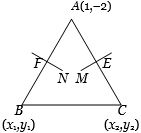
View full question & answer→MCQ 2171 Mark
If the lines $ax + by + c = 0$, $bx + cy + a = 0$ and $cx + ay + b = 0$ be concurrent, then
- A
${a^3} + {b^3} + {c^3} + 3abc = 0$
- B
${a^3} + {b^3} + {c^3} - abc = 0$
- ✓
${a^3} + {b^3} + {c^3} - 3abc = 0$
- D
AnswerCorrect option: C. ${a^3} + {b^3} + {c^3} - 3abc = 0$
c
(c) Here the given lines are
$ax + by + c = 0$.....$(i)$
$bx + cy + a = 0$.....$(ii)$
$cx + ay + b = 0$.....$(iii)$
The lines will be concurrent, if $\left| {\,\begin{array}{*{20}{c}}a&b&c\\b&c&a\\c&a&b\end{array}\,} \right| = 0$
==> ${a^3} + {b^3} + {c^3} - 3abc = 0$.
View full question & answer→MCQ 2181 Mark
The equations of two equal sides of an isosceles triangle are $7x - y + 3 = 0$ and $x + y - 3 = 0$ and the third side passes through the point $(1, -10)$. The equation of the third side is
- A
$y = \sqrt 3 x + 9$ but not $y = -\sqrt 3 x + 9$
- B
$3x + y + 7 = 0$ but not $3x + y - 7 = 0$
- ✓
$3x + y + 7 = 0$ or $x - 3y - 31 = 0$
- D
Neither $3x + y + 7$ nor $x - 3y - 31 = 0$
AnswerCorrect option: C. $3x + y + 7 = 0$ or $x - 3y - 31 = 0$
c
(c) Any line through $(1, -10)$ is given by $y + 10 = m(x - 1)$
Since it makes equal angle say ‘$\alpha $’ with the given lines $7x - y + 3 = 0$ and $x + y - 3 = 0$, therefore
$\tan \alpha = \frac{{m - 7}}{{1 + 7m}}$ $ = \frac{{m - ( - 1)}}{{1 + m( - 1)}} \Rightarrow m = \frac{1}{3}$ or $-3$
Hence the two possible equations of third side are $3x + y + 7 = 0$ and $x - 3y - 31 = 0$.
View full question & answer→MCQ 2191 Mark
A vector $a$ has components $ 2p$ and $1$ with respect to a rectangular cartesian system. The system is rotated through a certain angle about the origin in the anti-clockwise sense. If $a$ has components $ p+1$ and $1$ with respect to the new system, then
AnswerCorrect option: B. $p = 1$ or $ - \frac{1}{3}$
b
(b) If $x,\,\,y$ are the original components; $X,\,\,Y$the new components and $\alpha $ is the angle of rotation, then $x = X\cos \alpha - Y\sin \alpha $ and $y = X\sin \alpha + Y\cos \alpha $
$\therefore \,2p = (p + 1)\cos \alpha - \sin \alpha $ and $1 = (p + 1)\sin \alpha + \cos \alpha $
Squaring and adding, we get $4{p^2} + 1 = {(p + 1)^2} + 1$
$ \Rightarrow p + 1 = \pm {\rm{ }}2p \Rightarrow p = 1$ or $ - \frac{1}{3}.$
View full question & answer→MCQ 2201 Mark
The straight line passes through the point of inter -section of the straight lines $x + 2y - 10 = 0$ and $2x + y + 5 = 0,$ is
- A
$5x - 4y = 0$
- ✓
$5x + 4y = 0$
- C
$4x - 5y = 0$
- D
$4x + 5y = 0$
AnswerCorrect option: B. $5x + 4y = 0$
b
(b) From option $(b)$,
$\left| {{\rm{ }}\begin{array}{*{20}{c}}1&{\,\,2}&{ - 10}\\2&{\,1}&{\,\,5}\\5&4&{\,\,0}\end{array}{\rm{ }}} \right| = 1{\rm{ }}(0 - 20) - 2{\rm{ }}( - 25) - 10{\rm{ }}(3) = 0$
Hence, option $(b)$ is the correct answer.
View full question & answer→MCQ 2211 Mark
The triangle formed by the lines $x + y - 4 = 0,\,$ $3x + y = 4,$ $x + 3y = 4$ is
Answera
(a) The vertices of triangle are the intersection points of these given lines. The vertices of
$\Delta $ are $A(0,\,4),$ $B(1,2),$$C(4,0)$
Now, $AB = \sqrt {{{(0 - 1)}^2} + {{(4 - 1)}^2}} = \sqrt {10} $
$BC = \sqrt {{{(1 - 4)}^2} + {{(0 - 1)}^2}} = \sqrt {10} $
$AC = \sqrt {{{(0 - 4)}^2} + {{(0 - 4)}^{}}} = 4\sqrt 2 $
$\because AB = BC$; $\bigtriangleup$ is isosceles.
View full question & answer→MCQ 2221 Mark
The lines $ax + by + c = 0$, where $3a + 2b + 4c = 0$ are concurrent at the point
- A
$(1/2, 3/4)$
- B
$(1, 3)$
- C
$(3, 1)$
- ✓
$(3/4, 1/2)$
AnswerCorrect option: D. $(3/4, 1/2)$
d
(d) Dividing both sides of relation $3a + 2b + 4c = 0$ by $4$, we get $\frac{3}{4}a + \frac{1}{2}b + c = 0$, which shows that for all values of $a, b$ and $c$ each member of the set of lines $ax + by + c = 0$ passes through the point $\left( {\frac{3}{4},\frac{1}{2}} \right)$.
View full question & answer→MCQ 2231 Mark
Coordinates of the foot of the perpendicular drawn from $(0,0)$ to the line joining $(a\cos \alpha ,a\sin \alpha )$ and $(a\cos \beta ,a\sin \beta )$ are
- A
$\left( {\frac{a}{2},\frac{b}{2}} \right)$
- ✓
$\left[ {\frac{a}{2}(\cos \alpha + \cos \beta ),\frac{a}{2}(\sin \alpha + \sin \beta )} \right]$
- C
$\left( {\cos \frac{{\alpha + \beta }}{2},\sin \frac{{\alpha + \beta }}{2}} \right)$
- D
AnswerCorrect option: B. $\left[ {\frac{a}{2}(\cos \alpha + \cos \beta ),\frac{a}{2}(\sin \alpha + \sin \beta )} \right]$
b
(b) Slope of perpendicular
= -$\left[ {\frac{{\cos \alpha - \cos \beta }}{{\sin \alpha - \sin \beta }}} \right]$ $ = \tan \frac{{\alpha + \beta }}{2}$
Hence equation of perpendicular is
$y = \tan \left( {\frac{{\alpha + \beta }}{2}} \right){\rm{ }}x$ …..$(i)$
Now on solving the equation $(i)$ with the line, we get the required point.
Trick: Take suitable values of $a,\alpha ,\beta $ and then check with options.
View full question & answer→MCQ 2241 Mark
The area enclosed within the curve $|x| + |y| = 1$ is
- A
$\sqrt 2 $
- B
$1$
- C
$\sqrt 3 $
- ✓
$2$
Answerd
(d) The given lines are $ \pm x \pm y = 1$
i.e. $x + y = 1,x - y = 1,x + y = - 1$and $x - y = - 1$
These lines form a quadrilateral whose vertices are $A( - 1,0),B(0, - 1),C(1,0)$and $D(0,1)$
Obviously $ABCD$ is a square.
Length of each side of this square is $\sqrt {{1^2} + {1^2}} = \sqrt 2 $
Hence area of square is $\sqrt 2 \times \sqrt 2 = 2sq.$units
Trick: Requird area = $\frac{{2{c^2}}}{{|ab|}} = \frac{{2 \times {1^2}}}{{|1 \times 1|}} = 2$.
View full question & answer→MCQ 2251 Mark
The points $(1, 3)$ and $(5, 1)$ are the opposite vertices of a rectangle. The other two vertices lie on the line $y = 2x + c,$ then the value of c will be
Answerb
(b) Let $ABCD$ be a rectangle. Given $A\, (1, 3)$ and $C\, (5, 1)$. Equation $B$ and $D$ lie on $y = 2x + c$
We know that intersecting point of diagonal of rectangle is same or at midpoint. So mid point of $AC$ is $(3, 2)$. So $y = 2x + c$ passes throguh $(3, 2)$. Hence $c = - 4$.
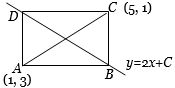
View full question & answer→MCQ 2261 Mark
Given the four lines with equations $x + 2y = 3,$ $3x + 4y = 7,\,\,2x + 3y = 4\,\,$ and $4x + 5y = 6,$ then these lines are
Answerd
(d) These lines cannot be the sides of a rectangle as none of these are parallel nor they are perpendicular.
Now check concurrency
$\left| {\,\begin{array}{*{20}{c}}1&2&{ - 3}\\3&4&{ - 7}\\2&3&{ - 4}\end{array}\,} \right| = 1( - 16 + 21) - 2(2) - 3(1) \ne 0$
Hence neither concurrent.
View full question & answer→MCQ 2271 Mark
A line $L$ is perpendicular to the line $5x - y = 1$ and the area of the triangle formed by the line $L$ and coordinate axes is $5$. The equation of the line $L$ is
- A
$x + 5y = 5$
- ✓
$x + 5y = \pm 5\sqrt 2 $
- C
$x - 5y = 5$
- D
$x - 5y = 5\sqrt 2 $
AnswerCorrect option: B. $x + 5y = \pm 5\sqrt 2 $
b
(b) A line perpendicular to the line $5x - y = 1$ is given by $x + 5y - \lambda = 0 = L$, (given)
In intercept form $\frac{x}{\lambda } + \frac{y}{{\lambda /5}} = 1$
So, area of triangle is $\frac{1}{2}$ $ \times $ (Multiplication of intercepts)
==> $\frac{1}{2}(\lambda ) \times \left( {\frac{\lambda }{5}} \right) = 5 \Rightarrow \lambda = \pm 5\sqrt 2 $
Hence the equation of required straight line is $x + 5y = \pm 5\sqrt 2 $ .
View full question & answer→MCQ 2281 Mark
Two vertices of a triangle are $(5, - 1)$ and $( - 2,3)$. If orthocentre is the origin then coordinates of the third vertex are
- A
$(7, 4)$
- B
$(-4, 7)$
- C
$(4, -7)$
- ✓
$(-4, -7)$
AnswerCorrect option: D. $(-4, -7)$
d
(d) Let the third vertex be $(h, k)$. Obviously the equation of $AB$ is $\sqrt {\frac{5}{2}} $$ \Rightarrow 4x + 7y - 13 = 0$.
Thus equation of $CE$ is $7x - 4y + \lambda = 0$, but it passes through origin, so $\lambda = 0$. Hence $7x - 4y = 0$ ....(i)
Also equation of $CE$ is $y - 0 = \frac{k}{h}(x - 0)$
==> $ - kx + hy = 0$......(ii)
Here (i) and (ii) are same lines, therefore $(h, k)$ is $( - 4, - 7)$.
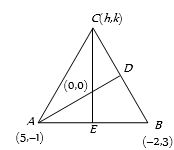
View full question & answer→MCQ 2291 Mark
The equation of the line which bisects the obtuse angle between the lines $x - 2y + 4 = 0$ and $4x - 3y + 2 = 0$, is
- ✓
$(4 - \sqrt 5 )x - (3 - 2\sqrt 5 )y + (2 - 4\sqrt 5 ) = 0$
- B
$(4 + \sqrt 5 )x - (3 + 2\sqrt 5 )y + (2 + 4\sqrt 5 ) = 0$
- C
$(4 + \sqrt 5 )x + (3 + 2\sqrt 5 )y + (2 + 4\sqrt 5 ) = 0$
- D
AnswerCorrect option: A. $(4 - \sqrt 5 )x - (3 - 2\sqrt 5 )y + (2 - 4\sqrt 5 ) = 0$
a
(a) The equations of the bisectors of the angles between the lines are $\frac{{x - 2y + 4}}{{\sqrt {1 + 4} }} = \pm \frac{{4x - 3y + 2}}{{\sqrt {16 + 9} }}$
Taking positive sign, then
$(4 - \sqrt 5 )x - (3 - 2\sqrt 5 ){\rm{ }}y - (4\sqrt 5 - 2) = 0$.....$(i)$
and negative sign gives
$(4 + \sqrt 5 )x - (2\sqrt 5 + 3)y + (4\sqrt 5 + 2) = 0$.....$(ii)$
Let $\theta $be the angle between the line $(i)$ and one of the given line, then $\tan \theta = \left| {\frac{{\frac{1}{2} - \frac{{4 - \sqrt 5 }}{{3 - 2\sqrt 5 }}}}{{1 + \frac{1}{2}.\frac{{4 - \sqrt 5 }}{{3 - 2\sqrt 5 }}}}} \right| = \sqrt 5 + 2 > 1$
Hence the line $(i)$ bisects the obtuse angle between the given lines.
View full question & answer→MCQ 2301 Mark
One side of a rectangle lies along the line $4x + 7y + 5 = 0.$ Two of its vertices are $(-3, 1)$ and $(1, 1)$. Then the equations of other three sides are
- ✓
$7x - 4y + 25 = 0,$$4x + 7y = 11$ and $7x - 4y - 3 = 0$
- B
$7x + 4y + 25 = 0,$$7y + 4x - 11 = 0$ and $7x - 4y - 3 = 0$
- C
$4x - 7y + 25 = 0,$$7x + 4y - 11 = 0$ and $4x - 7y - 3 = 0$
- D
AnswerCorrect option: A. $7x - 4y + 25 = 0,$$4x + 7y = 11$ and $7x - 4y - 3 = 0$
a
(a) (i) $4x + 7y = 4( - 3) + 7 = - 5$
(ii) $7x - 4y = 7( - 3) - 4 = - 25$
(iii) $4x + 7y = 4(1) + 7(1) = 11$
(iv) $7x - 4y = 7(1) - 4(1) = 3$
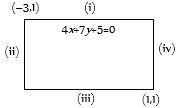
View full question & answer→MCQ 2311 Mark
A straight line moves so that the sum of the reciprocals of its intercepts on two perpendicular lines is constant, then the line passes through
Answera
(a) Take two perpendicular lines as the coordinate axes. If a, b be the intercepts made by the moving line on the coordinate axes, then the equation of the line is
$\frac{x}{a} + \frac{y}{b} = 1$.....$(i)$
According to the question $\frac{1}{a} + \frac{1}{b} = \frac{1}{k}$, (say)
i.e., $\frac{k}{a} + \frac{k}{b} = 1$ ....$.(ii)$
The result $(ii)$ shows that the straight line $(i)$ passes through a fixed point $(k, k)$.
View full question & answer→MCQ 2321 Mark
The point on the line $x + y = 4$ which lie at a unit distance from the line $4x + 3y = 10$, are
- ✓
$(3,\,1),( - 7,\,11)$
- B
$(3,\,1),(7,\,11)$
- C
$( - 3,\,1),( - 7,\,11)$
- D
$(1,\,3),( - 7,\,11)$
AnswerCorrect option: A. $(3,\,1),( - 7,\,11)$
a
(a) Let the point $(h, k)$ then $h + k = 4$..…$(i)$
and $1 = \pm \frac{{4h + 3k - 10}}{{\sqrt {{4^2} + {3^2}} }} \Rightarrow 4h + 3k = 15$…..$(ii)$
and $4h + 3k = 5$….$(iii)$
On solving $(i)$ and $(ii)$; and $(i)$ and $(iii)$, we get the required points $(3, 1)$ and $(-7, 11)$.
Trick : Check with options. Obviously, points $(3, 1)$ and $(-7,11)$ lie on $x + y = 4$ and perpendicular distance of these points from $4x + 3y = 10$ is $1$.
View full question & answer→MCQ 2331 Mark
The vertices of a triangle $OBC$ are $(0,\;0),\;( - 3,\; - 1)$ and $( - 1,\; - 3)\;$ respectively. Then the equation of line parallel to $BC$ which is at $\frac{1}{2}$unit distant from origin and cuts $OB$ and $OC$, is
- ✓
$2x + 2y + \sqrt 2 = 0$
- B
$2x + 2y - \sqrt 2 = 0$
- C
$2x - 2y + \sqrt 2 = 0$
- D
AnswerCorrect option: A. $2x + 2y + \sqrt 2 = 0$
a
(a) Gradient of $BC = - 1$ and its equation is $x + y + 4 = 0$. Therefore the equation of line parallel to $BC$is $x + y + \lambda = 0$. Also it is $\frac{1}{2}$unit distant from
origin. Thus $\frac{\lambda }{{\sqrt 2 }} = \frac{1}{2} \Rightarrow \lambda = \frac{{\sqrt 2 }}{2}.$
Hence the required equation of line is $2x + 2y + \sqrt 2 = 0$.
View full question & answer→MCQ 2341 Mark
The line $2x + 3y = 12$ meets the $x$-axis at $A$ and $y$-axis at $B$. The line through $(5, 5)$ perpendicular to $AB$ meets the $x$- axis , $y$ axis and the $AB$ at $C,\,D$ and $E$ respectively. If $O$ is the origin of coordinates, then the area of $OCEB$ is
AnswerCorrect option: C. $\frac{{23}}{3}sq. units$
c
(c) Here $ O$ is the point $(0,\,0)$. The line $2x + 3y = 12$ meets the $y$-axis at $B$ and so $B$ is the point $(0,4)$. The equation of any line perpendicular to the line $2x + 3y = 12$ and passes through $(5, 5)$ is $3x - 2y = 5$......$(i)$
The line $(i)$ meets the $x$-axis at $C$ and so co-ordinates of $C$ are$\left( {\frac{5}{3},\,0} \right).$Similarly the coordinates of $E$ are $(3, 2)$ by solving the line $AB$ and $(i)$.
Thus $O\,(0, 0)$, $C\left( {\frac{5}{3},0} \right)$, $E(3,\,2)$ and $B \,(0, 4)$. Now the area of figure $OCEB = $ area of $\Delta OCE$ + area of $\Delta OEB = \frac{{23}}{3}sq.$ units.
View full question & answer→MCQ 2351 Mark
A vertex of equilateral triangle is $(2, 3)$ and equation of opposite side is $x + y = 2,$ then the equation of one side from rest two, is
AnswerCorrect option: B. $y - 3 = (2 - \sqrt 3 )(x - 2)$
b
(b) $y - 3 = \tan (\theta \pm {60^o})(x - 2)$
As $\theta = {135^o},$So $y - 3 = \frac{{ - 1 \pm \sqrt 3 }}{{1 \mp ( - \sqrt 3 )}}(x - 2)$
i.e., $y - 3 = \frac{{ - 1 + \sqrt 3 }}{{\sqrt 3 + 1}}(x - 2) = (2 - \sqrt 3 )(x - 2)$.
View full question & answer→MCQ 2361 Mark
The equation of the bisector of the acute angle between the lines $3x - 4y + 7 = 0$ and $12x + 5y - 2 = 0$ is
- A
$21x + 77y - 101 = 0$
- ✓
$11x - 3y + 9 = 0$
- C
$31x + 77y + 101 = 0$
- D
$11x - 3y - 9 = 0$
AnswerCorrect option: B. $11x - 3y + 9 = 0$
b
(b) Bisectors of angles is given by $\frac{{3x - 4y + 7}}{5} = \pm \frac{{12x + 5y - 2}}{{13}}$
==> $11x - 3y + 9 = 0$ ......$(i)$
and $21x + 77y - 101 = 0$......$(ii)$
Let the angle between the line $3x - 4y + 7 = 0$ and $(i) $ is $\alpha ,$ then $\tan \alpha = \left| {\frac{{{m_1} - {m_2}}}{{1 + {m_1}{m_2}}}} \right| = \left| {\frac{{\frac{3}{4} - \frac{{11}}{3}}}{{1 + \frac{3}{4} \times \frac{{11}}{3}}}} \right| = \frac{{35}}{{45}} < 1$
$ \Rightarrow \alpha < {45^o}$
Hence $11x - 3y + 9 = 0$is the bisector of the acute angle between the given lines.
View full question & answer→MCQ 2371 Mark
The equation of the lines which passes through the point $(3, -2)$ and are inclined at ${60^o}$ to the line $\sqrt 3 x + y = 1$
- ✓
$y + 2 = 0,\;\;\sqrt 3 x - y - 2 - 3\sqrt 3 = 0$
- B
$x - 2 = 0,\;\;\sqrt 3 x - y + 2 + 3\sqrt 3 = 0$
- C
$\sqrt 3 x - y - 2 - 3\sqrt 3 = 0$
- D
AnswerCorrect option: A. $y + 2 = 0,\;\;\sqrt 3 x - y - 2 - 3\sqrt 3 = 0$
a
(a) The equation of any straight line passing through $(3, -2)$ is $y + 2 = m(x - 3)$ …..$(i)$
The slope of the given line is $ - \sqrt 3 $.
So, $\tan {60^o} = \pm \frac{{m - ( - \sqrt 3 )}}{{1 + m{\rm{ }}( - \sqrt 3 )}}$
On solving, we get $m = 0$ or $\sqrt 3 $
Putting the values of m in $(i)$, the required equation of lines are $y + 2 = 0$ and $\sqrt 3 x - y = 2 + 3\sqrt 3 $.
View full question & answer→MCQ 2381 Mark
The diagonal passing through origin of a quadrilateral formed by $x = 0,\;y = 0,\;x + y = 1$ and $6x + y = 3,$ is
- ✓
$3x - 2y = 0$
- B
$2x - 3y = 0$
- C
$3x + 2y = 0$
- D
AnswerCorrect option: A. $3x - 2y = 0$
a
(a)According to the figure, diagonal $BD$ is passing through origin, therefore its equation is given by
$\left( {y - \frac{3}{5}} \right) = \frac{{ - (3/5)}}{{ - (2/5)}}\left( {x - \frac{2}{5}} \right)$
==> $3x - 2y = 0$.
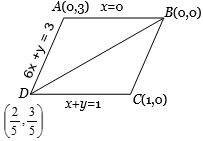
View full question & answer→MCQ 2391 Mark
The equation of the base of an equilateral triangle is $x + y = 2$ and the vertex is $(2, -1)$. The length of the side of the triangle is
- A
$\sqrt {3/2} $
- B
$\sqrt 2 $
- ✓
$\sqrt {2/3} $
- D
AnswerCorrect option: C. $\sqrt {2/3} $
c
(c) Let $p$ be the length of the perpendicular from the vertex $(2, -1)$ to the base $x + y = 2$.
Then $p = \left| {\frac{{2 - 1 - 2}}{{\sqrt {{1^2} + {1^2}} }}} \right| = \frac{1}{{\sqrt 2 }}$
If ‘a’ be the length of the side of triangle, then $p = a\sin {60^o} \Rightarrow \frac{1}{{\sqrt 2 }} = \frac{{a\sqrt 3 }}{2} \Rightarrow a = \sqrt {\frac{2}{3}} $.
View full question & answer→MCQ 2401 Mark
The area of a parallelogram formed by the lines $ax \pm by \pm c = 0$, is
- A
$\frac{{{c^2}}}{{ab}}$
- ✓
$\frac{{2{c^2}}}{{ab}}$
- C
$\frac{{{c^2}}}{{2ab}}$
- D
AnswerCorrect option: B. $\frac{{2{c^2}}}{{ab}}$
b
(b) $ax \pm by \pm c = 0 \Rightarrow \frac{x}{{ \pm c/a}} + \frac{y}{{ \pm c/b}} = 1$ which meets on axes at $A{\rm{ }}\left( {\frac{c}{a},0} \right){\rm{ }},{\rm{ }}$$C{\rm{ }}\left( { - \frac{c}{a},0} \right){\rm{ }},{\rm{ }}$${\rm{ }}B{\rm{ }}\left( {0,\frac{c}{b}} \right)$, $D{\rm{ }}\left( {0, - \frac{c}{b}} \right)$.
Therefore, the diagonals $AC$ and $BD$ of quadrilateral $ABCD$ are perpendicular, hence it is a rhombus whose area is given by $ = \frac{1}{2}AC \times BD = \frac{1}{2} \times \frac{{2c}}{a} \times \frac{{2c}}{b} = \frac{{2{c^2}}}{{ab}}$.
View full question & answer→MCQ 2411 Mark
For the straight lines given by the equation $(2 + k)x + (1 + k)y = 5 + 7k,$ for different values of $k$ which of the following statements is true
- A
- ✓
Lines pass through the point $(-2, 9)$
- C
Lines pass through the point $(2, -9)$
- D
AnswerCorrect option: B. Lines pass through the point $(-2, 9)$
b
(b) Putting $k = 1,{\rm{ }}2$, we get
$3x + 2y = 12$.....(i)
$4x + 3y = 19$.....(ii)
Obviously, the given lines are not parallel. Hence on solving them, we get $x = - {\rm{ }}2$, $y = 9$.
Therefore the lines pass through $( - 2,\,9)$.
View full question & answer→MCQ 2421 Mark
A line $4x + y = 1$ passes through the point $A(2,\; - \;7)$ meets the line $BC$ whose equation is $3x - 4y + 1 = 0$ at the point $B$. The equation to the line $AC$ so that $AB = AC$, is
- ✓
$52x + 89y + 519 = 0$
- B
$52x + 89y - 519 = 0$
- C
$89x + 52y + 519 = 0$
- D
$89x + 52y - 519 = 0$
AnswerCorrect option: A. $52x + 89y + 519 = 0$
a
(a) Slopes of $AB$ and $BC$ are $-4$ and $\frac{3}{4}$ respectively. If $\alpha $ be the angle between $AB$ and $BC$, then $\tan \alpha = \frac{{ - 4 - \frac{3}{4}}}{{1 - 4\left( {\frac{3}{4}} \right)}} = \frac{{19}}{8}$ .....$(i)$
Since $AB = AC$
$ \Rightarrow \angle ABC = \angle ACB = \alpha $
Thus the line $AC$ also makes an angle $\alpha $with BC. If m be the slope of the line $AC$, then its equation is $y + 7 = m(x - 2)$ .....$(ii)$
Now $\tan \alpha = \pm \left[ {\frac{{m - \frac{3}{4}}}{{1 + m.\frac{3}{4}}}} \right] \Rightarrow \frac{{19}}{8} = \pm \frac{{4m - 3}}{{4 + 3m}}$
==> $m = - 4$or -$\frac{{52}}{{89}}$.
But slope of $AB$ is $-4$, so slope of $AC$ is $ - \frac{{52}}{{89}}$.
Therefore the equation of line $AC$ given by $(ii)$ is $52x + 89y + 519 = 0$.
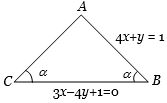
View full question & answer→MCQ 2431 Mark
Two consecutive sides of a parallelogram are $4x + 5y = 0$ and $7x + 2y = 0.$ If the equation to one diagonal is $11x + 7y = 9,$ then the equation of the other diagonal is
- A
$x + 2y = 0$
- B
$2x + y = 0$
- ✓
$x - y = 0$
- D
AnswerCorrect option: C. $x - y = 0$
c
(c) Since equation of diagonal $11x + 7y = 9$ does not pass through origin, so it cannot be the equation of the diagonal $OB$.
Thus on solving the equation $AC$ with the equations $OA$ and $OC$, we get $A\left( {\frac{5}{3}, - \frac{4}{3}} \right)$ and $C\,\left( {\frac{{ - 2}}{3},\,\frac{7}{3}} \right)$.
Therefore, the middle point M is $\left( {\frac{1}{2},\frac{1}{2}} \right)$
Hence the equation of $OB$ is $y = x$ i.e.,$x - y = 0$.
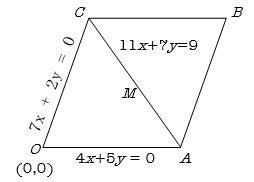
View full question & answer→MCQ 2441 Mark
The line joining two points $A(2,0), B(3,1)$ is rotated about $A$ in anti-clockwise direction through an angle of ${15^o}$. The equation of the line in the new position, is
AnswerCorrect option: A. $\sqrt 3 x - y - 2\sqrt 3 = 0$
a
(a) Here slope of $AB = \frac{1}{1} \Rightarrow \tan \theta = {m_1} = 1$or $\theta = {45^o}$.
Thus slope of new line is $\tan ({45^o} + {15^o}) = \tan {60^o} = \sqrt 3 $
{It is rotated anticlockwise so the angle will be ${45^o} + {15^o} = {60^o}$}
Hence the equation is $y = \sqrt 3 x + c$, but it still passes through (2,0), hence $c = - 2\sqrt 3 $.
Thus required equation is
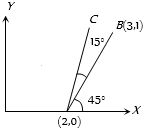
View full question & answer→MCQ 2451 Mark
In what direction a line be drawn through the point $(1, 2)$ so that its points of intersection with the line $x + y = 4$ is at a distance $\frac{{\sqrt 6 }}{3}$ from the given point
- A
${30^o}$
- B
${45^o}$
- C
${60^o}$
- ✓
${75^o}$
AnswerCorrect option: D. ${75^o}$
d
(d) Let the required line through the point $(1,2)$ be inclined at an angle $\theta $ to the axis of $x$. Then its equation is $\frac{{x - 1}}{{\cos \theta }} = \frac{{y - 2}}{{\sin \theta }} = r$ .....$(i)$
where r is distance of any point $(x, y)$ on the line from the point $(1, 2)$.
The coordinates of any point on the line $(i)$ are $(1 + r\cos \theta ,{\rm{ }}2 + r\sin \theta )$. If this point is at a distance $\frac{{\sqrt 6 }}{3}$ form (1, 2), then $r = \frac{{\sqrt 6 }}{3}.$
Therefore, the point is $\left( {1 + \frac{{\sqrt 6 }}{3}\cos \theta ,{\rm{ }}2 + \frac{{\sqrt 6 }}{3}\sin \theta } \right)$.
But this point lies on the line $x + y = 4$.
==> $\frac{{\sqrt 6 }}{3}(\cos \theta + \sin \theta ) = 1$ or $\sin \theta + \cos \theta = \frac{3}{{\sqrt 6 }}$
==> $\frac{1}{{\sqrt 2 }}\sin \theta + \frac{1}{{\sqrt 2 }}\cos \theta = \frac{{\sqrt 3 }}{2}$,
{Dividing both sides by $\sqrt 2 $}
==> $\sin (\theta + {45^o}) = \sin {60^o}$or sin ${120^o}$
==> $\theta = {15^o}$or ${75^o}$.
View full question & answer→MCQ 2461 Mark
If the slope of a line passing through the point $A \,(3, 2)$ be $3/4$, then the points on the line which are $5$ units away from $A$, are
- A
$(5, 5),\, (-1, -1)$
- ✓
$(7, 5), \,(-1, -1)$
- C
$(5, 7),\, (-1, -1)$
- D
$(7, 5), \, (1, 1)$
AnswerCorrect option: B. $(7, 5), \,(-1, -1)$
b
(b) The equation of line passes through $(3, 2)$ and of slope $\frac{3}{4}$ is $3x - 4y - 1 = 0$
Let the point be $(h,k)$then $3h - 4k - 1 = 0$……$(i)$
and ${(h - 3)^2} + {(y - 2)^2} = {5^2}$……$(ii)$
On solving the equations, we get $h = - 1,\,7$ and $k = - 1,5$. Hence points are $(-1, -1) $ and $(7, 5).$
View full question & answer→MCQ 2471 Mark
The equations of the lines through the point of intersection of the lines $x - y + 1 = 0$ and $2x - 3y + 5 = 0$ and whose distance from the point $(3, 2)$ is $\frac{7}{5},$ is
- A
$3x - 4y - 6 = 0$ and $4x + 3y + 1 = 0$
- B
$3x - 4y + 6 = 0$ and $4x - 3y - 1 = 0$
- ✓
$3x - 4y + 6 = 0$ and $4x - 3y + 1 = 0$
- D
AnswerCorrect option: C. $3x - 4y + 6 = 0$ and $4x - 3y + 1 = 0$
c
(c) Point of intersection is $(2, 3)$. Therefore, the equation of line passing through $(2, 3)$ is
$y - 3 = m\,(x - 2)$ ……$(i)$
or $mx - y - (2m - 3) = 0$.
According to the condition,
$\frac{{3m - 2 - (2m - 3)}}{{\sqrt {1 + {m^2}} }} = \frac{7}{5} \Rightarrow m = \frac{3}{4},\frac{4}{3}$
Hence the equations are $3x - 4y + 6 = 0$ and $4x - 3y + 1 = 0$.
View full question & answer→MCQ 2481 Mark
The vertices of a triangle are $(2, 1)$, $(5, 2)$ and $(4, 4)$. The lengths of the perpendicular from these vertices on the opposite sides are
- A
$\frac{7}{{\sqrt 5 }},\frac{7}{{\sqrt {13} }},\frac{7}{{\sqrt 6 }}$
- B
$\frac{7}{{\sqrt 6 }},\frac{7}{{\sqrt 8 }},\frac{7}{{\sqrt {10} }}$
- C
$\frac{7}{{\sqrt 5 }},\frac{7}{{\sqrt 8 }},\frac{7}{{\sqrt {15} }}$
- ✓
$\frac{7}{{\sqrt 5 }},\frac{7}{{\sqrt {13} }},\frac{7}{{\sqrt {10} }}$
AnswerCorrect option: D. $\frac{7}{{\sqrt 5 }},\frac{7}{{\sqrt {13} }},\frac{7}{{\sqrt {10} }}$
d
(d) ${L_{12}} \equiv x - 3y + 1 = 0$
${L_{23}} \equiv 2x + y - 12 = 0$
${L_{13}} \equiv 3x - 2y - 4 = 0$
Therefore, the required distances are
${D_3} = \left| {\frac{{4 - 3 \times 4 + 1}}{{\sqrt {10} }}} \right| = \frac{7}{{\sqrt {10} }}$
${D_1} = \left| {\frac{{4 + 1 - 12}}{{\sqrt 5 }}} \right| = \frac{7}{{\sqrt 5 }}$
${D_2} = \left| {\frac{{3 \times 5 - 2 \times 2 - 4}}{{\sqrt {9 + 4} }}} \right| = \frac{7}{{\sqrt {13} }}$.
View full question & answer→MCQ 2491 Mark
One diagonal of a square is along the line $8x - 15y = 0$ and one of its vertex is $(1, 2)$ Then the equation of the sides of the square passing through this vertex, are
- A
$23x + 7y = 9,\;7x + 23y = 53$
- B
$23x - 7y + 9 = 0,\;7x + 23y + 53 = 0$
- ✓
$23x - 7y - 9 = 0,\;7x + 23y - 53 = 0$
- D
AnswerCorrect option: C. $23x - 7y - 9 = 0,\;7x + 23y - 53 = 0$
c
(c) Slope of $BD$ is $\frac{8}{{15}}$ and angle made by $BD$ with $AD$ and $DC$ is ${45^o}$. So let slope of $DC$ be m, then $\tan {45^o} = \pm \frac{{m - \frac{8}{{15}}}}{{1 + \frac{8}{{15}}m}}$
$ \Rightarrow (15 + 8m) = \pm (15m - 8)$
==> $m = \frac{{23}}{7}$and $ - \frac{7}{{23}}$
Hence the equations of $DC$ and $AD$ are
$y - 2 = \frac{{23}}{7}(x - 1)$$ \Rightarrow 23x - 7y - 9 = 0$
and $y - 2 = - \frac{7}{{23}}(x - 1)$$ \Rightarrow 7x + 23y - 53 = 0$.
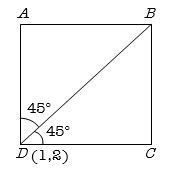
View full question & answer→MCQ 2501 Mark
Slope of a line which cuts intercepts of equal lengths on the axes is
Answera
(a) The equation of line $\frac{x}{a} + \frac{y}{a} = 1$
$⇒$ $x + y - a = 0$
${\rm{Slope}} = - \frac{{{\rm{Coefficient}}\,{\rm{of}}\,x}}{{{\rm{Coefficient}}\,{\rm{of}}\,y}} = - 1$.
View full question & answer→MCQ 2511 Mark
The line $(3x - y + 5) + \lambda (2x - 3y - 4) = 0$ will be parallel to $y$-axis, if $\lambda$ =
- A
$\frac{1}{3}$
- ✓
$\frac{{ - 1}}{3}$
- C
$\frac{3}{2}$
- D
$\frac{{ - 3}}{2}$
AnswerCorrect option: B. $\frac{{ - 1}}{3}$
b
(b) The given line can be written in this form $(3 + 2\lambda )x + ( - 1 - 3\lambda )y + (5 - 4\lambda ) = 0$
It is will be parallel to $y$-axis, if
$ - 1 - 3\lambda = 0 $
$\Rightarrow \,\lambda = - \frac{1}{3}$.
View full question & answer→MCQ 2521 Mark
The gradient of the line joining the points on the curve $y = {x^2} + 2x$ whose abscissa are $1$ and $3$, is
Answera
(a) The points are $(1, 3)$ and $(3, 15).$
Hence gradient $ = \frac{{12}}{2} = 6$.
View full question & answer→MCQ 2531 Mark
The equation of the straight line which passes through the point $(1, -2)$ and cuts off equal intercepts from axes, is
- A
$x + y = 1$
- B
$x - y = 1$
- ✓
$x + y + 1 = 0$
- D
$x - y - 2 = 0$
AnswerCorrect option: C. $x + y + 1 = 0$
c
(c) The equation of line which cuts off equal intercepts from axes a (say) is $\frac{x}{a} + \frac{y}{a} = 1$ or $x + y = a$
But it is passes through $(1, -2)$, therefore $1 - 2 = a$ $ \Rightarrow a = - 1$.
Hence the equation of straight line is $x + y + 1 = 0$.
View full question & answer→MCQ 2541 Mark
The equations of the lines which cuts off an intercept $-1$ from $y$-axis are equally inclined to the axes are
- A
$x - y + 1 = 0,\;\;x + y + 1 = 0$
- B
$x - y - 1 = 0,\;\;x + y - 1 = 0$
- ✓
$x - y - 1 = 0,\;\;x + y + 1 = 0$
- D
AnswerCorrect option: C. $x - y - 1 = 0,\;\;x + y + 1 = 0$
c
(c) Here $c = - 1$ and $m = \tan \theta = \tan {45^o} = 1$
(Since the line is equally inclined to the axes, so $\theta = {45^o}$ or $135^o$)
Hence equation of straight line is $y = \pm (1.\,x) - 1$
==> $x - y - 1 = 0$ and $x + y + 1 = 0$.
View full question & answer→MCQ 2551 Mark
The equation of the line whose slope is $3$ and which cuts off an intercept $3$ from the positive $x$ -axis is
- ✓
$y = 3x - 9$
- B
$y = 3x + 3$
- C
$y = 3x + 9$
- D
AnswerCorrect option: A. $y = 3x - 9$
a
(a) Obviously $m = \tan \theta = \frac{{ - c}}{3} $
$\Rightarrow 3 = \frac{{ - c}}{3} $
$\Rightarrow c = - 9$
Hence the required equation is $y = 3x - 9$.
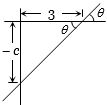
View full question & answer→MCQ 2561 Mark
The equation of the straight line passing through the point $(3, 2)$ and perpendicular to the line $y = x$ is
- A
$x - y = 5$
- ✓
$x + y = 5$
- C
$x + y = 1$
- D
$x - y = 1$
AnswerCorrect option: B. $x + y = 5$
b
(b) Let the required equation is $y = - x + c$ which is perpendicular to $y = x$ and passes through $(3, 2)$.
.So $2 = - 3 + c \Rightarrow c = 5$.
Hence required equation is $x + y = 5$.
View full question & answer→MCQ 2571 Mark
The equation of the line passing through the point $(x',\;y')$ and perpendicular to the line $yy' = 2a\,(x + x')$ is
- A
$xy' + 2ay + 2ay' - x'y' = 0$
- ✓
$xy' + 2ay - 2ay' - x'y' = 0$
- C
$xy' + 2ay + 2ay' + x'y' = 0$
- D
$xy' + 2ay - 2ay' + x'y' = 0$
AnswerCorrect option: B. $xy' + 2ay - 2ay' - x'y' = 0$
b
(b)Slope =$\frac{{ - y'}}{{2a}}$.
Hence equation is $y'x + 2ay = y'x' + 2ay'$.
View full question & answer→MCQ 2581 Mark
The equation of the line perpendicular to the line $\frac{x}{a} - \frac{y}{b} = 1$ and passing through the point at which it cuts $x$-axis, is
- A
$\frac{x}{a} + \frac{y}{b} + \frac{a}{b} = 0$
- B
$\frac{x}{b} + \frac{y}{a} = \frac{b}{a}$
- C
$\frac{x}{b} + \frac{y}{a} = 0$
- ✓
$\frac{x}{b} + \frac{y}{a} = \frac{a}{b}$
AnswerCorrect option: D. $\frac{x}{b} + \frac{y}{a} = \frac{a}{b}$
d
(d) The given line is $bx - ay = ab$
Obviously it cuts $x$-axis at $(a, 0)$. The equation of line perpendicular to $(i)$ is $ax + by = k$, but it passes through $(a, 0)$ ==> $k = {a^2}$.
Hence required equation of line is $ax + by = {a^2}$
i.e., $\frac{x}{b} + \frac{y}{a} = \frac{a}{b}$.
View full question & answer→MCQ 2591 Mark
The equation of the line parallel to the line $2x - 3y = 1$ and passing through the middle point of the line segment joining the points $(1, 3)$ and $(1, -7)$, is
- A
$2x - 3y + 8 = 0$
- ✓
$2x - 3y = 8$
- C
$2x - 3y + 4 = 0$
- D
$2x - 3y = 4$
AnswerCorrect option: B. $2x - 3y = 8$
b
(b) Mid point $ \equiv \left( {\frac{{1 + 1}}{2},\frac{{3 - 7}}{2}} \right) = (1, - 2)$
Therefore required line is $2x - 3y = k \Rightarrow 2x - 3y = 8$.
View full question & answer→MCQ 2601 Mark
The equation of a straight line passing through $(-3,2)$and cutting an intercept equal in magnitude but opposite in sign from the axes is given by
- ✓
$x - y + 5 = 0$
- B
$x + y - 5 = 0$
- C
$x - y - 5 = 0$
- D
$x + y + 5 = 0$
AnswerCorrect option: A. $x - y + 5 = 0$
a
(a)Let the equation be $\frac{x}{a} + \frac{y}{{ - a}} = 1 \Rightarrow x - y = a$
But it passes through $( - 3,\,2)$, hence $a = - 3 - 2 = - 5$. Hence the equation is $x - y + 5 = 0$.
View full question & answer→MCQ 2611 Mark
The equation of a line passing through the point of intersection of the lines $x + 5y + 7 = 0,\;\;3x + 2y - 5 = 0,$ and perpendicular to the line $7x + 2y - 5 = 0,$ is given by
- ✓
$2x - 7y - 20 = 0$
- B
$2x + 7y - 20 = 0$
- C
$ - 2x + 7y - 20 = 0$
- D
$2x + 7y + 20 = 0$
AnswerCorrect option: A. $2x - 7y - 20 = 0$
a
(a) Point of intersection of the lines is $(3, -2)$.
Hence the equation is $2x - 7y = 2(3) - 7( - 2) = 20$.
View full question & answer→MCQ 2621 Mark
A line passes through the point of intersection of $2x + y = 5$ and $x + 3y + 8 = 0$ and parallel to the line $3x + 4y = 7$ is
- ✓
$3x + 4y + 3 = 0$
- B
$3x + 4y = 0$
- C
$4x - 3y + 3 = 0$
- D
$4x - 3y = 3$
AnswerCorrect option: A. $3x + 4y + 3 = 0$
a
(a)Point of intersection $y = - \frac{{21}}{5}$and $x = \frac{{23}}{5}$
$\therefore $ $3x + 4y = \frac{{3(23) + 4( - 21)}}{5} = \frac{{69 - 84}}{5} = - 3$.
Hence, required line is $3x + 4y + 3 = 0$.
View full question & answer→MCQ 2631 Mark
The equation of the line joining the origin to the point $(-4, 5)$, is
- ✓
$5x + 4y = 0$
- B
$3x + 4y = 2$
- C
$5x - 4y = 0$
- D
$4x - 5y = 0$
AnswerCorrect option: A. $5x + 4y = 0$
a
(a) $m = \frac{5}{{ - 4}}.$ Therefore the line is $5x + 4y = 0$.
View full question & answer→MCQ 2641 Mark
The equation of a line through $(3,\, - 4)$ and perpendicular to the line $3x + 4y = 5$is
AnswerCorrect option: D. $y + 4 = \frac{4}{3}(x - 3)$
d
(d)The required equation, which passes through $(3, -4)$ and its gradient is $\frac{4}{3}$, is $(y + 4) = \frac{4}{3}(x - 3)$.
View full question & answer→MCQ 2651 Mark
Equation of the line passing through $(1, 2)$ and parallel to the line $y = 3x - 1$is
- A
$y + 2 = x + 1$
- B
$y + 2 = 3(x + 1)$
- ✓
$y - 2 = 3(x - 1)$
- D
$y - 2 = x - 1$
AnswerCorrect option: C. $y - 2 = 3(x - 1)$
c
(c) The required equation which passes through $(1, 2)$ and its gradient is $m = 3$, is $(y - 2) = 3(x - 1)$.
View full question & answer→MCQ 2661 Mark
Equation of the line passing through $(-1,1)$ and perpendicular to the line $2x + 3y + 4 = 0$ s
AnswerCorrect option: A. $2(y - 1) = 3(x + 1)$
a
(a) The gradient of line $2x + 3y + 4 = 0$is $ - \frac{2}{3}$. Now the equation of line passing through $(-1,1)$ is $y - 1 = m(x + 1),$ but $m = - \frac{1}{{ - 2/3}} = \frac{3}{2}$.
Therefore, required equation is $2(y - 1) = 3(x + 1)$.
View full question & answer→MCQ 2671 Mark
The equation of a line through the intersection of lines $x = 0$ and $y = 0$and through the point $(2, 2)$, is
- A
$y = x - 1$
- B
$y = - x$
- ✓
$y = x$
- D
$y = - x + 2$
AnswerCorrect option: C. $y = x$
c
(c) Obviously the point of intersection is $(0, 0)$. Thus the equation of line passing through the points $(0, 0)$ and $(2, 2)$ is $y = x$.
View full question & answer→MCQ 2681 Mark
Equation of a line through the origin and perpendicular to, the line joining $(a, 0)$ and $(-a, 0)$, is
- A
$y = 0$
- ✓
$x = 0$
- C
$x = - \;a$
- D
$y = - \;a$
AnswerCorrect option: B. $x = 0$
b
(b) The required equation passing through $(0, 0)$ and its gradient is $m = \frac{1}{0}$, is $y = \frac{1}{0}x \Rightarrow x = 0$.
View full question & answer→MCQ 2691 Mark
The points $A\, (1, 3)$ and $C\, (5, 1)$ are the opposite vertices of rectangle. The equation of line passing through other two vertices and of gradient $2$, is
- A
$2x + y - 8 = 0$
- ✓
$2x - y - 4 = 0$
- C
$2x - y + 4 = 0$
- D
$2x + y + 7 = 0$
AnswerCorrect option: B. $2x - y - 4 = 0$
b
(b) Mid point $ \equiv (3,\,2)$. Equation is $2x - y - 4 = 0$.
View full question & answer→MCQ 2701 Mark
The intercept cut off from $y$-axis is twice that from $x$-axis by the line and line is passes through $(1, 2)$ then its equation is
- ✓
$2x + y = 4$
- B
$2x + y + 4 = 0$
- C
$2x - y = 4$
- D
$2x - y + 4 = 0$
AnswerCorrect option: A. $2x + y = 4$
a
(a) Let the intercept be $a\,{\rm{ and}}\,2a$ , then the equation of line is $\frac{x}{a} + \frac{y}{{2a}} = 1$, but it also passes through $(1, 2)$, therefore $a = 2$.
Hence the required equation is $2x + y = 4$.
View full question & answer→MCQ 2711 Mark
The equation of line whose mid point is $({x_1},\;{y_1})$ in between the axes, is
- ✓
$\frac{x}{{{x_1}}} + \frac{y}{{{y_1}}} = 2$
- B
$\frac{x}{{{x_1}}} + \frac{y}{{{y_1}}} = \frac{1}{2}$
- C
$\frac{x}{{{x_1}}} + \frac{y}{{{y_1}}} = 1$
- D
AnswerCorrect option: A. $\frac{x}{{{x_1}}} + \frac{y}{{{y_1}}} = 2$
a
(a) Intersection point on x-axis is $(2{x_1},0)$ and on $y$-axis is $(0,{\rm{ }}2{y_1})$.
Thus equation of line passes through these points is $\frac{x}{{{x_1}}} + \frac{y}{{{y_1}}} = 2$.
View full question & answer→MCQ 2721 Mark
The equation of line passing through $(c, d)$ and parallel to $ax + by + c = 0,$ is
- A
$a(x + c) + b\,(y + d) = 0$
- B
$a(x + c) - b(y + d) = 0$
- ✓
$a(x - c) + b(y - d) = 0$
- D
AnswerCorrect option: C. $a(x - c) + b(y - d) = 0$
c
(c) The required equation which passes through $(c, d)$ and its gradient is $ - \frac{a}{b}$, is $y - d = - \frac{a}{b}(x - c)$
$ \Rightarrow a(x - c) + b(y - d) = 0$.
View full question & answer→MCQ 2731 Mark
The equation of line passing through point of intersection of lines $3x - 2y - 1 = 0$ and $x - 4y + 3 = 0$ and the point $(\pi ,\;0),$ is
- A
$x - y = \pi $
- B
$x - y = \pi (y + 1)$
- ✓
$x - y = \pi (1 - y)$
- D
$x + y = \pi (1 - y)$
AnswerCorrect option: C. $x - y = \pi (1 - y)$
c
(c)The point of intersection is $(1, 1)$ Therefore the equation of the line passing through $(1, 1)$ and $(\pi ,\,0)$ is $y - 1 = \frac{{ - 1}}{{\pi - 1}}(x - 1) \Rightarrow x - y = \pi (1 - y)$.
View full question & answer→MCQ 2741 Mark
The equation of line passing through the point of intersection of the lines $4x - 3y - 1 = 0$and $5x - 2y - 3 = 0$ and parallel to the line $2y - 3x + 2 = 0,$ is
- A
$x - 3y = 1$
- ✓
$3x - 2y = 1$
- C
$2x - 3y = 1$
- D
$2x - y = 1$
AnswerCorrect option: B. $3x - 2y = 1$
b
(b) The point of intersection of the lines is $(1, 1)$. The equation of line parallel to $2y - 3x + 2 = 0$ is $2y - 3x + k = 0$. It also passes through $(1, 1)$, $/therefore$ $\therefore$ $k=1$. Hence the required equation is $2y - 3x + 1 = 0$ or $3x - 2y = 1$.
View full question & answer→MCQ 2751 Mark
The equation of the line passing through $(4, -6)$ and makes an angle ${45^o}$ with positive $x$-axis, is
- ✓
$x - y - 10 = 0$
- B
$x - 2y - 16 = 0$
- C
$x - 3y - 22 = 0$
- D
AnswerCorrect option: A. $x - y - 10 = 0$
a
(a) The required equation is
$y + 6 = $ $\tan {45^o}(x - 4)$
$ \Rightarrow x - y - 10 = 0$.
View full question & answer→MCQ 2761 Mark
The equation of the line passes through $(a,\;b)$and parallel to the line $\frac{x}{a} + \frac{y}{b} = 1,$is
- A
$\frac{x}{a} + \frac{y}{b} = 3$
- ✓
$\frac{x}{a} + \frac{y}{b} = 2$
- C
$\frac{x}{a} + \frac{y}{b} = 0$
- D
$\frac{x}{a} + \frac{y}{b} + 2 = 0$
AnswerCorrect option: B. $\frac{x}{a} + \frac{y}{b} = 2$
b
(b)The required equation is $y - b = - \frac{b}{a}(x - a)$
$ \Rightarrow \frac{x}{a} + \frac{y}{b} = 2$.
View full question & answer→MCQ 2771 Mark
Equation of the hour hand at $4$ O’ clock is
- A
$x - \sqrt 3 \;y = 0$
- B
$\sqrt 3 \;x - y = 0$
- ✓
$x + \sqrt 3 \;y = 0$
- D
$\sqrt 3 \;x + y = 0$
AnswerCorrect option: C. $x + \sqrt 3 \;y = 0$
c
(c) Since the hour, minute and second hands always pass through origin because one end of these hands is always at origin. Now at $4$ O’ clock, the hour hand makes ${30^o}$angle in fourth quadrant. So the equation of hour hand is
$y = mx \Rightarrow y = - \frac{1}{{\sqrt 3 }}x$
$ \Rightarrow x + \sqrt 3 y = 0$.
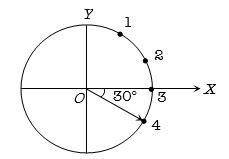
View full question & answer→MCQ 2781 Mark
The equation to the straight line passing through the point $(a{\cos ^3}\theta ,\;a{\sin ^3}\theta )$ and perpendicular to the line $x\sec \theta + y\,{\rm{cosec}}\,\theta = a,$ is
- ✓
$x\cos \theta - y\sin \theta = a\cos \;2\theta $
- B
$x\cos \theta + y\sin \theta = a\cos \;2\theta $
- C
$x\sin \theta + y\cos \theta = a\cos \;2\theta $
- D
AnswerCorrect option: A. $x\cos \theta - y\sin \theta = a\cos \;2\theta $
a
(a) $x\cos \theta - y\sin \theta = a{\rm{ }}({\cos ^4}\theta - {\sin ^4}\theta ) = a\cos 2\theta $.
View full question & answer→MCQ 2791 Mark
Equations of lines which passes through the points of intersection of the lines $4x - 3y - 1 = 0$ and $2x - 5y + 3 = 0$ and are equally inclined to the axes are
- A
$y \pm x = 0$
- ✓
$y - 1 = \pm \;1(x - 1)$
- C
$x - 1 = \pm \;2(y - 1)$
- D
AnswerCorrect option: B. $y - 1 = \pm \;1(x - 1)$
b
(b) Slopes of the lines are $1$ and $-1$
Since the point of intersection is $(1, 1)$
Hence the required equations are $y - 1 = \pm 1(x - 1)$.
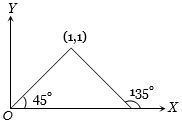
View full question & answer→MCQ 2801 Mark
The equation of a straight line passing through the points $( - 5,\; - 6)$ and $(3, 10)$, is
- A
$x - 2y = 4$
- ✓
$2x - y + 4 = 0$
- C
$2x + y = 4$
- D
AnswerCorrect option: B. $2x - y + 4 = 0$
b
(b) Slope$ = \frac{{10 + 6}}{{3 + 5}} = 2$. Hence the line is $2x - y = - 4$.
View full question & answer→MCQ 2811 Mark
The equation of the line which cuts off the intercepts $2a\sec \theta $ and $2a\,{\rm{cosec}}\,\theta $ on the axes is
- A
$x\sin \theta + y\cos \theta - 2a = 0$
- ✓
$x\cos \theta + y\sin \theta - 2a = 0$
- C
$x\sec \theta + y\,{\rm{cosec}}\theta - 2a = 0$
- D
$x\,{\rm{cosec}}\theta + y\sec \theta - 2a = 0$
AnswerCorrect option: B. $x\cos \theta + y\sin \theta - 2a = 0$
b
(b)Using the intercept form of the line
$\frac{x}{{2a\sec \theta }} + \frac{y}{{2a{\rm{cosec}}\theta }} = 1 \Rightarrow x\cos \theta + y\sin \theta = 2a$.
View full question & answer→MCQ 2821 Mark
If the equation $y = mx + c$ and $x\cos \alpha + y\sin \alpha = p$ represents the same straight line, then
- A
$p = c\sqrt {1 + {m^2}} $
- ✓
$c = p\sqrt {1 + {m^2}} $
- C
$cp = \sqrt {1 + {m^2}} $
- D
${p^2} + {c^2} + {m^2} = 1$
AnswerCorrect option: B. $c = p\sqrt {1 + {m^2}} $
b
(b)If the given lines represent the same line, then the length of the perpendiculars from the origin to the lines are equal, so that $\frac{c}{{\sqrt {1 + {m^2}} }} = $$\frac{p}{{\sqrt {{{\cos }^2}\alpha + {{\sin }^2}\alpha } }}$
$ \Rightarrow $ $c = p\sqrt {1 + {m^2}} $.
View full question & answer→MCQ 2831 Mark
The equation to the straight line passing through the point of intersection of the lines $5x - 6y - 1 = 0$ and $3x + 2y + 5 = 0$ and perpendicular to the line $3x - 5y + 11 = 0$ is
- ✓
$5x + 3y + 8 = 0$
- B
$3x - 5y + 8 = 0$
- C
$5x + 3y + 11 = 0$
- D
$3x - 5y + 11 = 0$
AnswerCorrect option: A. $5x + 3y + 8 = 0$
a
(a)The point of intersection of $5x - 6y - 1 = 0$and $3x + 2y + 5 = 0$is $( - 1,\, - 1)$. Now the line perpendicular to $3x - 5y + 11 = 0$is $5x + 3y + k = 0$, but it passes through $( - 1, - 1)$ ==> $ - 5 - 3 + k = 0 \Rightarrow k = 8$
Hence required line is $5x + 3y + 8 = 0$.
View full question & answer→MCQ 2841 Mark
Line passing through $(1, 2)$ and $(2, 5)$ is
- A
$3x - y + 1 = 0$
- B
$3x + y + 1 = 0$
- ✓
$y - 3x + 1 = 0$
- D
$3x + y - 1 = 0$
AnswerCorrect option: C. $y - 3x + 1 = 0$
c
(c) Required equation is $y - 2 = \frac{{5 - 2}}{{2 - 1}}(x - 1) \Rightarrow y - 3x + 1 = 0$.
View full question & answer→MCQ 2851 Mark
Equation of line passing through $(1, 2)$ and perpendicular to $3x + 4y + 5 = 0$ is
- A
$3y = 4x - 2$
- B
$3y = 4x + 3$
- C
$3y = 4x + 4$
- ✓
$3y = 4x + 2$
AnswerCorrect option: D. $3y = 4x + 2$
d
(d)Trick : Line $3y = 4x + 2$ is perpendicular to given line and passing through $(1, 2)$.
View full question & answer→MCQ 2861 Mark
The number of lines that are parallel to $2x + 6y + 7 = 0$ and have an intercept of length $10$ between the coordinate axes is
Answerb
(b) The equation of any line parallel to $2x + 6y + 7 = 0$ is $2x + 6y + k = 0$.
This meets the axes at $A\left( { - \frac{k}{2},0} \right)$and $B\left( {0, - \frac{k}{6}} \right)$.
By hypothesis, $AB = 10$
$ \Rightarrow \sqrt {\frac{{{k^2}}}{4} + \frac{{{k^2}}}{{36}}} = 10$
$\Rightarrow \sqrt {\frac{{10{k^2}}}{{36}}} = 10$
==> $10{k^2} = 3600 \Rightarrow k = \pm 6\sqrt {10} $.
Hence there are two lines given by $2x + 6y \pm 6\sqrt {10} = 0$.
View full question & answer→MCQ 2871 Mark
A straight the makes an angle of ${135^o}$ with the $x$-axis and cuts $y$-axis at a distance $-5$ from the origin. The equation of the line is
- A
$2x + y + 5 = 0$
- B
$x + 2y + 3 = 0$
- ✓
$x + y + 5 = 0$
- D
$x + y + 3 = 0$
AnswerCorrect option: C. $x + y + 5 = 0$
c
(c) ==> $y = (\tan {135^o})x - 5$
==> $y = - x - 5 \Rightarrow x + y + 5 = 0$.
View full question & answer→MCQ 2881 Mark
A straight line through $P(1, 2)$ is such that its intercept between the axes is bisected at $P$ Its equation is
- A
$x + 2y = 5$
- B
$x - y + 1 = 0$
- C
$x + y - 3 = 0$
- ✓
$2x + y - 4 = 0$
AnswerCorrect option: D. $2x + y - 4 = 0$
d
(d) Let the equation of the line be $\frac{x}{a} + \frac{y}{b} = 1$.
The coordinates of the mid point of the intercept $AB$ between the axes are $\left( {\frac{a}{2},\frac{b}{2}} \right)$.
$\frac{a}{2} = 1,\frac{b}{2} = 2 \Rightarrow a = 2,b = 4$.
Hence the equation of the line is $\frac{x}{2} + \frac{y}{4} = 1$, $2x + y = 4$.
View full question & answer→MCQ 2891 Mark
The equation of the straight line joining the point $(a,\;b)$ to the point of intersection of the lines $\frac{x}{a} + \frac{y}{b} = 1$ and $\frac{x}{b} + \frac{y}{a} = 1$ is
- ✓
${a^2}y - {b^2}x = ab\;(a - b)$
- B
${a^2}y + {b^2}y = ab\;(a + b)$
- C
${a^2}y + {b^2}x = ab$
- D
${a^2}x + {b^2}y = ab\;(a - b)$
AnswerCorrect option: A. ${a^2}y - {b^2}x = ab\;(a - b)$
a
(a)The given lines intersect at $\left( {\frac{{ab}}{{a + b}},\frac{{ab}}{{a + b}}} \right)$ and join of this with $(a, b)$ will have slope $\frac{{{b^2}}}{{{a^2}}}$. Now proceed.
View full question & answer→MCQ 2901 Mark
The equation of the line passing through $(1, 1)$ and parallel to the line $2x + 3y - 7 = 0$ is
- ✓
$2x + 3y - 5 = 0$
- B
$3x + 2y - 5 = 0$
- C
$3x - 2y - 7 = 0$
- D
$2x + 3y + 5 = 0$
AnswerCorrect option: A. $2x + 3y - 5 = 0$
a
(a) Required equation of the line, $2x + 3y + \lambda = 0$
This line passing through point $(1, 1)$
==> $2 + 3 + \lambda = 0 \Rightarrow \lambda = - 5$
Required equation is $2x + 3y - 5 = 0$.
View full question & answer→MCQ 2911 Mark
The equation of straight line passing through the intersection of the lines $x - 2y = 1$ and $x + 3y = 2$ and parallel to $3x + 4y = 0$ is
- A
$3x + 4y + 5 = 0$
- B
$3x + 4y - 10 = 0$
- ✓
$3x + 4y - 5 = 0$
- D
$3x + 4y + 6 = 0$
AnswerCorrect option: C. $3x + 4y - 5 = 0$
c
(c)The intersection point of lines $x - 2y = 1$ and $x + 3y = 2$ is $\left( {\frac{7}{5},\,\frac{1}{5}} \right)$ and the slope of required line $ = - \frac{3}{4}$
Equation of required line is $y - \frac{1}{5} = \frac{{ - 3}}{4}\left( {x - \frac{7}{5}} \right)$
==>$\frac{{3x}}{4} + y = \frac{{21}}{{20}} + \frac{1}{5}$==>$3x + 4y = 5$==>$3x + 4y - 5 = 0$.
View full question & answer→MCQ 2921 Mark
Equation of a line passing through the point of intersection of lines $2x - 3y + 4 = 0,$ $3x + 4y - 5 = 0$ and perpendicular to $6x - 7y + 3 = 0,$ then its equation is
- A
$119x + 102y + 125 = 0$
- ✓
$119x + 102y = 125$
- C
$119x - 102y = 125$
- D
AnswerCorrect option: B. $119x + 102y = 125$
b
(b) The point of intersection of lines $2x - 3y + 4 = 0$ and $3x + 4y - 5 = 0$ is $\left( {\frac{{ - 2}}{{34}},\,\frac{{22}}{{17}}} \right)$
The slope of required line $ = \frac{{ - 7}}{6}$
Equation of required line is $y - \frac{{22}}{{17}} = \frac{{ - 7}}{6}\left( {x + \frac{2}{{34}}} \right)$
==> $119x + 102y = 125$.
View full question & answer→MCQ 2931 Mark
If we reduce $3x + 3y + 7 = 0$ to the form $x\cos \alpha + y\sin \alpha = p,$ then the value of $p$ is
- A
$\frac{7}{{2\sqrt 3 }}$
- B
$\frac{7}{3}$
- C
$\frac{{3\sqrt 7 }}{2}$
- ✓
$\frac{7}{{3\sqrt 2 }}$
AnswerCorrect option: D. $\frac{7}{{3\sqrt 2 }}$
d
(d) Given form is $3x + 3y + 7 = 0$
==> $\frac{3}{{\sqrt {{3^2} + {3^2}} }}x + \frac{3}{{\sqrt {{3^2} + {3^2}} }}y + 7 = 0$
==> $\frac{3}{{3\sqrt 2 }}x + \frac{3}{{3\sqrt 2 }}y = \frac{{ - 7}}{{3\sqrt 2 }}$, $p = \left| {\frac{{ - 7}}{{3\sqrt 2 }}} \right|\, = \frac{7}{{3\sqrt 2 }}$.
View full question & answer→MCQ 2941 Mark
The equation of the straight line joining the origin to the point of intersection of $y - x + 7 = 0$ and $y + 2x - 2 = 0$ is
- A
$3x + 4y = 0$
- B
$3x - 4y = 0$
- C
$4x - 3y = 0$
- ✓
$4x + 3y = 0$
AnswerCorrect option: D. $4x + 3y = 0$
d
(d)The intersection point of $y - x + 7 = 0$ and $y + 2x - 2 = 0$ is $(3,\, - 4)$
Equation of straight line joining origin to $(3,\, - 4)$ is
$y - 0 = \frac{{ - 4}}{3}(x - 0)$ ==> $4x + 3y = 0$.
View full question & answer→MCQ 2951 Mark
A line $AB$ makes zero intercepts on $x$-axis and $y$-axis and it is perpendicular to another line $CD$, $3x + 4y + 6 = 0.$ The equation of line $ AB$ is
- A
$y = 4$
- B
$4x - 3y + 8 = 0$
- ✓
$4x - 3y = 0$
- D
$4x - 3y + 6 = 0$
AnswerCorrect option: C. $4x - 3y = 0$
c
(c) Given, line $AB$ making $0$ intercepts on x-axis and $y$-axis or $({x_1},\,{y_1}) \equiv (0,\,0)$ and the line is perpendicular to line $CD,\,3x + 4y + 6 = 0$. We know that standard equation of a line is $y = ax + b.$ Comparing given equation of line $CD$ with the standard equation, we get $a = 3$ and $b = 4$.
We also know that slope of the given line $CD = - \frac{a}{b} = \frac{{ - 3}}{4}.$ Since the line $AB$ is perpendicular to the line $CD$, therefore slope of the line $AB(m) = \frac{4}{3}$. Thus relation for the equation of the line $AB$ will be $(y - {y_1}) = m(x - {x_1})$ or $y - 0 = \frac{4}{3}(x - 0)$ or $3y = 4x$ or $4x - 3y = 0$.
View full question & answer→MCQ 2961 Mark
The equation of straight line passing through point of intersection of the straight lines $3x - y + 2 = 0$ and $5x - 2y + 7 = 0$ and having infinite slope is
- A
$x = 2$
- B
$x + y = 3$
- ✓
$x = 3$
- D
$x = 4$
AnswerCorrect option: C. $x = 3$
c
(c) Required line should be,
$(3x - y + 2) + \lambda (5x - 2y + 7) = 0$ …..$(i)$
==> $(3 + 5\lambda )x - (2\lambda + 1)y + (2 + 7\lambda ) = 0$
==> $y = \frac{{3 + 5\lambda }}{{2\lambda + 1}}x + \frac{{2 + 7\lambda }}{{2\lambda + 1}}$ …..$(ii)$
As the equation $(ii)$, has infinite slope, $2\lambda + 1 = 0$
==> $\lambda = - 1/2$ putting $\lambda = - 1/2$ in equation (i) we have $(3x - y + 2) + ( - 1/2)(5x - 2y + 7) = 0$==> $x = 3$.
View full question & answer→MCQ 2971 Mark
The equation of the straight line which is perpendicular to $y = x$ and passes through $(3, 2)$ is
- A
$x - y = 5$
- ✓
$x + y = 5$
- C
$x + y = 1$
- D
$x - y = 1$
AnswerCorrect option: B. $x + y = 5$
b
(b) Slope of given line $y = x$ is 1
$\therefore $ Slope of required line $ = - 1$
Thus, the equation of required line
$y - 2 = - 1(x - 3)$ ==> $x + y = 5$.
View full question & answer→MCQ 2981 Mark
Equation to the straight line cutting off an intercept $2$ from the negative direction of the axis of $y$ and inclined at $30^o$ to the positive direction of axis of $x$, is
AnswerCorrect option: D. $\sqrt 3 y - x + 2\sqrt 3 = 0$
d
(d) $y = mx + c$; $m = \tan 30^\circ $ $ = \frac{1}{{\sqrt 3 }}$; $c = - 2$
$\therefore $ $y = \frac{x}{{\sqrt 3 }} - 2$
==> $\sqrt 3 y - x + 2\sqrt 3 = 0$.
View full question & answer→MCQ 2991 Mark
The equation of the line bisecting perpendicularly the segment joining the points $(-4, 6)$ and $(8, 8)$ is
- ✓
$6x + y - 19 = 0$
- B
$y = 7$
- C
$6x + 2y - 19 = 0$
- D
$x + 2y - 7 = 0$
AnswerCorrect option: A. $6x + y - 19 = 0$
a
(a) Equation of the line passing through $( - 4,\,6)$ and $(8,\,8)$ is $y - 6 = \left( {\frac{{8 - 6}}{{8 + 4}}} \right)\,(x + 4)$ ==> $y - 6 = \frac{2}{{12}}(x + 4)$
==> $6y - 36 = x + 4$ ==> $6y - x - 40 = 0$ ……$(i)$
Now equation of any line perpendicular to it is
$6x + y + \lambda = 0$ ……$(ii)$
This line passes through the mid point of $( - 4,\,6)$ and $(8,\,8)$ i.e., $(2,\,7)$==> $6 \times 2 + 7 + \lambda = 0$
==> $19 + \lambda = 0 \Rightarrow \lambda = - 19$
From $(ii)$ the equation of required line is $6x + y - 19 = 0$.
View full question & answer→MCQ 3001 Mark
Equation of a line passing through $(1, -2)$ and perpendicular to the line $3x - 5y + 7 = 0$ is
- ✓
$5x + 3y + 1 = 0$
- B
$3x + 5y + 1 = 0$
- C
$5x - 3y - 1 = 0$
- D
$3x - 5y + 1 = 0$
AnswerCorrect option: A. $5x + 3y + 1 = 0$
a
(a) Equation of a line perpendicular to $3x - 5y + 7 = 0$ is $5x + 3y + \lambda = 0$……$(i)$
This equation passes through $(1,\, - 2)$
$5 \times 1 + 3 \times ( - 2) + \lambda = 0$
==> $5 - 6 + \lambda = 0$
==> $\lambda = 1$
Equation is $5x + 3y + 1 = 0$.
View full question & answer→MCQ 3011 Mark
If the line $\frac{x}{a} + \frac{y}{b} = 1$ passes through the points $(2, -3)$ and $(4, -5)$, then $(a,\;b)$=
- A
$(1, 1)$
- B
$(-1, 1)$
- C
$(1, -1)$
- ✓
$(-1, -1)$
AnswerCorrect option: D. $(-1, -1)$
d
(d) $\frac{2}{a} - \frac{3}{b} = 1$ and $\frac{4}{a} - \frac{5}{b} = 1$
==> $b = - 1,a = - 1$.
View full question & answer→MCQ 3021 Mark
For the lines $2x + 5y = 7$and $2x - 5y = 9,$which of the following statement is true
Answerc
(c)Let ${L_1} \equiv 2x + 5y - 7 = 0$ and ${L_2} \equiv 2x - 5y - 9 = 0$, so that ${m_1} = - \frac{2}{5},{m_2} = + \frac{2}{5}$.
Lines are neither parallel nor perpendicular, also not coincident. Hence the lines are intersecting.
View full question & answer→MCQ 3031 Mark
A straight line makes an angle of ${135^o}$ with $x$-axis and cuts $y$-axis at a distance of -$5$ from the origin. The equation of the line is
- A
$2x + y + 5 = 0$
- B
$x + 2y + 3 = 0$
- ✓
$x + y + 5 = 0$
- D
$x + y + 3 = 0$
AnswerCorrect option: C. $x + y + 5 = 0$
c
(c) Let the equation of line is $y = mx + c$
Given line makes an angle of $135^\circ $ with x-axis
So, $m = \tan \theta = \tan 135^\circ = - 1$ and cuts the intercepts $-5$ from origin to $y$-axis i.e., $c = - 5$
Hence, equation of line is $y = - x - 5$
$\Rightarrow x + y + 5 = 0$.
View full question & answer→MCQ 3041 Mark
Equation of the straight line making equal intercepts on the axes and passing through the point $(2, 4)$ is
- A
$4x - y - 4 = 0$
- B
$2x + y - 8 = 0$
- ✓
$x + y - 6 = 0$
- D
$x + 2y - 10 = 0$
AnswerCorrect option: C. $x + y - 6 = 0$
c
(c) Let the equation of line $\frac{x}{a} + \frac{y}{b} = 1$
Given $a = b$. So, equation of line is $x + y = a$ .....$(i)$
Line passes through $(2, 4)$
From equation $(i)$, $2 + 4 = a$. So, $a = 6$.
$\therefore $ Equation of line $x + y = 6$ i.e., $x + y - 6 = 0$.
View full question & answer→MCQ 3051 Mark
The equation of the line perpendicular to line $ax + by + c = 0$ and passing through $(a,\;b)$is equal to
- ✓
$bx - ay = 0$
- B
$bx + ay - 2ab = 0$
- C
$bx + ay = 0$
- D
AnswerCorrect option: A. $bx - ay = 0$
a
(a) Equation of line perpendicular to $ax + by + c = 0$ is $bx - ay + \lambda = 0$.....$(i)$
It passes through $(a, b)$
So, from equation $(i)$, $ab - ab + \lambda = 0 \Rightarrow \lambda = 0$
So equation of line is $bx - ay = 0$.
View full question & answer→MCQ 3061 Mark
The point $({t^2} + 2t + 5,\,2{t^2} + t - 2)$ lies on the line $x + y = 2$ for
Answerd
(d) The given point lies on the line $x + y = 2$, if $3{t^2} + 3t + 3 = 0$. Here discriminant $9 -12< 0$ Therefore the value of $t$ is imaginary. Thus the given point cannot lie on the line.
View full question & answer→MCQ 3071 Mark
The line joining the points $(-1, 3)$ and $(4, -2)$ will pass through the point $(p, q)$ if
- A
$p - q = 1$
- B
$p + q = 1$
- C
$p - q = 2$
- ✓
$p + q = 2$
AnswerCorrect option: D. $p + q = 2$
d
(d) Line joining point $( - 1,3)$ and $(4, - 2)$ is
$(y + 1) = \frac{{ - 5}}{5}(x - 3)$ ==> $y + 1 = - 1(x - 3)$
$x + y = 2$..... $(i)$
If line $(i)$ passes through point $(p, q)$, then $p + q = 2$.
View full question & answer→MCQ 3081 Mark
Two points $(a, 0)$ and $(0, b)$ are joined by a straight line, Another point on this line is
- ✓
$(3a, - 2b)$
- B
$({a^2},ab)$
- C
$( - 3a,\,2b)$
- D
$(a,\,b)$
AnswerCorrect option: A. $(3a, - 2b)$
a
(a) Equation of the required line is, $\frac{x}{a} + \frac{y}{b} = 1$.
From option $(a)$, only point $(3a, - 2b)$ lies on it.
View full question & answer→MCQ 3091 Mark
The line passing through the points $(3, -4)$ and $(-2, 6)$ and a line passing through $(-3,6)$ and $(9, -18)$ are
Answerb
(b) ${m_1} = \frac{{6 + 4}}{{ - 2 - 3}} = \frac{{10}}{{ - 5}} = - 2$ and ${m_2} = \frac{{ - 18 - 6}}{{9 - ( - 3)}} = - 2$
Hence the lines are parallel.
View full question & answer→MCQ 3101 Mark
If the line $2x + 3ay - 1 = 0$ and $3x + 4y + 1 = 0$ are mutually perpendicular, then the value of $a$ will be
- A
$\frac{1}{2}$
- B
$2$
- ✓
$ - \frac{1}{2}$
- D
AnswerCorrect option: C. $ - \frac{1}{2}$
c
(c) $\left( {\frac{{ - 2}}{{3a}}} \right){\rm{ }}\left( {\frac{{ - 3}}{4}} \right) = - 1$or $a = \frac{{ - 1}}{2}$.
View full question & answer→MCQ 3111 Mark
A straight line through origin bisect the line passing through the given points $(a\cos \alpha ,a\sin \alpha )$ and $(a\cos \beta ,a\sin \beta )$, then the lines are
Answera
(a) Mid point of $(a\,\cos \alpha ,a\sin \alpha )$ and $(a\cos \beta ,a\sin \beta )$ is $P\,\left( {\frac{{a(\cos \alpha + \cos \beta )}}{2},\frac{{a(\sin \alpha + \sin \beta )}}{2}} \right)$
Slope of line $AB$ is $\frac{{a\sin \beta - a\sin \alpha }}{{a\cos \beta - a\cos \alpha }}$$ = \frac{{\sin \beta - \sin \alpha }}{{\cos \beta - \cos \alpha }} = {m_1}$
and slope of $OP$is $\frac{{\sin \alpha + \sin \beta }}{{\cos \alpha + \cos \beta }} = {m_2}$
.Now ${m_1} \times {m_2} = \frac{{{{\sin }^2}\beta - {{\sin }^2}\alpha }}{{{{\cos }^2}\beta - {{\cos }^2}\alpha }} = - 1$
Hence the lines are perpendicular.
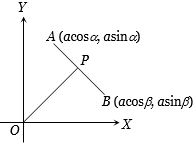
View full question & answer→MCQ 3121 Mark
In the equation $y - {y_1} = m(x - {x_1})$ if $m$ and $x_1$ are fixed and different lines are drawn for different values of $y_1$, then
- A
The lines will pass through a single point
- ✓
There will be a set of parallel lines
- C
There will be one line only
- D
AnswerCorrect option: B. There will be a set of parallel lines
b
(b) Since $m$ $(gradient)$ and are fixed and is variate, then they formed a set of parallel lines because gradient of every line remains $‘m’$ .
View full question & answer→MCQ 3131 Mark
If the co-ordinates of the points $A$ and $B$ be $(1, 0)$ and $(2,\sqrt 3 )$, then the angle made by the line $AB$ with $x$-axis is .....$^o$
Answerc
(c) Slope of the line is, $\tan \theta = \frac{{{y_2} - {y_1}}}{{{x_2} - {x_1}}} = \frac{{\sqrt 3 - 0}}{{2 - 1}}$ $ = \sqrt 3 $
==> $\theta = {\tan ^{ - 1}}\sqrt 3 = {60^o}$.
View full question & answer→MCQ 3141 Mark
The acute angle between the lines $y = 3$ and $y = \sqrt 3 x + 9$ is .....$^o$
- A
${30}$
- ✓
${60}$
- C
${45}$
- D
${90}$
AnswerCorrect option: B. ${60}$
b
(b)It is clear from figure that angle $ = {60^o}$
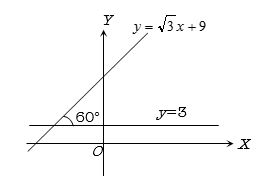
View full question & answer→MCQ 3151 Mark
The angle between the lines $y = (2 - \sqrt 3 )x + 5$ and $y = (2 + \sqrt 3 )x - 7$ is.......$^o$
- A
${30}$
- ✓
${60}$
- C
${45}$
- D
${90}$
AnswerCorrect option: B. ${60}$
b
(b)$\theta = {\tan ^{ - 1}}\left( {\frac{{2 - \sqrt 3 - 2 - \sqrt 3 }}{{1 + 4 - 3}}} \right) = {\tan ^{ - 1}}( - \sqrt 3 ) = {120^o}$
Considering smaller angle $\theta ' = {60^o}$.
View full question & answer→MCQ 3161 Mark
The angle between the lines whose intercepts on the axes are $a, -b$ and $b, -a $ respectively, is
- A
${\tan ^{ - 1}}\frac{{{a^2} - {b^2}}}{{ab}}$
- B
${\tan ^{ - 1}}\frac{{{b^2} - {a^2}}}{2}$
- ✓
${\tan ^{ - 1}}\frac{{{b^2} - {a^2}}}{{2ab}}$
- D
AnswerCorrect option: C. ${\tan ^{ - 1}}\frac{{{b^2} - {a^2}}}{{2ab}}$
c
(c)Equation of lines are $\frac{x}{a} - \frac{y}{b} = 1$and $\frac{x}{b} - \frac{y}{a} = 1$
==> ${m_1} = \frac{b}{a}$and ${m_2} = \frac{a}{b}$
Therefore $\theta = {\tan ^{ - 1}}\frac{{\frac{b}{a} - \frac{a}{b}}}{{1 + \frac{b}{a}.\frac{a}{b}}} = {\tan ^{ - 1}}\frac{{{b^2} - {a^2}}}{{2ab}}$.
View full question & answer→MCQ 3171 Mark
Angle between the lines $\frac{x}{a} + \frac{y}{b} = 1$ and $\frac{x}{a} - \frac{y}{b} = 1$ is
- ✓
$2{\tan ^{ - 1}}\frac{b}{a}$
- B
${\tan ^{ - 1}}\frac{{2ab}}{{{a^2} + {b^2}}}$
- C
${\tan ^{ - 1}}\frac{{{a^2} - {b^2}}}{{{a^2} + {b^2}}}$
- D
AnswerCorrect option: A. $2{\tan ^{ - 1}}\frac{b}{a}$
a
(a)The lines are $bx + ay - ab = 0$ and $bx - ay - ab = 0$.
Hence the required angle is
${\tan ^{ - 1}}\left| {\frac{{ab - ( - ab)}}{{{b^2} + ( - {a^2})}}} \right| = {\tan ^{ - 1}}\left| {\frac{{2ab}}{{{b^2} - {a^2}}}} \right| = 2{\tan ^{ - 1}}\frac{b}{a}$.
View full question & answer→MCQ 3181 Mark
The angle between the lines $x\cos {\alpha _1} + y\sin {\alpha _1} = {p_1}$ and $x\cos {\alpha _2} + y\sin {\alpha _2} = {p_2}$is
AnswerCorrect option: B. $({\alpha _1}\sim{\alpha _2})$
b
(b) $\theta = {\tan ^{ - 1}}\left[ {\frac{{ - \cot {\alpha _1} + \cot {\alpha _2}}}{{1 + \cot {\alpha _1}\cot {\alpha _2}}}} \right]$
$ = {\tan ^{ - 1}}\left[ {\frac{{\tan {\alpha _2} - \tan {\alpha _1}}}{{1 + \tan {\alpha _2}\tan {\alpha _1}}}} \right] = ({\alpha _2}\sim{\alpha _1})$
Aliter : Obviously, first line makes angle $\frac{\pi }{2} + {\alpha _1}$with the $x$-axis and second line makes the angle $\frac{\pi }{2} + {\alpha _2}$. Therefore, angle between these two lines is ${\alpha _1}\sim{\alpha _2}$.
View full question & answer→MCQ 3191 Mark
The angle between the lines $x\cos {30^o} + y\sin 30^\circ = 3$ and $x\cos {60^o} + y\sin {60^o} = 5$ is .....$^o$
AnswerCorrect option: B. ${30}$
b
(b)$\theta = {\tan ^{ - 1}}\left( {\frac{{ - \cot {{30}^o} + \cot {{60}^o}}}{{1 + \cot {{30}^o}\cot {{60}^o}}}} \right)$
$ = {\tan ^{ - 1}}\left( {\frac{{\tan {{60}^o} - \tan {{30}^o}}}{{1 + \tan {{30}^o}\tan {{60}^o}}}} \right) = {30^o}$.
View full question & answer→MCQ 3201 Mark
The angle between the two lines $y - 2x = 9$ and $x + 2y = - \;7,$ is .....$^o$
- A
${60}$
- B
${30}$
- ✓
${90}$
- D
${45}$
AnswerCorrect option: C. ${90}$
c
(c)These are perpendicular lines because ${m_1}{m_2} = (2)\left( {\frac{{ - 1}}{2}} \right) = - 1$
View full question & answer→MCQ 3211 Mark
If $\frac{1}{{ab'}} + \frac{1}{{ba'}} = 0,$ then lines $\frac{x}{a} + \frac{y}{b} = 1$ and $\frac{x}{{b'}} + \frac{y}{{a'}} = 1$ are
AnswerCorrect option: C. Perpendicular to each other
c
(c) ${a_1}{a_2} + {b_1}{b_2} = \frac{1}{{ab'}} + \frac{1}{{a'b}} = 0$
Therefore, the lines are perpendicular.
View full question & answer→MCQ 3221 Mark
To which of the following types the straight lines represented by $2x + 3y - 7 = 0$ and $2x + 3y - 5 = 0$ belong
Answera
(a) Let ${L_1} \equiv 2x + 3y - 7 = 0$and ${L_2} \equiv 2x + 3y - 5 = 0$
Here slope of ${L_1} = $slope of ${L_2} = - \frac{2}{3}$.
Hence the lines are parallel.
View full question & answer→MCQ 3231 Mark
The obtuse angle between the lines $y = - \;2$ and $y = x + 2$ is ....$^o$
- A
${120}$
- ✓
${135}$
- C
${150}$
- D
${160}$
AnswerCorrect option: B. ${135}$
b
(b) The gradient of the line $y = x + 2$ is $1$. Therefore, it makes an angle of ${45^o}$ with $x$-axis. The second line is parallel to $x$-axis. Hence the obtuse angle between the lines is ${135^o}$.
View full question & answer→MCQ 3241 Mark
The line passes through $(1, 0)$ and $( - \;2,\;\sqrt 3 )$ makes an angle of ...... with $x$-axis ......$^o$
- A
${60}$
- B
${120}$
- ✓
${150}$
- D
${135}$
AnswerCorrect option: C. ${150}$
c
(c) Gradient of the line which passes through $(1, 0)$ and $( - 2,\,\sqrt 3 )$ is $m = \frac{{\sqrt 3 - 0}}{{ - 2 - 1}} = - \frac{1}{{\sqrt 3 }}$
==> $\theta = {\tan ^{ - 1}}\left( { - \frac{1}{{\sqrt 3 }}} \right) = {150^o}$.
View full question & answer→MCQ 3251 Mark
Angle between $x = 2$ and $x - 3y = 6$ is
AnswerCorrect option: B. ${\tan ^{ - 1}}(3)$
b
(b) $\theta = {90^o} - {\tan ^{ - 1}}\left( {\frac{1}{3}} \right)$
$\tan \theta = \cot \left[ {{{\tan }^{ - 1}}\left( {\frac{1}{3}} \right)} \right] = 3$
$ \Rightarrow \theta = {\tan ^{ - 1}}(3)$.
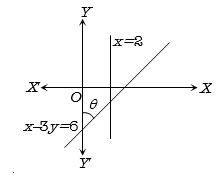
View full question & answer→MCQ 3261 Mark
If the lines $y = (2 + \sqrt 3 )x + 4$ and $y = kx + 6$ are inclined at an angle ${60^o}$ to each other, then the value of $k$ will be
Answerc
(c) $\frac{{k - (2 + \sqrt 3 )}}{{1 + k(2 + \sqrt 3 )}} = \sqrt 3 $ or $k - 2 - \sqrt 3 = \sqrt 3 + k2\sqrt 3 + 3k$,
$k = \frac{{ - 2(1 + \sqrt 3 )}}{{2(1 + \sqrt 3 )}} = - 1$.
View full question & answer→MCQ 3271 Mark
A straight line $(\sqrt 3 - 1)x = (\sqrt 3 + 1)y$ makes an angle ${75^o}$with another straight line which passes through origin. Then the equation of the line is
- ✓
$x = 0$
- B
$y = 0$
- C
$x + y = 0$
- D
$x - y = 0$
AnswerCorrect option: A. $x = 0$
a
(a)We know that $\frac{{\sqrt 3 + 1}}{{\sqrt 3 - 1}} = \tan {75^o}$
Hence the line makes an angle of ${75^o}$with y- axis, so the equation of y-axis is $x = 0$.
View full question & answer→MCQ 3281 Mark
The inclination of the straight line passing through the point $(-3, 6)$ and the midpoint of the line joining the point $(4, -5)$ and $(-2, 9)$ is
- A
$\pi /4$
- B
$\pi /6$
- C
$\pi /3$
- ✓
$3\pi /4$
AnswerCorrect option: D. $3\pi /4$
d
(d) Midpoint of the line joining the point $(4,\, - 5)$ and $( - 2,\,9)$ is $\left( {\frac{{4 - 2}}{2},\,\frac{{ - 5 + 9}}{2}} \right)$ i.e.$ (1, 2)$.
Inclination of straight line passing through point $(-3,6)$ and mid point $(1,\,2)$ is $m = \frac{{2 - 6}}{{1 + 3}} = \frac{{ - 4}}{4} = - 1 = \tan \theta $ .
==> $\theta = \frac{{3\pi }}{4}$.
View full question & answer→MCQ 3291 Mark
The angle between the lines $2x - y + 3 = 0$ and $x + 2y + 3 = 0$ is ........... $^\circ$
Answera
(a)Angle between two lines is given by $\tan \theta = \frac{{{m_1} - {m_2}}}{{1 + {m_1}{m_2}}}$
Given ${m_1} = \frac{{ - 1}}{2},$ ${m_2} = 2$ $\therefore \,\,{m_1}{m_2} = - 1$.
So the lines are perpendicular i.e., $\theta = 90^\circ $.
View full question & answer→MCQ 3301 Mark
The angle between the straight lines $x - y\sqrt 3 = 5$ and $\sqrt {3x} + y = 7$is ............. $^\circ$
Answera
(a)As ${a_1}{a_2} + {b_1}{b_2} = (1)\,(\sqrt 3 ) + ( - \sqrt 3 )\,(1) = 0$
Lines are perpendicular, $\theta = 90^\circ $.
View full question & answer→MCQ 3311 Mark
Angle between the lines $2x - y - 15 = 0$ and $3x + y + 4 = 0$ is .....$^o$
- A
${90}$
- ✓
${45}$
- C
${180}$
- D
${60}$
AnswerCorrect option: B. ${45}$
b
(b)Lines are $2x - y - 15 = 0$ .....(i)
and $3x + y + 4 = 0$ ......(ii)
Here, ${m_1} = 2,\,{m_2} = - \,3$
If angle between them is $\theta $, then
$\tan \theta = \left| {\frac{{{m_1} - {m_2}}}{{1 + {m_1}{m_2}}}} \right|$ $ = \left| {\frac{{2 + 3}}{{1 - 6}}} \right| = \left| {\frac{5}{{ - 5}}} \right|$= 1
$\tan \theta = \tan \frac{\pi }{4}$ ==> $\theta = \frac{\pi }{4} = 45^\circ .$
View full question & answer→MCQ 3321 Mark
If the line passing through $(4, 3)$ and $(2, k)$ is perpendicular to $y = 2x + 3$, then $k $=
Answerd
(d) $\left( {\frac{{k - 3}}{{2 - 4}}} \right){\rm{ }}(2) = - 1 $
$4\Rightarrow 2k - 6 = 2 $
$\Rightarrow k = 4$.
View full question & answer→MCQ 3331 Mark
The equation of the line passing through the point $(1, 2)$ and perpendicular to the line $x + y + 1 = 0$ is
- A
$y - x + 1 = 0$
- ✓
$y - x - 1 = 0$
- C
$y - x + 2 = 0$
- D
$y - x - 2 = 0$
AnswerCorrect option: B. $y - x - 1 = 0$
b
(b) The line perpendicular to the line $x + y + 1 = 0$ is $y - x + \lambda = 0$.
Also, it passes through the point $(1, 2)$;$\therefore $ $\lambda = - 1$.
Hence, required line is $y - x - 1 = 0$.
View full question & answer→MCQ 3341 Mark
The points on the $x$-axis whose perpendicular distance from the line $\frac{x}{a} + \frac{y}{b} = 1$ is a, are
- ✓
$\left[ {\frac{a}{b}(b \pm \sqrt {{a^2} + {b^2}} ),\,0} \right]$
- B
$\left[ {\frac{b}{a}(b \pm \sqrt {{a^2} + {b^2}} ),\,0} \right]$
- C
$\left[ {\frac{a}{b}(a \pm \sqrt {{a^2} + {b^2}} ),\,0} \right]$
- D
AnswerCorrect option: A. $\left[ {\frac{a}{b}(b \pm \sqrt {{a^2} + {b^2}} ),\,0} \right]$
a
(a) Let the point be $(h,0)$, then $a = \pm \frac{{bh + 0 - ab}}{{\sqrt {{a^2} + {b^2}} }}$
==> $bh = \pm a\sqrt {{a^2} + {b^2}} + ab \Rightarrow h = \frac{a}{b}(b \pm \sqrt {{a^2} + {b^2}} )$
Hence the point is $\left\{ {\frac{a}{b}(b \pm \sqrt {{a^2} + {b^2}} ),0} \right\}$.
View full question & answer→MCQ 3351 Mark
The length of the perpendicular from the point $(b,a)$to the line $\frac{x}{a} - \frac{y}{b} = 1$, is
- A
$\left| {\frac{{{a^2} - ab + {b^2}}}{{\sqrt {{a^2} + {b^2}} }}} \right|$
- ✓
$\left| {\frac{{{b^2} - ab - {a^2}}}{{\sqrt {{a^2} + {b^2}} }}} \right|$
- C
$\left| {\frac{{{a^2} + ab - {b^2}}}{{\sqrt {{a^2} + {b^2}} }}} \right|$
- D
AnswerCorrect option: B. $\left| {\frac{{{b^2} - ab - {a^2}}}{{\sqrt {{a^2} + {b^2}} }}} \right|$
b
(b) Length of perpendicular is $\left| {\frac{{\frac{b}{a} - \frac{a}{b} - 1}}{{\sqrt {{{\left( {\frac{1}{a}} \right)}^2} + {{\left( {\frac{1}{b}} \right)}^2}} }}} \right| = \left| {\frac{{{b^2} - {a^2} - ab}}{{\sqrt {{a^2} + {b^2}} }}} \right|$
View full question & answer→MCQ 3361 Mark
The distance between the lines $3x + 4y = 9$ and $6x + 8y = 15$ is
- A
$3\over2$
- ✓
$3\over10$
- C
$6$
- D
AnswerCorrect option: B. $3\over10$
b
(b) Here the lines are, $3x + 4y - 9 = 0$ ......$(i)$
and $6x + 8y - 15 = 0$ ......$(ii)$
Now distance from origin of both the lines are
$\frac{{ - 9}}{{\sqrt {{3^2} + {4^2}} }} = - \frac{9}{5}$and $\frac{{ - 15}}{{\sqrt {{6^2} + {8^2}} }} = - \frac{{15}}{{10}}$
Hence distance between both the lines are $\,\left| {\, - \frac{9}{5} - \left( { - \frac{{15}}{{10}}} \right)\,} \right|\, = \frac{3}{{10}}$.
Ailter: Put $y = 0$ in the first equation, we get $x = 3$ therefore, the point $(3, 0)$ lies on it. So the required distance between these two lines is the perpendicular length of the line $6x + 8y = 15$ from the point $(3, 0)$. i.e., $\frac{{6 \times 3 - 15}}{{\sqrt {{6^2} + {8^2}} }} = \frac{3}{{10}}$.
View full question & answer→MCQ 3371 Mark
The distance of the point of intersection of the lines $2x - 3y + 5 = 0$ and $3x + 4y = 0$from the line $5x - 2y = 0$ is
AnswerCorrect option: A. $\frac{{130}}{{17\sqrt {29} }}$
a
(a)Points of intersection are $y = \frac{{15}}{{17}},x = \frac{{ - 4 \times 15}}{{3 \times 17}} = \frac{{ - 20}}{{17}}$
Therefore $D = \left| {\frac{{5\left( {\frac{{ - 20}}{{17}}} \right) - 2\left( {\frac{{15}}{{17}}} \right)}}{{\sqrt {29} }}} \right| = \frac{{130}}{{17.\sqrt {29} }}$.
View full question & answer→MCQ 3381 Mark
If the length of the perpendicular drawn from the origin to the line whose intercepts on the axes are $a$ and $b$ be $p$, then
- A
${a^2} + {b^2} = {p^2}$
- B
${a^2} + {b^2} = \frac{1}{{{p^2}}}$
- C
$\frac{1}{{{a^2}}} + \frac{1}{{{b^2}}} = \frac{2}{{{p^2}}}$
- ✓
$\frac{1}{{{a^2}}} + \frac{1}{{{b^2}}} = \frac{1}{{{p^2}}}$
AnswerCorrect option: D. $\frac{1}{{{a^2}}} + \frac{1}{{{b^2}}} = \frac{1}{{{p^2}}}$
d
(d) $p = \frac{{ab}}{{\sqrt {{a^2} + {b^2}} }}$ or $\frac{{{a^2} + {b^2}}}{{{a^2}{b^2}}} = \frac{1}{{{p^2}}} \Rightarrow \frac{1}{{{a^2}}} + \frac{1}{{{b^2}}} = \frac{1}{{{p^2}}}$.
View full question & answer→MCQ 3391 Mark
The length of perpendicular drawn from origin on the line joining $(x',y')$ and $(x'',y'')$, is
- A
$ \frac{{x'y'' + y'x''}}{{\sqrt {{{(x'' - x')}^2} + {{(y'' - y')}^2}} }}$
- ✓
$ \frac{{x'y'' - y'x''}}{{\sqrt {{{(x'' - x')}^2} + {{(y'' - y')}^2}} }}$
- C
$ \frac{{x'x'' + y'y''}}{{\sqrt {{{(x'' + x')}^2} + {{(y'' + y')}^2}} }}$
- D
$ \frac{{x'y'' + y'y''}}{{\sqrt {{{(x'' - x')}^2} + {{(y'' - y')}^2}} }}$
AnswerCorrect option: B. $ \frac{{x'y'' - y'x''}}{{\sqrt {{{(x'' - x')}^2} + {{(y'' - y')}^2}} }}$
b
(b)Straight line $y - y' = \frac{{y'' - y'}}{{x'' - x'}}(x - x')$
Length of perpendicular $ = \frac{{x'(y'' - y') - y'(x'' - x')}}{{\sqrt {{{(x'' - x')}^2} + {{(y'' - y')}^2}} }}$
$ = \frac{{x'y'' - y'x''}}{{\sqrt {{{(x'' - x')}^2} + {{(y'' - y')}^2}} }}$
View full question & answer→MCQ 3401 Mark
The perpendicular distance of the straight line $12x + 5y = 7$ from the origin is given by
- ✓
$\frac{7}{{13}}$
- B
$\frac{{12}}{{13}}$
- C
$\frac{5}{{13}}$
- D
$\frac{1}{{13}}$
AnswerCorrect option: A. $\frac{7}{{13}}$
a
(a)Required distance =$\frac{7}{{\sqrt {{{(12)}^2} + {5^2}} }} = \frac{7}{{13}}$.
View full question & answer→MCQ 3411 Mark
The length of perpendicular from $(3, 1)$ on line $4x + 3y + 20 = 0$, is
Answerb
(b) Required length $\frac{{4(3) + 3(1) + 20}}{5} = 7$.
View full question & answer→MCQ 3421 Mark
The distance between two parallel lines $3x + 4y - 8 = 0$ and $3x + 4y - 3 = 0$, is given by
Answerd
(d) Let the distance of both lines are ${p_1}$ and ${p_2}$ from origin, then ${p_1} = - \frac{8}{5}$and ${p_2} = - \frac{3}{5}$. Hence distance between both the lines $ = |{p_1}\sim{p_2}| = \frac{5}{5} = 1$.
View full question & answer→MCQ 3431 Mark
The distance between $4x + 3y = 11$ and $8x + 6y = 15$, is
- A
$\frac{7}{2}$
- B
$4$
- ✓
$\frac{7}{{10}}$
- D
AnswerCorrect option: C. $\frac{7}{{10}}$
c
(c) $4x + 3y = 11$and $4x + 3y = \frac{{15}}{2}$
Therefore, $D = \left| {\,\frac{{11 - \frac{{15}}{2}}}{5}\,} \right| = \frac{7}{{10}}$.
View full question & answer→MCQ 3441 Mark
The length of the perpendicular drawn from origin upon the straight line $\frac{x}{3} - \frac{y}{4} = 1$is
- ✓
$2\frac{2}{5}$
- B
$3\frac{1}{5}$
- C
$4\frac{2}{5}$
- D
$3\frac{2}{5}$
AnswerCorrect option: A. $2\frac{2}{5}$
a
(a) The line is $4x - 3y - 12 = 0$
Hence the required length $ = 12/5$.
View full question & answer→MCQ 3451 Mark
The distance between the lines $3x - 2y = 1$and $6x + 9 = 4y$ is
- A
$\frac{1}{{\sqrt {52} }}$
- ✓
$\frac{{11}}{{\sqrt {52} }}$
- C
$\frac{4}{{\sqrt {13} }}$
- D
$\frac{6}{{\sqrt {13} }}$
AnswerCorrect option: B. $\frac{{11}}{{\sqrt {52} }}$
b
(b)$\therefore $ Distance between two lines = $d = \left| {\frac{{1 + \frac{9}{2}}}{{\sqrt {13} }}} \right|$
$ \Rightarrow $$d = \frac{{11}}{{2\sqrt {13} }} = \frac{{11}}{{\sqrt {52} }}$.
View full question & answer→MCQ 3461 Mark
Two points $A$ and $B$ have coordinates $(1, 1)$ and $(3, -2)$ respectively. The co-ordinates of a point distant $\sqrt {85} $from $B$ on the line through $B$ perpendicular to $AB$ are
- A
$(4, 7)$
- B
$(7, 4)$
- ✓
$(5, 7)$
- D
$(-5, -3)$
AnswerCorrect option: C. $(5, 7)$
c
(c) Trick : From option $(c)$,
$BP = \sqrt {{{(5 - 3)}^2} + {{(7 + 2)}^2}} $$ = \sqrt {4 + 81} = \sqrt {85} $
Hence option $(c)$ is correct.
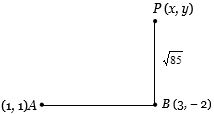
View full question & answer→MCQ 3471 Mark
The distance of the point $(-2, 3)$ from the line $x - y = 5$ is
- ✓
$5\sqrt 2 $
- B
$2\sqrt 5 $
- C
$3\sqrt 5 $
- D
$5\sqrt 3 $
AnswerCorrect option: A. $5\sqrt 2 $
a
(a) $p = \left| {\frac{{ - 2 - 3 - 5}}{{\sqrt {1 + 1} }}} \right| = \frac{{10}}{{\sqrt 2 }} = 5\sqrt 2 $.
View full question & answer→MCQ 3481 Mark
Distance between the lines $5x + 3y - 7 = 0$ and $15x + 9y + 14 = 0$ is
- A
$\frac{{35}}{{\sqrt {34} }}$
- B
$\frac{1}{{3\sqrt {34} }}$
- ✓
$\frac{{35}}{{3\sqrt {34} }}$
- D
$\frac{{35}}{{2\sqrt {34} }}$
AnswerCorrect option: C. $\frac{{35}}{{3\sqrt {34} }}$
c
(c) Given lines are $5x + 3y - 7 = 0$ .....$(i)$
and $15x + 9y + 14 = 0$ or $5x + 3y + \frac{{14}}{3} = 0$ .....$(ii)$
lines $(i)$ and $(ii)$ are parallel. Since ${c_1}$ and ${c_2}$ are of opposite signs, therefore the lines are on opposite sides of the origin. So the distance between them is
$ = \left| {\frac{{{c_1}}}{{\sqrt {a_1^2 + b_1^2} }}} \right| + \left| {\frac{{{c_2}}}{{\sqrt {a_2^2 + {b_2}} }}} \right|$ $ = \left| {\frac{{ - 7}}{{\sqrt {34} }}} \right| + \left| {\frac{{14}}{{3\sqrt {34} }}} \right|$ $ = \frac{{35}}{{3\sqrt {34} }}.$
View full question & answer→MCQ 3491 Mark
Distance between the parallel lines $3x + 4y + 7 = 0$ and $3x + 4y - 5 = 0$ is
- A
$\frac{2}{5}$
- ✓
$\frac{{12}}{5}$
- C
$\frac{5}{{12}}$
- D
$\frac{3}{5}$
AnswerCorrect option: B. $\frac{{12}}{5}$
b
(b) ${d_1} = $ distance of perpendicular from $(0,\,0)$ to $3x + 4y + 7 = 0$
${d_1} = \frac{{3 \times 0 + 4 \times 0 + 7}}{{\sqrt {{3^2} + {4^2}} }} = \frac{7}{5}$
${d_2} = \frac{{3 \times 0 + 4 \times 0 + ( - 5)}}{{\sqrt {{3^2} + {4^2}} }} = \frac{{ - 5}}{5}$
Required distance $ = \left| {\,{d_1} - {d_2}} \right|$$ = \left| {\,\frac{7}{5} - \left( {\frac{{ - 5}}{5}} \right)\,} \right| = \frac{{12}}{5}.$
View full question & answer→MCQ 3501 Mark
The position of the point $(8,-9)$ with respect to the lines $2x + 3y - 4 = 0$ and $6x + 9y + 8 = 0$ is
- ✓
Point lies on the same side of the lines
- B
Point lies on the different sides of the line
- C
Point lies on one of the line
- D
AnswerCorrect option: A. Point lies on the same side of the lines
a
(a) ${L_1}(8, - 9) = 2(8) + 3( - 9) - 4 = - 15$
${L_2}(8, - 9) = 6(8) + 9( - 9) + 8 = - 25$
Hence point lies on same side of the lines.
View full question & answer→MCQ 3511 Mark
The length of perpendicular from the point $(a\cos \alpha ,a\sin \alpha )$ upon the straight line $y = x\tan \alpha + c,$ $c > 0$ is
- ✓
$c\cos \alpha $
- B
$c{\sin ^2}\alpha $
- C
$c{\sec ^2}\alpha $
- D
$c{\cos ^2}\alpha $
AnswerCorrect option: A. $c\cos \alpha $
a
(a)Here, equation of line is $y = x\tan \alpha + c$, $c > 0$
Length of the perpendicular drawn on line from point $(a\cos \alpha ,\,a\sin \alpha )$
$p = \frac{{ - a\sin \alpha + a\cos \alpha \tan \alpha + c}}{{\sqrt {1 + {{\tan }^2}\alpha } }}$;
$p = \frac{c}{{\sec \alpha }} = c\,\cos \alpha $.
View full question & answer→MCQ 3521 Mark
The distance of point $(-2, 3)$ from the line $x - y = 5$ is
- ✓
$5\sqrt 2 $
- B
$2\sqrt 5 $
- C
$3\sqrt 5 $
- D
$5\sqrt 3 $
AnswerCorrect option: A. $5\sqrt 2 $
a
(a) Distance of point $(-2, 3)$ from the line $x - y = 5$ is $\left| {\,\frac{{ - 2 - 3 - 5}}{{\sqrt 2 }}\,} \right|$ = $\left| {\,\frac{{ - 10}}{{\sqrt 2 }}\,} \right|$ = $5\sqrt 2 $.
View full question & answer→MCQ 3531 Mark
Distance between the two parallel lines $y = 2x + 7$and $y = 2x + 5$ is
- A
$\frac{{\sqrt 5 }}{2}$
- B
$\frac{2}{5}$
- ✓
$\frac{2}{{\sqrt 5 }}$
- D
$\frac{1}{{\sqrt 5 }}$
AnswerCorrect option: C. $\frac{2}{{\sqrt 5 }}$
c
(c)Given lines are $2x - y + 7 = 0$ and $AB = 2AD = 2\sqrt {81 - 9} = 2\sqrt {72} = 12\sqrt 2 $
Both the lines are on same side of origin.
Distnace between two parallel lines = $\frac{{7 - 5}}{{\sqrt {{2^2} + {1^2}} }} = \frac{2}{{\sqrt 5 }}$.
View full question & answer→MCQ 3541 Mark
The perpendicular distance of the straight line $12x + 5y = 7$from the origin is equal to
- ✓
$\frac{7}{{13}}$
- B
$\frac{{12}}{{13}}$
- C
$\frac{5}{{13}}$
- D
$\frac{1}{{13}}$
AnswerCorrect option: A. $\frac{7}{{13}}$
a
(a)Perpendicular distance of straight line $12x + 5y - 7 = 0$ from the origin is $\frac{{12 \times 0 + 5 \times 0 - 7}}{{\sqrt {{{12}^2} + {5^2}} }}$ = $\left| {\,\frac{{ - 7}}{{13}}\,} \right|\, = \,\frac{7}{{13}}$.
View full question & answer→MCQ 3551 Mark
Choose the correct statement which describe the position of the point $(-6, 2)$ relative to straight lines $2x + 3y - 4 = 0$ and $6x + 9y + 8 = 0$
Answera
(a) $L \equiv 2x + 3y - 4 = 0$, ${L_{( - 6,2)}} = - 12 + 6 - 4 < 0$
$L' = 6x + 9y + 8 = 0$, $L{'_{( - 6,2)}} = - 36 + 18 + 8 < 0$
Hence the point is below both the lines..
View full question & answer→MCQ 3561 Mark
The position of the points $(3, 4)$ and $(2, -6)$ with respect to the line $3x - 4y = 8$ are
- A
On the same side of the line
- ✓
On different side of the line
- C
One point on the line and the other outside the line
- D
AnswerCorrect option: B. On different side of the line
b
(b) $L \equiv 3x - 4y - 8 = 0$
${L_{(3,4)}} = 9 - 16 - 8 < 0$ and ${L_{(2, - 6)}} = 6 + 24 - 8 > 0$
Hence, the points lie on different side of the line.
View full question & answer→MCQ 3571 Mark
The points $(at_1^2,2a{t_1}),(at_2^2,2a{t_2})$and $(a,0)$will be collinear, if
- A
${t_1}{t_2} = 1$
- ✓
${t_1}{t_2} = - 1$
- C
${t_1} + {t_2} = 1$
- D
${t_1} + {t_2} = - 1$
AnswerCorrect option: B. ${t_1}{t_2} = - 1$
b
(b)$\frac{{a - at_2^2}}{{at_2^2 - at_1^2}} = \frac{{ - 2a{t_2}}}{{2a{t_2} - 2a{t_1}}}$
==> $(1 - t_2^2) = - {t_2}({t_2} + {t_1})$or ${t_1}{t_2} = - 1$.
View full question & answer→MCQ 3581 Mark
If the given lines $y = {m_1}x + {c_1},y = {m_2}x + {c_2}$ and $y = {m_3}x + {c_3}$ be concurrent, then
- ✓
${m_1}({c_2} - {c_3}) + {m_2}({c_3} - {c_1}) + {m_3}({c_1} - {c_2}) = 0$
- B
${m_1}({c_2} - {c_1}) + {m_2}({c_3} - {c_2}) + {m_3}({c_1} - {c_3}) = 0$
- C
${c_1}({m_2} - {m_3}) + {c_2}({m_3} - {m_1}) + {c_3}({m_1} - {m_2}) = 0$
- D
AnswerCorrect option: A. ${m_1}({c_2} - {c_3}) + {m_2}({c_3} - {c_1}) + {m_3}({c_1} - {c_2}) = 0$
a
(a)$\left| {\begin{array}{*{20}{c}}{{m_1}}&{ - 1}&{{c_1}}\\{{m_2}}&{ - 1}&{{c_2}}\\{{m_3}}&{ - 1}&{{c_3}}\end{array}} \right| = 0$
==> ${m_1}({c_2} - {c_3}) + {m_2}({c_3} - {c_1}) + {m_3}({c_1} - {c_2}) = 0$.
View full question & answer→MCQ 3591 Mark
The lines
$(p - q)x + (q - r)y + (r - p) = 0$
$(q - r)x + (r - p)y + (p - q) = 0$
$(r - p)x + (p - q)y + (q - r) = 0$ are
Answerc
(c) $\left| {\,\begin{array}{*{20}{c}}{p - q}&{q - r}&{r - p}\\{q - r}&{r - p}&{p - q}\\{r - p}&{p - q}&{q - r}\end{array}\,} \right| = \left| {\,\begin{array}{*{20}{c}}0&{q - r}&{r - p}\\0&{r - p}&{p - q}\\0&{p - q}&{q - r}\end{array}\,} \right| = 0$
Hence the lines are concurrent.
Aliter : Since sum of the coefficient of $x, y$ and the constant term is zero, hence the lines are concurrent.
View full question & answer→MCQ 3601 Mark
Which of the following lines is concurrent with the lines $3x + 4y + 6 = 0$ and $6x + 5y + 9 = 0$
- A
$2x + 3y + 5 = 0$
- ✓
$3x + 3y + 5 = 0$
- C
$7x + 9y + 3 = 0$
- D
AnswerCorrect option: B. $3x + 3y + 5 = 0$
b
(b) Check by options.
From option $(a)$, $\left| {\,\begin{array}{*{20}{c}}3&4&6\\6&5&9\\2&3&5\end{array}\,} \right| = 3(25 - 27) - 4(12) + 6(8) \ne 0$
From option $(b)$, $\left| {\,\begin{array}{*{20}{c}}3&4&6\\6&5&9\\3&3&5\end{array}\,} \right| = 3(25 - 27) - 4(3) + 6(3) = 0$.
View full question & answer→MCQ 3611 Mark
The value of $k$ for which the lines $7x - 8y + 5 = 0$, $3x - 4y + 5 = 0$ and $4x + 5y + k = 0$ are concurrent is given by
Answera
(a) The lines are concurrent, if $\left| {\,\begin{array}{*{20}{c}}7&{ - 8}&5\\3&{ - 4}&5\\4&5&k\end{array}\,} \right| = 0$
==>$7( - 4k - 25) + 8(3k - 20) + 5(15 + 16) = 0$
$\Rightarrow k = - 45$.
View full question & answer→MCQ 3621 Mark
For what value of ‘$a$’ the lines $x = 3,y = 4$ and $4x - 3y + a = 0$ are concurrent
Answera
(a) Here the lines are $x - 3 = 0,y - 4 = 0$ and $4x - 3y + a = 0$.
.These will be concurrent, if $\left| {\,\begin{array}{*{20}{c}}1&0&{ - 3}\\0&1&{ - 4}\\4&{ - 3}&a\end{array}\,} \right| = 0 \Rightarrow a = 0$.
View full question & answer→MCQ 3631 Mark
The lines $15x - 18y + 1 = 0,$ $12x + 10y - 3 = 0$ and $6x + 66y - 11 = 0$ are
Answerc
(c) $3\,(12x + 10y - 3) - 2(15x - 18y + 1)$ $ = 6x + 66y - 11 = 0$
Hence the lines are concurrent.
View full question & answer→MCQ 3641 Mark
The straight lines $x + 2y - 9 = 0,$ $3x + 5y - 5 = 0$ and $ax + by - 1 = 0$ are concurrent, if the straight line $35x - 22y + 1 = 0$ passes through the point
- ✓
$(a,b)$
- B
$(b,a)$
- C
$( - a, - b)$
- D
AnswerCorrect option: A. $(a,b)$
a
(a) The three lines are concurrent. if $\left| {\,\begin{array}{*{20}{c}}1&2&{ - 9}\\3&5&{ - 5}\\a&b&{ - 1}\end{array}\,} \right| = 0$
$ \Rightarrow 35a - 22b + 1 = 0$
which is true if the line $35x - 22y + 1 = 0$ passes through $(a, b)$.
View full question & answer→MCQ 3651 Mark
The lines $2x + y - 1 = 0,ax + 3y - 3 = 0$ and $3x + 2y - 2 = 0$ are concurrent for
- ✓
$All \,\,a$
- B
$a = 4$only
- C
$ - 1 \le a \le 3$
- D
$a > 0$only
AnswerCorrect option: A. $All \,\,a$
a
(a) Given lines are concurrent, if $\left| {\,\begin{array}{*{20}{c}}2&1&{ - 1}\\a&3&{ - 3}\\3&2&{ - 2}\end{array}\,} \right| = 0\,\,$.
This is true for all values of a because ${C_2}$and ${C_3}$are identical.
View full question & answer→MCQ 3661 Mark
If lines $4x + 3y = 1,y = x + 5$ and $5y + bx = 3$ are concurrent, then $b$ equals
Answerc
(c) Lines are concurrent, if $\left| {\,\begin{array}{*{20}{c}}4&3&{ - 1}\\1&{ - 1}&5\\b&5&{ - 3}\end{array}} \right|\, = 0$
==> $4(3 - 25) - 3( - 3 - 5b) - 1(5 + b) = 0$
==> $ - 88 + 9 + 15b - 5 - b = 0$
$\Rightarrow - 84 + 14b = 0$
==> $b = 6$.
View full question & answer→MCQ 3671 Mark
Three lines $3x - y = 2,\,\,5x + ay = 3$ and $2x + y = 3$ are concurrent, then $a $=
Answerd
(d) $\left| {\,\begin{array}{*{20}{c}}3&{ - 1}&{ - 2}\\5&a&{ - 3}\\2&1&{ - 3}\end{array}\,} \right| = 0$
==> $3( - 3a + 3) + 1( - 15 + 6) - 2(5 - 2a) = 0$
==> $a = - 2$.
View full question & answer→MCQ 3681 Mark
The three lines $lx + my + n = 0$, $mx + ny + l = 0$, $nx + ly + m = 0$ are concurrent if
- A
$l = m + n$
- B
$m = l + n$
- C
$n = l + m$
- ✓
$l + m + n = 0$
AnswerCorrect option: D. $l + m + n = 0$
d
(d)$\left| {\,\begin{array}{*{20}{c}}l&m&n\\m&n&l\\n&l&m\end{array}\,} \right| = 0 \Rightarrow \left| {\begin{array}{*{20}{c}}{l + m + n}&m&n\\{l + m + n}&n&l\\{l + m + n}&l&m\end{array}} \right| = 0$
==> $(l + m + n)\left| {\,\begin{array}{*{20}{c}}1&m&n\\1&n&l\\1&l&m\end{array}\,} \right| = 0 \Rightarrow (l + m + n) = 0$.
View full question & answer→MCQ 3691 Mark
The straight lines $4ax + 3by + c = 0$ where $a + b + c = 0$, will be concurrent, if point is
- A
$(4,\, 3)$
- ✓
$(1/4, \,1/3)$
- C
$(1/2, \,1/3)$
- D
AnswerCorrect option: B. $(1/4, \,1/3)$
b
(b) The set of lines is $4ax + 3by + c = 0$, where $a + b + c = 0$.
Eliminating $c$, we get $4ax + 3by - (a + b) = 0$
==> $a(4x - 1) + b(3y - 1) = 0$
This passes through the intersection of the lines $4x - 1 = 0$ and $3y - 1 = 0$i.e.$x = \frac{1}{4},\,y = \frac{1}{3}$i.e., $\left( {\frac{1}{4},\,\frac{1}{3}} \right)$.
View full question & answer→MCQ 3701 Mark
If the lines $x + q = 0,y - 2 = 0$ and $3x + 2y + 5 = 0$ are concurrent, then value of $q$ will be
Answerc
(c) Lines are concurrent , if $\left| {\,\begin{array}{*{20}{c}}{{a_1}}&{{b_1}}&{{c_1}}\\{{a_2}}&{{b_2}}&{{c_2}}\\{{a_3}}&{{b_3}}&{{c_3}}\end{array}} \right| = 0$
==> $\left| {\,\,\begin{array}{*{20}{c}}1&0&{\,\,q}\\0&1&{ - 2\,}\\3&2&{\,\,5}\end{array}} \right|\, = \,0$
==> $1\,(5 + 4) - 0 + q\,(0 - 3) = 0$
.==> $9 - 3q = 0$
==> $q = 3.$
View full question & answer→MCQ 3711 Mark
The value of $\lambda $ for which the lines $3x + 4y = 5,$ $5x + 4y = 4$ and $\lambda x + 4y = 6$ meet at a point is
Answerb
(b) Given lines are $3x + 4y = 5,$ $5x + 4y = 4,$ $\lambda x + 4y = 6$. These lines meet at a point if the point of intersection of first two lines lies on the third line.
From $3x + 4y = 5$ and $5x + 4y = 4$
We get $x = \frac{{ - 1}}{2},$ $y = \frac{{13}}{8}$
This lies on $\lambda x + 4y = 6,$ if $\lambda \,\left( { - \frac{1}{2}} \right) + 4\left( {\frac{{13}}{8}} \right) = 6$
==> $\lambda = 1$.
View full question & answer→MCQ 3721 Mark
The three straight lines $ax + by = c,\,\,bx + cy = a$ and $cx + ay = b$ are collinear, if
- ✓
$a + b + c = 0$
- B
$b + c = a$
- C
$c + a = b$
- D
$a + b = c$
AnswerCorrect option: A. $a + b + c = 0$
a
(a) Given three straight lines $ax + by - c = 0$, $bx + cy - a = 0$, $cx + ay - b = 0$ are collinear,
Then $\left| {\,\begin{array}{*{20}{c}}a&b&{ - c}\\b&c&{ - a}\\c&a&{ - b}\end{array}\,} \right|\, = \,0$ $ \Rightarrow $$ - (a + b + c)\,\left| {\,\begin{array}{*{20}{c}}1&b&c\\1&c&a\\1&a&b\end{array}\,} \right| = 0$
Clearly,$(a + b + c) = 0$.
View full question & answer→MCQ 3731 Mark
If the middle points of the sides $BC,\, CA$ and $AB$ of the triangle $ABC$ be $(1, 3), \,(5, 7)$ and $(-5, 7)$, then the equation of the side $AB$ is
- A
$x - y - 2 = 0$
- ✓
$x - y + 12 = 0$
- C
$x + y - 12 = 0$
- D
AnswerCorrect option: B. $x - y + 12 = 0$
b
(b) Slope of $DE = \frac{{7 - 3}}{{5 - 1}} = 1 \Rightarrow $ Slope of $AB = 1$
Hence equation of $AB$ is $y - 7 = (x + 5) \Rightarrow x - y + 12 = 0$.
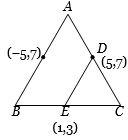
View full question & answer→MCQ 3741 Mark
If the coordinates of the vertices of the triangle $ABC$ be $(-1, 6)$, $(-3, -9)$, and $(5, -8)$ respectively, then the equation of the median through $C$ is
- A
$13x - 14y - 47 = 0$
- B
$13x - 14y + 47 = 0$
- ✓
$13x + 14y + 47 = 0$
- D
$13x + 14y - 47 = 0$
AnswerCorrect option: C. $13x + 14y + 47 = 0$
c
(c) Required equation of median is $y + 8 = \frac{{ - \frac{3}{2} + 8}}{{ - 2 - 5}}(x - 5)$
$ \Rightarrow 13x + 14y + 47 = 0$.
View full question & answer→MCQ 3751 Mark
The opposite vertices of a square are $(1, 2)$ and $(3, 8)$, then the equation of a diagonal of the square passing through the point $(1, 2)$, is
- ✓
$3x - y - 1 = 0$
- B
$3y - x - 1 = 0$
- C
$3x + y + 1 = 0$
- D
AnswerCorrect option: A. $3x - y - 1 = 0$
a
(a) Slope $ = \frac{{8 - 2}}{{3 - 1}} = 3$.
The diagonal is$y - 2 = 3(x - 1)$
$\Rightarrow 3x - y - 1 = 0$.
View full question & answer→MCQ 3761 Mark
A vertex of square is $(3, 4)$ and diagonal $x + 2y = 1,$ then the second diagonal which passes through given vertex will be
- A
$2x - y + 2 = 0$
- B
$x + 2y = 11$
- ✓
$2x - y = 2$
- D
AnswerCorrect option: C. $2x - y = 2$
c
(c) Slope =$ 2$ ==> Equation is $2x - y = 2$.
View full question & answer→MCQ 3771 Mark
If the straight line $ax + by + c = 0$ always passes through $(1, -2),$ then $a, b, c$ are
- ✓
In $A.P.$
- B
In $H.P.$
- C
In $G.P.$
- D
AnswerCorrect option: A. In $A.P.$
a
(a) $ax + by + c = 0$ is always through $(1,\, - 2)$.
$a - 2b + c = 0$ ==> $2b = a + c$
Therefore, $a, b$ and $c$ are in $A.P.$
View full question & answer→MCQ 3781 Mark
If vertices of a parallelogram are respectively $(0, 0)$, $(1, 0)$, $(2, 2)$ and $(1, 2)$, then angle between diagonals is
- A
$\pi /3$
- B
$\pi /2$
- C
$3\pi /2$
- ✓
$\pi /4$
AnswerCorrect option: D. $\pi /4$
d
(d)Here,
Slope of Ist diagonal= ${m_1} = \frac{{2 - 0}}{{2 - 0}} = 1$
$\Rightarrow {\theta _1} = {45^o}$
Slope of IInd diagonal= ${m_2} = \frac{{2 - 0}}{{1 - 1}} = \infty $
$\Rightarrow {\theta _2} = {90^o}$
==>${\theta _2} - {\theta _1} = {45^o} = \frac{\pi }{4}$.
View full question & answer→MCQ 3791 Mark
The area of the triangle formed by the line $x\sin \alpha + y\cos \alpha = \sin 2\alpha $and the coordinates axes is
- ✓
$\sin 2\alpha $
- B
$\cos 2\alpha $
- C
$2\sin 2\alpha $
- D
$2\cos 2\alpha $
AnswerCorrect option: A. $\sin 2\alpha $
a
(a)$\Delta = \frac{1}{2}(2\sin \alpha .2\cos \alpha ) = \sin 2\alpha $
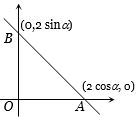
View full question & answer→MCQ 3801 Mark
The triangle formed by ${x^2} - 9{y^2} = 0$ and $x = 4$ is
Answera
(a) Given lines are ${x^2} - 9{y^2} = 0$ and $x = 4$.
We have ${x^2} - 9{y^2} = 0$
So equation of line is,
$x - 3y = 0$.....$(i)$
$x + 3y = 0$.....$(ii)$
$x = 4$.....$(iii)$
By solving $(i)$, $(ii)$ and $(iii)$ we get
$A(0,\,0),\,\,B\,\left( {4,\,\frac{{ - 4}}{3}} \right),\,\,C\,\left( {4,\,\frac{4}{3}} \right)$
Now, $AB = \sqrt {{{(4 - 0)}^2} + {{\left( {0 + \frac{4}{3}} \right)}^2}} = \frac{{4\sqrt {10} }}{3}$
$AC = \sqrt {{{(4 - 0)}^2} + {{\left( {0 - \frac{4}{3}} \right)}^2}} = \frac{{4\sqrt {10} }}{3}$
$BC = \sqrt {{{(4 - 4)}^2} + {{\left( {\frac{4}{3} + \frac{4}{3}} \right)}^2}} = \frac{8}{3}$
Hence $ABC$ is an isosceles triangle.
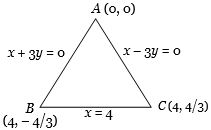
View full question & answer→MCQ 3811 Mark
The locus of a point so that sum of its distance from two given perpendicular lines is equal to $2$ unit in first quadrant, is
- A
$x + y + 2 = 0$
- ✓
$x + y = 2$
- C
$x - y = 2$
- D
AnswerCorrect option: B. $x + y = 2$
b
(b) We take the coordinate axes as two perpendicular lines. Let $P\,({x_1},{y_1})$ be the required point.
From $P\,({x_1},{y_1})$, we draw $PM$ and $PN$ perpendicular to $OX$ and $OY$ respectively.
Given, $PM + PN = 2$ ......$(i)$
But, $PM = {y_1},PN = {x_1}$
Hence from $(i)$, ${y_1} + {x_1} = 2$
Thus locus of $({x_1},{y_1})$is $x + y = 2$
which is a straight line.
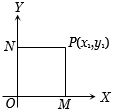
View full question & answer→MCQ 3821 Mark
The point moves such that the area of the triangle formed by it with the points $(1, 5)$ and $(3, -7)$ is $21$ sq. unit. The locus of the point is
- ✓
$6x + y - 32 = 0$
- B
$6x - y + 32 = 0$
- C
$x + 6y - 32 = 0$
- D
$6x - y - 32 = 0$
AnswerCorrect option: A. $6x + y - 32 = 0$
a
(a) Let the point be $(x,\,y).$ Area of triangle with points $(x,\,y),\,(1,\,5)$ and $(3,\, - 7)$ is $21$ sq. units
$\frac{1}{2}\left| {\,\begin{array}{*{20}{c}}x&y&1\\1&5&1\\3&{ - 7}&1\end{array}} \right| = 21$
Solving; locus of point $(x,\,y)$ is $6x + y - 32 = 0$.
View full question & answer→MCQ 3831 Mark
If the co-ordinates of the middle point of the portion of a line intercepted between coordinate axes $(3,2)$, then the equation of the line will be
- ✓
$2x + 3y = 12$
- B
$3x + 2y = 12$
- C
$4x - 3y = 6$
- D
$5x - 2y = 10$
AnswerCorrect option: A. $2x + 3y = 12$
a
(a) Obviously the coordinates of the points $A$ and $B$ are $(6, 0)$ and $(0,4)$ respectively.
therefore the equation of line $AB$ is $\frac{x}{6} + \frac{y}{4} = 1$
$ \Rightarrow 2x + 3y = 12$.
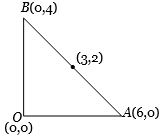
View full question & answer→MCQ 3841 Mark
The area of triangle formed by the lines $x = 0,y = 0$ and $\frac{x}{a} + \frac{y}{b} = 1$, is
- A
$ab$
- ✓
$\frac{{ab}}{2}$
- C
$2ab$
- D
$\frac{{ab}}{3}$
AnswerCorrect option: B. $\frac{{ab}}{2}$
b
(b) Area of the right angled triangle is
$ = \frac{1}{2}$(Perpendicular) $×$ (base) = $\frac{1}{2}ab$.
View full question & answer→MCQ 3851 Mark
If the coordinates of the points $A, B, C, D$, be $(a,\;b),$ $(a',\;b'),$ $( - a,\;b)$ and $(a',\; - b')$ respectively, then the equation of the line bisecting the line segments $AB$ and $CD$ is
AnswerCorrect option: B. $2ay - 2b'\;x = ab - a'b'$
b
(b) Mid point of $AB = E{\rm{ }}\left( {\frac{{a + a'}}{2},\frac{{b + b'}}{2}} \right)$ and mid point of $CD = F{\rm{ }}\left( {\frac{{a' - a}}{2},\frac{{b - b'}}{2}} \right)$. Hence equation of line $EF$ is
$y - \frac{{b + b'}}{2}$$ = \frac{{b - b' - b - b'}}{{a' - a - a - a'}}\left( {x - \frac{{a + a'}}{2}} \right)$
On simplification, we get $2ay - 2b'x - = ab - a'b'$.
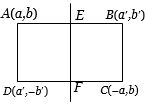
View full question & answer→MCQ 3861 Mark
If the coordinates of $A$ and $B$ be $(1, 1)$ and $(5, 7)$, then the equation of the perpendicular bisector of the line segment $AB$ is
- ✓
$2x + 3y = 18$
- B
$2x - 3y + 18 = 0$
- C
$2x + 3y - 1 = 0$
- D
$3x - 2y + 1 = 0$
AnswerCorrect option: A. $2x + 3y = 18$
a
(a) Mid point is $(3, 4)$
Slope of perpendicular$ = \frac{{ - 1}}{{6/4}} = \frac{{ - 2}}{3}$
Hence the line is $2x + 3y = 18$.
View full question & answer→MCQ 3871 Mark
The equation of the line bisecting the line segment joining the points $(a, b)$ and $(a',\;b')$ at right angle, is
- ✓
$2(a - a')x + 2(b - b')y = {a^2} + {b^2} - {a'^2} - {b'^2}$
- B
$(a - a')x + (b - b')y = {a^2} + {b^2} - {a'^2} - {b'^2}$
- C
$2(a - a')x + 2(b - b')y = {a'^2} + b{'^2} - {a^2} - {b^2}$
- D
AnswerCorrect option: A. $2(a - a')x + 2(b - b')y = {a^2} + {b^2} - {a'^2} - {b'^2}$
a
(a) $m = \frac{{ - 1}}{{\frac{{b' - b}}{{a' - a}}}} = \frac{{a' - a}}{{b - b'}}$. Mid point is $\left( {\frac{{a + a'}}{2},\frac{{b + b'}}{2}} \right)$
Therefore equation of line is $y - \left( {\frac{{b + b'}}{2}} \right) = \frac{{a' - a}}{{b - b'}}\left( {x - \frac{{a + a'}}{2}} \right)$
$ \Rightarrow 2(b - b')y + 2(a - a')x - {b^2} + {b'^2} - {a^2} + {a'^2} = 0$.
View full question & answer→MCQ 3881 Mark
Equation of the perpendicular bisector of the line segment joining the points $(7, 4)$ and $(-1, -2)$, is
- A
$4x - 3y = 15$
- B
$3x + 4y = 15$
- ✓
$4x + 3y = 15$
- D
AnswerCorrect option: C. $4x + 3y = 15$
c
(c) Mid point $ \equiv (3,\,1)$
Slope of perpendicular $ = \frac{{ - 1}}{{\frac{{ - 2 - 4}}{{ - 1 - 4}}}} = \frac{{ - 4}}{3}$
.Therefore the required equation is
$4x + 3y = 4(3) + 3(1) = 15$.
View full question & answer→MCQ 3891 Mark
If the intercept made by the line between the axis is bisected at the point $(5, 2)$, then its equation is
- A
$5x + 2y = 20$
- ✓
$2x + 5y = 20$
- C
$5x - 2y = 20$
- D
$2x - 5y = 20$
AnswerCorrect option: B. $2x + 5y = 20$
b
(b) The intercept made by the line between the axis is $(10, 4)$.
Hence, equation of line, $\frac{x}{{10}} + \frac{y}{4} = 1 \Rightarrow 2x + 5y = 20$.
View full question & answer→MCQ 3901 Mark
Equation of angle bisectors between $x$ and $y$ -axes are
AnswerCorrect option: A. $y = \pm x$
a
(a) Equations of angle bisectors between x and y-axis are $x + y = 0$ and $x - y = 0$,$(\because \theta = {45^o}$ or ${135^o})$
or $y = \pm x$.
View full question & answer→MCQ 3911 Mark
The line passing through $( - 1,\pi /2)$ and perpendicular to $\sqrt 3 \sin \theta + 2\cos \theta = \frac{4}{r}$ is
- ✓
$2 = \sqrt 3 \,r\cos \theta - 2\,r\sin \theta $
- B
$5 = - 2\sqrt 3 \,r\sin \theta + 4\,r\cos \theta $
- C
$2 = \sqrt 3 \,r\cos \theta + 2\,r\cos \theta $
- D
$5 = 2\sqrt 3 \,r\sin \theta + 4\,r\cos \theta $
AnswerCorrect option: A. $2 = \sqrt 3 \,r\cos \theta - 2\,r\sin \theta $
a
(a) Perpendicular to $\sqrt 3 \sin \theta + 2\cos \theta = \frac{4}{r}$ is
$\sqrt 3 \sin \left( {\frac{\pi }{2} + \theta } \right) + 2\cos \left( {\frac{\pi }{2} + \theta } \right) = \frac{k}{r}$
It is passing through $( - 1,\,\pi \,/\,2)$
$\sqrt 3 \sin \pi + 2\cos \pi = \frac{k}{{ - 1}} \Rightarrow k = 2$
$\sqrt 3 \cos \theta - 2\sin \theta = \frac{2}{r}$
==> $2 = \sqrt 3 r\cos \theta - 2r\sin \theta $.
View full question & answer→MCQ 3921 Mark
If $p$ and $p'$ be the distances of origin from the lines $x\sec \alpha + y{\rm{cosec }}\alpha = k$ and $x\cos \alpha - y\sin \alpha = k\cos 2\alpha $, then $4{p^2} + {p'^2}$=
- A
$k$
- B
$2k$
- ✓
${k^2}$
- D
$2{k^2}$
AnswerCorrect option: C. ${k^2}$
c
(c) Here $p = \left| {\frac{{ - k}}{{\sqrt {{{\sec }^2}\alpha + {\rm{cose}}{{\rm{c}}^2}\alpha } }}} \right|$, $p' = \left| {\frac{{ - k\cos 2\alpha }}{{\sqrt {{{\cos }^2}\alpha + {{\sin }^2}\alpha } }}} \right|$
Hence $4{p^2} + {p'^2} = \frac{{4{k^2}}}{{{{\sec }^2}\alpha + {\rm{cose}}{{\rm{c}}^2}\alpha }} + \frac{{{k^2}{{({{\cos }^2}\alpha - {{\sin }^2}\alpha )}^2}}}{1}$
$ = 4{k^2}{\sin ^2}\alpha {\cos ^2}\alpha + {k^2}({\cos ^4}\alpha + {\sin ^4}\alpha )$
$ - 2{k^2}{\cos ^2}\alpha {\sin ^2}\alpha $
$ = {k^2}{({\sin ^2}\alpha + {\cos ^2}\alpha )^2} = {k^2}$.
View full question & answer→MCQ 3931 Mark
The product of the perpendiculars drawn from the points $( \pm \sqrt {{a^2} - {b^2},} 0)$ on the line$\frac{x}{a}\cos \theta + \frac{y}{b}\sin \theta = 1$, is
- A
${a^2}$
- ✓
${b^2}$
- C
${a^2} + {b^2}$
- D
${a^2} - {b^2}$
AnswerCorrect option: B. ${b^2}$
b
(b) $\left( {\frac{{b\sqrt {{a^2} - {b^2}} \cos \theta + 0 - ab}}{{\sqrt {{b^2}{{\cos }^2}\theta + {a^2}{{\sin }^2}\theta } }}} \right)\,\left( {\frac{{ - b\sqrt {{a^2} - {b^2}} \cos \theta - ab}}{{\sqrt {{b^2}{{\cos }^2}\theta + {a^2}{{\sin }^2}\theta } }}} \right)$
$ = \frac{{ - [{b^2}({a^2} - {b^2}){{\cos }^2}\theta - {a^2}{b^2}]}}{{({b^2}{{\cos }^2}\theta + {a^2}{{\sin }^2}\theta )}}$
$ = \frac{{{b^2}[{a^2} - {a^2}{{\cos }^2}\theta + {b^2}{{\cos }^2}\theta ]}}{{{b^2}{{\cos }^2}\theta + {a^2}{{\sin }^2}\theta }}$
$ = \frac{{{b^2}[{a^2}{{\sin }^2}\theta + {b^2}{{\cos }^2}\theta ]}}{{{b^2}{{\cos }^2}\theta + {a^2}{{\sin }^2}\theta }}$=${b^2}$.
Trick : Let $a = 2,b = 1$and $\theta = \frac{\pi }{2}$,then the points are $( \pm \sqrt 3 ,\,0)$ and the line is $y = 1$. Length from $(\sqrt 3 ,0)$ on $y = 1$ is $1$ and that of from $( - \sqrt 3 ,0)$ is also $1$. Hence product is $1 \times 1 = 1$, which is given by $(b)$.
View full question & answer→MCQ 3941 Mark
The distance of the lines $2x - 3y = 4$from the point $(1, 1)$ measured parallel to the line $x + y = 1$ is
- ✓
$\sqrt 2 $
- B
$\frac{5}{{\sqrt 2 }}$
- C
$\frac{1}{{\sqrt 2 }}$
- D
$6$
AnswerCorrect option: A. $\sqrt 2 $
a
(a) The slope of line $x + y = 1$ is $ - 1$
It makes an angle of $135^\circ $ with $x$-axis.
The equation of line passing through $(1,\,\,1)$ and making an angle of $135^\circ $
is, $\frac{{x - 1}}{{\cos {{135}^o}}} = \frac{{y - 1}}{{\sin {{135}^o}}} = r$
==> $\frac{{x - 1}}{{ - 1/\sqrt 2 }} = \frac{{y - 1}}{{1/\sqrt 2 }} = r$
Co-ordinates of any point on this line are $\left( {1 - \frac{r}{{\sqrt 2 }},1 + \frac{r}{{\sqrt 2 }}} \right)$If this point lies on $2x - 3y = 4$, then
$2\left( {1 - \frac{r}{{\sqrt 2 }}} \right) - 3\left( {1 + \frac{r}{{\sqrt 2 }}} \right) = 4$
==> $r = \sqrt 2 .$
View full question & answer→MCQ 3951 Mark
If ${p_1},{p_2}$ and ${p_3}$ be the perpendiculars from the points $({m^2},2m)$,$(mm',m + m')$ and $(m{'^2},2m')$ respectively on the line $x\cos \alpha + y\sin \alpha + \frac{{{{\sin }^2}\alpha }}{{\cos \alpha }} = 0$, then ${p_1},{p_2}$ and ${p_3}$ are in
- A
$A. P.$
- ✓
$G. P.$
- C
$H. P.$
- D
AnswerCorrect option: B. $G. P.$
b
(b) ${p_1} = {m^2}\cos \alpha + 2m\sin \alpha + \frac{{{{\sin }^2}\alpha }}{{\cos \alpha }}$
or ${p_1} = {\left( {\frac{{m\cos \alpha + \sin \alpha }}{{\sqrt {\cos \alpha } }}} \right)^2}$ and ${p_3} = {\left( {\frac{{m'\cos \alpha + \sin \alpha }}{{\sqrt {\cos \alpha } }}} \right)^2}$
${p_2} = \frac{{mm'{{\cos }^2}\alpha + (m + m')\sin \alpha \cos \alpha + {{\sin }^2}\alpha }}{{\cos \alpha }}$
$ = \frac{{(m\cos \alpha + \sin \alpha )}}{{\sqrt {\cos \alpha } }}\left( {\frac{{m'\cos \alpha + \sin \alpha }}{{\sqrt {\cos \alpha } }}} \right) = \sqrt {{p_1}} .\sqrt {{p_3}} $
Since $p_2^2 = {p_1}.{p_3}$ and hence $G.P.$
View full question & answer→MCQ 3961 Mark
If the lines $ax + y + 1 = 0,x + by + 1 = 0$ and $x + y + c = 0$ ($a,\, b,\, c$ being distinct and different from $1$) are concurrent, then $\frac{1}{{1 - a}} + \frac{1}{{1 - b}} + \frac{1}{{1 - c}} = $
- A
$0$
- ✓
$1$
- C
$\frac{1}{{a + b + c}}$
- D
Answerb
(b) If the given lines are concurrent, then
$\left| {\,\begin{array}{*{20}{c}}a&1&1\\1&b&1\\1&1&c\end{array}\,} \right| = 0 \Rightarrow \left| {\,\begin{array}{*{20}{c}}a&{1 - a}&{1 - a}\\1&{b - 1}&0\\1&0&{c - 1}\end{array}{\kern 1pt} } \right| = 0$
$⇒$ {Apply ${C_2} \to {C_2} - {C_1}$and ${C_3} \to {C_3} - {C_1}$}
$⇒$ $a(b - 1)(c - 1) - (b - 1)(1 - a) - (c - 1)(1 - a) = 0$
$⇒$ $\frac{a}{{1 - a}} + \frac{1}{{1 - b}} + \frac{1}{{1 - c}} = 0$ $\{Divide\,\, by (1 - a)(1 - b)(1 - c)\}$
$⇒$ $\frac{1}{{1 - a}} + \frac{1}{{1 - b}} + \frac{1}{{1 - c}} = 1$.
View full question & answer→MCQ 3971 Mark
If straight lines $ax + by + p = 0$ and $x\cos \alpha + y\sin \alpha - p = 0$ include an angle $\pi /4$ between them and meet the straight line $x\sin \alpha - y\cos \alpha = 0$ in the same point, then the value of ${a^2} + {b^2}$ is equal to
Answerb
(b) It is given that the lines $ax + by + p = 0$ and $x\cos \alpha + y\sin \alpha = p$ are inclined at an angle $\frac{\pi }{4}$.
Therefore $\tan \frac{\pi }{4} = \frac{{ - \frac{a}{b} + \frac{{\cos \alpha }}{{\sin \alpha }}}}{{1 + \frac{{a\cos \alpha }}{{b\sin \alpha }}}}$
==> $a\cos \alpha + b\sin \alpha = - a\sin \alpha + b\cos \alpha $ .....$(i)$
It is given that the lines $ax + by + p = 0$, $x\cos \alpha + y\sin \alpha - p = 0$ and $x\sin \alpha - y\cos \alpha = 0$ are concurrent.
$\left| {\,\begin{array}{*{20}{c}}a&b&p\\{\cos \alpha }&{\sin \alpha }&{ - p}\\{\sin \alpha }&{ - \cos \alpha }&0\end{array}\,} \right| = 0$
==> $ - ap\cos \alpha - bp\sin \alpha - p = 0 \Rightarrow - a\cos \alpha - b\sin \alpha = 1$
==> $a\cos \alpha + b\sin \alpha = - 1$......$(ii)$
From $(i)$ and $(ii)$, $ - a\sin \alpha + b\cos \alpha = - 1$
From $(ii)$ and $(iii)$,
${(a\cos \alpha + b\sin \alpha )^2} + {( - a\sin \alpha + b\cos \alpha )^2} = 2$
==> ${a^2} + {b^2} = 2$.
View full question & answer→MCQ 3981 Mark
If for a variable line $\frac{x}{a} + \frac{y}{b} = 1$, the condition $\frac{1}{{{a^2}}} + \frac{1}{{{b^2}}} = \frac{1}{{{c^2}}}$ (c is a constant) is satisfied, then locus of foot of perpendicular drawn from origin to the line is
AnswerCorrect option: C. ${x^2} + {y^2} = {c^2}$
c
(c) Equation of perpendicular drawn from origin to the line $\frac{x}{a} + \frac{y}{b} = 1$ is $y - 0 = \frac{a}{b}(x - 0)$
[ $m$ of given line $ = \frac{{ - b}}{a}$, $\therefore m$ of perpendicular $\left. { = \frac{a}{b}} \right]$
==> $by - ax = 0$
==> $\frac{x}{b} - \frac{y}{a} = 0$
Now, the locus of foot of perpendicular is the intersection point of line $\frac{x}{a} + \frac{y}{b} = 1$ .....$(i)$
and $\frac{x}{b} - \frac{y}{a} = 0$......$(ii)$
To find locus, squaring and adding $(i)$ and $(ii)$
${\left( {\frac{x}{a} + \frac{y}{b}} \right)^2} + {\left( {\frac{x}{b} - \frac{y}{a}} \right)^2} = 1$
==> ${x^2}\left( {\frac{1}{{{a^2}}} + \frac{1}{{{b^2}}}} \right) + {y^2}\left( {\frac{1}{{{a^2}}} + \frac{1}{{{b^2}}}} \right) = 1$
==> ${x^2}\left( {\frac{1}{{{c^2}}}} \right) + {y^2}\left( {\frac{1}{{{c^2}}}} \right) = 1$ ,
==> ${x^2} + {y^2} = {c^2}$.
View full question & answer→MCQ 3991 Mark
$A$ ray of light coming from the point $(1, 2)$ is reflected at a point $A$ on the $x$-axis and then passes through the point $(5, 3)$. The coordinates of the point $A$ are
- ✓
$\left( {13/5,\;0} \right)$
- B
$\left( {5/13,\;0} \right)$
- C
$(-7,\, 0)$
- D
AnswerCorrect option: A. $\left( {13/5,\;0} \right)$
a
(a) Let the coordinates of $A$ be $(a, 0)$. Then the slope of the reflected ray is $\frac{{3 - 0}}{{5 - a}} = \tan \theta ,\,\,({\rm{say}})$.
The slope of the incident ray =$\frac{{2 - 0}}{{1 - a}} = \tan (\pi - \theta )$
Since $\tan \theta + \tan (\pi - \theta ) = 0 \Rightarrow \frac{3}{{5 - a}} + \frac{2}{{1 - a}} = 0$
==> $13 - 5a = 0 \Rightarrow a = \frac{{13}}{5}$
Thus the coordinates of $A$ are $\left( {\frac{{13}}{5},0} \right)$.
View full question & answer→MCQ 4001 Mark
The point $(4, 1)$ undergoes the following three transformations successively (i) Reflection about the line $y = x$ (ii)Translation through a distance $2$ units along the positive direction of $x$ - axis (iii) Rotation through an angle $\pi /4$ about the origin in the anti clockwise direction. The final position of the point is given by the coordinates
- A
$\left( {\frac{1}{{\sqrt 2 }},\frac{7}{{\sqrt 2 }}} \right)$
- B
$( - \sqrt 2 ,\,\,7\sqrt 2 )$
- ✓
$\left( { - \frac{1}{{\sqrt 2 }},\frac{7}{{\sqrt 2 }}} \right)$
- D
$(\sqrt 2 ,\,\,7\sqrt 2 )$
AnswerCorrect option: C. $\left( { - \frac{1}{{\sqrt 2 }},\frac{7}{{\sqrt 2 }}} \right)$
c
(c) $({x_1},{y_1}) \to \left( {\frac{{{y_1} - 1}}{{{x_1} - 4}}} \right) = - 1$ and $\frac{{{x_1} + 4}}{2} = \frac{{{y_1} + 1}}{2}$
==> ${x_1} + {y_1} = 5$ and ${x_1} - {y_1} = - 3$==> ${x_1} = 1,{y_1} = 4$
${2^{nd}}$ operation ==> $(3,4)$
${3^{rd}}$ operation ==> $\left( {\frac{3}{{\sqrt 2 }} - \frac{4}{{\sqrt 2 }},\frac{3}{{\sqrt 2 }} + \frac{4}{{\sqrt 2 }}} \right) = \left( {\frac{{ - 1}}{{\sqrt 2 }},\frac{7}{{\sqrt 2 }}} \right)$.
View full question & answer→MCQ 4011 Mark
The ends of the base of an isosceles triangle are at $(2a,\;0)$ and $(0,\;a).$ The equation of one side is $x=2a$ The equation of the other side is
- A
$x + 2y - a = 0$
- B
$x + 2y = 2a$
- C
$3x + 4y - 4a = 0$
- ✓
$3x - 4y + 4a = 0$
AnswerCorrect option: D. $3x - 4y + 4a = 0$
d
(d) Obviously, other line $AB$ will pass through $(0, a)$ and $(2a,k)$.
But as we are given $AB = AC$
$ \Rightarrow k = \sqrt {4{a^2} + {{(k - a)}^2}} $==> $k = \frac{{5a}}{2}$
Hence the required equation is $3x - 4y + 4a = 0$.
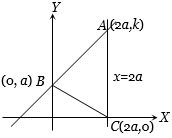
View full question & answer→MCQ 4021 Mark
If $A$ and $B$ are two points on the line $3x + 4y + 15 = 0$ such that $OA = OB = 9$ units, then the area of the triangle $OAB$ is
- A
$18 sq.$ units
- ✓
$18\sqrt 2 sq.$units
- C
18/$\sqrt 2 sq.$ units
- D
AnswerCorrect option: B. $18\sqrt 2 sq.$units
b
(b) $OA = OB = 9,OD = \frac{{15}}{{\sqrt {25} }} = 3$
Therefore$AB = 2AD = 2\sqrt {81 - 9} = 2\sqrt {72} = 12\sqrt 2 $
Hence $\Delta = \frac{1}{2}(3 \times 12\sqrt 2 ) = 18\sqrt 2 $ sq. units.
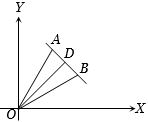
View full question & answer→MCQ 4031 Mark
One vertex of the equilateral triangle with centroid at the origin and one side as $x + y - 2 = 0$ is
- A
$( - 1, - 1)$
- B
$(2,2)$
- ✓
$( - 2, - 2)$
- D
AnswerCorrect option: C. $( - 2, - 2)$
c
(c) Let the co-ordinate of vertex $A$ be $(h,k)$. Then $AD$ is perpendicular to $BC$, therefore $OA\, \bot \,BC$
$⇒$ $\frac{{k - 0}}{{h - 0}} \times \frac{{ - 1}}{1} = - 1 \Rightarrow k = h$.....$(i)$
Let the coordinates of $D$ be$(\alpha ,\beta )$. Then the co-ordinates of $O$ are $\left( {\frac{{2\alpha + h}}{{2 + 1}},\frac{{2\beta + k}}{{2 + 1}}} \right)$. Therefore $\frac{{2\alpha + h}}{3} = 0$ and $\frac{{2\beta + k}}{3} = 0$ $ \Rightarrow \alpha = - \frac{h}{2},\beta = \frac{{ - k}}{2}$.
Since $(\alpha ,\beta )$lies on $x + y - 2 = 0$
$⇒$ $\alpha + \beta - 2 = 0$
$⇒$ $ - h/2 - k/2 - 2 = 0$==>$h + k + 4 = 0$
$⇒$ $2h + 4 = 0 \Rightarrow h = k = - 2$,[from (i)]
Hence the coordinates of vertex $A$ are $( - 2, - 2)$.
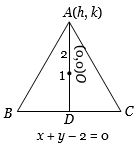
View full question & answer→MCQ 4041 Mark
Area of the parallelogram whose sides are $x\cos \alpha + y\sin \alpha = p$ $x\cos \alpha + y\sin \alpha = q,\,\,$ $x\cos \beta + y\sin \beta = r$ and $x\cos \beta + y\sin \beta = s$ is
- ✓
$ \pm (p - q)(r - s)\,{\rm{cosec}}(\alpha - \beta )$
- B
$(p + q)(r - s)\,{\rm{cosec }}(\alpha + \beta )$
- C
$(p + q)(r + s)\,{\rm{cosec }}(\alpha - \beta )$
- D
AnswerCorrect option: A. $ \pm (p - q)(r - s)\,{\rm{cosec}}(\alpha - \beta )$
a
(a) Use, Area = ${p_1}.{p_2}{\rm{cosec}}\theta $
where $\tan \theta = \frac{{ - \tan \alpha + \tan \beta }}{{1 + \tan \alpha \tan \beta }} = \tan (\beta - \alpha )$
$\theta = \beta - \alpha ,{p_1} = p - q,{p_2} = r - s$.
View full question & answer→MCQ 4051 Mark
Locus of the points which are at equal distance from $3x + 4y - 11 = 0$ and $12x + 5y + 2 = 0$ and which is near the origin is
- A
$21x - 77y + 153 = 0$
- ✓
$99x + 77y - 133 = 0$
- C
$7x - 11y = 19$
- D
AnswerCorrect option: B. $99x + 77y - 133 = 0$
b
(b) Let point be $({x_1},{y_1}),$then according to the condition $\frac{{3{x_1} + 4{y_1} - 11}}{5} = - \left( {\frac{{12{x_1} + 5{y_1} + 2}}{{13}}} \right)$
Since the given lines are on opposite sides with respect to origin, hence the required locus is $99x + 77y - 133 = 0$ .
View full question & answer→MCQ 4061 Mark
If a variable line drawn through the point of intersection of straight lines $\frac{x}{\alpha } + \frac{y}{\beta } = 1$and $\frac{x}{\beta } + \frac{y}{\alpha } = 1$ meets the coordinate axes in $A$ and $B$, then the locus of the mid point of $AB$ is
- A
$\alpha \beta (x + y) = xy(\alpha + \beta )$
- ✓
$\alpha \beta (x + y) = 2xy(\alpha + \beta )$
- C
$(\alpha + \beta )(x + y) = 2\alpha \beta xy$
- D
AnswerCorrect option: B. $\alpha \beta (x + y) = 2xy(\alpha + \beta )$
b
(b) The equation of a line passing through the intersection of straight lines $\frac{x}{\alpha } + \frac{y}{\beta } = 1$ and $\frac{x}{\beta } + \frac{y}{\alpha } = 1$ is
$\left( {\frac{x}{\alpha } + \frac{y}{\beta } - 1} \right) + \lambda \left( {\frac{x}{\beta } + \frac{y}{\alpha } - 1} \right) = 0$
or $x\,\left( {\frac{1}{\alpha } + \frac{\lambda }{\beta }} \right) + y\left( {\frac{1}{\beta } + \frac{\lambda }{\alpha }} \right) - \lambda - 1 = 0$
This meets the axes at
$A{\rm{ }}\left( {\frac{{\lambda + 1}}{{\frac{1}{\alpha } + \frac{\lambda }{\beta }}},0} \right)$ and $B{\rm{ }}\left( {0,\frac{{\lambda + 1}}{{\frac{1}{\beta } + \frac{\lambda }{\alpha }}}} \right)$.
Let $(h, k)$ be the mid point of $AB$,
then $h = \frac{1}{2}.\frac{{\lambda + 1}}{{\frac{1}{\alpha } + \frac{\lambda }{\beta }}},k = \frac{1}{2}.\frac{{\lambda + 1}}{{\frac{1}{\beta } + \frac{\lambda }{\alpha }}}$
Eliminating $\lambda $from these two, we get
$2hk(\alpha + \beta ) = \alpha \beta (h + k)$.
The locus of $(h,k)$is $2xy(\alpha + \beta ) = \alpha \beta (x + y)$.
View full question & answer→MCQ 4071 Mark
A straight line through the point $(1, 1)$ meets the $x$-axis at ‘$A$’ and the $y$-axis at ‘$B$’. The locus of the mid-point of $AB$ is
- A
$2xy + x + y = 0$
- ✓
$x + y - 2xy = 0$
- C
$x + y + 2 = 0$
- D
$x + y - 2 = 0$
AnswerCorrect option: B. $x + y - 2xy = 0$
b
(b) Equation of line passing through point $(1, 1)$ is,
$y - 1 = m(x - 1)$......$(i)$
Line $(i)$ meets x-axis, so $y = 0$
$\therefore $ $\frac{{ - 1}}{m} = x - 1 \Rightarrow x = 1 - \frac{1}{m}$
Line $(i)$ meets y-axis, so $x = 0$
$\therefore $ $y - 1 = - m \Rightarrow y = 1 - m$
Let mid point of $AB$ be $(h, k)$,
Then $h = \frac{{0 + (1 - (1/m))}}{2}$;$k = \frac{{0 + (1 - m)}}{2}$
$m = \frac{1}{{1 - 2h}}$ ; $m = 1 - 2k$
$1 - 2k = \frac{1}{{1 - 2h}}$
==> $1 - 2k - 2h + 4hk = 1$
==> $ - 2h - 2k + 4hk = 0$
Hence the Locus of mid point is, $x + y - 2xy = 0$.
View full question & answer→MCQ 4081 Mark
The line $3x + 2y = 24$ meets $y$-axis at $A$ and $x$-axis at $B$. The perpendicular bisector of $AB$ meets the line through $(0, - 1)$ parallel to $x$-axis at $C$. The area of the triangle $ABC$ is ............... $\mathrm{sq. \, units}$
Answerb
(b) The coordinates of $A$ and $B$ are $(0,\,12)$and $(8,0)$ respectively. The equation of the perpendicular bisector of $AB$ is $y - 6 = \frac{2}{3}(x - 4)$ or $2x - 3y + 10 = 0$ .....$(i)$
Equation of a line passing through $(0, -1)$ and parallel to $x$-axis is $y = - 1$. This meets $(i)$ at $C$, Therefore the coordinates of $C$ are $\left( { - \frac{{13}}{2}, - 1} \right)$.
Hence the area of the triangle $ABC$ is
$\Delta = \frac{1}{2}\left| {\begin{array}{*{20}{c}}0&{12}&1\\8&0&1\\{ - \frac{{13}}{2}}&{ - 1}&1\end{array}\,} \right| = 91$ sq. units.
View full question & answer→MCQ 4091 Mark
A pair of straight lines drawn through the origin form with the line $2x + 3y = 6$ an isosceles right angled triangle, then the lines and the area of the triangle thus formed is
- ✓
$x - 5y = 0$ ; $5x + y = 0$ ; $\Delta = \frac{{36}}{{13}}$
- B
$3x - y = 0$ ; $5x + y = 0$ ; $x + 3y = 0$; ;$\Delta = \frac{{36}}{{13}}$$\Delta = \frac{{12}}{{17}}$
- C
$5x - y = 0$ ; $x + 5y = 0$ ; $\Delta = \frac{{13}}{5}$
- D
AnswerCorrect option: A. $x - 5y = 0$ ; $5x + y = 0$ ; $\Delta = \frac{{36}}{{13}}$
a
(a) $y = mx$. It makes an angle of $ \pm {45^o}$ with $2x + 3y = 6$.
$\tan ( \pm {45^o}) = \frac{{m - ( - 2/3)}}{{1 + m( - 2/3)}} = \pm 1$
or $3m + 2 = \pm (3 - 2m)$$ \Rightarrow m = \frac{1}{5}, - 5$
Hence sides are
$x - 5y = 0,$
$5x + y = 0$
and $2x + 3y = 6$.
Solving in pairs, vertices are $(0,\,0)$,
$\left( {\frac{6}{{13}},\frac{{30}}{{13}}} \right)\,,\left( {\frac{{30}}{{13}}, - \frac{6}{{13}}} \right)$.
.$\Delta = \left| {\frac{1}{2}({x_1}{y_2} - {x_2}{y_1})} \right| = \frac{1}{2} \times \frac{{936}}{{169}} = \frac{{36}}{{13}}$.
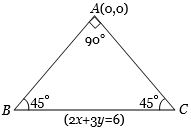
View full question & answer→MCQ 4101 Mark
Equation of one of the sides of an isosceles right angled triangle whose hypotenuse is $3x + 4y = 4$ and the opposite vertex of the hypotenuse is $(2, 2)$, will be
AnswerCorrect option: A. $x - 7y + 12 = 0$
a
(a) Since $\angle A = \angle C = {45^o}$. We have to find equation of $AB$. Here let gradient of $AB$ be $m$, then equation of $AB$ is $y - 2 = m(x - 2)$……(i)
But angle between $3x + 4y = 4$ and (i) is ${45^o}$
So, $\tan {45^o} = \frac{{m + \frac{3}{4}}}{{1 - \frac{{3m}}{4}}} \Rightarrow m = \frac{1}{7}$
Hence, the required equation is $x - 7y + 12 = 0$
{By putting the value of m in (i)}.
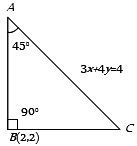
View full question & answer→MCQ 4111 Mark
A point starts moving from $(1, 2)$ and its projections on $x$ and $y$ - axes are moving with velocities of $3m/s$ and $2m/s$ respectively. Its locus is
- ✓
$2x - 3y + 4 = 0$
- B
$3x - 2y + 1 = 0$
- C
$3y - 2x + 4 = 0$
- D
$2y - 3x + 1 = 0$
AnswerCorrect option: A. $2x - 3y + 4 = 0$
a
(a) After time $‘t’$ secs.
Abcissa, $x = 1 + 3\,t$ and ordinate, $y = 2 + 2\,t$
Eliminating $t,$ $\frac{{x - 1}}{3} = \frac{{y - 2}}{2}$ or $2x - 2 = 3y - 6$
or $2x - 3y + 4 = 0.$
View full question & answer→MCQ 4121 Mark
Co-ordinates of the orthocentre of the triangle whose vertices are $A(0, 0) , B(3, 4)$ and $C(4, 0)$ is
AnswerCorrect option: D. $\left( {3,\frac{3}{4}\,} \right)$
d
To find orthocentre of the triangle formed by (0,0),(3,4) and (4,0)
Let $H$ be the orthocenter of $\triangle O A B$
Therefore (slope of $O P$ i.e $O H) .($ slope of $B A)=-1$ $\Rightarrow\left(\frac{y-0}{3-0}\right) \cdot\left(\frac{4-0}{3-4}\right)=-1 \Rightarrow-\frac{4}{3} y=-1 \Rightarrow y=\frac{3}{4}$
Therefore required orthocenter $=(3, y)=\left(3, \frac{3}{4}\right)$
View full question & answer→MCQ 4131 Mark
A line is such that its segment between the straight lines $5x - y - 4 = 0$ and $3x + 4y - 4 = 0$ is bisected at the point $(1, 5)$, then its equation is
- ✓
$83x - 35y + 92 = 0$
- B
$35x - 83y + 92 = 0$
- C
$35x + 35y + 92 = 0$
- D
AnswerCorrect option: A. $83x - 35y + 92 = 0$
a
(a) Any line through the middle point $M(1, 5)$ of the intercept $AB$ may be taken as
$\frac{{x - 1}}{{\cos \theta }} = \frac{{y - 5}}{{\sin \theta }} = r$…..$(i)$
where $‘r$’ is the distance of any point $(x, y)$ on the line $(i)$ from the point $M(1, 5)$.
Since the points $A$ and $B$ are equidistant from $M$ and on the opposite sides of it,
therefore if the coordinates of A are obtained by putting r=d in (i), then the co-ordinates of B are given by putting $r = - d$.
Now the point $A(1 + d\cos \theta ,\,5 + d\sin \theta )$ lies on the line $5x - y - 4 = 0$
and point $B(1 - d\cos \theta ,\,5 - d\sin \theta )$ lies on the line $3x + 4y - 4 = 0$.
Therefore, $5(1 + d\cos \theta ) - (5 + d\sin \theta ) - 4 = 0$
and $3(1 - d\cos \theta ) + $ $4(5 - d\sin \theta ) - 4 = 0$
Eliminating $‘d’$ from the two, we get $\frac{{\cos \theta }}{{35}} = \frac{{\sin \theta }}{{83}}$.
Hence the required line is $\frac{{x - 1}}{{35}} = \frac{{y - 5}}{{83}}$ or $83x - 35y + 92 = 0$.
View full question & answer→MCQ 4141 Mark
The equation of the bisector of that angle between the lines $x + 2y - 11 = 0$, $3x - 6y - 5 = 0$ which contains the point $(1, -3)$ is
- ✓
$3x = 19$
- B
$3y = 7$
- C
$3x = 19$and $3y = 7$
- D
AnswerCorrect option: A. $3x = 19$
a
(a) Since the origin and the point $(1, -3)$ lie on the same side of $x + 2y - 11 = 0$ and on the opposite side of $3x - 6y - 5 = 0$. Therefore, the bisector of the angle containing $(1, - 3)$ is the bisector of that angle which does not contain the origin and is given by $\frac{{ - x - 2y + 11}}{{\sqrt 5 }} = - \left( {\frac{{ - 3x + 6y + 5}}{{\sqrt {45} }}} \right)$ i.e., $3x = 19$.
View full question & answer→MCQ 4151 Mark
Given vertices $A(1,\,1),B(4,\, - 2)$ and $C(5,\,5)$ of a triangle, then the equation of the perpendicular dropped from $C$ to the interior bisector of the angle $A$ is
- A
$y - 5 = 0$
- ✓
$x - 5 = 0$
- C
$y + 5 = 0$
- D
$x + 5 = 0$
AnswerCorrect option: B. $x - 5 = 0$
b
(b) The internal bisector of the angle $A$ will divide the opposite side $BC$ at $D$ in the ratio of arms of the angle i.e.$AB = 3\sqrt 2 $ and $AC = 4\sqrt 2 $.
Hence by ratio formula the point $D$ is $\left( {\frac{{31}}{7},1} \right)$.
Slope of $AD$by $\frac{{{y_2} - {y_1}}}{{{x_2} - {x_1}}} = 0$.
Slope of a line perpendicular to $AD$ is $\infty $.
Any line through C perpendicular to this bisector is $\frac{{y - 5}}{{x - 5}} = m = \infty $; $x - 5 = 0$.
View full question & answer→MCQ 4161 Mark
$P$ is a point on either of the two lines $y - \sqrt 3 |x| = 2$ at a distance of $5\,units$ from their point of intersection. The coordinates of the foot of the perpendicular from $P$ on the bisector of the angle between them are
- A
$\left( {0,\frac{{4 + 5\sqrt 3 }}{2}} \right)$ or $\left( {0,\frac{{4 - 5\sqrt 3 }}{2}} \right)$ depending on which the point $P$ is taken
- ✓
$\left( {0,\frac{{4 + 5\sqrt 3 }}{2}} \right)$
- C
$\left( {0,\frac{{4 - 5\sqrt 3 }}{2}} \right)$
- D
$\left( {\frac{5}{2},\frac{{5\sqrt 2 }}{2}} \right)$
AnswerCorrect option: B. $\left( {0,\frac{{4 + 5\sqrt 3 }}{2}} \right)$
b
(b) Since $|x| = \left\{ \begin{array}{l}x,\,\,\,\,\,x \ge 0\\ - x,\,\,x < 0\end{array} \right.$, therefore the equations of two lines are $y = \sqrt 3 x + 2,x \ge 0$ and $y = - \sqrt 3 x + 2,x < 0$.
Clearly, $y$ - axis the only bisector of the angle between these two lines. There are two points $P$ and $Q$ on these lines at a distance of $5$ units from $A$. Clearly, $M$ is foot of the perpendicular from $P$ and $Q$ on $y$ - axis $(bisector)$
$AM = AP\,\cos {30^o} = \frac{{5\sqrt 3 }}{2}$
Hence, co-ordinate of $M$ are $\left( {0,\,\,2 + \frac{{5\sqrt 3 }}{2}} \right)$.
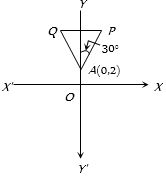
View full question & answer→MCQ 4171 Mark
The point $(4, 1)$ undergoes the following two successive transformation
$(i)$ Reflection about the line $y = x$
$(ii)$ Translation through a distance $2$ units along the positive $x$-axis
Then the final coordinates of the point are
AnswerCorrect option: B. $(3, 4)$
b
(b) After first transformation, the point will be $(1, 4)$ and therefore, final point is $(1 + 2,\,4) = (3,\,4)$ .
View full question & answer→MCQ 4181 Mark
Let $L$ be the line $2x + y = 2$. If the axes are rotated by ${45^o}$, then the intercepts made by the line $L$ on the new axes are respectively
AnswerCorrect option: C. $2\sqrt 2 $ and $2\sqrt 2 /3$
c
(c) Suppose the axes are rotated in the anticlockwise direction through an angle ${45^o}$. To find the equation of $L$ w.r.t the new axis, we replace $x$ by $x\cos \alpha - y\sin \alpha $ and by $x\sin \alpha + y\cos \alpha $, so that equation of line w.r.t. new axes is
==> $1/1(x\cos {45^o} - y\sin {45^o}) + \frac{1}{2}(x\sin {45^o} + y\cos {45^o}) = 1$
Since, $p, q$ are the intercept made by the line on the coordinate axes. we have on putting $(p, 0)$ and then $(0, q)$
==> $\frac{1}{p} = \frac{1}{a}\cos \alpha + \frac{1}{b}\sin \alpha$
$\Rightarrow \frac{1}{q} = - \frac{1}{a}\sin \alpha + \frac{1}{b}\cos \alpha $
==> $\frac{1}{p} = \frac{1}{1}\cos {45^o} + \frac{1}{2}\sin {45^o}$
$ \Rightarrow \frac{1}{p} = \frac{1}{{\sqrt 2 }} + \frac{1}{2}.\frac{1}{{\sqrt 2 }} = \frac{3}{{2\sqrt 2 }}$
$p = \frac{{2\sqrt 2 }}{3}$; $\frac{1}{q} = - \frac{1}{1}\sin {45^o} + \frac{1}{2}\cos {45^o}$
$\frac{1}{q} = \frac{{ - 1}}{{\sqrt 2 }} + \frac{1}{{2\sqrt 2 }} = - \frac{1}{{2\sqrt 2 }}\,,\,\,\,\therefore q = 2\sqrt 2 $
So intercept made by is assume on the new axis $\left( {2\sqrt 2 /3,\,\,2\sqrt 2 } \right)$.
If the rotation is assume in clockwise direction, so intercept made by the line on the new axes would be $\left( {2\sqrt 2 ,\,2\sqrt 2 /3} \right)$.
View full question & answer→MCQ 4191 Mark
If two vertices of a triangle are $(5, -1)$ and $( - 2, 3)$ and its orthocentre is at $(0, 0)$, then the third vertex
AnswerCorrect option: B. $(-4, - 7)$
b
Let the third vertex of $\Delta ABC$ be $(a,b)$.
or thocenter $=H(0,0)$
Let $A(5,-1)$ and $B(-2,3)$ be other two vertices of $\Delta ABC$.
Now, (Slpoe of $AH$)$ \times $ (Slope of $BC$) $=-1$
$ \Rightarrow \left( {\frac{{ - 1 - 0}}{{5 - 0}}} \right)\left( {\frac{{b - 3}}{{a + 2}}} \right) = - 1$
$ \Rightarrow b - 3 = 5\left( {a + 2} \right)\,\,\,\,\,\,\,\,\,....\left( 1 \right)$
Similariy,
(Slope of $BH$ )$ \times $(Slop of $AC$ )$=-1$
$ \Rightarrow - \left( {\frac{3}{2}} \right) \times \left( {\frac{{b + 1}}{{a - 5}}} \right) = - 1$
$ \Rightarrow 3b + 3 = 2a - 10$
$ \Rightarrow 3b - 2a + 13 = 0\,\,\,\,\,\,\,\,\,\,.....\left( 2 \right)$
On solving equation $(1)$ and $(2)$ we get $a=-4$, $b=-7$
Hence, third vertex is $(-4,-7)$
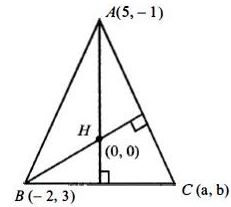
View full question & answer→MCQ 4201 Mark
If the point $(1 , a)$ lies between the straight lines $x + y = 1$ and $2(x + y) = 3$ then $a$ lies in interval
- A
$\left( {\frac{3}{2},\infty } \right)$
- B
$\left( {1,\frac{3}{2}} \right)$
- C
$\left( { - \infty ,0} \right)$
- ✓
$\left( {0,\frac{1}{2}} \right)$
AnswerCorrect option: D. $\left( {0,\frac{1}{2}} \right)$
d
Since, $(1,a)$ lies between $x+y=1$
and $2(x+y)=3$
$\therefore $ Put $x=1$ in $2(x+y)=3$.
we get the rangeb of $y$. thus,
$2\left( {1 + y} \right) = 3 \Rightarrow y = \frac{3}{2} - 1 = \frac{1}{2}$
Thus $'a'$ lies in $\left( {0,\frac{1}{2}} \right)$
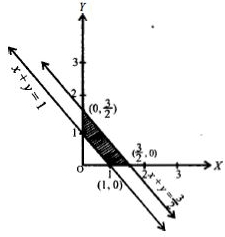
View full question & answer→MCQ 4211 Mark
Let $L$ be the line $y = 2x,$ in the two dimensional plane.
Statement $1:$ The image of the point $(0, 1)$ in $L$ is the point $\left( {\frac{4}{5},\frac{3}{5}} \right).$
Statement $2:$ The points $(0, 1)$ and $\left( {\frac{4}{5},\frac{3}{5}} \right)$ lie on opposite sides of the line $L$ and are at equal distance from it.
- A
Statement $1$ is true, Statement $2$ is false.
- B
Statement $1$ is true, Statement $2$ is true,
Statement $2$ is not a correct explanation for Statement $1.$
- ✓
Statement $1$ is true, Statement $2$ is true,
Statement $2$ is a correct explanation for Statement $1.$
- D
Statement $1$ is false, Statement $2$ is true.
AnswerCorrect option: C. Statement $1$ is true, Statement $2$ is true,
Statement $2$ is a correct explanation for Statement $1.$
c
Statement- $1$
Let $P'\left( {{x_1},{y_1}} \right)$ be the image of $(0,1)$ with respect to the line $2x-y=0$ then
$\frac{{{x_1}}}{2} = \frac{{{y_1} - 1}}{{ - 1}} = \frac{{ - 4\left( 0 \right) + 2\left( 1 \right)}}{5}$
$ \Rightarrow {x_1} = \frac{4}{5},{y_1} = \frac{3}{5}$
Thus, statement- $1$ is true.
Also, statement- $2$ is true and correct explanation for statement- $1$.
View full question & answer→MCQ 4221 Mark
If the straight lines $x + 3y = 4,\,\,3x + y = 4$ and $x +y = 0$ form a triangle, then the triangle is
Answerc
Let equation of $AB:x+3y=4$
Let equation of $BC:3x+y=4$
Let equation of $CA:x+y=0$
Now,By solving these equations we get
$A=(-2,2)$, $B=(1,1)$ and $C=(2,-2)$
Now, $AB = \sqrt {9 + 1} = \sqrt {10} $,
$BC = \sqrt {1 + 9} = \sqrt {10} $
and $CA = \sqrt {16 + 16} = \sqrt {32} $
Since, length of $AB$ and $BC$ are same therfore triangle is isosceles.
View full question & answer→MCQ 4231 Mark
The point of intersection of the lines $(a^3 + 3)x+ ay + a - 3 =0$ and $(a^5 + 2)x+ (a + 2)y+ 2a + 3 = 0$ ($a$ is a real) lies on the $y-$ axis for
AnswerCorrect option: A. no value of $a$
a
Given equation of lines are
$\left( {{a^3} + 3} \right)x + ay + a - 3 = 0$ and
$\left( {{a^5} + 2} \right)x + \left( {a + 2} \right)y + 2a + 3 = 0$ (a real)
Since point of intersection of lines lies on $y-$ axis.
$\therefore $ Put $x=0$ in each equation, we get
$ay+a-3=0$ and
$(a+2)y+2a+3=0$
On solving these we get
$(a+2)(a-3)-a(2a+3)=0$
$ \Rightarrow {a^2} - a - 6 - 2{a^2} - 3a = 0$
$ \Rightarrow - {a^2}4a - 6 = 0 \Rightarrow {a^2} + 4a + 6 = 0$
$ \Rightarrow a = \frac{{ - 4 \pm \sqrt {16 - 24} }}{2} = \frac{{ - 4 \pm \sqrt { - 8} }}{2}$
This shows that the point of intersection of the lines lies on the $y-$ axis for on value of $'a'$
View full question & answer→MCQ 4241 Mark
If the line $y = mx + 1$ meets the circle $x^2 + y^2 + 3x = 0$ in two points equidistant from and on opposite sides of $x-$ axis, then
- A
$3m +2=0$
- ✓
$3m - 2=0$
- C
$2m + 3=0$
- D
$2m - 3=0$
AnswerCorrect option: B. $3m - 2=0$
b
Circle: ${x^2} + {y^2} + 3x = 0$
Center, $B = \left( { - \frac{3}{2},0} \right)$
Redius $ = \frac{3}{2}$ units.
Line: $y=mx+1$
$y$ -intercept of the line $=1$
$\therefore A = \left( {0,1} \right)$
Slope of line, $m = \,\tan \theta = \frac{{OA}}{{OB}}$
$ \Rightarrow m = \frac{1}{{\frac{3}{2}}} = \frac{2}{3}$
$ \Rightarrow 3m - 2 = 0$
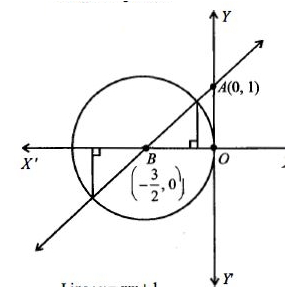
View full question & answer→MCQ 4251 Mark
The Line $L$ is given by $:\frac{x}{5} + \frac{y}{b} = 1$ passes through the point $(13,32)$ . The line $K$ is parallel to $L$ and has the equation $\frac{x}{c} + \frac{y}{3} = 1$ . Then the distance between $L $ and $ K$ is
- A
$\sqrt {17\;} $
- B
$\frac{{17}}{{\sqrt {15\;} }}\;$
- ✓
$\frac{{23}}{{\sqrt {17\;} }}$
- D
$\;\frac{{23}}{{\sqrt {15\;} }}$
AnswerCorrect option: C. $\frac{{23}}{{\sqrt {17\;} }}$
c
As the line passes through $(13,32),$ we have
$\frac{13}{5}+\frac{32}{b}=1 \Rightarrow \frac{32}{b}=1-\frac{13}{5}=-\frac{8}{5} \Rightarrow b=-20$
Thus the line is $\frac{x}{5}-\frac{y}{20}=1,$ i.e., $4 x-y=20$
The equation of line parallel to $4 x-y=20$ has slope $4.$
Thus $-\frac{3}{c}=4 . \quad \therefore c=-\frac{3}{4}$
Then the equation to line $k$ is $4 x-y=-3$
The distance between lines $k$ and $c$ is
$\frac{20+3}{\sqrt{4^{2}+1^{2}}}=\frac{23}{\sqrt{17}}$
View full question & answer→MCQ 4261 Mark
The perpendicular bisector of the line segment joining $P(1, 4)$ અને $Q(k, 3) $ has $y-$ intercept $-4$ . Then a possible value of $ k$ is
Answerc
Slope of $P Q=\frac{3-4}{k-1}=\frac{-1}{k-1}$
slope of perpendicular bisector of $P Q=(k-1)$
Also mid point of $P Q\left(\frac{k+1}{2}, \frac{7}{2}\right)$ equation of perpendicular bisector is $y-\frac{7}{2}=(k-1)\left(x-\frac{k+1}{2}\right)$
$\Rightarrow 2 x-7=2(k-1)-\left(k^{2}-1\right)$
$\Rightarrow 2(k-1) x-2 y+\left(8-k^{2}\right)=0$
$y$ -intercept $=\frac{-8-k^{2}}{-2}=-4$
$\Rightarrow 8-k^{2}=-8$
$k^{2}=16$
$k=\pm 4$
View full question & answer→MCQ 4271 Mark
Let $P( - 1,\,0),\,$$Q(0,\,0)$ and $R\,(3,\,3\sqrt 3 )$ be three point . The equation of the bisector of the angle $PQR $ is
AnswerCorrect option: C. $\sqrt 3 x + y = 0$
c
Slope of the line $Q M$ is $\tan \frac{2 \pi}{3}=-\sqrt{3}$
Hence equation is line $\mathrm{QM}$ is $\mathrm{y}=-\sqrt{3} \mathrm{x}$
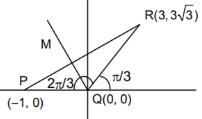
View full question & answer→MCQ 4281 Mark
If $(a, a^2) $ falls inside the angle made by the lines $y\; = \frac{x}{2},\;x > \;0$ and $y\; = \;3x,\;x\; > \;0$ then $a$ belong to
- A
($3,$ $\infty $)
- ✓
$\left( {\frac{1}{2},\,3} \right)$
- C
$\left( { - 3, - \frac{1}{2}} \right)$
- D
$\left( {0,\frac{1}{2}} \right)$
AnswerCorrect option: B. $\left( {\frac{1}{2},\,3} \right)$
b
Given lines are $y=\frac{x}{2}(x>0)$ and $y=3 x(x>0)$ using $\left(a, a^{2}\right)$ in these lines
$a^{2}-\frac{a}{2}>0$
and $\quad a^{2}-3 a<0$
Solving $(\mathrm{i})$ and $(\mathrm{ii})$ we get $\frac{1}{2}$
View full question & answer→MCQ 4291 Mark
The line parallel to the $x$- axis and passing through the intersection of the lines $ax + 2by + 3b = 0$ and $bx - 2ay - 3a = 0$, where $(a,\,b) \ne (0,\,0)$ is
- A
Above the $x$-axis at a distance of $3/2$ from it
- B
Above the $x$-axis at a distance of $2/3$ from it
- ✓
Below the $x$-axis at a distance of $3/2$ from it
- D
Below the $x$-axis at a distance of $2/3$ from it
AnswerCorrect option: C. Below the $x$-axis at a distance of $3/2$ from it
c
(c) The lines passing through the intersection of the lines $ax + 2by + 3b = 0$ and $bx - 2ay - 3a = 0$ is
$ax + 2by + 3b + \lambda (bx - 2ay - 3a) = 0$
$ \Rightarrow (a + b\lambda )x$$ + (2b - 2a\lambda )y + 3b - 3\lambda a = 0$…..$(i)$
Line $(i)$ is parallel to $x$-axis,
$\therefore $ $a + b\lambda = 0 \Rightarrow \lambda = \frac{{ - a}}{b} = 0$
Put the value of $\lambda $ in $(i)$
$ax + 2by + 3b - \frac{a}{b}(bx - 2ay - 3a) = 0$
$y\left( {2b + \frac{{2{a^2}}}{b}} \right) + 3b + \frac{{3{a^2}}}{b} = 0$, $y\left( {\frac{{2{b^2} + 2{a^2}}}{b}} \right) = - \left( {\frac{{3{b^2} + 3{a^2}}}{b}} \right)$
$y = \frac{{ - 3({a^2} + {b^2})}}{{2({b^2} + {a^2})}} = \frac{{ - 3}}{2}$, $y = - \frac{3}{2}$
So, it is $3/2$ unit below $ x$-axis.
View full question & answer→MCQ 4301 Mark
If $a, b, c$ are in harmonic progression, then straight line $\frac{x}{a} + \frac{y}{b} + \frac{1}{c} = 0$ always passes through a fixed point, that point is
- A
$( - 1,\; - 2)$
- B
$( - 1,\;2)$
- ✓
$(1,\; - 2)$
- D
$(1,\; - 1/2)$
AnswerCorrect option: C. $(1,\; - 2)$
c
(c) $a, b, c$ are in $H. P$., then $\frac{2}{b} = \frac{1}{a} + \frac{1}{c}$.....$(i)$
Given line is $\frac{x}{a} + \frac{y}{b} + \frac{1}{c} = 0$.....$(ii)$
Subtracting both $\frac{1}{a}(x - 1) + \frac{1}{b}(y + 2) = 0$
Since $a \ne 0,b \ne 0$
So, $(x - 1) = 0 \Rightarrow x = 1{\rm{ and }}(y + 2) = 0 \Rightarrow y = - 2$.
Trick : Checking from options, let a, b, c are $\frac{1}{1},\frac{1}{2},\frac{1}{3}$.
Then $x + 2y + 3 = 0$will satisfy $(c)$ option.
View full question & answer→MCQ 4311 Mark
The equation of the straight line passing through the point $(4, 3)$ and making intercepts on the co-ordinate axes whose sum is $ -1$ is
- ✓
$\frac{x}{2} - \frac{y}{3} = 1$ and $\frac{x}{{ - 2}} + \frac{y}{1} = 1$
- B
$\frac{x}{2} - \frac{y}{3} = - 1$ and $\frac{x}{{ - 2}} + \frac{y}{1} = - 1$
- C
$\frac{x}{2} - \frac{y}{3} = 1$ and $\frac{x}{2} + \frac{y}{1} = 1$
- D
$\frac{x}{2} - \frac{y}{3} = - 1$ and $\frac{x}{{ - 2}} + \frac{y}{1} = - 1$
AnswerCorrect option: A. $\frac{x}{2} - \frac{y}{3} = 1$ and $\frac{x}{{ - 2}} + \frac{y}{1} = 1$
a
(a) Here $a + b = - 1$. Required line is $\frac{x}{a} - \frac{y}{{1 + a}} = 1$ .....$(i)$
Since line $(i)$ passes through $(4, 3)$
$\therefore $ $\frac{4}{a} - \frac{3}{{1 + a}} = 1$ $ \Rightarrow $ $4 + 4a - 3a = a + {a^2}$
==> ${a^2} = 4 \Rightarrow a = \pm 2$
$\therefore $ Required lines are $\frac{x}{2} - \frac{y}{3} = 1$ and $\frac{x}{{ - 2}} + \frac{y}{1} = 1$.
View full question & answer→MCQ 4321 Mark
If ${x_1},{x_2},{x_3},\,\,{\rm{and }}\,{y_1},{y_2},{y_3}$ are both in G.P. with the same common ratio, then the points $({x_1},{y_1}),$ $({x_2},\,{y_2})$ and $({x_3},\,{y_3})$
- ✓
- B
- C
- D
Are vertices of a triangle
Answera
(a)Taking co-ordinates as $\left( {\frac{x}{r},\,\frac{y}{r}} \right)$; $(x,\,y)\,{\rm{and}}\,(xr,\,yr)$
Above co-ordinates satisfy the relation $y = mx$, so lie on a straight line.
View full question & answer→MCQ 4331 Mark
A square of side a lies above the $x$ -axis and has one vertex at the origin. The side passing through the origin makes an angle $\alpha ,(0 < \alpha < \frac{\pi }{4})$ with the positive direction of $x$-axis. The equation of its diagonal not passing through the origin is
- A
$y(\cos \alpha - \sin \alpha ) - x(\sin \alpha - \cos \alpha ) = a$
- ✓
$y(\cos \alpha + \sin \alpha ) - x(\sin \alpha - \cos \alpha ) = a$
- C
$y(\cos \alpha + \sin \alpha ) + x(\sin \alpha + \cos \alpha ) = a$
- D
$y(\cos \alpha + \sin \alpha ) + x(\sin \alpha - \cos \alpha ) = a$
AnswerCorrect option: B. $y(\cos \alpha + \sin \alpha ) - x(\sin \alpha - \cos \alpha ) = a$
b
(b) Co-ordinates of $A = (a\cos \alpha ,\,a\sin \alpha )$
Equation of $OB$, $y = \tan \left( {\frac{\pi }{4} + \alpha } \right)\,x$
$\because$ $CA\,\,{ \bot ^r}\,\,{\rm{to}}\,\,OB$
$\therefore$ Slope of $CA = - \cot \left( {\frac{\pi }{4} + \alpha } \right)$
Equation of CA,$y - a\sin \alpha = - \cot \left( {\frac{\pi }{4} + \alpha } \right)\,(x - a\cos \alpha )$
==> $y(\sin \alpha + \cos \alpha ) + x(\cos \alpha - \sin \alpha ) = a$
$ \Rightarrow $ $y\,(\cos \alpha + \sin \alpha ) - x\,(\sin \alpha - \cos \alpha ) = a$.
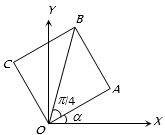
View full question & answer→MCQ 4341 Mark
The number of integral values of $'\alpha '$ for which the abscissa of point of intersection of lines $y = x + 9\alpha $ and $3\alpha x + 2y + 9 = 0$ is integer, is
Answerb
$3 \alpha x+2 x+18 \alpha+9=0$
$\Rightarrow x=\frac{-18 \alpha-9}{3 \alpha+2}=-6+\frac{3}{3 \alpha+2}$
View full question & answer→MCQ 4351 Mark
$A(0,2)$ and $C(6,4)$ are opposite vertices of square $ABCD$. Sum of slopes of sides through vertex $A$ will be-
- A
$-\frac{3}{2}$
- ✓
$\frac{3}{2}$
- C
$-\frac{1}{2}$
- D
$\frac{1}{2}$
AnswerCorrect option: B. $\frac{3}{2}$
View full question & answer→MCQ 4361 Mark
Distance of the point $(2, 5)$ from the line $3x + y + 4 = 0$ measured parallel to the line $3x - 4y + 8 = 0$ is
Answerc
Let distance be "r".
Co-ordinates of 'P' are
$(2+r \cos \theta, 5+r \sin \theta)$ where $\tan \theta=\frac{3}{4}$
which lies on the line $3 x+y+4=0$
$3(2+r \cos \theta)+5+r \sin \theta+4=0$
$r\left(3 \cdot \frac{4}{5}+\frac{3}{5}\right)+15=0 \Rightarrow r=-\frac{15}{3}=-5$
But distance can not be negative
$\therefore r=5$
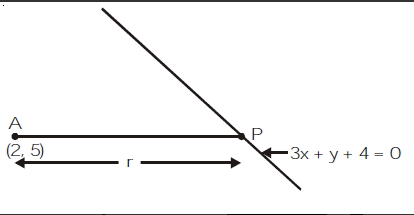
View full question & answer→MCQ 4371 Mark
The true set of real values of $\lambda$ for which the point $P$ with co-ordinate $(\lambda , \lambda ^2)$ does not lie inside the triangle formed by the lines, $x - y = 0 ; x + y - 2 = 0\, ane \,x + 3 = 0$ is :
- A
$(-\infty , - 2]$
- B
$[0, \infty ]$
- C
$[- 2, 0]$
- ✓
$(-\infty , - 2]\, \cup \,[0, \infty ]$
AnswerCorrect option: D. $(-\infty , - 2]\, \cup \,[0, \infty ]$
d
Point lies on the parabola $y = x^2$ . Solve $y = x^2$ with the line $x + y = 2$
View full question & answer→MCQ 4381 Mark
The set of values of $'b'$ for which the origin and the point $(1, 1)$ lie on the same side of the straight line, $a^2x + a by + 1 = 0\,\,; \forall a \in R, b > 0$ are :
- A
$b \in (2, 4)$
- ✓
$b \in (0, 2)$
- C
$b \in [0, 2]$
- D
$(2, \infty )$
AnswerCorrect option: B. $b \in (0, 2)$
b
$L=a^2 x+a b y+1$
for origin $(0,0)$
$\therefore L =0+0+1=1 \Rightarrow+ ve$
for $(1,1)$
$L=a^2+a b+1$
for both points to be on same side nature of $L$ should be same
$\therefore a^2+a b+1 > 0$
which is a quadratic expression in a
then $D < 0$
$\Rightarrow b ^2-4.1 .1 < 0$
$\Rightarrow b ^2 < 4$
$\Rightarrow b ^2-4 < 0$
$\Rightarrow-2 < b < 2$
$\therefore b \in(-2,2)$
but in question $b > 0$ (given)
hence $b \in(0,2)$
View full question & answer→MCQ 4391 Mark
The co-ordinates of the vertices $P, Q, R\,\, \& \,\,S$ of square $PQRS$ inscribed in the triangle $ABC$ with vertices $A \equiv (0, 0) , B \equiv (3, 0)\,\, \& \,\,C \equiv (2, 1)$ given that two of its vertices $P, Q$ are on the side $AB$ are respectively
- A
$\left( {\frac{1}{4}\,\,,\,\,0} \right)\,\,,\,\,\left( {\frac{3}{8}\,\,,\,\,0} \right)\,\,,\,\,\left( {\frac{3}{8}\,\,,\,\,\frac{1}{8}} \right)\,\,\& \,\,\left( {\frac{1}{4}\,\,,\,\,\frac{1}{8}} \right)$
- B
$\left( {\frac{1}{2}\,\,,\,\,0} \right)\,\,,\,\,\left( {\frac{3}{4}\,\,,\,\,0} \right)\,\,,\,\,\left( {\frac{3}{4}\,\,,\,\,\frac{1}{4}} \right)\,\,\& \,\,\left( {\frac{1}{2}\,\,,\,\,\frac{1}{4}} \right)$
- C
$(1, 0) , \left( {\frac{3}{2}\,\,,\,\,0} \right)\,\,,\,\,\left( {\frac{3}{3}\,\,,\,\,\frac{1}{2}} \right)\,\,\& \,\,\left( {1\,\,,\,\,\frac{1}{2}} \right)$
- ✓
$\left( {\frac{3}{2}\,\,,\,\,0} \right)\,\,,\,\,\left( {\frac{9}{4}\,\,,\,\,0} \right)\,\,,\,\,\left( {\frac{9}{4}\,\,,\,\,\frac{3}{4}} \right)\,\,\& \,\,\left( {\frac{3}{2}\,\,,\,\,\frac{3}{4}} \right)$
AnswerCorrect option: D. $\left( {\frac{3}{2}\,\,,\,\,0} \right)\,\,,\,\,\left( {\frac{9}{4}\,\,,\,\,0} \right)\,\,,\,\,\left( {\frac{9}{4}\,\,,\,\,\frac{3}{4}} \right)\,\,\& \,\,\left( {\frac{3}{2}\,\,,\,\,\frac{3}{4}} \right)$
d
Let co-ordinates of $P$ are $\left( x _1, 0\right)$ and side of square is ' $a$ '
$\therefore Q \left( x _1+ a , 0\right)$
$S \left( x _1, a \right)$
$R \left( x _1+ a , a \right)$
Now,
$m_{ HS }=m_{M C}$
$\Rightarrow \frac{ a }{ x _1}=\frac{1}{2} \Rightarrow x _1=2 a \ldots \ldots(1) m_{ HR }= m _{ HC }$
$\Rightarrow \frac{ a }{ x _1+ a -3}=-1 \Rightarrow x _1+2 a -3=0 \ldots \ldots(2)$
from $(1)$ and $(2)$
$a=\frac{3}{4}$ and $x_1=\frac{3}{2}$
Hence co-ordinates of $P, Q, R, \& S$ can be determined.
as $\left(\frac{3}{2}, 0\right),\left(\frac{9}{4}, 0\right),\left(\frac{9}{4}, \frac{3}{4}\right)$ and $\left(\frac{3}{2}, \frac{3}{4}\right)$
View full question & answer→MCQ 4401 Mark
Consider the equation $y -y_1 = m (x -x_1) $. If $m\, \& \,x_1$ are fixed and different lines are drawn for different values of $y_1,$ then :
AnswerCorrect option: D. $(C)$ & $(B)$ both
d
All the lines will have a fixed slope $m$ so all lines will be parallel
All lines will be passing through $\left(x_{1}, y_{1}\right)$.
$x_{1}$ is fixed.
$\therefore x=x_{1}$ cuts the above lines at $\left(x_{1}, y_{1}\right)$
View full question & answer→MCQ 4411 Mark
If the point $(a, 2a)$ falls between the lines $\left| {x + y + 1} \right| = 4$ then complete set of values of $'a'$ is
- ✓
$\left( { - \frac{5}{3},1} \right)$
- B
$\left( {1,\frac{5}{3}} \right)$
- C
$\left( {\frac{{ - 4}}{3},\frac{4}{3}} \right)$
- D
$\left( { - \infty ,\frac{{ - 5}}{3}} \right) \cup \left( {1,\infty } \right)$
AnswerCorrect option: A. $\left( { - \frac{5}{3},1} \right)$
a
$|x+y+1|=4$ is pair of straight lines and
these lines are $x+y=3 $ and $ x+y=-5$
$(a,2 a)$ lies between these line
$(a+2 a-3)(a+2 a+5)<0$
$(a-1)\left(a+\frac{5}{3}\right)<0$
$\mathrm{a} \in\left(-\frac{5}{3}, 1\right)$
View full question & answer→MCQ 4421 Mark
The equation of the line passing through $(1,2)$ and having a distance equal to $7\,units$ from the point $(8,9)$ is :-
- A
$y = 3x -1$
- ✓
$y = 2$
- C
$y -x = 1$
- D
$x + y = 3$
AnswerCorrect option: B. $y = 2$
b
Let the equation of the line be $y=m x+c$
Since it passes through $(1,2)$
$\therefore 2=m+c$
$\therefore$ Line becomes $\mathrm{y}=\mathrm{mx}+2-\mathrm{m}$ ......$(1)$
Distance of line $( 1)$ from $(8,9)$
$=\frac{|9-8 m+m-2|}{\sqrt{1+m^{2}}}=7$
$\Rightarrow(1-\mathrm{m})^{2}=\left(1+\mathrm{m}^{2}\right) \Rightarrow \mathrm{m}=0$
$\therefore$ The line is $y=2$
View full question & answer→MCQ 4431 Mark
The equation of a straight line passing through $(3,2)$ and cutting an intercept of $2\,units$ between the lines $3x + 4y = 11$ and $3x + 4y = 1$ is :-
- A
$2x + y -8 = 0$
- ✓
$3y -4x + 6 = 0$
- C
$3x + 4y -17 = 0$
- D
$2x -y -4 = 0$
AnswerCorrect option: B. $3y -4x + 6 = 0$
b
Distance between the given parallel lines
$=\frac{|11-1|}{\sqrt{3^{2}+4^{2}}}=2$
$\therefore$ Required line is perpendicular to the given lines and passes through $(3,2).$
$\therefore$ The required equation is
$3 y-4 x+6=0$
View full question & answer→MCQ 4441 Mark
Given the family of lines, $a (2x + y + 4) + b (x - 2y - 3) = 0 $. Among the lines of the family, the number of lines situated at a distance of $\sqrt{10}$ from the point $M (2, - 3)$ is :
Answerb
The point of intersection of the two lines are $(-1, -2)$
Distance $PM =\sqrt{10}$
Hence the required line is one which passes through $(-1, -2)$ and is $\perp $ to $P.M. \Rightarrow B$
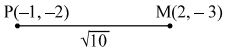
View full question & answer→MCQ 4451 Mark
A light beam emanating from the point $A(3, 10)$ reflects from the line $2x + y - 6 = 0$ and then passes through the point $B(5, 6)$ . The equation of the incident and reflected beams are respectively :
- ✓
$4 x - 3 y + 18 = 0\, ane \,y = 6$
- B
$x - 2 y + 8 = 0\, ane \,x = 5$
- C
$x + 2 y - 8 = 0\, ane \,y = 6$
- D
AnswerCorrect option: A. $4 x - 3 y + 18 = 0\, ane \,y = 6$
a
slope of $AB = - 2 =$ slope of given line
$\Rightarrow \,\,PAB$ is isosceles .
Equation of line $MP$ is $x - 2y + 12 = 0$ .
Solving it with $2x + y - 6 = 0$
point $P(0, 6)$ .
Equation of $AP$ is $4x - 3y + 18 = 0$ and
equation of $BP$ is $y - 6 = 0$
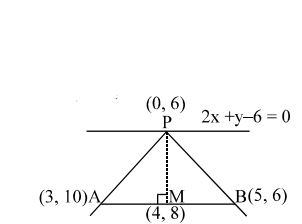
View full question & answer→MCQ 4461 Mark
Let the co-ordinates of the two points $A\, \& \,B$ be $(1, 2)$ and $(7, 5)$ respectively. The line $AB$ is rotated through $45^o$ in anti clockwise direction about the point of trisection of $AB$ which is nearer to $B$. The equation of the line in new position is :
- A
$2x - y - 6 = 0$
- B
$x - y - 1 = 0$
- ✓
$3x - y - 11 = 0$
- D
AnswerCorrect option: C. $3x - y - 11 = 0$
c
point of trisection is $(5, 4)$ . After rotation the slope of the line
$tan \theta_1 =$$\frac{{\tan \,45^\circ \,\, + \,\,\tan \,{\theta _2}}}{{1\,\, - \,\,\tan \,45^\circ \,\,\tan \,{\theta _2}}}$ $=\frac{{1\,\, + \,\,{\textstyle{1 \over 2}}}}{{1\,\, - \,\,{\textstyle{1 \over 2}}}}$ $= 3$ $\Rightarrow \,\,C$
View full question & answer→MCQ 4471 Mark
Sum of values of $'k'$ for which image of point $(\lambda^2 + 1,\lambda )$ with respect to line $y = -3x + 6k$ is the point $(\lambda,\lambda-1)$, is-
- A
$\frac{1}{3}$
- B
$-1$
- C
$-2$
- ✓
$2$
View full question & answer→MCQ 4481 Mark
Image of the family of lines $(\lambda + 2)x + (\lambda -1)y -(8 \lambda + 1) = 0$ in line mirror $y = x$ is (where $\lambda$ & $\mu$ are parameters)
- ✓
$(\mu + 1)x -(2 \mu + 1)y + \mu -2 = 0$
- B
$(\mu + 1)x + (2\mu + 1)y + \mu + 2 = 0$
- C
$(\mu -1)x -(2\mu + 1)y + \mu -2 = 0$
- D
$(\mu + 1)x + (2 \mu -1)y -\mu -2 = 0$
AnswerCorrect option: A. $(\mu + 1)x -(2 \mu + 1)y + \mu -2 = 0$
a
$(\lambda+2) x+(\lambda-1) y-(2 \lambda+1)=0$
$(2 x-y-1)+\lambda(x+y-8)=0$
The family of lines passes through $(3,5)$
mirror image of $(3,5)$ in line $y=x$
$\equiv(5,3)$
$\therefore$ New family of lines
$\equiv(\mu+1) x-(2 \mu+1) y+\mu-2=0$
View full question & answer→MCQ 4491 Mark
A ray of light is incident along a line which meets another line, $7x - y + 1 = 0$ , at the point $(0, 1)$ . The ray is then reflected from this point along the line , $y + 2x = 1$ . Then the equation of the line of incidence of the ray of light is
- A
$41x - 25y + 25 = 0$
- B
$41x + 25y - 25 = 0$
- ✓
$41x - 38y + 38 = 0$
- D
$41x + 38y - 38 = 0$
AnswerCorrect option: C. $41x - 38y + 38 = 0$
c
$ \Rightarrow $ Equation of incident ray is $41x - 38y + 38 = 0$
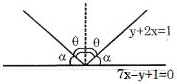
View full question & answer→MCQ 4501 Mark
A ray of light coming from the point $(1, 2)$ is reflected at a point $A$ on the $x$ -axis and then passes through the point $(5, 3)$, the co-ordinates of the point $A$ are :-
- ✓
$\left( {\frac{{13}}{5},0} \right)$
- B
$\left( {\frac{{5}}{13},0} \right)$
- C
$(-7, 0)$
- D
AnswerCorrect option: A. $\left( {\frac{{13}}{5},0} \right)$
a
Let $R$ be the refreaction of the point $P(1,2)$ in $x$ - axis then ${R} \equiv(1,-2)$
Eq of line $\mathrm{RQ}$ is $\mathrm{y}+2=\frac{3+2}{5-1}(\mathrm{x}-1)$
$\Rightarrow 5 x-4 y-13=0$
put $y=0$
$\mathrm{x}=\frac{13}{5}$
$\therefore \mathrm{A} \equiv\left(\frac{13}{5}, 0\right)$
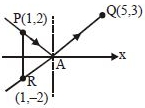
View full question & answer→MCQ 4511 Mark
The value of $a$ for which the image of the point $(a,a -1)\, w.r.t.$ the line mirror $3x + y = 6a$ is the point $(a^2 + 1, a)$ is :-
Answerc
$L \equiv \left( {\frac{{{a^2} + a + 1}}{2},\frac{{2a - 1}}{2}} \right)$
Since $L$ lines on line $AB$
$\therefore 3 \frac{a^{2}+a+1}{2}+\frac{2 a-1}{2}=6 a$
$\Rightarrow 3 a^{2}-7 a+2=0$
$\Rightarrow \mathrm{a}=2, \frac{1}{3}$
Also $\mathrm{PQ} \perp \mathrm{AB}$
$\Rightarrow-3 \frac{1}{a^{2}-a+1}=-1$
$\Rightarrow a^{2}-a-2=0 \Rightarrow a=2,-1$
$\therefore $ Common value of $a=2$
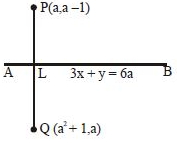
View full question & answer→MCQ 4521 Mark
If $B$ is the reflection of the point $A(1, 2)$ with respect to the line $y = x$ and $(\alpha, \beta)$ is the reflection of $B$ with respect to $y = 0$, then-
- A
$\alpha = 1, \beta = -2$
- B
$\alpha = 0, \beta = 0$
- ✓
$\alpha = 2, \beta = -1$
- D
AnswerCorrect option: C. $\alpha = 2, \beta = -1$
c
$A(1, 2)$ Reflection of $A$ about $y = k$ If $B(2, 1)$ Reflection of $B$ about $x$ -axis i.e., $y = 0$ is $(2, -1)$ on $\alpha = 2, \beta = -1$
View full question & answer→MCQ 4531 Mark
If image of point $P\left( {\lambda ,\,2\lambda } \right)$ in the line mirror $x -y + 2 = 0$ is $\left( {\mu ,\,3\lambda } \right)$ , then choose the correct option
- A
$\mu - \lambda = 0$
- ✓
$\lambda + \mu = 1$
- C
$\lambda - \mu = - 1$
- D
$\lambda + \mu = 0$
AnswerCorrect option: B. $\lambda + \mu = 1$
b
$\frac{\lambda+\mu}{2}-\frac{5 \lambda}{2}+2=0$
$\mu-4 \lambda+4=0$ ..........$(1)$
and $\mathrm{m}_{\mathrm{PQ}}=\frac{\lambda}{\mu-\lambda}=-1$
$\Rightarrow \quad \mu=0 \quad$ and $\quad \lambda=1$
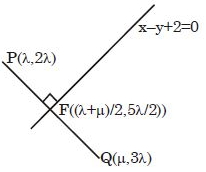
View full question & answer→MCQ 4541 Mark
One side of a square is inclined at an acute angle $\alpha$ with the positive $x-$axis, and one of its extremities is at the origin. If the remaining three vertices of the square lie above the $x-$axis and the side of a square is $4$, then the equation of the diagonal of the square which is not passing through the origin is
- A
$(cos\, \alpha + sin\, \alpha) x + (cos\, \alpha - sin\, \alpha) y = 4$
- B
$(cos\, \alpha + sin\, \alpha) x - (cos\, \alpha - sin\, \alpha) y = 4$
- ✓
$(cos\, \alpha - sin\, \alpha) x + (cos\, \alpha + sin\, \alpha) y = 4$
- D
$(cos\, \alpha - sin\, \alpha) x - (cos\, \alpha + sin\, \alpha) y = 4 cos\, 2\alpha$
AnswerCorrect option: C. $(cos\, \alpha - sin\, \alpha) x + (cos\, \alpha + sin\, \alpha) y = 4$
c
$\therefore \,\,\,$ slope of line $AC =$ $\frac{{\not 4\sin\, \alpha - \not 4\cos\, \alpha }}{{\not 4\cos\, \alpha + \not 4\sin\, \alpha }}$
$\therefore \,\,\,$ equation of line = $\frac{{\sin\, \alpha - \sin\, \alpha }}{{\cos\, \alpha \sin\, \alpha }}$
$y - sin\, \alpha =$ $\frac{{\sin\, \alpha - \sin\, \alpha }}{{\cos\, \alpha \sin\, \alpha }}$ $(x - 4cos\, \alpha)$
$y\, cos\, \alpha + y\, sin\, \alpha - 4 \, sin\, \alpha · cos\, \alpha = x \,sin\, \alpha - x \,cos\, \alpha - 4 \,sin^2\, \alpha - sin\, \alpha cos\, \alpha + 4\, cos^2\, \alpha$
$x (cos\, \alpha - sin\, \alpha) + y (cos\, \alpha + sin\, \alpha) = 4\Rightarrow(D)$
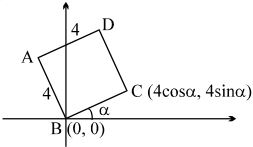
View full question & answer→MCQ 4551 Mark
The four points whose co-ordinates are $(2, 1), (1, 4), (4, 5), (5, 2)$ form :
- A
a rectangle which is not a square
- B
a trapezium which is not a parallelogram
- ✓
- D
a rhombus which is not a square.
Answerc
$A(2, 1), B (1, 4), C(4, 5), D(5, 2)$
$AB = BC = CD = DA =\sqrt{10}$
also $AC \bot BD$
i.e. $m_{AC}\, \times\, m_{BD} = -1$
and $AC = BD$
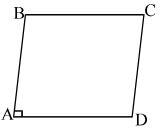
View full question & answer→MCQ 4561 Mark
The base $BC$ of a triangle $ABC$ is bisected at the point $(p, q)$ and the equation to the side $AB \,\,ane\,\, AC$ are $px + qy = 1 \,\,ane\,\, qx + py = 1$ . The equation of the median through $A$ is :
- A
$(p - 2q) x + (q - 2p) y + 1 = 0$
- B
$(p + q) (x + y) - 2 = 0$
- ✓
$(2pq - 1) (px + qy - 1) = (p^2 + q^2 - 1) (qx + py - 1)$
- D
AnswerCorrect option: C. $(2pq - 1) (px + qy - 1) = (p^2 + q^2 - 1) (qx + py - 1)$
c
Equation through $A$ is
$(px + qy -1) + (qx + py - 1) = 0 .....(1)$
if this represent $AB$ then, point $D (p, q)$ satisfies $(1)$
$\Rightarrow[pp + qq - 1] + \lambda [pq + pq - 1] = 0$
$\lambda = \frac{{ - (2pq - 1)}}{{{p^2} + {q^2} - 1}}$
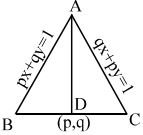
View full question & answer→MCQ 4571 Mark
If $P = (1, 0) ; Q = (-1, 0) \,\,ane\,\, R = (2, 0)$ are three given points, then the locus of the points $S$ satisfying the relation, $SQ^2 + SR^2 = 2 SP^2$ is :
AnswerCorrect option: D. a straight line parallel to $y-$ axis .
d
Let $S(x, y)$ and $P(1,0), Q(-1,0), R(2,0)$ are given points
$\therefore(S Q)^{2}+(S R)^{2}=2(S P)^{2}$
$\Rightarrow(x+1)^{2}+y^{2}+(x-2)^{2}+y^{2}=2\left[(x-1)^{2}+y^{2}\right]$
$\Rightarrow 2 x^{2}+2 y^{2}+2 x-4 x+5=2 x^{2}+2 y^{2}-4 x+2$
$\Rightarrow 2 x+3=0$
which is a straight line parallel to $y$ -axis.
View full question & answer→MCQ 4581 Mark
The co-ordinates of the orthocentre of the triangle bounded by the lines, $4x - 7y + 10 = 0; x + y=5$ and $7x + 4y = 15$ is :
- A
$(2, 1)$
- B
$(- 1, 2)$
- ✓
$(1, 2)$
- D
$(1, - 2)$
AnswerCorrect option: C. $(1, 2)$
c
Given lines $4 x-7 y+10=0----(1)$
$x+y-5=0----(2)$
$7 x+4 y-15=0----(3)$
On solving eq ( 1 ) and ( 3 ) $7 x+4\left(\frac{4 x+10}{7}\right)-15=0$
$49 x+16 x+40-105=0$
$65 x=65 \Rightarrow x=1$
From eq (1) $4-7 y=-10$
$-7 y=-14$
$y=2$
Point of intersection is (1,2) Here Equation (1) and (3) are perpendicular So the lines formed right angle triangle Hence the orthocentre of Right angle triangle is the point at which $90^{0}$ angle is formed Hence (1,2) is orthocentre
View full question & answer→MCQ 4591 Mark
Given $A(1, 1)$ and $AB$ is any line through it cutting the $x-$ axis in $B$. If $AC$ is perpendicular to $AB$ and meets the $y-$ axis in $C$, then the equation of locus of mid- point $P$ of $BC$ is
- ✓
$x + y = 1$
- B
$x + y = 2$
- C
$x + y = 2xy$
- D
$2x + 2y = 1$
AnswerCorrect option: A. $x + y = 1$
a
$y - 1 = m (x - 1)$
$y - 1 = - \,\frac{1}{m}\,$ $(x-1)$
$2h = 1 - \,\frac{1}{m}\,$
$2k = 1 + \,\frac{1}{m}\,$
locus is $x + y = 1 $
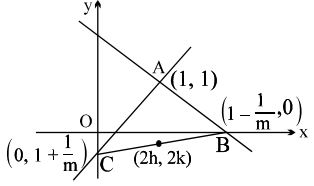
View full question & answer→MCQ 4601 Mark
The number of possible straight lines , passing through $(2, 3)$ and forming a triangle with coordinate axes, whose area is $12 \,sq$. units , is
Answerc
equation of any line through $(2, 3)$ is
$y -3 = m(x - 2)$
$y = mx - 2m + 3$
with the help of the fig. area of $\Delta OAB = \pm 12$
ie. $\frac{1}{2}\left( {\frac{{2m - 3}}{m}} \right)(3 - 2m) = \pm 12$
taking $+$ sign me get $(2m+3)^2 = 0$
this gives one value of $m = -3/2$
taking negative sign we get
$4m^2 - 36m + 9 = 0\,\,(D > 0)$
quadratic in m gives $2$ values of $m$
$\Rightarrow\,\,3$ st. lines are possible.
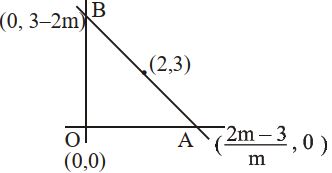
View full question & answer→MCQ 4611 Mark
Two mutually perpendicular straight lines through the origin from an isosceles triangle with the line $2x + y = 5$ . Then the area of the triangle is :
Answera
$A D=\left|\frac{0+0-5}{\sqrt{(2)^{2}+(1)^{2}}}\right| \Rightarrow \frac{5}{\sqrt{5}} \Rightarrow \sqrt{5}$
$In$ triangle $A B D$
$\tan 45^{\circ}=\frac{A D}{B D} \Rightarrow \frac{\sqrt{5}}{B D}=1$
$B D=\sqrt{5}$
$DC=\sqrt{5}$
$BC=2 \sqrt{5}$
Area of $\Delta A B C=\frac{1}{2} \times B C \times A D \Rightarrow \frac{1}{2} \times 2 \sqrt{5} \times \sqrt{5}$$=5$
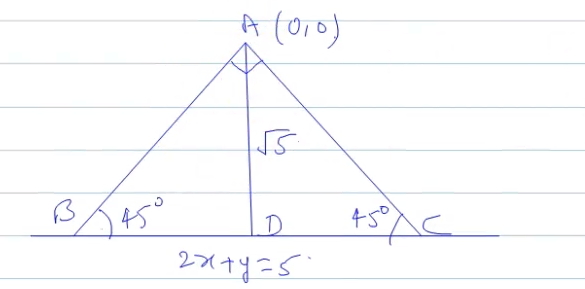
View full question & answer→MCQ 4621 Mark
A pair of straight lines $x^2 - 8x + 12 = 0$ and $y^2 - 14y + 45 = 0$ are forming a square. Co-ordinates of the centre of the circle inscribed in the square are
- A
$(3, 6)$
- ✓
$(4, 7)$
- C
$(4, 8)$
- D
AnswerCorrect option: B. $(4, 7)$
b
$\quad x^{2}-8 x+12=0$
$\Rightarrow(x-6)(x-2)=0$
$y^{2}-14 y+45=0$
$(y-5)(y-9)=0$
Thes sides of square are
x=2, x=6, y=5, y=9
The centre of circle in square will be
$\left(\frac{2+6}{2}, \frac{5+9}{2}\right)=\left(\frac{8}{2}, \frac{14}{2}\right)$
$=(4,7)$
View full question & answer→MCQ 4631 Mark
Three lines $x + 2y + 3 = 0 ; x + 2y - 7 = 0$ and $2x - y - 4 = 0$ form the three sides of two squares. The equation to the fourth side of each square is
- A
$2x - y + 14 = 0\,\,\, ane\,\, \,2x - y + 6 = 0$
- B
$2x - y + 14 = 0\,\,\, ane\,\, \,2x - y - 6 = 0$
- C
$2x - y - 14 = 0\,\,\, ane\,\, \,2x - y - 6 = 0$
- ✓
$2x - y - 14 = 0\, ane \,2x - y + 6 = 0$
AnswerCorrect option: D. $2x - y - 14 = 0\, ane \,2x - y + 6 = 0$
d
$d = \left| {\,\frac{{10}}{{\sqrt 5 }}\,} \right|$
$3^{rd}$ side is parallel to the line $2x - y - 4 = 0$
Hence line is $2x - y + \lambda = 0$
now $\left| {\frac{{\lambda + 4}}{{\sqrt 5 }}} \right|$$= \frac{{10}}{{\sqrt 5 }}$
$\lambda + 4 = \pm 10$
$\lambda = 6$ or $\lambda = - 14 \Rightarrow (B)$
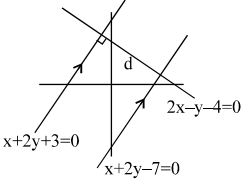
View full question & answer→MCQ 4641 Mark
If the vertices $P$ and $Q$ of a triangle $PQR$ are given by $(2, 5)$ and $(4, -11)$ respectively, and the point $R$ moves along the line $N: 9x + 7y + 4 = 0$, then the locus of the centroid of the triangle $PQR$ is a straight line parallel to
Answerd
$R (x, y)$ lies on $9x + 7y + 4 =0$
$ \Rightarrow R\left( {a,\frac{{\left( {4 + 9a} \right)}}{7}} \right)$ , centroid of $\Delta PQR = (h, k)$
$h = \left( {\frac{{2 + 4 + a}}{3}} \right) = \frac{{6 + a}}{3}$ $....(1)$
$k = \frac{{5 - 11 - \frac{{(4 + 9a)}}{7}}}{3} = \frac{{ - 46 - 9a}}{{7 \times 3}}$ $....(2)$
from $(1) \& (2)$ we get
equating $x$ $3h - 6 = \frac{{ - (21k - 46)}}{9} \Rightarrow 27h + 21k - 54 + 46 = 0$
or locus is $9x + 7y - 8/3 = 0$
this line is $\coprod $ to $N$
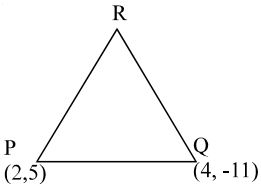
View full question & answer→MCQ 4651 Mark
The pair of straight lines $x^2 - 4xy + y^2 = 0$ together with the line $x + y + 4 = 0$ form a triangle which is :
- A
right angled but not isosceles
- B
- C
- ✓
Answerd
consider angle bet $x^2 - 4xy + y^2 = 0$
Let $\frac{y}{x}$ $= m$
$\therefore\,\,\,m^2 - 4m + 1 = 0$
$\therefore\,\,\,m =$ $2 \pm \sqrt 3 $
$\therefore \Delta \,is\,equlated$
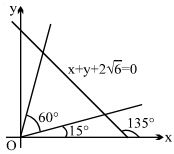
View full question & answer→MCQ 4661 Mark
An equilateral triangle has each of its sides of length $6\,\, cm$ . If $(x_1, y_1) ; (x_2, y_2) \,\, and \,\, (x_3, y_3)$ are its vertices then the value of the determinant,${{\left| {\,\begin{array}{*{20}{c}}{{x_1}}&{{y_1}}&1\\{{x_2}}&{{y_2}}&1\\{{x_3}}&{{y_3}}&1\end{array}\,} \right|}^2}$ is equal to :
Answerd
The area of a triangle having $\left(x_{1}, y_{1}\right) ;\left(x_{2}, y_{2}\right) \;and\;\left(x_{3}, y_{3}\right)$ as its vertices is, $\frac{1}{2}\left|\begin{array}{lll}x_{1} & y_{1} & 1 \\ x_{2} & y_{2} & 1 \\ x_{3} & y_{3} & 1\end{array}\right|=A($ let $)$
Now, $\left|\begin{array}{lll}x_{1} & y_{1} & 1 \\ x_{2} & y_{2} & 1 \\ x_{3} & y_{3} & 1\end{array}\right|^{2}=4 A^{2}$
The given triangle is equilateral and each side is of $6 \mathrm{cm}$. Then area $(A)=\frac{\sqrt{3}}{4} \times 6^{2}$
Then $4 A^{2}=4 \times \frac{3}{4^{2}} \times 36 \times 36=3 \times 9 \times 36=972$
View full question & answer→MCQ 4671 Mark
Let $PQR$ be a right angled isosceles triangle, right angled at $P\, (2, 1)$. If the equation of the line $QR$ is $2x + y = 3$, then the equation representing the pair of lines $PQ$ and $PR$ is
- A
$3x^2 - 3y^2 + 8xy + 20x + 10y + 25 = 0$
- ✓
$3x^2 - 3y^2 + 8xy - 20x - 10y + 25 = 0$
- C
$3x^2 - 3y^2 + 8xy + 10x + 15y + 20 = 0$
- D
$3x^2 - 3y^2 - 8xy - 10x - 15y - 20 = 0$
AnswerCorrect option: B. $3x^2 - 3y^2 + 8xy - 20x - 10y + 25 = 0$
b
Let the slopes of $P Q$ and $P R$ be $m$ and $-\frac{1}{m}$ respectively. since $\triangle P Q R$ is an isosceles triangle, $\angle P Q R=\angle P R Q$ $\Rightarrow\left|\frac{m+2}{1-2 m}\right|=\left|\frac{-\frac{1}{m}+2}{1+\frac{2}{m}}\right|$ as slope of $Q R=2$
$\Rightarrow m+2=\pm(1-2 m) \Rightarrow m=3$ or $-\frac{1}{3}$
So the equation of $P Q$ and $P R$ are $(y-1)=3(x-2)$ and $y-1=\left(-\frac{1}{3}\right)(x-2)$
Thus, joint equation representing $P Q$ and $P R$ is
$(3(x-2)-(y-1))((x-2)+3(y-1))=0$
$\Rightarrow 3(x-2)^{2}-3(y-1)^{2}+8(x-2)(y-1)=0$
$\Rightarrow 3 x^{2}-3 y^{2}+8 x y-20 x-10 y+25=0$
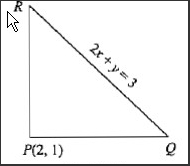
View full question & answer→MCQ 4681 Mark
In a triangle $ABC,$ side $AB$ has the equation $2 x + 3 y = 29$ and the side $AC$ has the equation , $x + 2 y = 16$ . If the mid - point of $BC$ is $(5, 6)$ then the equation of $BC$ is :
- A
$x - y = - 1$
- B
$5 x - 2 y = 13$
- ✓
$x + y = 11$
- D
$3 x - 4 y = - 9$
AnswerCorrect option: C. $x + y = 11$
c
Let co-ordinates of $B$ be $\left(x_{1}, y_{1}\right) \& C$ be $\left(x_{2}, y_{2}\right)$
$\therefore(5,6)$ is the mid point,
so, $\frac{x_{1}+x_{2}}{2}=5, \frac{y_{1}+y_{2}}{2}=6$
$\Rightarrow x_{1}+x_{2}=10, y_{1}+y_{2}=12$
$B\left(x_{1}, y_{1}\right)$ lies on the line $2 x+3 y=29$
$\therefore 2 x_{1}+3 y_{1}=29---(1)$
$C\left(x_{2}, y_{2}\right)$ lies on the line $x+2 y=16$
$\therefore x_{2}+2 y_{2}=16$
$\therefore$ putting $x_{1}, y_{1}$ in the form of $x_{2}, y_{2}$ in (1)
$2\left(10-x_{2}\right)+3\left(12-y_{2}\right)=29 \quad\left\{x_{1}=10-x_{2}, y_{1}=12-y_{2}\right\}$
$\Rightarrow 20-2 x_{2}+36-3 y_{2}=29$
$\Rightarrow 2 x_{2}+3 y_{2}=27$
on subtracting (3) and $(2) \times 2$
$-y_{2}=-5$
$y_{2}=5$
Putting $y_{2}$ in (2)
$x_{2}+2(5)=16$
$x_{2}=6$
$x_{1}=10-x_{2}$
$=4$
$y_{1}=12-5=7$
Equation:
$\frac{x-x_{1}}{x_{2}-x_{1}}=\frac{y-y_{1}}{y_{2}-y_{1}}$
$\Rightarrow \frac{x-4}{2}=\frac{y-7}{-2}$
$\Rightarrow-x+4=y-7$
$\Rightarrow x+y=11$
View full question & answer→MCQ 4691 Mark
$ABC$ is an isosceles triangle . If the co-ordinates of the base are $(1, 3)$ and $(- 2, 7) $, then co-ordinates of vertex $A$ can be :
- A
$\left( { - \,{\textstyle{1 \over 2}}\,\,,\,\,5} \right)$
- B
$\left( { - \,{\textstyle{1 \over 8}}\,\,,\,\,5} \right)$
- C
$\left( {{\textstyle{5 \over 6}}\,\,,\,\, - \,5} \right)$
- ✓
$\left( { - \,7\,\,,\,\,{\textstyle{1 \over 8}}} \right)$
AnswerCorrect option: D. $\left( { - \,7\,\,,\,\,{\textstyle{1 \over 8}}} \right)$
d
Vertex will satisfy the equation of the perpendicular bisectors except the middle point .
View full question & answer→MCQ 4701 Mark
If in triangle $ABC$ ,$ A \equiv (1, 10) $, circumcentre $\equiv$ $\left( { - \,\,{\textstyle{1 \over 3}}\,\,,\,\,{\textstyle{2 \over 3}}} \right)$ and orthocentre $\equiv$ $\left( {{\textstyle{{11} \over 3}}\,\,,\,\,{\textstyle{4 \over 3}}} \right)$ then the co-ordinates of mid-point of side opposite to $A$ is :
- ✓
$(1, - 11/3)$
- B
$(1, 5)$
- C
$(1, - 3)$
- D
$(1, 6)$
AnswerCorrect option: A. $(1, - 11/3)$
a
We know that,
The orthocentre,centroid and circumcentre of any triangle are collinear.And the centroid divides
the distance from othocentre to circumcentre in the ratio $2: 1 .$
Let the centroid be $G(x, y)$, its coordinates can be found using the section formula.
$\therefore(x, y) \equiv\left(\frac{\frac{-2}{3}+\frac{11}{3}}{3}, \frac{\frac{4}{3}+\frac{4}{3}}{3}\right) \equiv\left(1, \frac{8}{9}\right)$
Also, the centroid $(G)$ divides the medians $(A D)$ in the ratio 2: 1
Let the coordinates of $D$ be $(h, k)$
$\therefore 1=\frac{2 h+1}{3}$ and $\frac{8}{9}=\frac{2 k+10}{3}$
$h=1$ and $8=6 k+30$
and $k=\frac{-11}{3}$
$\therefore D(h, k)=\left(1, \frac{-11}{3}\right)$
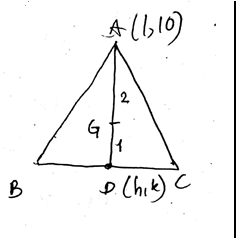
View full question & answer→MCQ 4711 Mark
The co-ordinates of three points $A(-4, 0) ; B(2, 1)$ and $C(3, 1)$ determine the vertices of an equilateral trapezium $ABCD$ . The co-ordinates of the vertex $D$ are :
- A
$(6, 0)$
- B
$(- 3, 0)$
- C
$(- 5, 0)$
- ✓
$(9, 0)$
AnswerCorrect option: D. $(9, 0)$
d
Equilateral mean isosceles trapezium
View full question & answer→MCQ 4721 Mark
The line $2x + 3y = 12$ meets the $x -$ axis at $A$ and the $y -$ axis at $B$ . The line through $(5, 5)$ perpendicular to $AB$ meets the $x -$ axis, $y -$ axis $\&$ the line $AB$ at $C, D, E$ respectively. If $O$ is the origin, then the area of the $OCEB$ is :
- A
$\frac{{20}}{3}$ sq. units
- ✓
$\frac{{23}}{3}$ sq. units
- C
$\frac{{26}}{3}$ sq. units
- D
$\frac{{5\sqrt {52} }}{9}$ sq. units
AnswerCorrect option: B. $\frac{{23}}{3}$ sq. units
b
Equation of line $ED$ is $3x - 2y = 5$
$\therefore$ pt $E$ is $(3, 2) C(5/3, 0)$
now area of $OCEB = AR(\Delta OBC+\Delta BEC)$
$\Delta OBC =$ $\frac{1}{2} × 4 ×\frac{5}{3} =\frac{10}{3} ....(1)$
$\Delta BEC = (BE × CE)$
$\frac{1}{2} \times \sqrt {13} \times \frac{2}{3}\sqrt {13} = \frac{{13}}{3}$ $= ....(2)$
Area $OCEB =$ $\frac{{10}}{3}$ + $\frac{{13}}{3}$ = $\frac{{23}}{3}$ sq. units
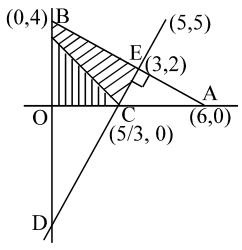
View full question & answer→MCQ 4731 Mark
Let $A \equiv (3, 2)$ and $B \equiv (5, 1)$. $ABP$ is an equilateral triangle is constructed on the side of $AB$ remote from the origin then the orthocentre of triangle $ABP$ is
- A
$\left( {4 - \frac{1}{2}\sqrt 3 ,\,\,\frac{3}{2} - \sqrt 3 } \right)$
- B
$\left( {4 + \frac{1}{2}\sqrt 3 ,\,\,\frac{3}{2} + \sqrt 3 } \right)$
- C
$\left( {4 - \frac{1}{6}\sqrt 3 ,\,\,\frac{3}{2} - \frac{1}{3}\sqrt 3 } \right)$
- ✓
$\left( {4 + \frac{1}{6}\sqrt 3 ,\,\,\frac{3}{2} + \frac{1}{3}\sqrt 3 } \right)$
AnswerCorrect option: D. $\left( {4 + \frac{1}{6}\sqrt 3 ,\,\,\frac{3}{2} + \frac{1}{3}\sqrt 3 } \right)$
d
$m_{AB} = -1/2$
$M_{PM} = 2$
$h = \frac{{a\sqrt 3 }}{2}$ now $a =\sqrt{5} = AB$ ; $h = \frac{{\sqrt {15} }}{2}$
so point $P \frac{{x - y}}{{\cos \theta }} = \frac{{y - 3/2}}{{\sin \theta }} = h$
$P : x = 4 + \frac{{\sqrt 3 }}{2}$ , $y = \frac{3}{2} + \sqrt{3} $
so orthocentre/centroid is $\frac{{\sum {x_1}}}{3},\,\,\,\frac{{\sum {y_1}}}{3}$
$= 4 + \frac{{\sqrt 3 }}{6} , \frac{3}{2} + \frac{{\sqrt 3 }}{3}$
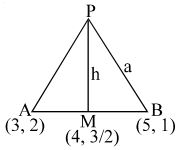
View full question & answer→MCQ 4741 Mark
The vertex of a right angle of a right angled triangle lies on the straight line $2x + y - 10 = 0$ and the two other vertices, at points $(2, -3)$ and $(4, 1)$ then the area of triangle in sq. units is
- A
$\sqrt{10}$
- ✓
$3$
- C
$\frac{33}{5}$
- D
$11$
Answerb
$M_1M_2 = -1 $
$\frac{{9 - 2a}}{{a - 4}}\,\,\times\,\,\frac{{13 - 2a}}{{a - 2}} = -1$
$117 - 26a - 18a + 4a^2 = -(a^2 - 6a + 8)$
$5a^2 - 50a + 125 = 0$
$a = 5$
so $B$ is $(5, 0)$
so area $= \frac {1}{2} AB × AC = \frac{1}{2} \sqrt{2} × 3 \sqrt{2} = 3 $
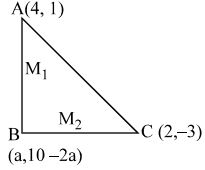
View full question & answer→MCQ 4751 Mark
If one vertex of an equilateral triangle of side $'a'$ lies at the origin and the other lies on the line $x - \sqrt{3} y = 0$ then the co-ordinates of the third vertex are :
- A
$(0, a)$
- B
$\left( {\frac{{\sqrt 3 \,a}}{2}\,\,,\,\, - \,\frac{a}{2}} \right)$
- C
$(0, - a)$
- ✓
Answerd
make a figure and interpret
Slope of the line $x=\sqrt{3} y$ is $\frac{1}{\sqrt{3}}$ which is $30^{\circ}$ with the positive $x$ -axis. As it is an equilateral triangle the other vertex must be on $x=-\sqrt{3} y$
Let the side be $(x, y)$. Hence, $x^{2}+y^{2}=a^{2}$
$4 y^{2}=a^{2}$
$y=\pm \frac{a}{2}$
similarily, $x=\pm \frac{\sqrt{3} a}{2}$
Hence, if the triangle lies in the 1 st quadrant and 4 th quadrant vertex is $\left(\frac{\sqrt{3} a}{2},-\frac{a}{2}\right)$
If the triangle lies in the 2 nd and 3 rd quadrant the vertex is $\left(-\frac{\sqrt{3} a}{2},-\frac{a}{2}\right)$
View full question & answer→MCQ 4761 Mark
The $x -$ co-ordinates of the vertices of a square of unit area are the roots of the equation $x^2 - 3 |x| + 2 = 0$ and the $y -$ co-ordinates of the vertices are the roots of the equation $y^2 - 3y + 2 = 0$ then the possible vertices of the square is/are :
- A
$(1, 1), (2, 1), (2, 2), (1, 2)$
- B
$(- 1, 1), (- 2, 1), (- 2, 2), (- 1, 2)$
- C
$(2, 1), (1, - 1), (1, 2), (2, 2)$
- ✓
$(A)$ or $(B)$ both
AnswerCorrect option: D. $(A)$ or $(B)$ both
d
$x^{2}-3|x|+2=0$
$\Longrightarrow(|x|-1)(|x|-2)=0 \therefore x=-1,1,2,-2$
$y^{2}-3 y+2=0$
$\Longrightarrow(y-1)(y-2)=0 \Rightarrow y=1,2$
The square is of unit radius. Hence, the coordinates of the square can be:
(1,1),(1,2),(2,1),(2,2)
(-1,1),(-1,2),(-2,2),(-2,1)
View full question & answer→MCQ 4771 Mark
$P (x, y)$ moves such that the area of the triangle formed by $P, Q (a , 2 a)$ and $R (- a, - 2 a)$ is equal to the area of the triangle formed by $P, S (a, 2 a)\,\,\, \&\,\, \,T (2 a, 3 a)$. The locus of $'P'$ is a straight line given by :
- A
$3x - y = a$
- B
$(A)$ or $(C)$ both
- C
$y = 2ax$
- ✓
$5x - 3y + a = 0$
AnswerCorrect option: D. $5x - 3y + a = 0$
d
$\Delta P Q R=\Delta P S T$
$P(x, y), Q(a, 2 a), R(-a,-2 a)$
$P(x, y), S(a, 2 a) \quad, T(2 a, 3 a)$
$\frac{1}{2}\left|\begin{array}{ccc}x & y & 1 \\ a & 2 a & 1 \\ -a & -2 a & 1\end{array}\right|=\frac{1}{2}\left|\begin{array}{cccc}x & y & 1 \\ a & 2 a & 1 \\ 2 a & 3 a & 1\end{array}\right|$
$\left(2 a x-2 a^{2}-a y\right)-\left(-2 a^{2}+29 x-4 y\right)=\left(29 x+3 a^{2}+2 a y\right)-\left(4 a^{2}-3 a x-a y\right)$
$2 a x+3 a^{2}+2 a y=4 a^{2}-3a x-a y$
$5 a x+3 a y=a^{2}$
$5 x+3 y=a$
View full question & answer→MCQ 4781 Mark
Given three points $P, Q, R$ with $P(5, 3)$ and $R$ lies on the $x-$ axis. If equation of $RQ$ is $x -2y = 2$ and $PQ$ is parallel to the $x-$ axis, then the centroid of $\Delta PQR$ lies on the line
- A
$x -2y + 1 = 0$
- B
$2x + y -9 = 0$
- ✓
$2x -5y = 0$
- D
$5x -2y = 0$
AnswerCorrect option: C. $2x -5y = 0$
c
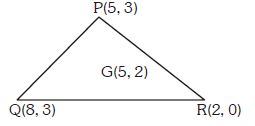
View full question & answer→MCQ 4791 Mark
The origin and the points where the line $L_1$ intersect the $x$ -axis and $y$ -axis are vertices of right angled triangle $T$ whose area is $8$. Also the line $L_1$ is perpendicular to line $L_2$ : $4x -y = 3$, then perimeter of triangle $T$ is -
- ✓
$10 + \sqrt {68}$
- B
$8 + \sqrt {32}$
- C
$17 + \sqrt {257}$
- D
$4 \sqrt {2}+ 4$
AnswerCorrect option: A. $10 + \sqrt {68}$
a
Let $L_1$ $\equiv$ $x + 4y -c = 0$
$\therefore$ Points $(c, 0),$ $\left( {0,\frac{c}{4}} \right)$ $(0, 0)$
area $= 8 \Rightarrow c^2 = 64 \Rightarrow c = 8$ or $-8$
$\therefore$ perimeter $=8 + 2 + \sqrt {68} = 10 + \sqrt {68}$
View full question & answer→MCQ 4801 Mark
The line $\frac{x}{a} + \frac{y}{b} = 1$ moves in such a way that $\frac{1}{{{a^2}}} + \frac{1}{{{b^2}}} + \frac{1}{{2{c^2}}}$, where $a, b, c \in R_0$ and $c$ is constant, then locus of the foot of the perpendicular from the origin on the given line is -
AnswerCorrect option: B. $x^2 + y^2 = 2c^2$
b
$\mathrm{OP}=\left|\frac{1}{\sqrt{\frac{1}{\mathrm{a}^{2}}+\frac{1}{\mathrm{b}^{2}}}}\right|$
$\Rightarrow \mathrm{h}^{2}+\mathrm{k}^{2}=2 \mathrm{c}^{2}$
$\Rightarrow x^{2}+y^{2}=2 c^{2}$
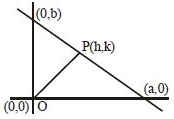
View full question & answer→MCQ 4811 Mark
In an isosceles triangle $ABC, \angle C = \angle A$ if point of intersection of bisectors of internal angles $\angle A$ and $\angle C$ divide median of side $AC$ in $3 : 1$ (from vertex $B$ to side $AC$), then value of $cosec \ \frac{B}{2}$ is equal to
Answerc
As shown in above figure $\mathrm{AB}=\mathrm{BC}$
and $\mathrm{IB}=\mathrm{rcosec} \frac{\mathrm{B}}{2}, \mathrm{ID}=\mathrm{r}$
$ \Rightarrow \quad \frac{{{\rm{IB}}}}{{\rm{D}}} = \frac{{r\cos ec\frac{{\rm{B}}}{2}}}{{\rm{r}}} = \frac{3}{1}[{\rm{ where \,\,r\,\, is\,\, inradius }}]$
$ \Rightarrow \cos ec\frac{B}{2} = 3$
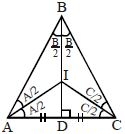
View full question & answer→MCQ 4821 Mark
Let $P$ be a moving point such that sum of its perpendicular distances from $2x + y = 3$ and $x - 2y + 1 = 0$ is always $2\, units$ then area bounded by locus of point $P$ is
Answerb
$\frac{{\left| {2x + y - 3} \right|}}{{\sqrt 5 }} + \frac{{\left| {x - 2y + 1} \right|}}{{\sqrt 5 }} = 2$
locus will be square with center $(1,1)$ and side length $2\sqrt 2 $
View full question & answer→MCQ 4831 Mark
Triangle formed by the lines $3x + y + 4 = 0$ , $3x + 4y -15 = 0$ and $24x -7y = 3$ is a/an
Answerb
$\frac{24}{7}>-\frac{3}{4}>-3$
$\tan A=\frac{\frac{24}{7}+\frac{3}{4}}{1-\frac{24}{7} \cdot \frac{3}{4}}=-\frac{117}{51},$
$\tan B=\frac{-\frac{3}{4}+3}{1+\frac{9}{4}}=\frac{9}{13}$
$\tan C=\frac{-3-\frac{24}{7}}{1-3 \cdot \frac{24}{7}}=\frac{45}{65}=\frac{9}{13}$
View full question & answer→MCQ 4841 Mark
Two consecutive sides of a parallelogram are $4x + 5y = 0$ and $7x + 2y = 0$. If the equation to one diagonal is $11x + 7y = 9$, then the equation to the other diagonal is :-
- A
$3x + 7y = 0$
- B
$11x -7y = 0$
- ✓
$x -y = 0$
- D
$x + y = 0$
AnswerCorrect option: C. $x -y = 0$
c
$4 x+5 y=0$ ......$(i)$
$7 x+2 y=0$ ........$(ii)$
$11 x+7 y=9$ ........$(iii)$
Solving $(i)$ and $(iii)$
$A \equiv \left( {\frac{5}{3}, - \frac{4}{3}} \right)$
Solving $(ii)$ and $(iii)$
$C \equiv\left(-\frac{2}{3}, \frac{7}{3}\right)$
Co-ordinates of middle point of $\mathrm{AC}$
$M \equiv \left( {\frac{1}{2},\frac{1}{2}} \right)$
Equation of other diagonal which passes through $\mathrm{O}$ and $\mathrm{M}$ is
$y-0=\frac{\frac{1}{2}-0}{\frac{1}{2}-0}(x-0)$
or $y=x$
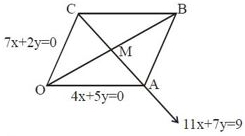
View full question & answer→MCQ 4851 Mark
The co-ordinates of the vertices $A$ and $B$ of an isosceles triangle $ABC (AC = BC)$ are $(-2,3)$ and $(2,0)$ respectively. $A$ line parallel to $AB$ and having a $y$ -intercept equal to $\frac{43}{12}$ passes through $C$, then the co-ordinates of $C$ are :-
- A
$\left( { - \frac{3}{4},1} \right)$
- ✓
$\left( {1,\frac{{17}}{6}} \right)$
- C
$\left( {\frac{2}{3},\frac{4}{5}} \right)$
- D
$(1, 0)$
AnswerCorrect option: B. $\left( {1,\frac{{17}}{6}} \right)$
b
Let ${C}(\alpha, \beta)$
$\therefore(\alpha+2)^{2}+(\beta-3)^{2}=(\alpha-2)^{2}+\beta^{2}$
$\Rightarrow 8 \alpha-6 \beta+9=0$ ......$(1)$
Slope of $\mathrm{AB}=-\frac{3}{4}$
$\therefore$ Equation of line parallel to $AB$ and having
$y$ -intercept $=\frac{43}{12}$ is
$y=-\frac{3}{4} x+\frac{43}{12} \Rightarrow 9 x+12 y=43$
$\because$ It passes through $\mathrm{C}.$
$\therefore 9 \alpha+12 \beta=43$ .......$(2)$
Solving $( 1)$ and $( 2)$ we have $\alpha=1, \beta=\frac{17}{6}$
$\therefore \quad \mathrm{C} \equiv\left(1, \frac{17}{6}\right)$
View full question & answer→MCQ 4861 Mark
The equation of the pair of bisectors of the angles between two straight lines is,$12x^2 - 7xy - 12y^2 = 0$ . If the equation of one line is $2y - x = 0$ then the equation of the other line is :
- ✓
$41x - 38y = 0$
- B
$38x - 41y = 0$
- C
$38x + 41y = 0$
- D
$41x + 38y = 0$
AnswerCorrect option: A. $41x - 38y = 0$
a
$(2y - x) (y - mx) = mx^2 - xy (2m + 1) + 2y^2 = 0 $
$\Rightarrow$ the equation to the pair of bisectors are :
$\frac{{{x^2}\,\, - \,\,{y^2}}}{{m\,\, - \,\,2}} = \frac{{ - \,\,2\,xy}}{{2\,m\,\, + \,\,1}} \equiv 12x^2 - 7xy - 12y^2 $$\Rightarrow m = 41/38 $
View full question & answer→MCQ 4871 Mark
If the line $y = mx$ bisects the angle between the lines $ax^2 + 2h xy + by^2 = 0$ then $m$ is a root of the quadratic equation :
- ✓
$hx^2 + (a - b) x - h = 0$
- B
$x^2 + h (a - b) x - 1 = 0$
- C
$(a - b) x^2 + hx - (a - b) = 0$
- D
$(a - b) x^2 - hx - (a - b) = 0$
AnswerCorrect option: A. $hx^2 + (a - b) x - h = 0$
a
Equation of bisectors of the pair of straight lines ax $x^2+2 h x y+b y^2=0$ is $h\left(x^2-y^2\right)-(a-b) x y=0 \ldots(1)$
Since $y=m x$ is given to be the bisector of the pair of straight lines, then the line will satisfy the equation (1).
Then we get,
$h\left(1-m^2\right)-(a-b) m=0$
$h m^2+(a-b) m-h=0$
So m satisfies the equation $hx ^2+(a-b) x - h =0$.
View full question & answer→MCQ 4881 Mark
$A$ is a point on either of two lines $y + \sqrt{3}$ $|x|$ $= 2$ at a distance of $\frac{4}{{\sqrt 3 }}$ units from their point of intersection. The co-ordinates of the foot of perpendicular from $A$ on the bisector of the angle between them are
- A
$\left( { - \,\frac{2}{{\sqrt 3 }}\,\,,\,\,2} \right)$
- ✓
$(0, 0)$
- C
$\left( {\frac{2}{{\sqrt 3 }}\,\,,\,\,2} \right)$
- D
$(0, 4)$
AnswerCorrect option: B. $(0, 0)$
b
Draw figure
$y + \sqrt 3 x = 2$ for $x > 0$
$y = - \sqrt 3 x = 2$ for $x < 0$
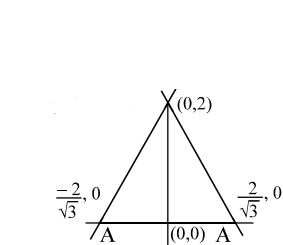
View full question & answer→MCQ 4891 Mark
Let $u \equiv ax + by + a \sqrt[3]{b} = 0$ $v \equiv bx - ay + b \sqrt[3]{a} = 0$ $a, b\, \in \,R$ be two straight lines. The equation of the bisectors of the angle formed by $k_1u -k_2v = 0\, \& \,k_1u + k_2v = 0$ for non zero real $k_1\, \& \,k_2$ are:
- A
$u = 0$
- B
$k_2u + k_1v = 0$
- C
$v = 0$
- ✓
$(A)$ & $(C)$ both
AnswerCorrect option: D. $(A)$ & $(C)$ both
d
Note that the lines are perpendicular . Assume the co-ordinate area to be directed along $u = 0\, \& \,v = 0$ . Now the lines $k_1 u -k_2 v = 0\, \& \,k_1 u + k_2 v = 0$ are equally inclined with $u\, v$ axes . Hence the bisectors are $u = 0\, \& \,v = 0$
View full question & answer→MCQ 4901 Mark
Let distinct lines $L_1,L_2$ belong to family of lines $(x -2y -3) + \lambda (x + 3y + 2) = 0$ and $B_1$ is angle bisector of $L_1$ and $L_2$ which passes through point $A(2,3),$ then equation of other bisector of $L_1$ and $L_2$ is ($\lambda$ is a parameter)
- ✓
$x + 4y + 3 = 0$
- B
$4x + y -3 = 0$
- C
$x + y = 5$
- D
$2x -y = 1$
AnswerCorrect option: A. $x + 4y + 3 = 0$
a
Fixed point of family is $(1,-1)$
$\Rightarrow$ other bisector is
$y+1=-\frac{1}{4}(x-1)$
$x+4 y+3=0$
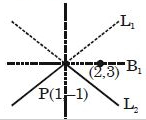
View full question & answer→MCQ 4911 Mark
The equation of the bisector of the acute angle between the lines $2x - y + 4 = 0$ and $x - 2y =1$ is
- A
$x + y + 5 = 0$
- ✓
$x - y + 1 = 0$
- C
$x y - 5 = 0$
- D
$x - y - 4 = 0$
AnswerCorrect option: B. $x - y + 1 = 0$
b
The equations of the lines are
$2 x-y+4=0$ and $-x+2 y+1=0$
We have, $2 \times-1+(-1) \times 2<0$ i.e. $a_{1} a_{2}+b_{1} b_{2}<0$
Therefore, the equation of the bisector of acute angles is
$\frac{2 x-y+4}{\sqrt{1+4}}=\frac{-x+2 y+1}{\sqrt{(-1)^{2}+2^{2}}}$
$\Rightarrow 2 x-y+4=-x+2 y+1$
$\Rightarrow 3 x-3 y+3=0$
$\Rightarrow x-y+1=0$
View full question & answer→MCQ 4921 Mark
Let $B_1 = 3x + 4y -7 = 0$ ane $B_2 \equiv 4x -3y -14 = 0$ are angle bisectors of the angle between the lines $L_1 = 0$ & $L_2 = 0$ in which $L_1$ is passes through the point $(1, 2)$ then
- ✓
$B_1$ is acute angle bisector
- B
$B_2$ is acute angle bisector
- C
$B_1 \ \& \ B_2$ both are right angle bisector
- D
AnswerCorrect option: A. $B_1$ is acute angle bisector
a
Let $\mathrm{d}_{1} $ and $ \mathrm{d}_{2}$ are the distance of point $(1,2)$ from the bisector $\mathrm{B}_{1} $ and $ \mathrm{B}_{2}$
$\mathrm{d}_{1}=\frac{|3+8-7|}{5}=\frac{4}{5}$
$\mathrm{d}_{2}=\frac{|4-6-14|}{5}=\frac{16}{5}$
$\because \mathrm{d}_{1}<\mathrm{d}_{2}$
$\therefore $ $\mathrm{B}_{1}$ is an acute angle bisector
View full question & answer→MCQ 4931 Mark
$ABC$ is a variable triangle such that $A$ is $(1, 2)$ , $B$ and $C$ lie on line $y = x + \lambda $(where $\lambda $ is a variable), then locus of the orthocenter of triangle $ABC$ is
- A
$(x -1)^2 + y^2 = 4$
- ✓
$x + y = 3$
- C
$2x -y = 0$
- D
AnswerCorrect option: B. $x + y = 3$
b
As altitude from $A$ is fixed and orthocentre lies on altitude hence $x + y = 3$ is required locus.
View full question & answer→MCQ 4941 Mark
Set of values of $'\alpha '$ for which the angle bisector of the lines $(\alpha + 1)x + 2y + 5 = 0$ and $4x + \alpha y -3 = 0$ containing origin is also the obtuse angle bisector, is
- ✓
$\left( { - \infty , - \frac{2}{3}} \right)$
- B
$\left( { - \frac{2}{3}, \infty } \right)$
- C
$\left( { - \infty , - \frac{2}{3}} \right) \cup \left( {1,\infty } \right)$
- D
$\left( { - 1,\infty } \right)$
AnswerCorrect option: A. $\left( { - \infty , - \frac{2}{3}} \right)$
a
$(\alpha+1) \mathrm{x}+2 \mathrm{y}+5=0$
$-4 x-\alpha y+3=0$
$a_{1} a_{2}+b_{1} b_{2}>0$
$\Rightarrow-6 \alpha>4 \Rightarrow \alpha<-\frac{2}{3}$
View full question & answer→MCQ 4951 Mark
If $A \& B$ are the points $(- 3, 4)$ and $(2, 1),$ then the co-ordinates of the point $C$ on $AB$ produced such that $AC = 2\, BC$ are :
- A
$(2, 4)$
- B
$(3, 7)$
- ✓
$(7, -2)$
- D
$\left( { - \,\frac{1}{2}\,\,,\,\,\frac{5}{2}} \right)$
AnswerCorrect option: C. $(7, -2)$
c
since $A C=2 B C=>\frac{A C}{B C}=2: 1$
This means, C divides AB externally in the ratio 2: 1
Using the section formula, if a point $(x, y)$ divides the
line joining the points $\left(x_{1}, y_{1}\right)$ and $\left(x_{2}, y_{2}\right)$ externally in the ratio $m: n,$ then $(x, y)=$
$\left(\frac{m x_{2}-n x_{1}}{m-n}, \frac{m y_{2}-n y_{1}}{m-n}\right)$
Substituting $\left(x_{1}, y_{1}\right)=(-3,4)$ and $\left(x_{2}, y_{2}\right)=(2,1)$ and $m=2, n=1$ in the section formula,we get
$C=\left(\frac{2(2)-1(-3)}{2-1}, \frac{2(1)-1(4)}{2-1}\right)=(7,-2)$
View full question & answer→MCQ 4961 Mark
If $P \equiv \left( {\frac{1}{{{x_p}}}\,\,,\,\,p} \right) ; Q = \left( {\frac{1}{{{x_q}}}\,\,,\,\,q} \right) ; R =\left( {\frac{1}{{{x_r}}}\,\,,\,\,r} \right)$ where $x_k \ne 0,$ denotes the $k^{th}$ term of an $H.P.$ for $k \in N,$ then :
- A
$Ar. (\Delta PQR) =$ $\frac{{{p^2}\,{q^2}\,{r^2}}}{2}\,\,\sqrt {{{(p\, - \,q)}^2}\,\, + \,\,{{(q\, - \,r)}^2}\,\, + \,\,{{(r\, - \,p)}^2}} $
- B
$\Delta PQR$ is a right angled triangle
- ✓
the points $P, Q, R$ are collinear
- D
AnswerCorrect option: C. the points $P, Q, R$ are collinear
c
If $\frac{1}{ x _1}, \frac{1}{ x _2}, \frac{1}{ x _3}, \ldots . \frac{1}{ x _{ k }}$ are in $HP$
then $a_1, a_2, a_i, \ldots a_{\text {a }}$ are in $A P$
where $\frac{1}{ x _{ l }}= a _1, \frac{1}{ x _2}= a _2, \frac{1}{ x _{ k }}= a _{ k }$.
$\frac{1}{ x _1}= a _p= a _1+( p -1) d$
$\frac{1}{ x _1}= a _4= a _1+( q -1) d$
$\frac{1}{ x _{ l }}= a _{ r }= a _1+( r -1) d$
Slope of $P Q=\frac{(q-p)}{(q-p) d}=\frac{1}{d}$
Slope of $Q R=\frac{(r-q)}{(r-q) d}=\frac{1}{d}$
Slope of $P R=\frac{(r-p)}{(r-p) d}=\frac{1}{d}$
All have same slope, hence all points are collinear.
View full question & answer→MCQ 4971 Mark
The acute angle between two straight lines passing through the point $M(- 6, - 8)$ and the points in which the line segment $2x + y + 10 = 0$ enclosed between the co-ordinate axes is divided in the ratio $1 : 2 : 2$ in the direction from the point of its intersection with the $x -$ axis to the point of intersection with the $y -$ axis is :
- A
$\pi /3$
- ✓
$ \pi /4$
- C
$\pi /6$
- D
$ \pi /12$
AnswerCorrect option: B. $ \pi /4$
b
the co-ordinate of $P$ and $Q$ are $(-4, -2)$ and $(-2, -6)$ respectively
View full question & answer→MCQ 4981 Mark
Points $A\, \& \,B$ are in the first quadrant ; point $'O'$ is the origin . If the slope of $OA$ is $1$, slope of $OB$ is $7$ and $OA = OB$, then the slope of $AB$ is :
- A
$ - 1/5$
- B
$ - 1/4$
- C
$- 1/3$
- ✓
$- 1/2$
AnswerCorrect option: D. $- 1/2$
d
$tan\theta = 7$ ;
$sin \theta =$$\frac{7}{{5\sqrt 2 }}$ ;
$cos\theta =$ $\frac{1}{{5\sqrt 2 }}$
now $m_{AB} = $ $\frac{{ - 1}}{2}$
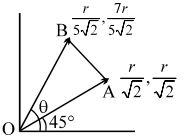
View full question & answer→MCQ 4991 Mark
The co-ordinates of a point $P$ on the line $2x - y + 5 = 0$ such that $|PA - PB|$ is maximum where $A$ is $(4, - 2)$ and $B$ is $(2, - 4)$ will be :
- A
$(11, 27)$
- ✓
$(- 11, - 17)$
- C
$(- 11, 17)$
- D
$(0, 5)$
AnswerCorrect option: B. $(- 11, - 17)$
b
$|PA - PB|$ will be maximum if $P, A \,\, $ and $\,\, B$ will be collinear .
Hence $2 a - b + 5 = 0$ and the determinant
$\left| {\,\begin{array}{*{20}{c}}a & b& 1\\4& { - \,2}& 1\\2&{ - \,4}& 1\end{array}\,} \right|$ $= 0$
View full question & answer→MCQ 5001 Mark
The line $x + y = p$ meets the axis of $x\, \& \,y$ at $A\, \& \,B$ respectively . A triangle $APQ$ is inscribed in the triangle $OAB$, $O$ being the origin, with right angle at $Q . P$ and $Q$ lie respectively on $OB$ and $AB$ . If the area of the triangle $APQ$ is $3/8^{th}$ of the area of the triangle $OAB$, then $\frac{{A\,Q}}{{B\,Q}}$ is equal to :
Answerd
$\frac{{\Delta AQP}}{{\Delta AOB}} = \frac{3}{8}$ or $\frac{{\frac{{{p^2}\lambda }}{{{{(\lambda + 1)}^2}}}}}{{\frac{1}{2}{p^2}}} = \frac{3}{8}$
$\Rightarrow$ $\lambda = 3,\frac{1}{3}$
$\frac{{AQ}}{{BQ}} = 3\,\,\,or\,\,\,\frac{1}{3}$
$\frac{1}{3}$ is rejected because this gives negative coordinater of $P$ and it is gives that $P$ lies on $OB.$
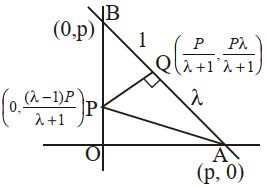
View full question & answer→