MCQ
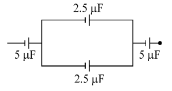
Equivalence in the following circuit is:
Image
  • $\frac{5}{3} \mu F$
  • B
    $\frac{3}{5} \mu F$
  • C
    $15 \mu F$
  • D
    $\frac{1}{15} \mu F$

Answer

Correct option: A.
$\frac{5}{3} \mu F$
(a)$\frac{5}{3} \mu F$

Need a full question paper?

Generate a complete, print-ready paper with questions like this in minutes — across 16+ boards, with answer keys.

Start Generating Free

Similar questions

If an electron and a positron annihiliate, then the energy released is
Using the expression $2 d \sin \theta=\lambda$, one calculates the values of $d$ by measuring the corresponding angles $\theta$ in the range $0$ to $90^{\circ}$. The wavelength $\lambda$ is exactly knowns and the error in $\theta$ is constant for all values of $\theta$. As $\theta$ increases from $0^{\circ}$ :
$3.8$ days is the half-life period of a sample. After how many days, the sample will become $\frac{{1}}{{8}} \, th$ of the original substance
A luminous object is placed at a distance of $30 \,cm$ from the convex lens of focal length $20 \,cm$. On the other side of the lens, at what distance from the lens a convex mirror of radius of curvature $10\, cm$ be placed in order to have an upright image of the object coincident with it.....$cm$
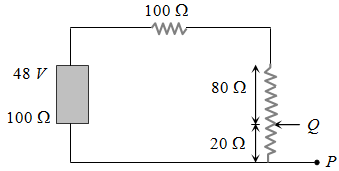
In the circuit, the potential difference across PQ will be nearest to
A non uniformly shaped conductor is charged then at it's sharpest point
Magnetic field due to a ring having $n$ turns at a distance $x$ on its axis is proportional to (if $r$ = radius of ring)
Which of the following statements about the Bohr model of the hydrogen atom is false
The current in a coil of self inductance $2.0 \,H$ is increasing according to $I =2 \sin \left( t ^{2}\right) A$. The amount of energy spent during the period when current changes from $0$ to $2\, A$ is......$J.$
A parallel plate capacitor has plates of area $A$ separated by distance $d$ between them. It is filled with a dielectric which has a dielectric constant that varies as $\mathrm{k}(\mathrm{x})=\mathrm{K}(1+\alpha \mathrm{x})$ where $\mathrm{x}$ is the distance measured from one of the plates. If $(\alpha \text {d)}<<1,$ the total capacitance of the system is best given by the expression