Question
Establish a relation between electric current and drift velocity.

OR

Prove that the current density of a metallic conductor is directly proportional to the drift speed of electrons.
Answer

Relation between electric current and drift velocity:

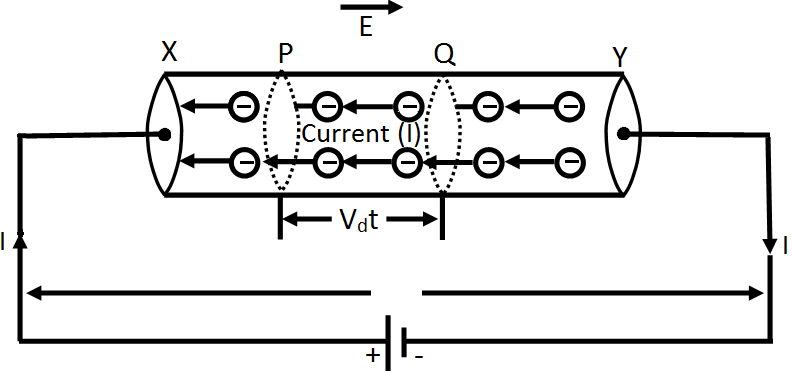
Consider a uniform metallic wire XY of length l and cross-sectional area A. A potential difference V is applied across the ends X and Y of the wire. This causes an electric field at each point of the wire of strength.

$\text{E}=\frac{\text{V}}{\text{l}}\dots\text{(i)}$

Due to this electric field, the electrons gain a drift velocity vd opposite to direction of electric field. If q be the charge passing through the cross-section of wire in t seconds, then

$\text{Current in write I}=\frac{\text{q}}{\text{r}}\dots\text{(ii)}$

The distance traversed by each electron in time t = average velocity × time = vd t

If we consider two planes P and Q at a distance vd t in a conductor, then the total charge flowing in time t will be equal to the total charge on the electrons present within the cylinder PQ.

The volume of this cylinder = cross sectional area × height = A vd t

If n is the number of free electrons in the wire per unit volume, then the number of free electrons

in the cylinder = n(Avd t)

If charge on each electron is -e (e = 1.6 × 10⁻¹⁹C), then the total charge flowing through a cross-section of the wire

q = (nAvd t) (-e) = –neAvd t ...(iii)

$\therefore$ Current flowing in the wire,

$\text{I}=\frac{\text{q}}{\text{t}}=\frac{-\text{v}}{\text{t}}$

i.e., current I = -neAvd ...(iv)

This is the relation between electric current and drift velocity. Negative sign shows that the direction of current is opposite to the drift velocity.

Numerically I = -neAvd ...(v)

$\therefore$ Current density, $\text{J}=\frac{\text{I}}{\text{A}}=\text{d}$

$\Rightarrow\text{J}\propto\text{vd.}$

That is, current density of a metallic conductor is directly proportional to the drift velocity.

Need a full question paper?

Generate a complete, print-ready paper with questions like this in minutes — across 16+ boards, with answer keys.
Start Generating Free

Similar questions

A thin paper of thickness 0.02mm having a refractive index 1.45 is pasted across one of the slits in a Young's double slit experiment. The paper transmits $\frac{4}{9}$ of the light energy falling on it.
  1. Find the ratio of the maximum intensity to the minimum intensity in the fringe pattern.
  2. How many fringes will cross through the centre if an identical paper piece is pasted on the other slit also? The wavelength of the light used is 600nm.
An electron and a positron are released from (0, 0, 0) and (0, 0, 1.5R) respectively, in a uniform magnetic field $\text{P}=\text{B}_0\vec{\text{i}}$, each with an equal momentum of magnitude p = eBR. Under what conditions on the direction of momentum will the orbits be nonintersecting circles?
A charge Q is uniformly distributed on a thin spherical shell. What is the field at the centre of the shell? If a point charge is brought close to the shell, will the field at the centre change? Does your answer depend on whether the shell is conducting or nonconducting?
A wave travelling on a string, at a speed of 10m/s causes each particle of the string to oscillate with a time period of 20ms.
  1. What is the wavelength of the wave?
  2. If the displacement of a particle is 1.5mm at a certain instant, what will be the displacement of a particle 10cm away from it at the same instant?
Two circular coils of radii 5.0cm and 10cm carry equal currents of 21 A. The coils have 50 and 100 turns reepectively and are placed in such a way that their planes as well as the centres coincide. Find the magnitude of the magnetic field B at the common centre of the coils if the currents in the coils are (a) in the same sense (b) in the opposite sense.
By defining electric dipole and dipole moment, find the necessary formula for the field intensity at any point located on the neutral (equatorial plane) of the dipole.
A coil having an inductance L and a resistance R is connected to a battery of emf $\in.$ Find the time taken for the magnetic energy stored in the circuit to change from one fourth of the steady-state value to half of the steady-state value.
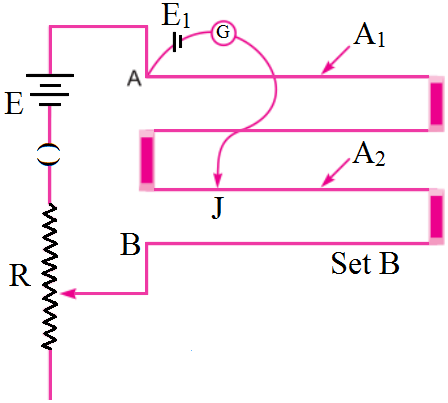
You are given two sets of potentiometer circuits to measure the emf E1 of a cell.

Set A: consists of a potentiometer wire of a material of resistivity $\rho_1$, area of cross-section A1 and length l.

Set B: consists of a potentiometer of two composite wire of equal lengths $\frac{\text{l}}2{}$ each, of resistivity $\rho_1,\rho_2$ and area of cross-section A1, A2 respectively.

Find the relation between resistivity of the two wires with respect to their area of cross section, if the current flowing in the two sets is same.

Compare the balancing length obtained in the two sets.

An atom is in its excited state. Does the probability of its coming to ground state depend on whether the radiation is already present or not? If yes, does it also depend on the wavelength of the radiation present?
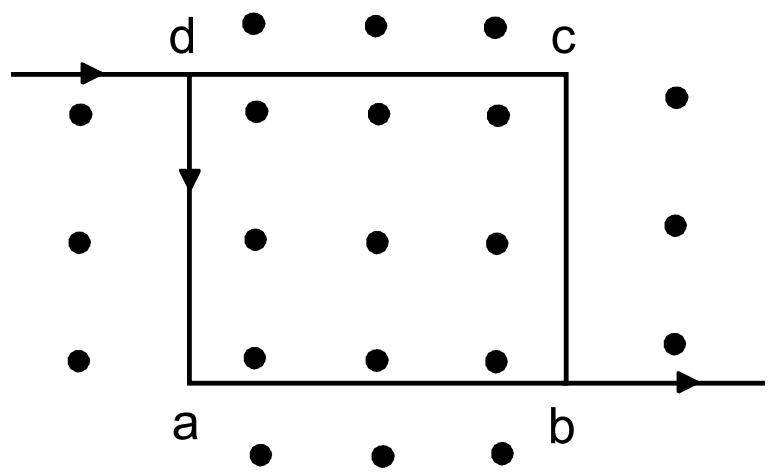
A current of 2A enters at the corner d of a square frame abcd of side 20cm and leaves at the opposite corner b. A magnetic field B = 0.1 T exists in the space in a direction perpendicular to the plane of the frame, as shown in the figure. Find the magnitude and direction of the magnetic forces on the four sides of the frame.