Question
Establish the following vector in equalities geometrically or otherwise :
(a) $|\vec{a}+\vec{b}| \leq|\vec{a}|+|\vec{b}|$
(b) $|\vec{a}+\vec{b}| \geq|\vec{a}|-|\vec{b}| \mid$
(c) $|\vec{a}-\vec{b}| \leq|\vec{a}|+|\vec{b}|$
(d) $|\vec{a}-\vec{b}| \geq|\vec{a}|-|\vec{b}| \mid$
When does the equality sign above apply?
Answer

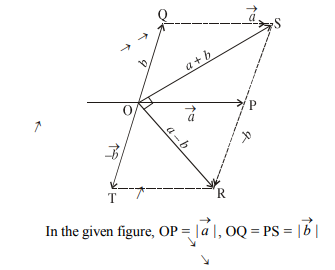
Consider two vectors $\vec{a}$ and $\vec{b}$ which are represented by $\overrightarrow{ OP }$ and $\overrightarrow{ OQ }$ two sides of parallelogram OPSQ. From the vector addition rule of parallelogram $(\vec{a}+\vec{b})$ is represented by the $\overrightarrow{ OS }$ vector.
Image
In the given figure, $OP =|\vec{a}|, OQ = PS =|\vec{b}|$
and $\quad OS =|\vec{a}+\vec{b}|$
(a) To prove : $|\vec{a}+\vec{b}| \leq|\vec{a}|+|\vec{b}|$
Proof : We know that in a triangle the length of one side is always less than the sum of lengths of the remaining two sides. Therefore in $\triangle OPS$ :
$OS < OP+PS$
$OS < OP+OQ$
$|\vec{a}+\vec{b}| <|\vec{a}|+|\vec{b}|\quad\quad...(1)$
If both the vectors are acting in the same direction along the same straight line, that is, they are collinear then,
$|\vec{a}+\vec{b}|=|\vec{a}|+|\vec{b}|\quad\quad...(2)$
From equations (1) and (2)
$|\vec{a}+\vec{b}| \leq|\vec{a}|+|\vec{b}|$
The equal sign applies only when the vectors are collinear and acting in the same direction.
Hence Proved.
(b) To prove : $|\vec{a}+\vec{b}| \geq \mid |\vec{a}|-|\vec{b}| \mid$
Proof : In a triangle, one side is greater than the difference between the other two sides. In $\triangle OPS$,
$OS+PS >OP $
$OS > |OP-PS| $
$OS >|OP-OQ| \quad\quad...(3)$
$\quad\quad\quad\therefore PS=OQ$
The modulus of ($OP - OQ$) has been taken, hence LHS will always be positive. But the value of RHS can also be engative if $OP < PS$.
Thus from equation (3),
$|\vec{a}+\vec{b}|> \mid |\vec{a}|-|\vec{b}| \mid\quad\quad...(4)$
If two vectors $\vec{a}$ and $\vec{b}$ are working in opposite directions along the same straight line, then
$|\vec{a}+\vec{b}|= \mid |\vec{a}|-|\vec{b}| \mid\quad\quad...(5)$
From equations (4) and (5)
$|\vec{a}+\vec{b}| \geq \mid |\vec{a}|-|\vec{b}| \mid$
Hence Proved.
(c) To prove : $|\vec{a}-\vec{b}| \leq|\vec{a}|+|\vec{b}|$
Proof : In $\triangle OPR$,
$OP=|\vec{a}|, PR=|-\vec{b}|=\vec{b}, OR=|\vec{a}-\vec{b}|$
From $\triangle OPR$,
$OR < OP+PR $
$|\vec{a}-\vec{b}| < |\vec{a}|+|\vec{b}|\quad\quad...(6)$
Now, vector $\vec{a}$ and $\vec{b}$ are in opposite directions along the same line then,
$|\vec{a}-\vec{b}|=|\vec{a}|+|\vec{b}|\quad\quad...(7)$
From equations (6) and (7)
$|\vec{a}-\vec{b}| \leq|\vec{a}|+|\vec{b}|$
Hence Proved.
(d) To prove : $|\vec{a}-\vec{b}| \geq \mid|\vec{a}|-|\vec{b}| \mid$
Proof : Since in any triangle one side is greater than the difference between the two sides then, in $\triangle OPR$,
$OP+PR > OP $
$OR > |OP-PR| $
$OR > |OP-OT|\quad\quad...(8)$
$\quad\quad\quad\because OT=PR$
Hence, modulus of (OP - OT) will always be positive. This means that the value of LHS will always be positive, but the value of RHS can also be negative if
$OP < OT$
Then from equation (8),
$|\vec{a}-\vec{b}|> \mid|\vec{a}|-|\vec{b}|\mid$ $\quad\quad...(9)$
If both vectors are in straight line and in same direction then,
$|\vec{a}-\vec{b}| = \mid|\vec{a}|-|\vec{b}|\mid$ $\quad\quad...(10)$
From equations (9) and (10)
$|\vec{a}-\vec{b}| \geq \mid|\vec{a}|-|\vec{b}|\mid$
Hence Proved.

Need a full question paper?

Generate a complete, print-ready paper with questions like this in minutes — across 16+ boards, with answer keys.

Start Generating Free

Similar questions

A particle executes simple harmonic motion of amplitude A.
i. At what distance from the mean position is its kinetic energy equal to its potential energy?
ii. At what points is its speed half the maximum speed?
A thin paper of thickness 0.02mm having a refractive index 1.45 is pasted across one of the slits in a Young's double slit experiment. The paper transmits $\frac{4}{9}$ of the light energy falling on it.
  1. Find the ratio of the maximum intensity to the minimum intensity in the fringe pattern.
  2. How many fringes will cross through the centre if an identical paper piece is pasted on the other slit also? The wavelength of the light used is 600nm.
Write Hooke's law. On what does the value of co-efficient of elasticity depend? Draw a graph between stress and strain with in the elastic limit.###Write Hooke's law. How to determine the coefficient of elasticity of a material of wire in the laboratory? Explain. Make necessary diagram also Compare the Young's Modulus of elasticity of different material.
On an open ground, a motorist follows a track that turns to his left by an angle of 60º after every 500 m. Starting from a given turn specify the displacement of the motorist at the third, sixth and eighth turn. Compare the magnitude of the displacement with the total path length covered by the motorist in each case.
The displacement x (in cm) of an oscillating particle varies with time t (in seconds) according to the equation. $\text{x}=2\cos(0.5\pi\text{t}+\frac{\pi}{3})$ Find 
  1. Amplitude of oscillation.
  2. The time period of oscillation.
  3. The maximum velocity of the particle.
  4. The maximum acceleration of the particle.
A ball is thrown vertically upwards with a velocity of 20m/ s from the top of a building of height 25m from the ground,
  1. How high will the ball reach?
  2. How long will it take for the ball to reach the ground?
  3. Trace the trajectory of motion of this ball.
The initial pressure and volume of a given mass of a gas $\Big(\frac{\text{C}_\text{P}}{\text{C}_\text{V}}=\gamma\Big)$ are P0 and V0. The gas can exchange heat with the surrounding.
  1. It is slowly compressed to a volume $\frac{\text{V}_0}{2}$ and then suddenly compressed to $\frac{\text{V}_0}{4}.$ Find the final pressure.
  2. If the gas is suddenly compressed from the volume V0 to $\frac{\text{V}_0}{2}$ and then slowly compressed to $\frac{\text{V}_0}{4},$ what will be the final pressure?
Consider an ideal gas with following distribution of speeds.
Speed m/s
200
400
600
800
1000
% of molecules
10
20
40
20
10
If all the molecules with speed 1000m/s escape from the system, calculate new Vrms and hence T.
A current of 1.0A exists in a copper wire of cross-section 1.0mm2. Assuming one free electron per atom, calculate the drift speed of the free electrons in the wire. The density of copper is 9000kg/m-3.
Suppose the $19\Omega$ resistor of the previous problem is disconnected. Find the current through P2Q2 in the two situations:
  1. Both the wires move towards right.
  2. If P1Q1 moves towards left but P2Q2 moves towards right.