Question types

PART - 1 CH - 3 Motion in a Plane question types

130 questions across 9 question groups — pick any mix to generate a Physics paper with step-by-step answer keys.

130
Questions
9
Question groups
5
Question types
Sample Questions

PART - 1 CH - 3 Motion in a Plane questions

One sample from each question group in this chapter. Select any group above to see the full set with answer keys.

The speed at the maximum height of a projectile is half of its initial speed $u$. The horizontal range of projectile is
  • A
    $\frac{3 u^2}{2 g}$
  • B
    $\frac{\sqrt{3} u^2}{2 g}$
  • C
    $\frac{u^2}{2 g}$
  • D
    $\frac{2 u^2}{g}$
View full solution
If the vector is a unit vector in the direction of A. So
  • $\hat{n}=\frac{\vec{A}}{|\vec{A}|}$
  • B
    $\hat{n}=\frac{|\vec{A}|}{\vec{A}}$
  • C
    $\hat{n}=|\overrightarrow{ A }||\overrightarrow{ A }|$
  • D
    $\hat{n}=\hat{n} \times \overrightarrow{ A }$

Answer: A.

View full solution
Two forces of 2 and 3 newton are acting perpendicular to each other on a particle. Their resultant force will make an angle with the force of 3 newton
  • A
    $2 / 3$
  • $\tan ^{-1}\left(\frac{2}{3}\right)$
  • C
  • D
    $\tan ^{-1}\left(\frac{3}{2}\right)$

Answer: B.

View full solution
Pick out the only vector quantity in the following list :
Temperature, pressure, impulse, time, power, total path length, energy, gravitational potential, coefficient of friction, charge.
View full solution
For any arbitrary motion in space, which of the following relations are true?
(a) $\vec{v}_{\text {avg }}=(1 / 2)\left[\vec{v}\left(t_1\right)+\vec{v}\left(t_2\right)\right]$
(b) $\vec{v}_{ avg }=\left[\vec{r}\left(t_2\right)-\vec{r}\left(t_1\right)\right] /\left(t_2-t_1\right)$
(c) $\vec{v}(t)=\vec{v}(0)+\vec{a} t$
(d) $\vec{r}( t )=\vec{r}(0)+\vec{v}(0) t+(1 / 2) \vec{a} t^2$
(e) $\vec{a}_{\text {avg }}=\left[\vec{v}\left(t_2\right)-\vec{v}\left(t_1\right)\right] /\left(t_2-t_1\right)$
Here, 'average' means the average values of physical quantities related to the time interval $t_2$ and $t_1$.
View full solution
Pick out the two scalar quantities in the following list :
Force, angular momentum, work, current, linear momentum, electric field, average velocity, magnetic moment, relative velocity.
View full solution
State, for each of the following physical quantities, if it is a scalar or a vector : volume, mass, speed, acceleration, density, number of moles, velocity, angular frequency, displacement, angular velocity.
View full solution
A ball is thrown in horizontal direction from the top of a tower and another ball is dropped from the top of same tower. What will be the time difference between both the balls to reach the earth?
View full solution
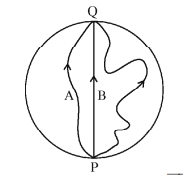
Three girls skating on a circular ice ground of radius 200 m start from a point P on the edge of the ground and reach a point Q diametrically opposite to P following different paths as shown in Fig. What is the magnitude of the displacement vector for each? For which girl is this equal to the actual length of path skate?
Image
View full solution
Read each statement below carefully and state. with reasons, if it is true or false :
(a) The net acceleration of a particle in circular motion is always along the radius of the circle towards the centre.
(b) The velocity vector of a particle at a point is always along the tangent to the path of the particle at that point.
(c) The acceleration vector of a particle in uniform circular motion averaged over one cycle is a null vector.
View full solution
A ball is thrown with a velocity of $15 ms^{-1}$ at angle $45^{\circ}$ with the horizontal. What is the range of ball? What is the time of flight for the ball to return to same plane from the point of throwing?
View full solution
A 0.1 kg stone tied to a thread of 1 m long and moves in a horizontal circular path at a speed of 2 rotations per second. Calculate the tension on the thread.
View full solution
Q 263 Marks Question3 Marks
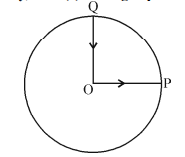
A cyclist starts from the centre O of a circular park of radius 1 km, reaches the edge P of the park, then cycles along the circumference, and returns to the centre along QO as shown in Fig. If the round trip takes 10 min, what is the (a) net displacement (b) average velocity, and (c) average speed of the cyclist?
Image
View full solution
Q 273 Marks Question3 Marks
Read each statement below carefully and state with reason, if it is true or false :
(a) The magnitude of a vector is always a scalar,
(b) each component of a vector is always a scalar,
(c) the total path length is always equal to the magnitude of the displacement vector of a particle.
(d) the average speed of a particle (defined as total path length divided by the time taken to cover the path) is either greater or equal to the magnitude of average velocity of the particle over the same interval of time, (e) Three vectors not lying in a plane can never add up to give a null vector.
View full solution
Q 283 Marks Question3 Marks
State with reasons, whether the following algebraic operations with scalar and vector physical quantities are meaningful :
(a) adding any two scalars, (b) adding a scalar to a vector of the same dimensions, (c) multiplying any vector by any scalar, (d) multiplying any two scalars, (e) adding any two vectors, (f) adding a component of a vector to the same vector.
View full solution
Q 293 Marks Question3 Marks
An aircraft is flying at a height of 3400 m above the ground. If the angle subtendent at a ground observation point by the aircraft position 10.0 s a part is 30º, what is the speed of the aircraft?
View full solution
Q 303 Marks Question3 Marks
Read each statement below carefully and state, with reasons and examples, if it is true or false :
A scalar quantity is one that
(a) is conserved in a process
(b) can never take negative values
(c) must be dimensionless
(d) does not vary from one point to another in space
(e) Has the same value for observers with different orientations of axes.
View full solution
Q 314 Marks Question4 Marks
The position of a particle is given by $\vec{r}=\left(3 \cdot 0 t \hat{i}-2 \cdot 0 t^2 \hat{j}+4 \cdot 0 \hat{k}\right) m$. where $t$ is in seconds and the coefficient have the proper units for $\vec{r}$ to be in meters.
(a) Find the $\vec{v}$ and $\vec{a}$ of the particle.
(b) What is the magnitude and direction of velocity of the particle at $t=2 s$ ?
View full solution
Q 324 Marks Question4 Marks
A cricketer can throw a ball to a maximum horizontal distance of 100 m. How much high above the ground can the cricketer throw the same ball?
View full solution
Q 334 Marks Question4 Marks
The ceiling of a long hall is 25 m high. What is the maximum horizontal distance that a ball thrown with a speed of $4 0 ms ^{-1}$ can go without hitting the ceiling of the hall?
View full solution
Column - AColumn - B
1. Position vector of a particle located at point $P$ is
$\vec{r}=x \hat{i}+y \hat{j}+z \hat{k}$
the resultant of this $|\vec{r}|=$
(A) $45^{\circ}$
2. A vector can be expressed as the product of its magnitude and unit vectorthen $\vec{A}=$(B) $\sqrt{x^2+y^2+z^2}$
3. When $\vec{P}$ and $\vec{Q}$ are in opposite directions then magnitude of $\vec{R} \ldots$.(C) 1
4. The sum of squares of all three direction cosines of a vector is always,(D) $\hat{n}|\overrightarrow{A}|$
5. The value of $\theta$ for maximum range in $R =\frac{u^2 \sin 2 \theta}{g}$ should be(E) Minimum
View full solution
Column - AColumn - B
1. The value of centripetal acceleration (A) $|\overrightarrow{ A }|=$
2. $\overrightarrow{A}=A_x \hat{i}+A_y \hat{j}+A_z \hat{k}$
the magnitude of $|\overrightarrow{ A }|$ will be :
(B) $H _{\max }=\frac{1}{4} R _{\max }$
3. Instantaneous acceleration
$\vec{a}=$
(C) Tangential
4. What is the relationship between maximum height and maximum range.(D) $\frac{d v}{d t}$
5. The velocity vector is always in the path of motion(E) $\frac{ V ^2}{ R }$
View full solution
Given $\vec{a}+\vec{b}+\vec{c}+\vec{d}=0$, which of the following statements are correct :
(a) $\vec{a}, \vec{b}, \vec{c}$ and $\vec{d}$ must each be a null vector.
(b) The magnitude of $(\vec{a}+\vec{c})$ equal the magnitude of $(\vec{b}+\vec{d})$.
(c) The magnitude of $\vec{a}$ can never be greater than the sum of magnitudes of $\vec{b}, \vec{c}$ and $\vec{d}$.
(d) $\vec{b}+\vec{c}$ must lie in the plane of $\vec{a}$ and $\vec{d}$ if $\vec{a}$ are not collinear, and in the line of $\vec{a}$ and $\vec{d}$, if they are collinear?
View full solution
Establish the following vector in equalities geometrically or otherwise :
(a) $|\vec{a}+\vec{b}| \leq|\vec{a}|+|\vec{b}|$
(b) $|\vec{a}+\vec{b}| \geq|\vec{a}|-|\vec{b}| \mid$
(c) $|\vec{a}-\vec{b}| \leq|\vec{a}|+|\vec{b}|$
(d) $|\vec{a}-\vec{b}| \geq|\vec{a}|-|\vec{b}| \mid$
When does the equality sign above apply?
View full solution
$\hat{i}$ and $\hat{j}$ are unit vectors along $x$ and $y$ axis respectively. What is the magnitude and direction of the vectors $\hat{i}+\hat{j}$ and $\hat{i}-\hat{j}$ ? What are the component of a vector $\overrightarrow{ A }=2 \hat{ i }+3 \hat{ j }$ along the direction of $\hat{i}+\hat{j}$ and $\hat{i}-\hat{j}$ ? (You can use the graphical method).
View full solution
A particle starts from the origin at t = 0 with a velocity of $10 \cdot 0 \hat{ j } m / s$ and moves in the X-Y planes with a constant acceleration of $(8 \cdot 2 \hat{i}+2 \cdot 0 \hat{j}) ms ^{-2}$.
(a) At what time is the $x$-coordinate of the particle 16 m? What is the y -coordinate of the particle at that time?
(b) What is the speed of the particle at that time?
View full solution
On an open ground, a motorist follows a track that turns to his left by an angle of 60º after every 500 m. Starting from a given turn specify the displacement of the motorist at the third, sixth and eighth turn. Compare the magnitude of the displacement with the total path length covered by the motorist in each case.
View full solution

Generate a PART - 1 CH - 3 Motion in a Plane paper free

Pick question groups from the list above, set marks and difficulty, and export a branded PDF with step-by-step answer keys. First 3 chapters free — no signup.

Download App