Question
Establish the following vector inequalities geometrically or otherwise:
$|\text{a}-\text{b}|\le|\text{a}|+|\text{b}|$
When does the equality sign above apply?
Answer

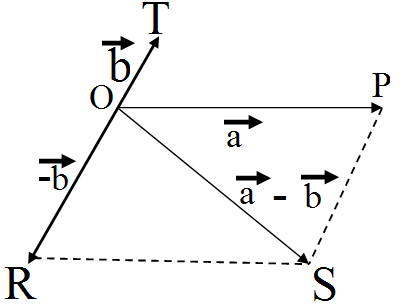
Let two vectors $\vec{\text{a}}$ and $\vec{\text{b}}$ be represented by the adjacent sides of a parallelogram PORS, as shown in the given figure.

$|\vec{\text{OR}}|=|\vec{\text{PS}}|=|\vec{\text{b}}|\ ...(\text{i})$

$|\vec{\text{OP}}|=|\vec{\text{a}}|\ ...(\text{ii})$

In a triangle, each side is smaller than the sum of the other two sides.

Therefore, in $\triangle\text{OPS},$

$\text{OS}<\text{OP}+\text{PS}$

$|\vec{\text{a}}-\vec{\text{b}}|<|\vec{\text{a}}|+|-\vec{\text{b}}|$

$|\vec{\text{a}}-\vec{\text{b}}|<|\vec{\text{a}}|+|\vec{\text{b}}|\ ...(\text{iii})$

If the two vectors act in a straight line but in opposite directions, then we can write:

$|\vec{\text{a}}-\vec{\text{b}}|=|\vec{\text{a}}|+|\vec{\text{b}}|\ ...(\text{iv})$

Combining equations (iii) and (iv), we get:

$|\vec{\text{a}}-\vec{\text{b}}|\le|\vec{\text{a}}|+|\vec{\text{b}}|$

Need a full question paper?

Generate a complete, print-ready paper with questions like this in minutes — across 16+ boards, with answer keys.

Start Generating Free

Similar questions

Suppose the particle of the previous problem has a mass m and a speed v before the collision and it sticks to the rod after the collision. The rod has a mass M:
  1. Find the velocity of the centre of mass C of the system constituting ''The rod plus the particle''.
  2. Find the velocity of the particle with respect to C before the collision.
  3. Find the velocity of the rod with respect to C before the collision.
  4. Find the angular momentum of the particle and of the rod about the centre of mass C before the collision.
  5. Find the moment of inertia of the system about the vertical axis through the centre of mass C after the collision.
  6. Find the velocity of the centre of mass C and the angular velocity of the system about the centre of mass after the collision.
The driver of a three-wheeler moving with a speed of 36km/h sees a child standing in the middle of the road and brings his vehicle to rest in 4.0s just in time to save the child. What is the average retarding force on the vehicle ? The mass of the three-wheeler is 400kg and the mass of the driver is 65kg.
An oxygen cylinder of volume 30 litres has an initial gauge pressure of 15 atm and a temperature of 27°C. After some oxygen is withdrawn from the cylinder, the gauge pressure drops to 11 atm and its temperature drops to 17°C. Estimate the mass of oxygen taken out of the cylinder (R = 8.31J mol-1K-1, molecular mass of O2 = 32u).
Estimate the average thermal energy of a helium atom at:
  1. Room temperature (27°C)
  2. The temperature on the surface of the Sun(6000K)
  3. The temperature of 10 million kelvin (the typical core temperature in the case of a star).
A car starting from rest, accelerates uniformly with 5m/s2 for sometime and then decelerates to come to rest with 3m/s2. Find the maximum velocity attained during the motion and the distance covered in a total time of 6 seconds of the journey.
From a certain apparatus, the diffusion rate of hydrogen has an average value of 28.7cm3 s-1. The diffusion of another gas under the same conditions is measured to have an average rate of 7.2cm3 s-1. Identify the gas.
[Hint: Use Graham’s law of diffusion $\frac{\text{R}_1}{\text{R}_2}=\Big(\frac{\text{M}_2}{\text{M}_1}\Big)^{\frac{1}{2}},$ where R1 , R2 are diffusion rates of gases 1 and 2, and M1 and M2 their respective molecular masses. The law is a simple consequence of kinetic theory]
See Fig. 4.15. A wooden block of mass $2 kg$ rests on a soft horizontal floor. When an iron cylinder of mass $25 kg$ is placed on top of the block, the floor yields steadily and the block and the cylinder together go down with an acceleration of $0.1 m s ^{-2}$. What is the action of the block on the floor (a) before and (b) after the floor yields ? Take $g=10 m s ^{-2}$. Identify the action-reaction pairs in the problem.
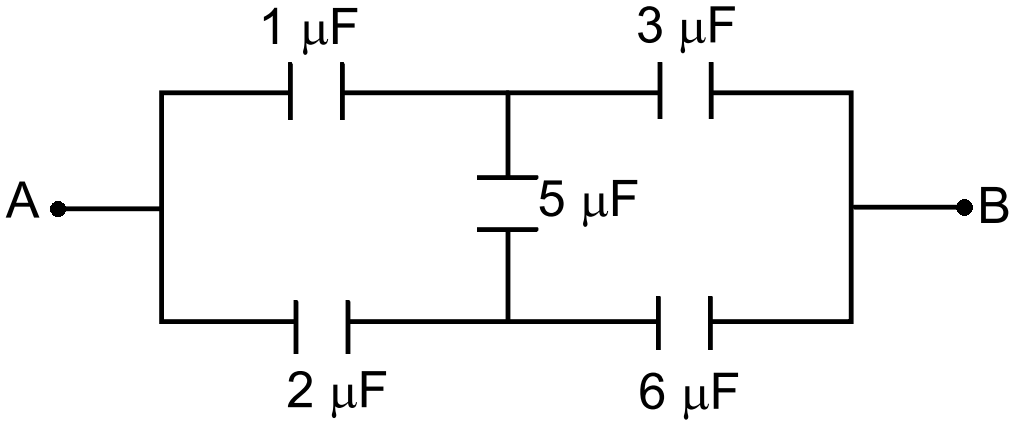
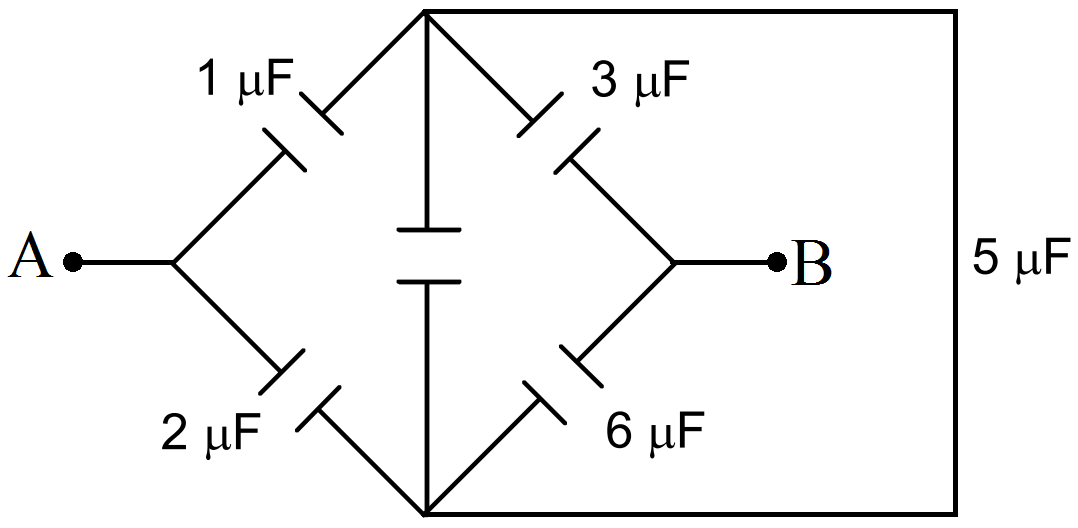
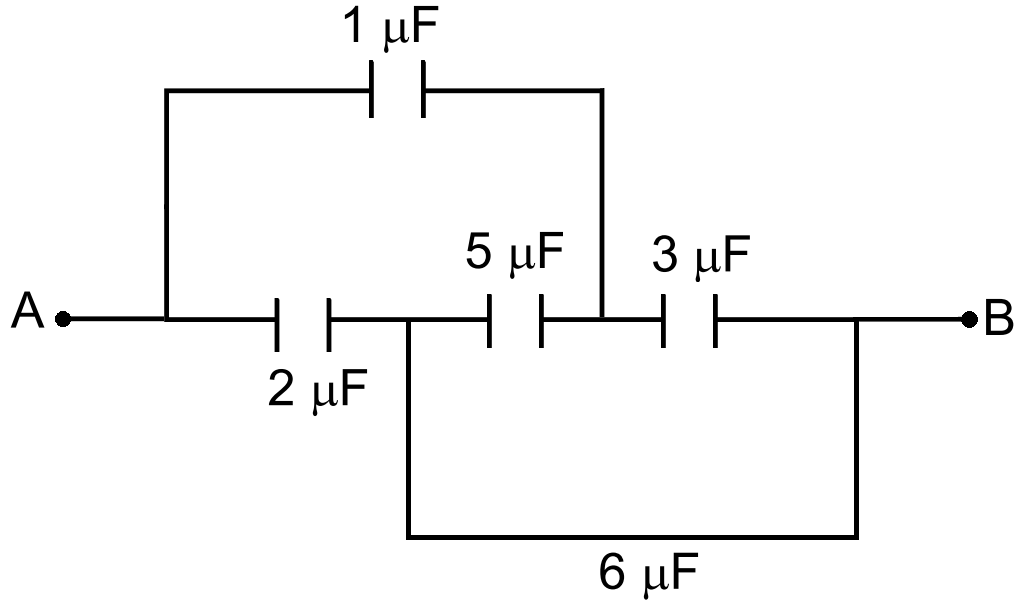
Convince yourself that parts (a), (b) and (c) of figure are identical. Find the capacitance between the points A and B of the assembly.


What is the density of water at a depth where pressure is 80.0 atm , given that its density at the surface is $1.03 \times 10^3 kg m ^{-3}$ ?
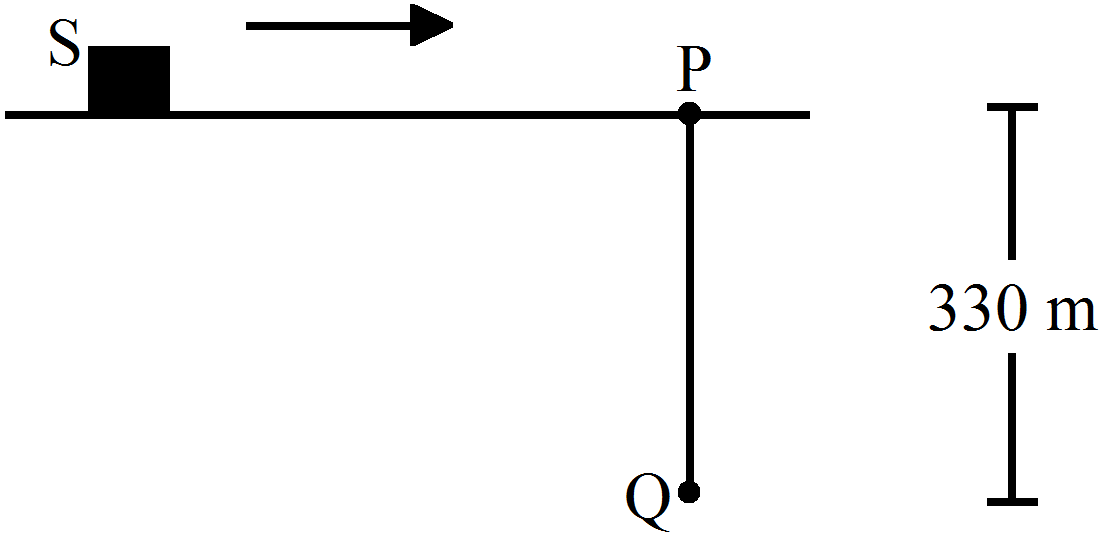
Figure, shows a source of sound moving along the X-axis at a speed of 22m/s continuously emitting a sound of frequency 2.0kHz which travels s in air at a speed of 330m/s. A listener Q stands on the Y-axis at a distance of 330 m from the origin. At t = 0, the source crosses the origin P.

  1. When does the sound emitted from the source at P reach the listener Q?
  2. What will be the frequency heard by the listener at this instant?
  3. Where will the source be at this instant?