Question
Establish the following vector inequalities geometrically or otherwise: $|\text{a}-\text{b}|\le|\text{a}|+|\text{b}|$ When does the equality sign above apply?
Answer

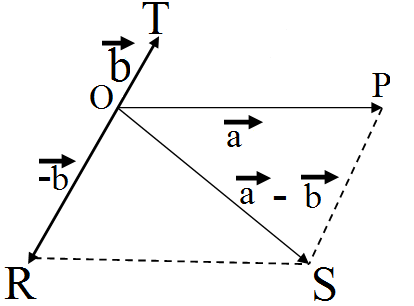
Let two vectors $\vec{\text{a}}$ and $\vec{\text{b}}$ be represented by the adjacent sides of a parallelogram PORS, as shown in the given figure.
$|\vec{\text{OR}}|=|\vec{\text{PS}}|=|\vec{\text{b}}|\ ...(\text{i})$ $|\vec{\text{OP}}|=|\vec{\text{a}}|\ ...(\text{ii})$ In a triangle, each side is smaller than the sum of the other two sides. Therefore, in $\triangle\text{OPS},$ $\text{OS}<\text{OP}+\text{PS}$ $|\vec{\text{a}}-\vec{\text{b}}|<|\vec{\text{a}}|+|-\vec{\text{b}}|$ $|\vec{\text{a}}-\vec{\text{b}}|<|\vec{\text{a}}|+|\vec{\text{b}}|\ ...(\text{iii})$ If the two vectors act in a straight line but in opposite directions, then we can write: $|\vec{\text{a}}-\vec{\text{b}}|=|\vec{\text{a}}|+|\vec{\text{b}}|\ ...(\text{iv})$ Combining equations (iii) and (iv), we get: $|\vec{\text{a}}-\vec{\text{b}}|\le|\vec{\text{a}}|+|\vec{\text{b}}|$

Need a full question paper?

Generate a complete, print-ready paper with questions like this in minutes — across 16+ boards, with answer keys.

Start Generating Free

Similar questions

Find the height of the geostationary satellite from the earth's surface by finding the formula for the height of the satellite from the earth's surface and also find the value of orbital velocity of the geostationary satellite.
Given the example of the motion in the following cases:
  1. Where magnitude and direction of the acceleration of the particle changes.
  2. Where the magnitude and direction of acceleration of body remains constant.
  3. Where magnitude of acceleration changes but its direction remains constants.
  4. Where the magnitude of acceleration remains constant but its direction changes.
A bucket full of water is placed in a room at $15°C$ with initial relative humidity $40\%$. The volume of the room is $50m^3$.
  1. How much water will evaporate?
  2. lf the room temperature is increased by $5°C$, how much more water will evaporate? The saturation vapour pressure of water at $15°C$ and $20°C$ are $1.6kPa$ and $2.4kPa$ respectively.
The current in an ideal, long solenoid is varied at a uniform rate of 0.01A/s. The solenoid has 2000 turns/m and its radius is 6.0cm.
  1. Consider a circle of radius 1.0cm inside the solenoid with its axis coinciding with the axis of the solenoid. Write the change in the magnetic flux through this circle in 2.0 seconds.
  2. Find the electric field induced at a point on the circumference of the circle.
  3. Find the electric field induced at a point outside the solenoid at a distance 8.0cm from its axis.
The bob of a pendulum at rest is given a sharp hit to impart a horizontal velocity $\sqrt{10\text{gl}},$ where l is the length of the pendulum. Find the tension in the string when,
  1. The string is horizontal.
  2. The bob is at its highest point.
  3. The string makes an angle of $60°$ with the upward vertical.
Consider an ideal gas with following distribution of speeds.
Speed m/s
200
400
600
800
1000
% of molecules
10
20
40
20
10
Calculate $V_{rms}$ and hence T. $(m = 3.0 \times 10^{-26}kg)$
The radius of atom is of the order of $\mathring{\text{A}}$ and radius of nucleus is of the order of fermi. How many magnitudes higher is the volume of atom as compared to the volume of nucleus?
A car of mass $1000\ kg$ accelerstes uniformly from rest to $I$ veloclty of $54\ km/ h$ in $5$ seconds. Calculate:
  1. Its acceleration.
  2. Its gain in $K.E$.
  3. Average power of the engine during this period Neglect friction.
Consider a straight piece of length x of a wire carrying a current i. Let P be a point on the perpendicular bisector of the piece, situated at a distance d from its middle point. Show that for d >> x, the magnetic field at P varies as $\frac{1}{\text{d}^2}$ whereas ford d << x, it varies as $\frac{1}{\text{d}}.$
What do you understand by Poisson's ratio? Find the value of Poisson's ratio at which the volume of a wire does not change when the wire is subjected to a tension.