Question
Given the example of the motion in the following cases:
  1. Where magnitude and direction of the acceleration of the particle changes.
  2. Where the magnitude and direction of acceleration of body remains constant.
  3. Where magnitude of acceleration changes but its direction remains constants.
  4. Where the magnitude of acceleration remains constant but its direction changes.
Answer

  1. In S.H.M., acceleration is always proportional to displacement but directed opposite to the displacement. So in this case, magnitude as well as direction of acceleration changes.
  2. A body falling under gravity near the surface of the earth.
  3. A body falling under gravity from a height comparable to the radius of the earth.
  4. A body revolving in a circular path with constant speed.

Need a full question paper?

Generate a complete, print-ready paper with questions like this in minutes — across 16+ boards, with answer keys.

Start Generating Free

Similar questions

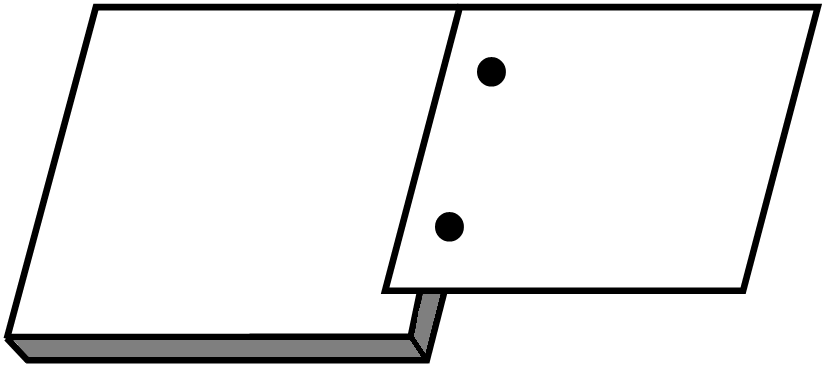
Two long metallic strips are joined together by two rivets each of radius $0.1cm$ (see Fig.).

 Each rivet can withstand a maximum shearing stress of $3.0 \times 10^8Nm^{-2}$. Calculate the maximum tangential force a strip can exert.
Define molar specific heat capacities at constant volume and pressure. Considering thermodynamical process in a cylinder with parameters P, V and T, derive the Mayer's relation.
Figure shows two blocks A and B, each having a mass of 320g connected by a light string passing over a smooth light pulley. The horizontal surface on which the block A can slide is smooth. The block A is attached to a spring of spring constant 40N/m whose other end is fixed to a support 40cm above the horizontal surface. Initially, the spring is vertical and unstretched when the system is released to move. Find the velocity of the block A at the instant it breaks off the surface below it. Take $g = 10m/s^2$.
A bulb with rating 250V, 100W is connected to a power supply of 220V situated 10m away using a copper wire of area of cross-section $5mm^2$. How much power will be consumed by the connecting wires? Resistivity of copper $1.7\times10^{-8}\Omega-\text{m}$.
Is it possible that in a Coolidge tube characteristic $\text{L}_\alpha$ X-rays are emitted but not $\text{K}_\alpha$ X-rays?
A uniform rod of length L rests against a smooth roller as shown in figure. Find the friction coefficient between the ground and the lower end if the minimum angle that the rod can make with the horizontal is $\theta.$
A brass boiler has a base area of $0.15 \mathrm{~m}^2$ and thickness 1.0 cm . It boils water at the rate of $6.0 \mathrm{~kg} / \mathrm{min}$ when placed on a gas stove. Estimate the temperature of the part of the flame in contact with the boiler. Thermal conductivity of brass $=109 \mathrm{~J} \mathrm{~s}^{-1} \mathrm{~m}^{-1} \mathrm{~K}^{-1} ;$ Heat of vaporisation of water $=2256 \times 103 \mathrm{~J} \mathrm{~kg}^{-1}$.
At what temperature is the root mean square speed of an atom in an argon gas cylinder equal to the rms speed of a helium gas atom at $-20°C$? (atomic mass of $Ar = 39.9u$, of $He = 4.0u$).
Earthquakes generate sound waves inside the earth. Unlike a gas, the earth can experience both transverse $( S )$ and Iongitudinal ( $P$ ) sound waves. Typically the speed of $S$ wave is about $4.0 km s ^{-1}$, and that of $P$ wave is $8.0 km s ^{-1}$. A seismograph records P and S waves from an earthquake. The first P wave arrives 4 min before the first S wave. Assuming the waves travel in straight line, at what distance does the earthquake occur?
Test if the following equations are dimensionally correct:
  1. $\text{h}=\frac{2\text{S}\cos\theta}{\rho\text{rg}}$
  2. $\text{u}=\sqrt{\frac{\text{P}}{\rho}}$
  3. $\text{V}=\frac{\pi\text{Pr}^4\text{t}}{8\eta l}$
  4. $\text{v}=\frac{1}{2\pi}\sqrt{\frac{\text{mg}l}{\text{I}}}$
where h = height, S = surface tension, $\rho$ = density, P = pressure, V = volume, $\eta$ = coefficient of viscosity, v = frequency and I = moment of inertia.