Question
Establish the relation between electric field and potential gradient.

Answer

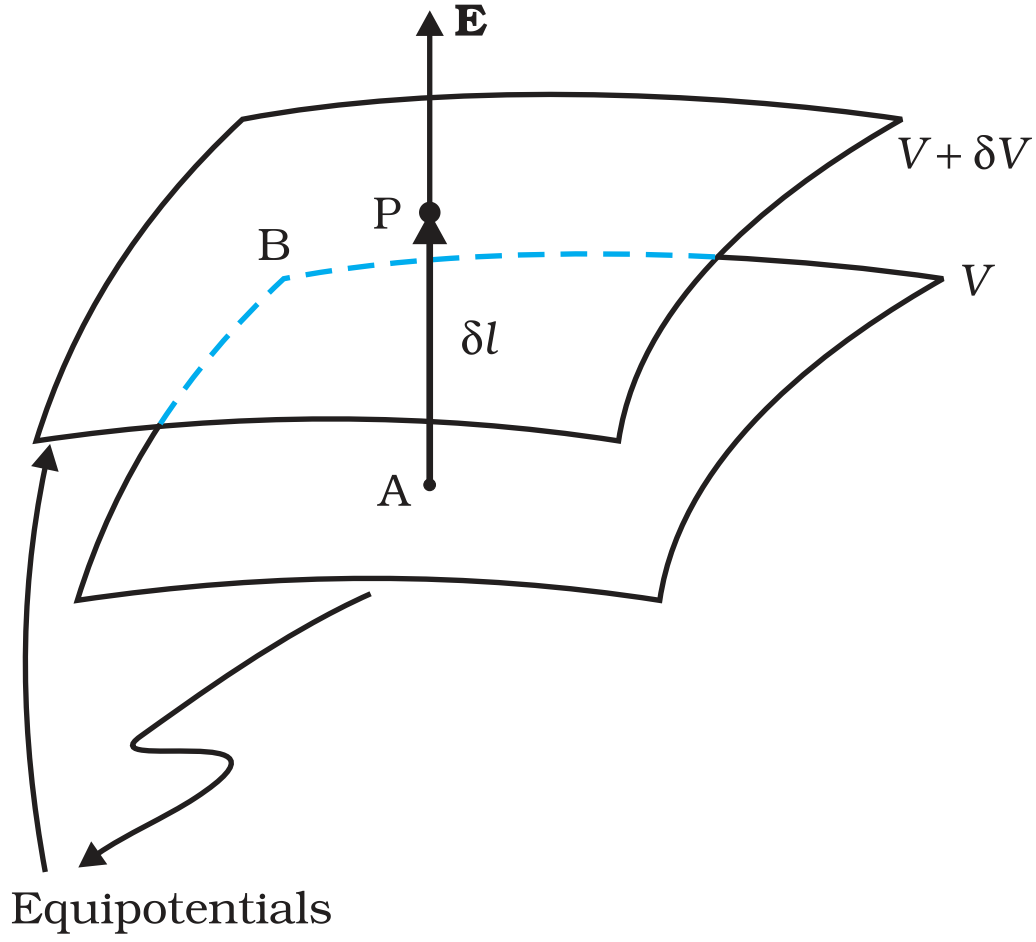
Let us consider two closely spaced equipotential surfaces A and B as shown in figure.

Let the potential of A be VA = V and potential of B be VB = V - dV where dV is decrease in potential in the direction of electric field $\vec{\text{E}}$ normal to A and B.

Let dr be the perpendicular distance between the two equipotential surfaces. When a unit positive charge is moved along this perpendicular from the surface B to surface A against the electric field, the work done in this process is:

$\text{W}_{\text{BA}}=-\vec{\text{E}}(\text{dr})$

This work done equals the potentail difference VA - VB,

$\therefore\text{W}_{\text{BA}}=\text{V}_{\text{A}}-\text{V}_{\text{B}}=\text{V}-(\text{V}-\text{dV})=\text{dV}$

$\therefore-\vec{\text{E}}=\text{dV}$

Or, $\vec{\text{E}}=-\frac{\text{dV}}{\text{dr}}$ = negative of potential gradlant.

Need a full question paper?

Generate a complete, print-ready paper with questions like this in minutes — across 16+ boards, with answer keys.
Start Generating Free

Similar questions

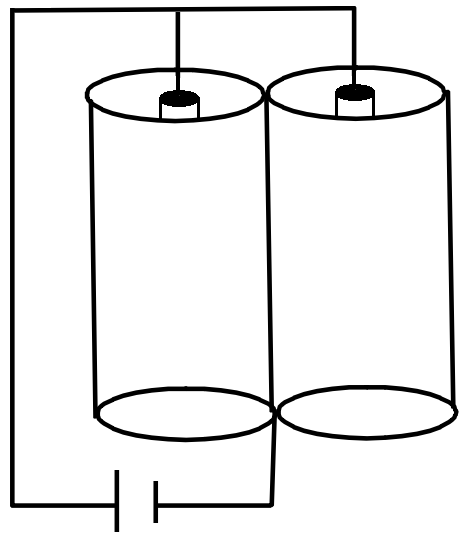
The outer cylinders of two cylindrical capacitors of capacitance $2.2\mu\text{F}$ each, are kept in contact and the inner cylinders are connected through a wire. A battery of emf 10V is connected as shown in figure. Find the total charge supplied by the battery to the inner cylinders.

A particle is moving at a constant speed V from a large distance towards a concave mirror of radius R along its principal axis. Find the speed of the image formed by the mirror as a function of the distance x of the particle from the mirror.
The capacitance between the adjacent plates shown in figure is 50nF. A charge of $1.0\mu\text{C}$ is placed on the middle plate:

  1. What will be the charge on the outer surface of the upper plate?
  2. Find the potential difference developed between the upper and the middle plates.
Compare and contrast the nature of $\alpha-, \beta-$ and $\gamma-$radiations.
An air bubble of radius 2.0mm is formed at the bottom of a 3.3m deep river. Calculate the radius of the bubble as it comes to the surface. Atmospheric pressure = 1.0 × 10⁵ Pa and density of water = 1000kg/m-3.
  1. Derive the expression for the torque acting on the rectangular current carrying coil of a galvanometer. Why is the magnetic field made radial?
  2. An $\alpha-$particle is accelerated through a potential difference of 10kV and moves along x-axis. It enters in a region of uniform magnetic field B = 2 × 10⁻³T acting along y-axis. Find the radius of its path. (Take mass of $\alpha-$particle = 6.4 × 10–27kg).
A wave travelling on a string, at a speed of 10m/s causes each particle of the string to oscillate with a time period of 20ms.
  1. What is the wavelength of the wave?
  2. If the displacement of a particle is 1.5mm at a certain instant, what will be the displacement of a particle 10cm away from it at the same instant?
Calculate and compare the energy released by a) fusion of 1.0 kg of hydrogen deep within Sun and b) the fission of 1.0 kg of $^{235}\text{U}$ in a fission reactor.
$\text{ }^{212}_{33}\text{Bi}$ can disintegrate either by emitting an $\alpha$-particle of by emitting a $\beta^-$-particle.
  1. Write the two equations showing the products of the decays.
  2. The probabilities of disintegration $\alpha$ and $\beta$ -decays are in the ratio $\frac{7}{13}.$ The overall half-life of 212Bi is one hour. If 1g of pure 212Bi is taken at 12.00 noon, what will be the composition of this sample at 1P.m. the same day?
A permanent magnet in the shape of a thin cylinder of length 10 cm has M = 106A/m. Calculate the magnetisation current IM.