Question
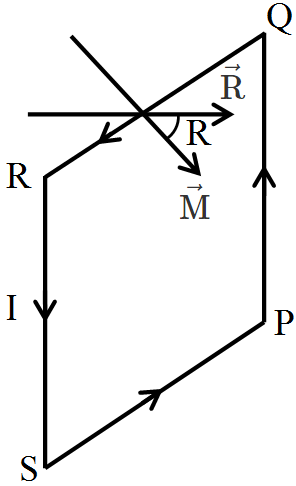
  1. Derive the expression for the torque acting on the rectangular current carrying coil of a galvanometer. Why is the magnetic field made radial?
  2. An $\alpha-$particle is accelerated through a potential difference of 10kV and moves along x-axis. It enters in a region of uniform magnetic field B = 2 × 10⁻³T acting along y-axis. Find the radius of its path. (Take mass of $\alpha-$particle = 6.4 × 10–27kg).

Answer

  1.  

$\text{PQ}=\text{RS}=1$

$\text{PS}=\text{QR}=\text{b}$

Area $\text{A}=\text{lb}$

$\vec{\text{M}}\times\vec{\text{IA}}$

$\overrightarrow{\text{F}_{\text{PQ}}}=\text{IlB}\otimes$

$\overrightarrow{\text{F}_{\text{RS}}}=\text{IlB}\ominus$

$\overrightarrow{\text{F}_{\text{QR}}}=\text{IbB}\sin(90^\circ-\theta)=\text{IbB}\cos\theta\text{ up}$

$\overrightarrow{\text{F}_{\text{SP}}}=\text{IbB}\sin(90^\circ-\theta)=\text{IbB}\cos\theta\text{ down}$

Only $\overrightarrow{\text{F}_{\text{PB}}}\ \& \ \overrightarrow{\text{F}_{\text{RS}}}$ form a couple to apply torque on loop,
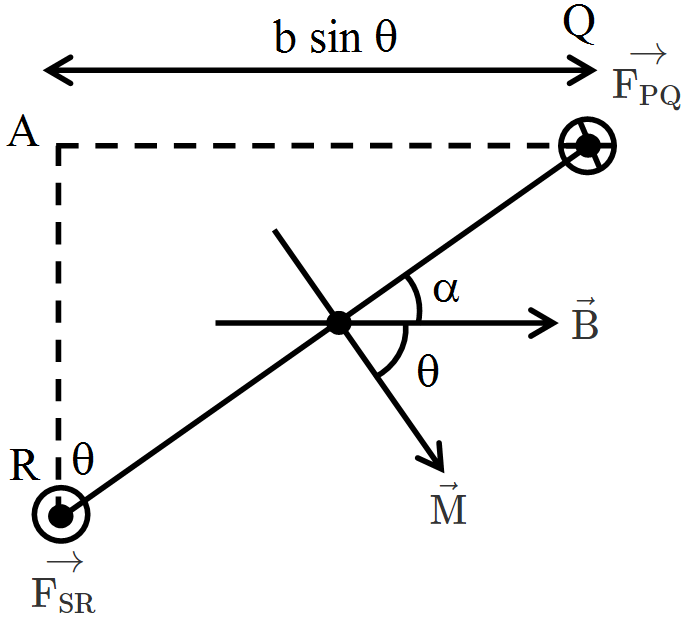
$\tau=\text{MB}\sin\theta$

Magnetic field is taken radial in Galvanometer coil in order to create $\theta=90^\circ$ at every orientation of coil in the magnetic field so that current varies linearly with deflection.

  1. $\text{qV}=\frac{1}{2}\text{mv}^2$

$\Rightarrow\text{v}=\sqrt{\frac{2\text{qV}}{\text{m}}}$

$\because\vec{\text{v}}=\text{vi}\perp\vec{\text{B}}(=\text{Bj})$

$\therefore$ Particle deflects along circular path of radius $\text{r}=\frac{\text{mv}}{\text{qB}}=\frac{\text{m}}{\text{qB}}\sqrt{\frac{2\text{qv}}{\text{m}}}=\frac{1}{\text{B}}\sqrt{\frac{2\text{mv}}{\text{q}}}$

$\text{r}=\frac{1}{2\times10^{-3}}\sqrt{\frac{2\times6.4\times10^{-27}\times10^4}{2\times1.6\times10^{-19}}}$

$=\frac{1}{2\times10^{-3}}\times2\times10^{-2}$

$=10^1\text{m}=10\text{m}.$
Need a full question paper?

Generate a complete, print-ready paper with questions like this in minutes — across 16+ boards, with answer keys.

Start Generating Free

Similar questions

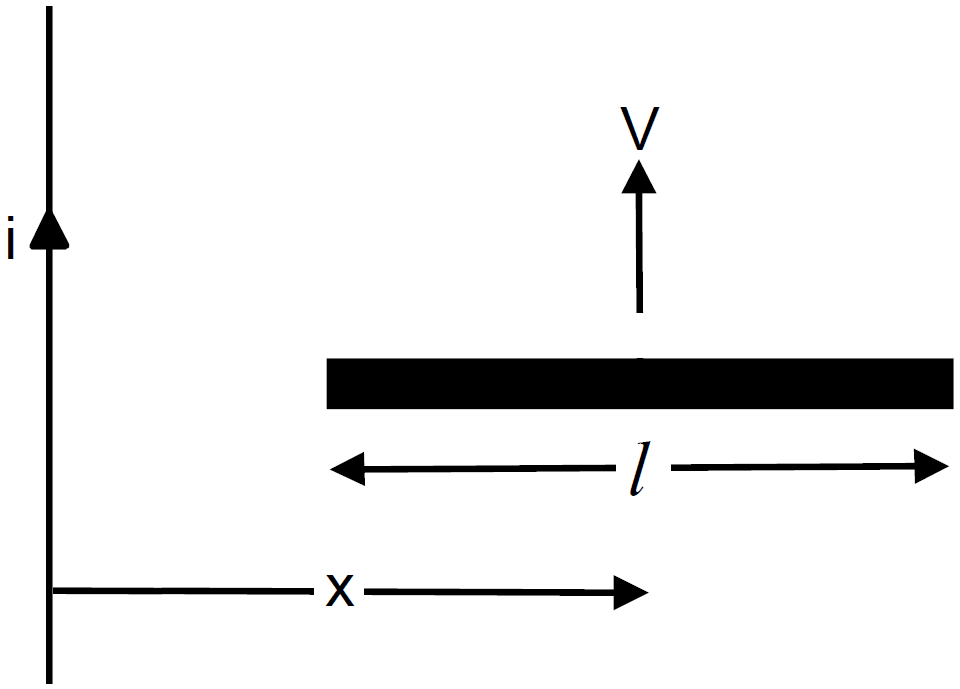
Figure shows a straight, long wire carrying a current i and a rod of length l coplanar with the wire and perpendicular to it. The rod moves with a constant velocity v in a direction parallel to the wire. The distance of the wire from the centre of the rod is x. Find motional emf induced in the rod.

Figure shows two parallel plate capacitors with fixed plates and connected to two batteries. The separation between the plates is the same for the two capacitors. The plates are rectangular in shape with width b and lengths l1 and l2 The left half of the dielectric slab has a dielectric constant K1 and the right half K2. Neglecting any friction, find the ratio of the emf of the left. battery to that of the right battery for which the dielectric slab may remain in equilibrium.

Define magnetic permeability and magnetic susceptibility. Prove that $\mu_{r} = (1+\chi)$.
Monochromatic light of wavelength 632.8 nm is produced by a helium-neon laser. The power emitted is 9.42 mW.
  1. Find the energy and momentum of each photon in the light beam,
  2. How many photons per second, on the average, arrive at a target irradiated by this beam? (Assume the beam to have uniform cross-section which is less than the target area), and
  3. How fast does a hydrogen atom have to travel in order to have the same momentum as that of the photon?
What do you mean by modulation ? Define modulation index. For an amplitude modulated wave the maximum and minimum amplitude is ' $a$ ' and ' $b$ '. Calculate modulation index for it.
A proton goes undeflected in a crossed electric and magnetic field (the fields are perpendicular to each other) at a speed of 2.0 × 10⁵ms-1. The velocity is perpendicular to both the fields. When the electric field is switched off, the proton moves along a circle of radius 4.0cm. Find the magnitudes of the electric and magnetic fields. Take the mass of the proton = 1.6 × 10⁻²⁷kg
Can $\text{L}_\alpha$ X-ray of one material have shorter wavelength than $\text{K}_\alpha$ X-ray of another?
Explain ac voltage applied on a capacitor.Explain charging and discharging of a capacitor.
What will be the total flux through the faces of the cube (Fig.) with side of length a if a charge q is placed at:

  1. A: a corner of the cube.
  2. B: mid-point of an edge of the cube.
  3. C: centre of a face of the cube.
  4. D: mid-point of B and C.

Two identical pith balls are charged by rubbing against each other. They are suspended from a horizontal rod through two strings of length 20cm each, the separation between the suspension points being 5cm. In equilibrium, the separation between the balls is 3cm. Find the mass of each ball and the tension in the strings. The charge on each ball has a magnitude 2.0 × 10-8C.