MCQ
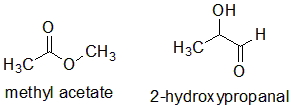
Esters are fiunctional isomers of:
  • A
    Hydroxy aldehyde
  • B
    Ketone
  • C
    Diketone
  • D
    Diols

Answer

Esters are functional isomers of hydroxy aldehydes.

Need a full question paper?

Generate a complete, print-ready paper with questions like this in minutes — across 16+ boards, with answer keys.

Start Generating Free

Similar questions

Consider the following complex $[Co(NH_3)_5CO_3]ClO_4$. The coordination number, oxidation number, number of $d-$ electrons and number of unpaired $d-$ electrons on the metal are respectively
The standard heats of formation in $kcal$ $mo{l^{ - 1}}$ of $N{O_2}(g)$ and ${N_2}{O_4}(g)$ are $8.0$  and $2.0 $ respectively. The heat of dimerization of $N{O_2}$ in $kcal$ is $2N{O_2}(g) = {N_2}{O_4}(g)$
In a gaseous reaction 

${A_{2\left( g \right)}} \longrightarrow {B_{\left( g \right)}} + \frac{1}{2}\,{C_{\left( g \right)}}$ the increase in pressure from $100\, mm$ to $120\, mm$ is noticed in $5\,\min$. The rate of dissappearence of $A_2$ in $mm\, min^{-1}$ is

The correct order of the decreasing ionic radii among the following isoelectronic species is
Holme signal can be given by the using
A $1\, M$ solution of glucose reaches dissociation equilibrium according to equation given below $6HCHO$ $\rightleftharpoons$ ${C_6}{H_{12}}{O_6}$. What is the concentration of $HCHO$ at equilibrium if equilibrium constant is $6 \times {10^{22}}$
Which among the following is not true for a cyclic process:
$\begin{array}{*{20}{c}}
  {O\,\,\,\,\,\,\,\,\,\,\,\,\,\,} \\ 
  {||\,\,\,\,\,\,\,\,\,\,\,\,\,\,\,} \\ 
  {C{H_3} - C - O - {C_2}{H_5}} 
\end{array}$ $\xrightarrow{{{H_2}N - N{H_2}}}X$;  $\begin{array}{*{20}{c}}
  {\,\,\,\,\,\,\,O\,\,\,\,\,\,\,\,\,\,} \\ 
  {\,\,\,\,\,\,\,\,||\,\,\,\,\,\,\,\,\,\,\,} \\ 
  {C{H_3} - C - {C_2}{H_5}} 
\end{array}$ $\xrightarrow{{{H_2}N - N{H_2}}}Y$

$X$ and $Y$ are

A hydrogen electrode is immersed in a solution with $pH = 0\,(HCl)$. By how much will the potential (reduction) change if an equivalent amount of $NaOH$ is added to the solution.

(Take $pH_2 = 1\,atm$ ), $T = 298\,K$.

Which one of the following reaction is not possible