Question
Estimate the total number of air molecules (inclusive of oxygen, nitrogen, water vapour and other constituents) in a room of capacity $25.0m^3$ at a temperature of $27°C$ and $1$ atm pressure.

Answer

Volume of the room, $\mathrm{V}=25.0 \mathrm{~m}^3$ Temperature of the room, $\mathrm{T}=27^{\circ} \mathrm{C}=300 \mathrm{~K}$ Pressure in the room, $\mathrm{P}=1 \mathrm{~atm}=1 \times$
$1.013 \times 10^5 \mathrm{~Pa}$ The ideal gas equation relating pressure ( P ), Volume ( V ), and absolute temperature ( T ) can be written as, $\mathrm{PV}=\mathrm{k}_{\mathrm{B}} \mathrm{NT}$ Where, $\mathrm{K}_{\mathrm{B}}$ is Boltzmann constant $=1.38 \times 10^{-23} \mathrm{~m}^2 \mathrm{~kg} \mathrm{~s}^{-2} \mathrm{k}^{-1} \mathrm{~N}$ is the number of air molecules in the room $\therefore \mathrm{N}=\frac{\mathrm{PV}}{\mathrm{K}_{\mathrm{B}} \mathrm{T}}=\frac{1.013 \times 10^5 \times 25}{\left(1.38 \times 10^{23} \times 300\right)}=6.11 \times 10^{26}$ molecules Therefore, the total number of air molecules in the given room is $6.11 \times 10^{26}$

Need a full question paper?

Generate a complete, print-ready paper with questions like this in minutes — across 16+ boards, with answer keys.
Start Generating Free

Similar questions

A body oscillates with SHM according to the equation $($ in $SI$ units $)$, $x=5 \cos [2 \pi t+\pi / 4] \text {. }$
At $t=1.5 s$, calculate the $(a)$ displacement, $(b)$ speed and $(c)$ acceleration of the body.
What is the analogue of mass in rotational motion? Derive the expression for the kinetic energy of a rotating body.
A solid floats with $\frac{1}{4}\text{th}$ of its volume above the surface of water. Calculate the density of the solid.
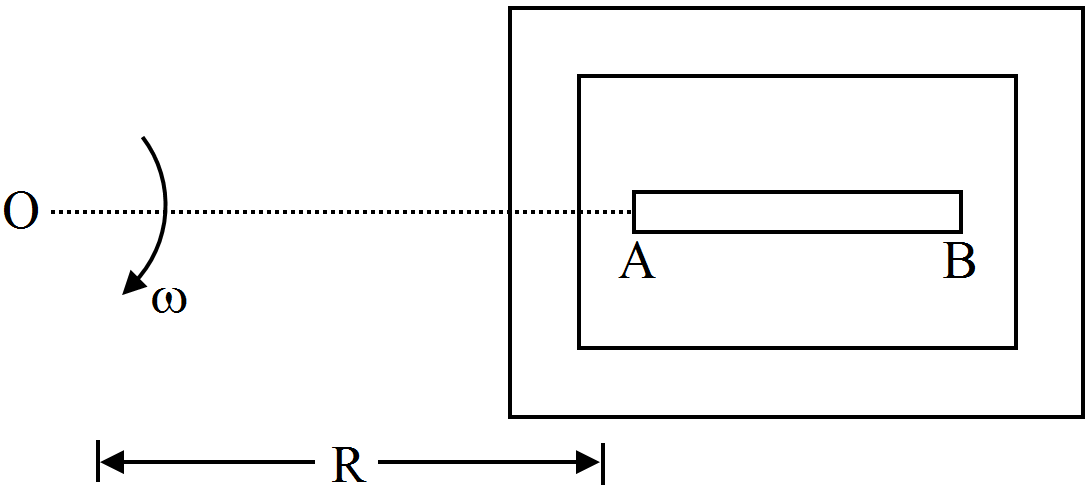
A table with smooth horizontal surface is fixed in a cabin that rotates with angular speed o in a circular path of radius R. A smooth groove AB of length L(< < R) is made on the surface of table as shown in figure. A small particle is kept at the point A in the groove and is released to move, find the time taken by the particle to reach the point B.
If the Earth were to suddenly contract to $\frac{1}{\text{n}}^{\text{th}}$ of its present radius, without any change in its mass, then what will be the effect on the duration of the day?
Estimate the average mass density of a sodium atom assuming its size to be about $2.5 \mathring{\text{A}}.$ (Use the known values of Avogadro’s number and the atomic mass of sodium). Compare it with the mass density of sodium in its crystalline phase: $970kg m^{–3}. $Are the two densities of the same order of magnitude? If so, why?
A steel wire is suspended vertically from a rigid support. When loaded with weight in air, it extends by $x_1$. When the weight is completely inside the water, the extension becomes $x_2​​​​​​​$. Find the relative density of the material of the weight.
Iceberg floats in water with part of it submerged. What is the fraction of the volume of iceberg submerged if the density of ice is $\rho_\text{i}=0.917\text{g cm}^{-3}?$
State the laws of limiting friction. Hence define coefficient of friction.
If the horizontal range of projectile be a and the maximum height attained by it is b, then prove that the velocity of projectile is $\Big[2\text{g}\Big(\text{b}+\frac{\text{a}^2}{16\text{b}}\Big)\Big]^\frac{1}{2}.$