Question
State the laws of limiting friction. Hence define coefficient of friction.

Answer

The laws of limiting friction are as follows:
  1. The value of limiting friction depends on the nature of the two surfaces in contact and on the state of their smoothness.
  2. The force of friction acts tangential to the surfaces in contact in a direction opposite to the direction of relative motion.
  3. The value of limiting friction is directly proportional to the normal reaction between the two given surfaces.
  4. For any two given surfaces and for a given value of normal reaction the force of limiting friction is independent of the shape and surface area of surfaces in contact. Coefficient of limiting friction for two given surfaces in contact is defined as the ratio of the force of limiting friction $f_1$ between them and the force of normal reaction N.
$\therefore\mu_\text{l}=\frac{\int_\text{l}}{\text{N}}$.

Need a full question paper?

Generate a complete, print-ready paper with questions like this in minutes — across 16+ boards, with answer keys.

Start Generating Free

Similar questions

A particular particle created in a nuclear reactor leaves a $1\ cm$ track before decaying. Assuming that the particle moved at $0.995c$, calculate the life of the particle:
  1. In the lab frame and.
  2. In the frame of the particle.
Show that terminal velocity V of a spherical object of radius r, density $\rho$ falling vertically through a viscous fluid of density $\sigma$ and coefficient of viscosity n is given by:$\text{V}=\frac29\frac{(\rho-\sigma)\text{r}^2\text{g}}{\eta}$
A person sitting on the top of a tall building is dropping balls at regular intervals of one second. Find the positions of the $3^{rd}, 4^{th}$ and $5^{th}$ ball when the $6^{th}$ ball is being dropped.
A car tyre contains air at a pressure of $4$ atm and its temperature is $27°C$. The tyre suddenly bursts. Calculate the resulting temperature. $(\gamma=1.4)$
 A rod of length $L$ is placed along the $X-$axis between $x = 0$ and $x = L$. The linear density $($mass$/$ length$) \rho$ of the rod varies with the distance x from the origin as $\rho=\text{a + bx.}$
  1. Find the $SI$ units of $a$ and $b.$
  2. Find the mass of the rod in terms of $a, b$ and $L.$
What is the radius of curvature of the parabola traced out by the projectile in the previous problem at a point where the particle velocity makes an angle $\frac{\theta}{2}$ with the horizontal?
What happens to the moment of force about a point, if the line of action of the force moves towards the point?
A straight horizontal wire of mass 10mg and length 1.0m carries a current of 2.0A. What minimum magnetic field B should be applied in the region, so that the magnetic force on the wire may balance its weight?
Two moles of gas A at 27°C are mixed with 3 moles of gas B at 37°C. If both are monoatomic ideal gases, what will be the temperature of the mixture?
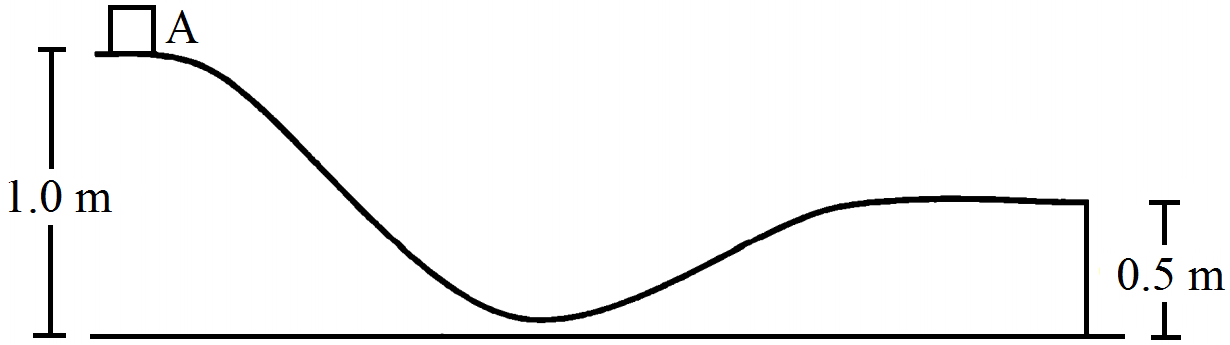
Figure shows a particle sliding on a frictionless track which terminates in a straight horizontal section. If the particle starts slipping from the point A, how far away from the track will the particle hit the ground?