MCQ
Ethyl acetate reacts with $C{H_3}MgBr$ to form
  • A
    Secondary alcohol
  • Tertiary alcohol
  • C
    Primary alcohol and acid
  • D
    Acid

Answer

Correct option: B.
Tertiary alcohol
b
$\underset{Ethyl\,\,acetate}{\mathop{\begin{matrix}
   \,O  \\
   \,||  \\
   C{{H}_{3}}C-C-{{C}_{2}}{{H}_{5}}  \\
\end{matrix}}}$ $+\,C{{H}_{3}}MgBr\,\to $ $\begin{array}{*{20}{c}}
  {\begin{array}{*{20}{c}}
  {\,\,\,\,\,\,\,\,\,\,O - MgBr} \\ 
  {|\,\,\,\,\,\,\,\,\,\,\,\,\,\,} 
\end{array}} \\ 
  {C{H_3} - C - O - {C_2}{H_5}} \\ 
  {|\,\,\,\,\,\,\,\,\,\,\,\,\,\,} \\ 
  {C{H_3}\,\,\,\,\,\,\,} 
\end{array}$  $\xrightarrow[{ - \,Mg\, < \,\begin{array}{*{20}{c}}
  {Br} \\ 
  {OH} 
\end{array}}]{{ + \,{H_2}O}}$ $\begin{array}{*{20}{c}}
  {\begin{array}{*{20}{c}}
  {\,\,\,\,\,\,\,OH} \\ 
  | 
\end{array}} \\ 
  {C{H_3} - C - OH} \\ 
  | \\ 
  {\,\,\,\,\,\,\,\,\,C{H_3}} 
\end{array}$ $\xrightarrow{{ - \,{H_2}O}}$ $\begin{array}{*{20}{c}}
  O \\ 
  {||} \\ 
  {C{H_3} - C - C{H_3}} 
\end{array}$ $\xrightarrow[{C{H_3}MgBr}]{{Excess\,\,of}}$ $\begin{array}{*{20}{c}}
  {\begin{array}{*{20}{c}}
  {C{H_3}\,\,} \\ 
  {|\,\,\,\,\,\,\,\,} 
\end{array}} \\ 
  {C{H_3} - C - OMgBr} \\ 
  {\,\,|\,\,\,\,\,\,\,\,\,\,} \\ 
  {C{H_3}\,} 
\end{array}$ $\xrightarrow{{{H_2}O}}$ $\mathop {\begin{array}{*{20}{c}}
  {\begin{array}{*{20}{c}}
  {\,\,\,\,\,C{H_3}} \\ 
  | 
\end{array}} \\ 
  {C{H_3} - C - OH} \\ 
  {\,\,|} \\ 
  {\,\,\,\,\,\,\,\,\,\,C{H_{3.}}} 
\end{array}}\limits_{t\, - \,Butanol} $

Need a full question paper?

Generate a complete, print-ready paper with questions like this in minutes — across 16+ boards, with answer keys.

Start Generating Free

Similar questions

Match List $I$ with List $II$

LIST $-I$

(Cell)

LIST $-II$

(Use/Property/Reaction)

$A$ Leclanche

cell

$I$ Converts energy of combustion into electrical energy
$B$ Ni-Cd cell $II$ Does not involve any ion in solution and is used in hearing aids
$C$ Fuel cell $III$ Rechargeable

$D$ Mercury cell

$IV$ Reaction at anode

$\mathrm{Zn} \rightarrow \mathrm{Zn}^{2+}+2 \mathrm{e}^{-}$

Choose the correct answer from the options given below:
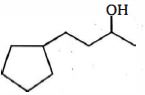
Which combination $(s)$ of alkyl bromide and epoxide can be used to prepare the  following product by addition of the Grignard reagent derived from the alkyl  bromide to the epoxide? 
Product $(A)$ of the reaction is
Carbohydrates are stored in human body as
Azo dye is prepared by the coupling of phenol and :
The $IUPAC$ name of the following structure is

$\begin{array}{*{20}{c}}
  {C{H_3}\,\,\,\,\,\,\,O\,\,\,\,\,\,\,\,\,\,\,\,\,\,\,\,\,\,\,\,\,\,\,\,\,\,\,} \\ 
  {|\,\,\,\,\,\,\,\,\,\,\,\,\,\,\,||\,\,\,\,\,\,\,\,\,\,\,\,\,\,\,\,\,\,\,\,\,\,\,\,\,\,\,} \\ 
  {C{H_3} - CH - C - C{H_2} - C{H_2}OH} 
\end{array}$

A hydrogen electrode is immersed in a solution with $pH = 0\,(HCl)$. By how much will the potential (reduction) change if an equivalent amount of $NaOH$ is added to the solution.

(Take $pH_2 = 1\,atm$ ), $T = 298\,K$.

A variable, opposite external potential $(E_{ext})$ is applied to the cell $Zn\,|\,Z{n^{2 + }}\,(1\,M)\,\,||\,\,C{u^{2 + }}\,(1\,M)\,|\,Cu,$ of potential $1.1\,V.$ When $E_{ext} < 1.1\,V$ and $E_{ext} > 1.1\,V,$ respectively electrons flow from
Which of the following principles is not true for zymogen activation?
Which of the following acid on heating gives geometrical isomers as a product ?