MCQ
Ethylene difluoride on hydrolysis gives
  • Glycol
  • B
    Fluoroethanol
  • C
    Difluoroethanol
  • D
    Freon

Answer

Correct option: A.
Glycol
a
$\begin{array}{*{20}{c}}
  {C{H_2} - F} \\ 
  {|\,\,\,\,\,\,\,\,\,\,\,\,\,\,\,\,\,\,} \\ 
  {C{H_2} - F} 
\end{array}$ $\xrightarrow{{Hydrolysis}}$ $\begin{array}{*{20}{c}}
  {C{H_2} - OH} \\ 
  {|\,\,\,\,\,\,\,\,\,\,\,\,\,\,\,\,\,\,\,\,\,\,\,} \\ 
  {C{H_2} - OH} 
\end{array}$

Need a full question paper?

Generate a complete, print-ready paper with questions like this in minutes — across 16+ boards, with answer keys.

Start Generating Free

Similar questions

Which of the following is not hydrolysed ?
The $EAN$ of platinum in potassium hexachloroplatinate $(IV)$ is :
Methyl amine on reaction with chlorine in the presence of $NaOH$ gives :
$\begin{matrix}
   OH\,\,  \\
   |\,\,\,\,\,\,\,  \\
   C{{H}_{3}}-CH-C{{H}_{2}}-  \\
\end{matrix}\begin{matrix}
   O\,\,\,\,\,  \\
   ||\,\,\,\,\,\,  \\
   C{{H}_{2}}-C-C{{H}_{3}}\to   \\
\end{matrix}\begin{matrix}
   OH\,\,\,\,\,\,\,\,\,\,\,\,\,\,\,\,\,\,\,\,\,\,\,  \\
   |\,\,\,\,\,\,\,\,\,\,\,\,\,\,\,\,\,\,\,\,\,\,\,\,\,\,\,\,  \\
   C{{H}_{3}}-CH-{{(C{{H}_{2}})}_{3}}-C{{H}_{3}}  \\
\end{matrix}$

Above conversion can be achieved by

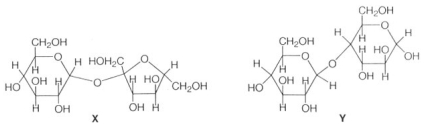
The correct statement$(s)$ about the following sugars ${X}$ and ${Y}$ is$(are)$

$(A)$ ${X}$ is a reducing sugar and ${Y}$ is a non-reducing sugar

$(B)$ ${X}$ is a non-reducing sugar and ${Y}$ is a reducing sugar

$(C)$ The glucosidic linkages in ${X}$ and ${Y}$ are $\alpha$ and $\beta$, respectively

$(D)$ The glucosidic linkages in ${X}$ and ${Y}$ are $\beta$ and $\alpha$, respectively
The Bouveault-Blanc reduction involves
Metals are usually used as catalysts belong to:
The half life period of a gaseous reactant undergoing thermal decomposition was measured for various initial pressures $'p_0'$ as follows :

 $\begin{array}{|l|l|l|} \hline P_0\,\,(mmHg) & 250 & 300 \\ \hline t_{1/2}\,\,(minutes) & 135 & 112.5 \\ \hline \end{array}$

The order of reaction is -

Activation energy of a chemical reaction can be determined by ______________.
The transition element that has lowest enthalpy of atomisation is