MCQ
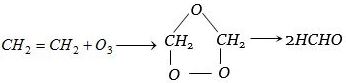
Ethylene reacts with ozone gas to form the compound
  • $HCHO$
  • B
    ${C_2}{H_5}OH$
  • C

  • D
    $C{H_3}CHO$

Answer

Correct option: A.
$HCHO$
a
(a)

Need a full question paper?

Generate a complete, print-ready paper with questions like this in minutes — across 16+ boards, with answer keys.

Start Generating Free

Similar questions

Electrode potentials of five elements $A,\,B,\,C,\,D$ and $E$ are respectively $-1.36 , -0.32, 0, -1.26$  and $ -0.42$. The reactivity order of these elements are in the order of
Assertion $A:$ Hydrolysis of an alkyl chloride is a slow reaction but in the presence of $NaI$, the rate of the hydrolysis increases.

Reason $R : I^{-1}$ is a good nucleophile as well as a good leaving group.

In the light of the above statements, choose the correct answer from the options given below.

The half-life of $2 $ sample are $0.1 $ and $ 0.4 $ seconds. Their respective concentration are $200 $ and  $ 50 $ respectively. What is the order of the reaction
Ferrous sulphate on heating gives
Thermal decomposition of a $Mn$ compound $(X)$ at $513\, K$ results in compound $Y$, $MnO_2$ and a gaseous product. $MnO_2$ reacts with $NaCl$ and concentrated $H_2SO_4$ to give a pungent gas $Z. X, Y$ and $Z$, respectively
Acetylenic hydrogens are acidic because
Consider the following statements pertaining to fuel cells :-
$(a)$ Hydrogen oxygen fuel cell make use of concentrated $KOH$ solution as  electrolyte and porous graphite impregnated with platinum as electrodes
$(b)$ The efficiency of fuel cell is less then unity due to polarisation at electrodes and  the resistance offered by the electrode and the electrolyte
$(c)$ The electrical work, assuming the cell to be working reversibly may be  represented as $-\Delta G = W_{electrical} = -\Delta H + T \Delta S$
Which of the above statements are correct
In order to complete the reaction $1 - {\text{Pentyne}}\xrightarrow{{\text{a}}}4 - {\text{Octyne}}\xrightarrow{{\text{b}}}cis{\text{ 4 Octene}}$ $a$ and $b$ will be

$(1)$ $NaN{H_2};\mathop {C{H_3}}\limits^{{\text{a}}\,\,\,\,\,\,\,} C{H_2}Br$:${H_2},{\text{ }}\mathop {{\text{(one mole)}}}\limits^{\text{b}} {\text{ }}Pd{\text{ or }}Ni$

$(2)$ $NaN{H_2};C{H_3}C{H_2}C{H_2}Br$:${H_2}{\text{ (two moles) }}Pd{\text{ or }}Ni$

$(3)$ $NaN{H_2};C{H_3}C{H_2}C{H_2}Br$:${H_2},{\text{ (one mole) }}Pd{\text{ or }}Ni$

$(4)$ $NaN{H_2};C{H_3}C{H_2}C{H_2}Br$:$B{H_3},{H_2}{O_2},O{H^ - }$

The ratio of $pH$ of $0.1\, M\, H_2SO_4$ and that of $0.1\, N\, H_2SO_4$ is
Which describes the best stereochemical aspects of the following reaction ?