MCQ
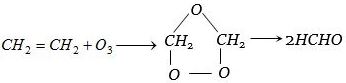
Ethylene reacts with ozone gas to form the compound
- ✓$HCHO$
- B${C_2}{H_5}OH$
- C

- D$C{H_3}CHO$
Generate a complete, print-ready paper with questions like this in minutes — across 16+ boards, with answer keys.
Above reaction is an example of
| List $I$(Quantum Number) | List $II$(Information provided) |
| $A$. mı | $I$. Shape of orbital |
| $B$. $m_s$ | $II$. Size of orbital |
| $C$. $1$ | $III$. Orientation of orbital |
| $D$. $\mathrm{n}$ | $IV$. Orientation of spin of electron |
Choose the correct answer from the options given below :
|
List$-I$ (Shape) |
List$-II$ (Molecules) |
| $(A)$ $T-$shaped | $(I)$ $XeF _{4}$ |
| $(B)$ Trigonal planar | $(II)$ $SF _{4}$ |
|
$(C)$ Square planar |
$(III)$ $ClF _{3}$ |
| $(D)$ See-saw | $(IV)$ $BF _{3}$ |
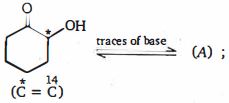
$\mathrm{C}\mathrm{H}_{3} -\mathrm{C} \equiv \mathrm{CH} \xrightarrow[873\;K]{\text { red hot iron tube}} \mathrm{A}$
the number of sigma$(\sigma)$ bonds present in the product $A$ is