Question
Evaluate: $-\frac{5}{7}-\left(-\frac{3}{8}\right)$

Answer


$\begin{aligned} & -\frac{5}{7}-\left(-\frac{3}{8}\right) \\ & -\frac{5}{7}+\frac{3}{8}\end{aligned}$
27,8
27,4
27,2
77,1
1

L.C.M. of 7 and $8=2 \times 2 \times 2 \times 7=56$
$ \Rightarrow \frac{-5 \times 8}{7 \times 8}+\frac{3 \times 7}{8 \times 7} $
$(\because$ L.C.M. of 7 and $8=56)$
$ =\frac{-40+21}{56}=\frac{-19}{56} $

Need a full question paper?

Generate a complete, print-ready paper with questions like this in minutes — across 16+ boards, with answer keys.
Start Generating Free

Similar questions

A sum amounts to Rs. 2,652 in 6 years at 5% p.a. simple interest. Find:
(i) the sum
(ii) the time in which the same sum will double itself at the same rate of interest.
40 pens are bought at 4 for Rs. 50 and all of them are sold at 5 for Rs. 80 Find
(i) C.P. of one pen.
(ii) S/P. of one pen.
(iii) Profit made by selling one pen.
(iv) Profit percent made by selling one pen.
(v) C.P. of 40 pens
(vi) S.P. of 40 pens.
(vii) Profit made by selling 40 pens.
(viii) Profit percent made by selling 40 pens. Are the results of parts (iv) and (viii) same? What conclusion do you draw from the above result?
From a sack of potatoes weighing $120 \mathrm{~kg}$, a merchant sells portions weighing $6 \mathrm{~kg}, 5 \frac{1}{4} \mathrm{~kg}, 9 \frac{1}{2} \mathrm{~kg}$, and $9 \frac{3}{4} \mathrm{~kg}$ respectively.
(i) How many kg did he sell?
(ii) How many kg is still left in the sack?
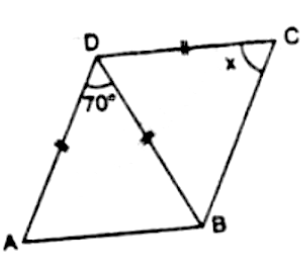
Find $x$ in Figure Given: $D A=D B=D C, B D$ bisects $\angle A B C$ and $\angle A D B=$$70^{\circ}$.
Image
Find the area of the rhombus, if its diagonals are 30 cm and 24 cm.
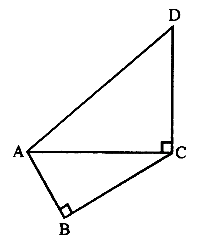
In the given figure, $A D=13 cm , B C=12 cm , A B=3 cm$ and angle $A C D=$ angle $A B C=90^{\circ}$. Find the length of $D C$.
Convert given fraction into a fraction with equal denominator:
$\frac{4}{5}, \frac{17}{20}, \frac{23}{40} \text { and } \frac{11}{16}$
Construct an isosceles ∆ MNP such that base MN = 5.8 cm, base angle MNP = 30°. Construct an incircle to this triangle and measure its radius.
Draw ∠ABC = 120°. Bisect the angle using ruler and compasses only. Measure each 1 angle so obtained and check whether the angles obtained on bisecting ∠ABC are equal or not.
Evaluate: $\frac{9}{-16}+\left(-\frac{5}{-12}\right)$