Question
Evaluate the following definite integrals:$\int_{0}^\limits{\frac{\pi}{2}}\text{x}^2\sin\text{x}\text{ dx}$

Answer

Let $\text{I}=\int_{0}^\limits{\frac{\pi}{2}}\text{x}^2\sin\text{x}\text{ dx}$ Apply integration by part.$\text{I}=\big[\text{x}^2(-\cos\text{x})\big]^{\frac{\pi}{2}}_0-\int_{0}^\limits{\frac{\pi}{2}}2\text{x}(-\cos\text{x})\text{ dx}$
$\Rightarrow\text{I}=(0-0)+2\int_{0}^\limits{\frac{\pi}{2}}\text{x}\cos\text{x}\text{ dx}$ $\Big(\cos\frac{\pi}{2}=0\Big)$
Apply integration by part again,$\text{I}=0+2\Bigg[\big[\text{x}\sin\text{x}\big]_0^{\frac{\pi}{2}}-\int_{0}^\limits{\frac{\pi}{2}}1\times\sin\text{x}\text{ dx}\Bigg]$
$\Rightarrow\text{I}=2\Big(\frac{\pi}{2}\sin\frac{\pi}{2}-0\Big)-2\int_{0}^\limits{\frac{\pi}{2}}\sin\text{x dx}$
$\Rightarrow\text{I}=2\Big(\frac{\pi}{2}-0\Big)-\big[2(-\cos\text{x})\big]^{\frac{\pi}{2}}_0$
$\Rightarrow\text{I}=\pi+2\Big(\cos\frac{\pi}{2}-\cos0\Big)$
$\Rightarrow\text{I}=\pi+2(0-1)$
$\Rightarrow\text{I}=\pi-2$

Need a full question paper?

Generate a complete, print-ready paper with questions like this in minutes — across 16+ boards, with answer keys.
Start Generating Free

Similar questions

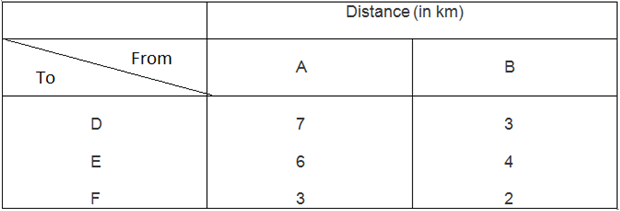
An oil company has two depots, A and B, with capacities of 7000 litres and 4000 litres respectively. The company is to supply oil to three petrol pumps, D, E, F whose requirements are 4500, 3000 and 3500 litres respectively. The distance (in km) between the depots and petrol pumps is given in the following table:

Assuming that the transportation cost per km is Rs. 1.00 per litre, how should the delivery be scheduled in order that the transportation cost is minimum?
Discuss the continuity and differentiability of $\text{f(x)}=\text{e}^{|\text{x}|}.$
Show that $\text{f(x)}=|\cos\text{x}|$ is a continuous function.
If a, b, c are real numbers such that $\begin{vmatrix}\text{b}+\text{c}&\text{c}+\text{a}&\text{a}+\text{b}\\\text{c}+\text{a}&\text{a}+\text{b}&\text{b}+\text{c}\\\text{a}+\text{b}&\text{b}+\text{c}&\text{c}+\text{a}\end{vmatrix}=0,$ then show that either $a + b + c = 0$ or $a = b= c.$
Classify the following functions as injection, surjection or bijection:$f : R \rightarrow R$, defined by$ f(x) = 5x^3 + 4$
Evaluate the following integrals:$\int^\limits{\text{a}}_0\text{x}\sqrt{\frac{\text{a}^2-\text{x}^2}{\text{a}^2+\text{x}^2}}\text{ dx}$
If the coordinates of the points $A, B, C$, are $(1,2,3),(4,5,6),(-4,3,-6)$ and $(2,9,2)$, then find the angle between $A B$ and $C D$.
If $\text{x}-\text{e}^{\frac{\text{x}}{\text{y}}},$ prove that $\frac{\text{dy}}{\text{dx}}=\frac{\text{x}-\text{y}}{\text{x}\log\text{x}}$
Find the point on the curve $\frac{\text{x}^2}{9}+\frac{\text{y}^2}{16}=1$ at which the tangent are:
  1. parallel to x-axis
  2. paralle to y- axis
Integrate the following w. r. t. x:

$\frac{2 x^2-1}{x^4+9^2+20}$