Question
Evaluate the following integrals:
$\int\tan^32\text{x}\sec2\text{x dx}$

Answer

$\int\tan^32\text{x}\sec2\text{x}=\tan^22\text{x}\tan2\text{x}\sec2\text{x}$
$=\big(\sec^22\text{x}-1\big)\tan2\text{x}\sec2\text{x}$
$=\sec^22\text{x}\tan2\text{x}\sec2\text{x}-\tan2\text{x}\sec2\text{x}$
$\therefore\ \int\tan^32\text{x}\sec2\text{x}\text{ dx}$
$=\int\sec^22\text{x}\tan2\text{x}\sec2\text{x dx}-\int\tan2\text{x}\sec2\text{x dx}$
$=\int\sec^22\text{x}\tan2\text{x}\sec2\text{x dx}-\frac{\sec2\text{x}}{2}+\text{C}$
Let $2\text{x}=\text{t}$
$\therefore\ 2\sec2\text{x}\tan2\text{x dx}=\text{dt}$
$\therefore\ \int\tan^32\text{x}\sec2\text{x dx}=\frac{1}{2}\int\text{t}^2\text{dt}-\frac{\sec2\text{x}}{2}+\text{C}$
$=\frac{\text{t}^3}{6}-\frac{\sec2\text{x}}{2}+\text{C}$
$=\frac{(\sec2\text{x})^3}{6}-\frac{\sec2\text{x}}{2}+\text{C}$

Need a full question paper?

Generate a complete, print-ready paper with questions like this in minutes — across 16+ boards, with answer keys.
Start Generating Free

Similar questions

If $\text{y}=\tan^{-1}$ show that $(1+\text{x}^2)\frac{\text{d}^2\text{y}}{\text{dx}^2}+2\text{x}\frac{\text{dy}}{\text{dx}}=0$
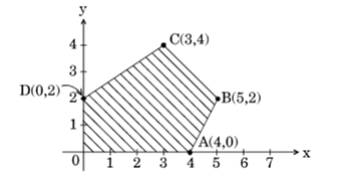
The corner points of the feasible region determined by the system of linear inequations are as shown below:
Image

Answer each of the following:
$i.$ Let $z = 13x - 15y$ be the objective function. Find the maximum and minimum values of $z$ and also the
corresponding points at which the maximum and minimum values occur.
$ii.$ Let $z = kx + y$ be the objective function. Find $k,$ if the value of $z$ at $A$ is same as the value of $z$ at $B.$
Find points at which the tangent to the curve $y = x^3– 3x^2 – 9x + 7$ is parallel to the $x-$axis.
For $A, B$ and $C$ the chances of being selected as the manager of a firm are in the ratio $4:1:2$ respectively. The respective probabilities for them to introduce a radical change in marketing strategy are $0.3, 0.8$ and $0.5.$ If the change does take place, find the probability that it is due to the appointment of $B$ or $C$
If $\vec{a}, \vec{b}, \vec{c}$ are perpendicular to each other and of equal magnitudes, then prove that the vector $\vec{a}+\vec{b}+\vec{c}$ makes equal angle with $\vec{a}, \vec{b}$ and $\vec{c}$
Given A = {2, 3, 4}, B = {2, 5, 6, 7}. Construct an example of each of the following:
  1. An injective map from A to B.
  2. A mapping from A to B which is not injective.
  3. A mapping from A to B.
Find the points o local maxima or local minima, if any, of the following functions, using the first derivatives test. Also, find the local maximum or local minimum values, as the case may be:
$\text{f}(\text{x})=\text{x}\sqrt{1-\text{x}}, \text{x}\geq0$
Find the coordinates of the point where the line through (3, -4, -5) and (2, -3, 1) corsses the plane 2x + y + z = 7.
Integrated the function: $\int \frac { e ^ { 2 x } - e ^ { - 2 x } } { e ^ { 2 x } + e ^ { - 2 x } } d x.$
Evaluate the following integrals:
$\int\frac{1}{\sqrt{\tan^{-1}\text{x}}.(1+\text{x}^2)}\text{dx}$