Question
Evaluate the following intregals:
$\int\frac{\text{x}}{(\text{x}-1)^2(\text{x}+2)}\ \text{dx}$

Answer

we have

$\text{I}=\int\frac{\text{x}\text{dx}}{(\text{x}-1)(\text{x}+2)}$

Let $\frac{\text{x}}{(\text{x}-1)^2(\text{x}+2)}=\frac{\text{A}}{\text{x}-1}+\frac{\text{B}}{(\text{x}-1)^2}+\frac{\text{C}}{\text{x}+2}$

$\Rightarrow\frac{\text{x}}{(\text{x}-1)^2(\text{x}+2)}=\frac{\text{A}(\text{x}-1)(\text{x}+2)+\text{B}(\text{x}+2)+\text{C}(\text{x}-1)^2}{(\text{x}-1)^2(\text{x}+2)}$

$\Rightarrow\text{x}=\text{A}(\text{x}^2+2\text{x}-\text{x}-2)+\text{B}(\text{x}+2)+\text{C}(\text{x}^2-2\text{x}+1)$

$\Rightarrow\text{x}=\text{A}(\text{x}^2+\text{x}-2)+\text{B}(\text{x}+2)+\text{C}(\text{x}^2-2\text{x}+1)$

$\Rightarrow\text{x}=(\text{A}+\text{C})\text{x}^2+(\text{A}+\text{B}-2\text{C})\text{x}+(-2\text{A}+2\text{B}+\text{C})$

A + C = 0 ...(1)

A + B - 2C = 1 ...(2)

-2A + 2B + C = 0 ...(3)

Solving(1), (2) and (3), we get

$\text{A}=\frac{2}{9},\text{B}=\frac{1}{3}\text{ and }\text{C}=-\frac{2}{9}$

$\therefore\frac{\text{x}}{(\text{x}-1)^2(\text{x}+2)}=\frac{2}{9(\text{x}-1)}+\frac{1}{3(\text{x}-1)^2}-\frac{2}{9(\text{x}+2)}$

$\Rightarrow\text{I}=\frac{2}{9}\int\frac{\text{dx}}{\text{x}-1}+\frac{1}{3}\int\frac{\text{dx}}{(\text{x}-1)^3}-\frac{2}{9}\int\frac{\text{dx}}{\text{x}+2}$

$=\frac{2}{9}\log|\text{x}-1|+\frac{1}{3}\times\Big(\frac{-1}{\text{x}-1}\Big)-\frac{2}{9}\log|\text{x}+2 |+\text{C}$

$=\frac{2}{9}\log\Big(\frac{\text{x}-1}{\text{x}+2}\Big)-\frac{1}{3(\text{x}-1)}+\text{C}$

Need a full question paper?

Generate a complete, print-ready paper with questions like this in minutes — across 16+ boards, with answer keys.
Start Generating Free

Similar questions

If $\text{A}=\begin{bmatrix}\cos\alpha+\sin\alpha&\sqrt{2}\sin\alpha\\-\sqrt{2}\sin\alpha&\cos\alpha-\sin\alpha\end{bmatrix},$ prove that
$ \text{A}^2=\begin{bmatrix}\cos\text{n}\alpha+\sin\text{n}\alpha&\sqrt{2}\sin\text{n}\alpha\\-\sqrt{2}\sin\text{n}\alpha&\cos\text{n}\alpha-\sin\text{n}\alpha\end{bmatrix}$ for all $\text{n}\in\text{N}.$
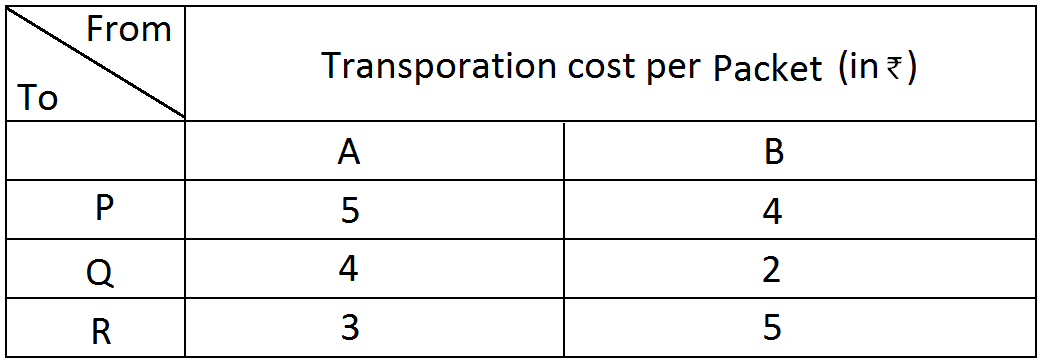
A medical company has factories at two places, A and B. From these places, supply is made to each of its three agencies situated at P, Q and R. The monthly requirements of the agencies are respectively 40, 40 and 50 packets of the medicines, while the production capacity of the factories, A and B, are 60 and 70 packets respectively. The transportation cost per packet from the factories to the agencies are given below:

How many packets from each factory be transported to each agency so that the cost of transportation is minimum? Also find the minimum cost?

If A and B are independent events such that P(A) = p, P(B) = 2p and P(Exactly one of A and B occurs) $=\frac{5}{9},$ then find the value or p.
$\text{Evaluate} \int\limits_0^{2} (x^{2} + 2x + 1) \text{dx as limit of sums.}$
If $\text{y}=\sqrt{\text{a}^2-\text{x}^2},$ prove that $\text{y}\frac{\text{dy}}{\text{dx}}+\text{x}=0$
$\text{If } x^{\text{m }} \text{y}^{\text{n}} = ({x + \text{y)}^{\text{m + n}}}, \text{prove that} \frac{\text{d}^{2}\text{y}}{\text{d}x^{2}} = 0.$
If xy = ex-y, find $\frac{\text{dy}}{\text{dx}}$
A manufacturer has employed 5 skilled men and 10 semi-skilled men and makes two models A and B of an article. The making of one item of model A requires 2 hours work by a skilled man and 2 hours work by a semi-skilled man. One item of model B requires 1 hour by a skilled man and 3 hours by a semi-skilled man. No man is expected to work more than 8 hours per day. The manufacturer’s profit on an item of model A is Rs. 15 and on an item of model B is Rs. 10. How many of items of each model should be made per day in order to maximize daily profit? Formulate the above LPP and solve it graphically and find the maximum profit.
Using integration, find the area of the region bounded by the triangle whose vertices are (2, –2), (4, 5) and (6, 2).
Find the shortest distance between the lines $\frac{{x + 1}}{7} = \frac{{y + 1}}{{ - 6}} = \frac{{z + 1}}{1}$ and $\frac{{x - 3}}{1} = \frac{{y - 5}}{{ - 2}} = \frac{{z - 7}}{1}$