Question
Evaluate the following intregals:
$\int\frac{4\text{x}^2+3}{(\text{x}^2+2)(\text{x}^2+3)(\text{x}^2+4)}\ \text{dx}$

Answer

We have,
$\int\frac{(4\text{x}^2+3)\text{dx}}{(\text{x}^2+2)(\text{x}^2+3)(\text{x}^2+4)}\ $
Putting $x^2 = t$
Then,
$\frac{4\text{x}^2+3}{(\text{x}^2+2)(\text{x}^2+3)(\text{x}^2+4)}=\frac{4\text{t}^2+3}{(\text{t}+2)(\text{t}+3)(\text{t}+4)}$
Let $\frac{4\text{x}^2+3}{(\text{x}^2+2)(\text{x}^2+3)(\text{x}^2+4)}=\frac{\text{A}}{\text{t}+2}+\frac{\text{B}}{\text{t}+3}+\frac{\text{C}}{\text{t}+4}$
$\Rightarrow\frac{4\text{x}^2+3}{(\text{x}^2+2)(\text{x}^2+3)(\text{x}^2+4)}=\frac{\text{A}(\text{t}+3)(\text{t}+4)+\text{C}(\text{t}+2)(\text{t}+3)}{(\text{t}+2)(\text{t}+3)(\text{t}+4)}$
$\Rightarrow 4t^2 + 3 = A(t + 3)(t+ 4 ) + B(t + 2)(t + 4) + C(t + 2)(t + 3)$
putting $t + 3 = 0$
$⇒ t = -3$
$\therefore$ $4 \times (-3)^2 + 3 = B(-3 + 2)(-3 + 4)$
$\Rightarrow 39 = B(-1)$
$\Rightarrow B = -39$
Putting$ t + 2 = 0$
$⇒ t = -2$
$\therefore$ $4(-2)^2 + 3 = A(-2 + 3)(-2 + 4)$
$\therefore$ $19 = A \times 1 \times 2$
$\Rightarrow\text{A}=\frac{19}{2}$
Let $t + 4 = 0$
$\Rightarrow t = -4$
$\therefore$ $4 \times (-4)^2 + 3 = C(-4 + 2)(-4 + 3)$
$\Rightarrow 67 = C(-2)(-1)$
$\Rightarrow\text{C}=\frac{67}{2}$
$\therefore\frac{4\text{t}^2+3}{(\text{t}+2)(\text{t}+3)(\text{t}+4)}=\frac{19}{2(\text{t}+2)}-\frac{39}{\text{x}^2+3}-\frac{39}{(2\text{t}+4)}$
$\Rightarrow\frac{4\text{t}^2+3}{(\text{x}^2+2)(\text{x}^2+3)(\text{x}^2+4)}=\frac{19}{2(\text{x}^2+2)}-\frac{39}{\text{x}^2+3}+\frac{67}{2(\text{x}^2+4)}$
$\therefore\text{I}=\frac{19}{2}\int\frac{\text{dx}}{\text{x}^2+(\sqrt{2})^2}-39\int\frac{\text{dx}}{\text{x}^2+(\sqrt{3})^2}-\frac{67}{2}\int\frac{\text{dx}}{\text{x}^2+2^2}$
$=\frac{19}{2}\times\frac{1}{\sqrt{2}}\tan^{-1}\Big(\frac{\text{x}}{\sqrt{2}}\Big)-\frac{39}{\sqrt{3}}\tan^{-1}\Big(\frac{\text{x}}{\sqrt{3}}\Big)-67\times\frac{1}2{}\tan^{-1}\Big(\frac{\text{x}}{2}\Big)+\text{C}$
$=\frac{19}{2\sqrt{2}}\tan^{-1}\Big(\frac{\text{x}}{\sqrt{2}}\Big)-\frac{39}{\sqrt{3}}\tan^{-1}\Big(\frac{\text{x}}{\sqrt{3}}\Big)-\frac{67}{4}\tan^{-1}\Big(\frac{\text{x}}{2}\Big)+\text{C}$

Need a full question paper?

Generate a complete, print-ready paper with questions like this in minutes — across 16+ boards, with answer keys.
Start Generating Free

Similar questions

Evaluate the following integrals:
$\int\text{e}^{2\text{x}}\sin(3\text{x}+1)\text{dx}$
Evaluate the following intregals:
$\int\frac{\text{x}^2}{(\text{x}-1)(\text{x}-2)(\text{x}-3)}\ \text{dx}$
Solve the following differential equation:
$\frac{\text{dy}}{\text{dx}}=(\text{x}+\text{y}+1)^{2}$
Prove the Theorem : If $x=f(t)$ and $y=g(t)$ are differentiable functions of $t$ so that $y$ is a differentiable function of $x$ and if $\frac{d x}{d t} \neq 0$ then $\frac{d y}{d x}=\frac{\frac{d y}{d t}}{\frac{d x}{d t}}$.
Solve the following initial value problems:
$(\text{y}^4-2\text{x}^3\text{y})\text{dx}+(\text{x}^4-2\text{xy}^3)\text{dy}=0,\text{y}(1)=1$
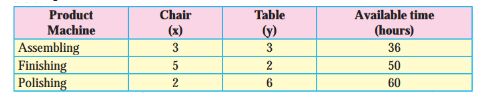
We first draw the lines processed on three machines : Assembling, Finishing and Polishing. The time required for each product in hours and availability of each machine is given by following table:

Image

Formulate the above problem as L.P.P. Solve it graphically to get maximum profit.

Evaluate the following intregals:
$\int\frac{1}{5-4\cos\text{x}}\ \text{dx}$
A factory makes tennis rackets and cricket bats. A tennis racket takes 1.5 hours of machine time and 3 hours of craftman's time in its making while a cricket bat takes 3 hours of machine time and 1 hour of craftman's time. In a day, the factory has the availability of not more than 42 hours of machine time and 24 hours of craftman's time.
  1. What number of rackets and bats must be made if the factory is to work at full capacity?
  2. If the profit on a racket and on a bat is Rs. 20 and Rs. 10 respectively, find the maximum profit of the factory when it works at full capacity.
Evaluate the following integrals:$\int^\limits{\frac{\pi}{6}}_{0}\cos^{-3}2\theta\sin2\theta\text{ d}\theta$
Find $\frac{\text{dy}}{\text{dx}}$ in the following cases:
$\text{x}^{\frac{2}{3}}+\text{y}^{\frac{2}{3}}=\text{a}^{\frac{2}{3}}$