Question
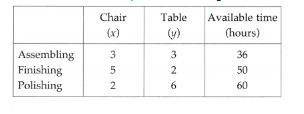
We first draw the lines processed on three machines : Assembling, Finishing and Polishing. The time required for each product in hours and availability of each machine is given by following table:

Image

Formulate the above problem as L.P.P. Solve it graphically to get maximum profit.

Answer

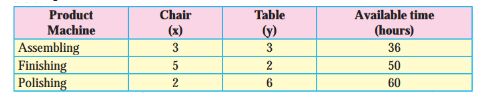
Let the number of chairs and tables made by the carpenter be x and y respectively. The profits are ₹ 140 per chair and ₹ 210 per table. ∴ total profit z = ₹ (140x + 210y) This is the objective function which is to be maximized. The constraints are as per the following table :
Image

From the table, the constraints are

$3 x+3 y \leq 36,5 x+2 y \leq 50,2 x+6 y \leq 60$

The number of chairs and tables cannot be negative. ∴ x ≥ 0, y ≥ 0 Hence, the mathematical formulation of given LPP is : Maximize z = 140x + 210y, subject to

$3 x+3 y \leq 36,5 x+2 y \leq 50,2 x+6 y \leq 60, x \geq 0, y \geq 0$

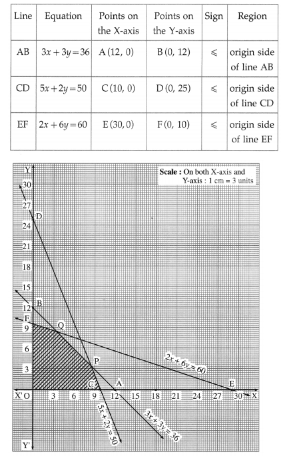
We first draw the lines AB, CD and EF whose equations are 3x + 3y = 36, 5x + 2y = 50 and 2x + 6y = 60 respectively.
Image

The feasible region is OCPQFO which is shaded in the graph. The vertices of the feasible region are O (0, 0), C (10, 0), P, Q and F (0, 10). P is the point of intersection of the lines 5x + 2y = 50 … (1) and 3x + 3y = 36 … (2) Multiplying equation (1) by 3 and equation (2) by 2, we get 15x + 6y = 150 6x + 6y = 72 On subtracting, we get 26

$9 x=78 \therefore x=\frac{26}{3}$

Substituting $x=\frac{26}{3}$ in (2), we get

$3\left(\frac{26}{3}\right)+3 y=36$

$3 y=10 y=\frac{10}{3}$

Q is the point of intersection of the lines 3x + 3y = 36 … (2) and 2x + 6y = 60 … (3) Multiplying equation (2) by 2, we get 6x + 6 y = 72 Subtracting equation (3) from this equation, we get 4x = 12 ∴ x = 3 Substituting x = 3 in (2), we get 3(3) + 3y = 36 ∴ 3y = 27 ∴ y = 9 ∴ Q is (3, 9). Hence, the vertices of the feasible region are O (0, 0),

$C(10,0), \mathrm{P}\left(\frac{26}{3}, \frac{10}{3}\right), \mathrm{Q}(3,9)$ and $\mathrm{F}(0,10)$.

The values of the objective function z = 140x + 210y at these vertices are z(O) = 140(0) + 210(0) = 0 + 0 = 0 z(C) = 140 (10) + 210(0) = 1400 + 0 = 1400

$z(\mathrm{P})=140\left(\frac{26}{3}\right)+210\left(\frac{10}{3}\right)=\frac{3640+2100}{3}=\frac{5740}{3}=1913.33$

z(Q) = 140(3) + 210(9) = 420 + 1890 = 2310 z(F) = 140(0) + 210(10) = 0 + 2100 = 2100 ∴ z has maximum value 2310 when x = 3 and y = 9 Hence, the carpenter should make 3 chairs and 9 tables to get the maximum profit of ₹ 2310.
Need a full question paper?

Generate a complete, print-ready paper with questions like this in minutes — across 16+ boards, with answer keys.

Start Generating Free

Similar questions

Find the vector equation of the plane passing through the point (3, 4, 2) and (7, 0, 6) and perpendicular to the plane 2x - 5y - 15 = 0. Also, show that the plane thus obtaines contains the line
Find the area under the curve $\text{y}=\sqrt{6\text{x}+4}$ above x-axis from $x = 0$ to $x = 2$. Draw a sketch of curve also.
A box manufacturer makes large and small boxes from a large piece of cardboard. The large boxes require 4 sq. metre per box while the small boxes require 3 sq. metre per box. The manufacturer is required to make at least three large boxes and at least twice as many small boxes as large boxes. If 60 sq. metre of cardboard is in stock, and if the profits on the large and small boxes are Rs. 3 and Rs. 2 per box, how many of each should be made in order to maximize the total profit?
Determine the values of a, b, c for which the function
$\text{f}\text{(x)}=\begin{cases}\frac{\sin\text{(a}+1)\text{x}+\sin\text{x}}{\text{x}}, &\text{for}\text{ x}<0,&\\\text{ c},&\text{for x}=0\\\frac{\sqrt{\text{x}+\text{bx}^2}-\sqrt{\text{x}}}{\text{bx}^\frac{3}{2}},&\text{for x}>0\end{cases}$ is continuous at x = 0.
In what ratio deose the x-axies divide the area of the region bounded by the parabolas $y = 4x - x^2 $and$ y = x^2 - x?$
The vertices A, B, C of triangle ABC have respectively position vector $\vec{\text{a}},\ \vec{\text{b}},\ \vec{\text{c}}$ with respect to given origin O. Show that the point D where the bisector of $\angle{\text{A}}$ meets BC has position Vector $\vec{\text{d}}=\frac{\beta\vec{\text{b}}+\gamma\vec{\text{c}}}{\beta+\gamma}$, where $\beta=\big|\vec{\text{c}}-\vec{\text{a}}\big|$ and, $\gamma=\big|\vec{\text{a}}-\vec{\text{b}}\big|$.
The surface area of a spherical bubble is increasing at the rate of $2 cm^2 / s$. When the radius of the bubble is 6 cm , at what rate is the volume of the bubble increasing?
There are three urns $A, B,$ and $C$. Urn $A$ contains $4$ red balls and $3$ black balls. urn $B$ contains $5$ red balls and $4$ black balls. Urn $C$ contains $4$ red and $4$ black balls. One ball is drawn from each of these urns. What is the probability that $3$ balls drawn consists of $2$ red balls and a black ball?
Form the differential equation corresponding to $\text{y}^2-2\text{ay}+\text{x}^2=\text{a}^2$ by eliminating a.
A coin is tossed 5 times. What is the probability of getting at least 3 heads?