Question
$\text{Evaluate}\int\limits^{\pi}_{0} e^{2x} . \sin\big(\frac{\pi}{4} + x\big)\text{dx}$

Answer

$\text{Let I } = \int^{\pi}_{0}\sin\bigg(\frac{\pi}{4} + \text{x}\bigg)e^{2x}\text{dx}$
$ = \sin\bigg(\frac{\pi}{4}+\text{x}\bigg)\frac{e^{2x}}{2}\Bigg]^{\pi}_{0} -\int^{\pi}_{0} \cos\bigg(\frac{\pi}{4} + \text{x}\bigg)\frac{e^{2x}}{2}\text{dx}$
$\text{I} = \Bigg[\sin\bigg(\frac{\pi}{4} + \text{x}\bigg)\frac{e^{2x}}{2}- \frac{1}{2}\Bigg(\cos\bigg(\frac{\pi}{4}+\text{x}\bigg)\frac{e^{2x}}{2}\Bigg)\Bigg]^{\pi}_{0} + \frac{1}{2}\int^{\pi}_{0}-\sin\bigg(\frac{\pi}{4}+\text{x}\bigg)\frac{e^{2x}}{x}\text{dx}$
$\frac{5}{4}\text{I} =\bigg\{\frac{1}{2}\bigg[2\sin\bigg(\frac{\pi}{4} + \text{x}\bigg)-\cos\bigg(\frac{\pi}{4} + \text{x}\bigg)\bigg]e^{2x}\bigg\}^{\pi}_{0}$
$\text{I} = \frac{1}{5}\bigg\{2\bigg(-\frac{1}{\sqrt{2}}\bigg)+ \frac{1}{\sqrt{2}}\bigg\}e^{2\pi} - \bigg\{2\bigg(\frac{1}{\sqrt{2}}\bigg)-\frac{1}{\sqrt{2}}\bigg\}\Bigg] = \frac{-1}{5\sqrt{2}}(e^{2x + 1})$

Need a full question paper?

Generate a complete, print-ready paper with questions like this in minutes — across 16+ boards, with answer keys.

Start Generating Free

Similar questions

Solve the following differential equations:

$\frac{\text{dy}}{\text{dx}}=\text{y}\tan\text{ x, y}(0)=1$
Find the vector equation of the plane passing through the point (3, 4, 2) and (7, 0, 6) and perpendicular to the plane 2x - 5y - 15 = 0. Also, show that the plane thus obtaines contains the line 
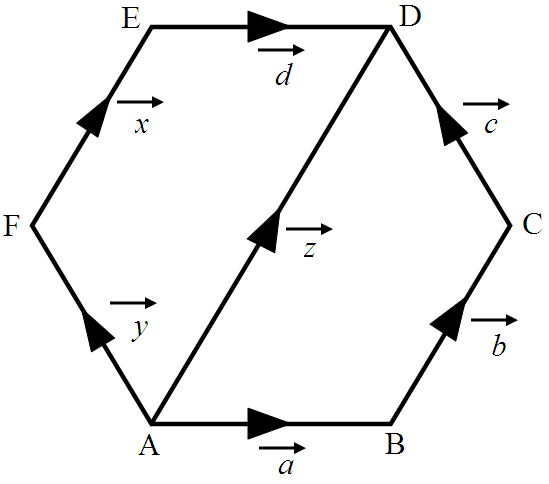
In Figure ABCD is a regular hexagon, which vectors are:
  1. Collinear.
  2. Equal.
  3. Co-initial.
  4. Collinear but not equal.

A manufacturer produces three products x, y, z which he sells in two markets. Annual sales are indicated below:
Market   Products  
I 10, 000 2, 000 18, 000
II 6, 000 20, 000 8, 000
  1. If unit sales prices of x, y and z are ₹ 2.50, ₹ 1.50 and ₹ 1.00 respectively, find the total revenue in each market with the help of matrix algebra.
  2. If the unit costs of the above three commodities are ₹ 2.00, ₹ 1.00 and 50 paise respectively. Find the gross profit.
Determine the area under the curve $\text{y}=\sqrt{\text{a}^2-\text{x}^2}$ included between the lines x = 0 and x = a.
Form the differential equation of the family of ellipses having foci on y-axis and centre at origin.
If $(\cos\text{x})^\text{y}=(\cos\text{y})^\text{x},$ find $\frac{\text{dy}}{\text{dx}}$
If A and B are two events such that,
$\text{P(A)}=\frac{6}{11},\text{P(B)}=\frac{5}{11}$ and $\text{P}(\text{A}\cap\text{B})=\frac{7}{11},$ then find $\text{P}(\text{A}\cap\text{B}),$ P(A|B) and P(B|A).
Differentiate the following functions with respect to x:
$\text{e}^{\sin\text{x}}+(\tan\text{x})^\text{x}$
Finde the value of a and b, if the function f(x) defined by $\text{f(x)}\begin{cases}\text{x}^2+3\text{x}+\text{a}, &\text{x}\leq1\\\text{bx}+2, & \text{x}>1\end{cases}$is differentiable at x = 1.