Question
Evaluvate the following intregals:
$\int\frac{1}{1-\tan\text{x}}\text{ dx}$

Answer

Let $\text{I}=\int\frac{1}{1-\tan\text{x}}\text{ dx}$
$=\int\frac{1}{1-\frac{\sin\text{x}}{\cos\text{x}}}\ \text{dx}$
$=\int\frac{\cos\text{x}}{\cos\text{x}-\sin\text{x}}\ \text{dx}$
Let $\cos\text{x}=\lambda\frac{\text{d}}{\text{dx}}(\cos\text{x}-\sin\text{x})+\mu(\cos\text{x}-\sin\text{x})+\text{v}$
$=\lambda\frac{\text{d}}{\text{dx}}(-\sin\text{x}-\cos\text{x})+\mu(\cos\text{x}-\sin\text{x})+\text{v}$
$\cos\text{x}=\sin(-\lambda-\mu)+\cos\text{x}(-\lambda+\mu)+\text{v}$
Compairing the cooefficients of $\cos\text{x}\ \&\sin\text{x}$ on the both the sides,
$-\lambda-\mu=0\ ...(1)$
$-\lambda+\mu=1\ ...(2)$
$\text{v}=0\ ...(3)$
Equation (1), (2), (3) gives
$\lambda=-\frac{1}{2},\mu=\frac{1}{2},\text{v}=0$
$\text{I}=\int\frac{-\frac{1}{2}(-\sin\text{x}-\cos\text{x})+\frac{1}{2}(\cos\text{x}-\sin\text{x}_)}{(\cos\text{x}-\sin\text{x})}\ \text{dx}$
$=\frac{1}{2}\int\frac{(\cos\text{x}+\sin\text{x})}{(\sin\text{x}-\cos\text{x})}\ \text{dx}+\frac{1}{2}\int\ \text{dx}$
$\text{I}=-\frac{1}{2}\log|\cos\text{x}-\sin\text{x}|+\frac{1}{2}\text{x}+\text{C}$
$\text{I}=\frac{1}{2}\text{x}-\frac{1}{2}\log|\cos\text{x}-\sin\text{x}|+\text{C}$

Need a full question paper?

Generate a complete, print-ready paper with questions like this in minutes — across 16+ boards, with answer keys.

Start Generating Free

Similar questions

Find the percentage error in calculating the surface area of a cubical box if an error of $1\%$ is made in measuring the lengths of edges of the cube.
Differentiate $\sin^{-1}\sqrt{1-\text{x}^2}$ with respect to $\cos^{-1}\text{x},$ if
$\text{x}\in(0, 1)$
Evaluate the following integrals as limit of sum:
$\int\limits^2_{0}\text{e}^{\text{x}}\text{ dx}$
Find the shortest distance between the lines whose vector equations are $ \vec r = \left( {1 - t} \right)\hat i + (t - 2)\hat j + (3 - 2t)\hat k$ and $\vec r = \left( {s + 1} \right)\hat i + (2s - 1)\hat j - (2s + 1)\hat k$
$\text{A}=\begin{bmatrix}3&-4&2\\ 2&3&5\\ 1&0&1\end{bmatrix}$, find $A^{-1}$ and hence solve the following system of equations:
$3x - 4y +2z = -1, 2x + 3y + 5z = 7, x + z = 2$
The management committee of a residential colony decided to award some of its members (say x) for honesty, some (say y) for helping others and some others (say z) for supervising the workers to keep the colony neat and clean. The sum of all the awardees is 12. Three times the sum of awardees for cooperation and supervision added to two times the number of awardees for honesty is 33. If the sum of the number of awardees for honesty and supervision is twice the number of awardees for helping others, using matrix method, find the number of awardees of each category. Apart from these values, namely, honesty, cooperation and supervision, suggest one more value which the management of the colony must include for awards.
Prove that the volume of the largest cone that can be inscribed in a sphere of radius $R$ is $\frac{8}{27}$ of the volume of the sphere
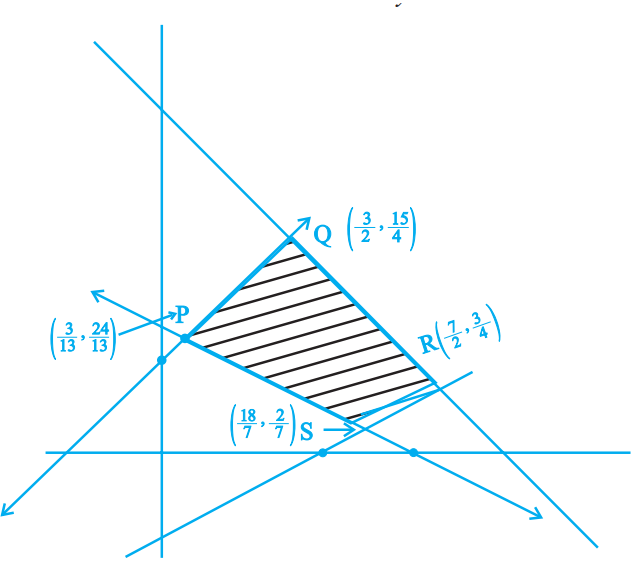
In the feasible region (shaded) for a LPP is shown. Determine the maximum and minimum value of Z = x + 2y.
If the median to the base of a triangle is perpendicular to the base, then triangle is isosceles.
The two adjacent sides of a parallelogram are $2\hat{\text{i}}-4\hat{\text{j}}-5\hat{\text{k}}$ and $2\hat{\text{i}}+2\hat{\text{j}}+3\hat{\text{k}}.$ Find the two unit vectors parallel to its diagonals. Using the diagonal vectors, find the area of the parallelogram.