Question
Every invertible function is:
  1. Monotonic function.
  2. Constant function.
  3. Identity function.
  4. Not necessarily monotonic function.

Answer

  1. Monotonic function.

Solution:

We know that "every invertible function is a monotonic function".

Need a full question paper?

Generate a complete, print-ready paper with questions like this in minutes — across 16+ boards, with answer keys.

Start Generating Free

Similar questions

The integral $\int \frac{1}{\sqrt[4]{(x-1)^{3}(x+2)^{5}}} d x$ is equal to :

(where $\mathrm{C}$ is a constant of integration)

Let $f: \mathbb{R} \rightarrow(0, \infty)$ and $g: \mathbb{R} \rightarrow \mathbb{R}$ be twice differentiable functions such that $f^{\prime \prime}$ and $g^{\prime \prime}$ are continuous functions on $\mathbb{R}$. Suppose $f^{\prime}(2)=g(2)=0, \quad f^{\prime \prime}(2) \neq 0$ and $g^{\prime}(2) \neq 0$. If $\lim _{x \rightarrow 2} \frac{f(x) g(x)}{f^{\prime}(x) g^{\prime}(x)}=1$, then

($A$) $f$ has a local minimum at $x=2$

($B$) fhas a local maximum at $x=2$

($C$) $f^{\prime \prime}(2)>f(2)$

($D$) $f(x)-f^{\prime \prime}(x)=0$ for at least one $x \in \mathbb{R}$
The integral $\int \limits_{0}^{2} \| x-1|-x| d x$ is equal to
The point on the curve y = 6x - x2 at which the tangent to the curve is inclined at $\frac{\pi}{4}$ to the line x + y = 0 is:
  1. $(-3,-27)$
  2. $(3,9)$
  3. $\Big(\frac{7}{2},\frac{35}{4}\Big)$
  4. $(0,0)$
$\sum\limits_{\lambda  = 1}^{10} {{{\sin }^{ - 1}}\left( {\sin \left( {\lambda \pi  - \frac{\pi }{6}} \right)} \right)} $ is equal to-
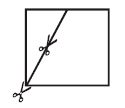
Consider a square of side $2\ cm$ . It is cut from one of its corner as shown in adjacent figure. Maximum value of sum of the perimeters of two plane figures thus formed is
$\int\limits^{\frac{\pi}{2}}_0\sin2\text{x }\log\tan\text{x dx}$ is equal to:
  1. $\pi$
  2. $\frac{\pi}{2}$
  3. $0$
  4. $2\pi$
Let $ A$ be a $2$$ \times $$2$ matrix with non-zero entries and let ${A^2} = I$ where $I$  is $2\times 2$ identity matrix. Define $tr(A) =$ sum of diagonal elements of $A$ and $|A|=$ determinant of matrix $A$ 

Statement $-1 :$ ${\rm{tr}}\left( A \right) = 0$

Statement $-2 :$  $\det \left( A \right) = 1$

The order and the degree of differential equation $\frac{{{d^4}y}}{{d{x^4}}} - 4\frac{{{d^3}y}}{{d{x^3}}} + 8\frac{{{d^2}y}}{{d{x^2}}} - 8\frac{{dy}}{{dx}} + 4y = 0$ are respectively
Let $\vec{\text{a}}$ and $\vec{\text{b}}$ be two unit vectors and a be the angle between them. Then, $\vec{\text{a}}+\vec{\text{b}}$ is a unit vector if:
  1. $\text{a}=\frac{\pi}{4}$
  2. $\text{a}=\frac{\pi}{3}$
  3. $\text{a}=\frac{2\pi}{3}$
  4. $\text{a}=\frac{\pi}{2}$