Question
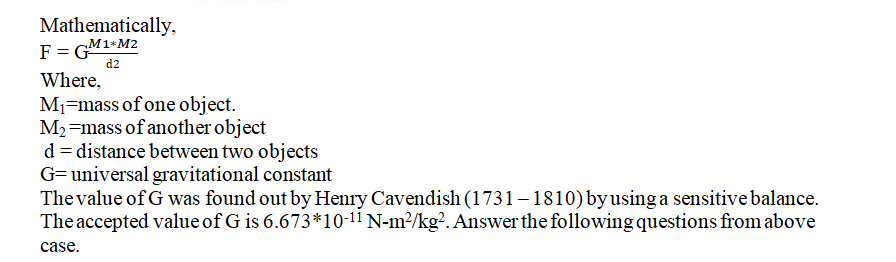
Every object in the universe attracts every other object with a force which is proportional to the product of their masses ($m1*m2$) and inversely proportional to the square of the distance ($d^2$) between them. The force is along the line joining the centers of two objects.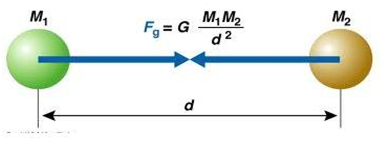
(i)Gravitational force does not depend on
$(a)$ Masses of objects
$(b)$ Separation between objects
$(c)$ Charges on objects
$(d)$ None of these
(ii) Force of gravitation varies with masses of object as
$(a)$ Product of masses
$(b)$ Sum of masses
$(c)$ Difference of masses
$(d)$ None of these
(iii) When mass of one body is doubled then force of gravitation will become
$(a)$ Force will remain same
$(b)$ Force will become double
$(c)$ Force will become halved
$(d)$ None of these
(iv)What is universal gravitational constant? What is its SI unit?
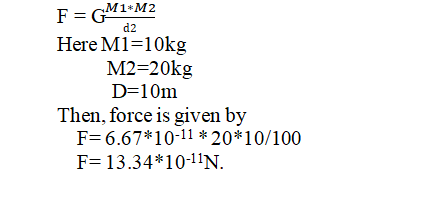
(v) Two objects of masses 10kg and 20kg separated by distance 10m. What is gravitational force between them?
(i)Gravitational force does not depend on
$(a)$ Masses of objects
$(b)$ Separation between objects
$(c)$ Charges on objects
$(d)$ None of these
(ii) Force of gravitation varies with masses of object as
$(a)$ Product of masses
$(b)$ Sum of masses
$(c)$ Difference of masses
$(d)$ None of these
(iii) When mass of one body is doubled then force of gravitation will become
$(a)$ Force will remain same
$(b)$ Force will become double
$(c)$ Force will become halved
$(d)$ None of these
(iv)What is universal gravitational constant? What is its SI unit?
(v) Two objects of masses 10kg and 20kg separated by distance 10m. What is gravitational force between them?
 ,
,