Question
Expand the following:
$(4 a-b+2 c)^2$

Answer

$(4 a-b+2 c)^2=(4 a)^2+(-b)^2+(2 c)^2+2(4 a)(-b)+2(-b)(2 c)+2(2 c)(4 a)$
${\left[\therefore a^2+b^2+c^2+2 a b+2 b c+2 c a=(a+b+c)^2\right]}$
$=16 a^2+b^2+4 c^2-8 a b-4 a c+16 c a$

Need a full question paper?

Generate a complete, print-ready paper with questions like this in minutes — across 16+ boards, with answer keys.
Start Generating Free

Similar questions

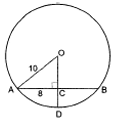
In given figure, if $O A=10, A B=16$ and $O D \perp$ to $A B$. Find the value of the $C D$.
Image
A cylinder whose height is two thirds of its diameter has the same volume as a sphere of radius $4\ cm$. Calculate the radius of the base of the cylinder.
Factorize the following expressions: $3\sqrt{3}\text{a}^3-\text{b}^3-5\sqrt{5}\text{c}^3-3\sqrt{15}\text{abc}$
Factorise:
$4 x^2-9 y^2-2 x-3 y$
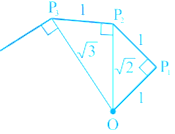
Classroom activity (Constructing the 'square root spiral') : Take a large sheet of paper and construct the 'square root spiral' in the following fashion. Start with a point $O$ and draw a line segment $O P_1$ of unit length. Draw a line segment $P_1 P_2$ perpendicular to $O P_1$ of unit length (see Fig.). Now draw a line segment $P_2 P_3$ perpendicular to $O P_2$. Then draw a line segment $P_3 P_4$ perpendicular to $O P_3$. Continuing in this manner, you can get the line segment $P_{n-1} P_n$ by drawing a line segment of unit length perpendicular to $OP _{n-1}$. In this manner, you will have created the points $P _2$, $P_3, \ldots, P_n, \ldots$, and joined them to create a beautiful spiral depicting $\sqrt{2}, \sqrt{3}, \sqrt{4}, \ldots$

Fig. : Constructing square root spiral
$B E$ and $C F$ are two equal altitudes of a triangle $A B C$. Using $RHS$ congruence rule, prove that a triangle $A B C$ is isosceles.
Factorize: $\text{x}^2+6\sqrt{2}\text{x}+10$
Expand:
$(-3 a+4 b-5 c)^2$
Factorise:
$1+64 x^3$
Solve the following equations: $\sqrt{\frac{\text{a}}{\text{b}}}=\Big(\frac{\text{b}}{\text{a}}\Big)^{1-2\text{x}},$ where a, b are distinct positive primes.