Question
Explain a tuning fork (vibrating) is held close to ear. One hears a faint sound. The same vibrating tuning fork is placed on table, such that its handle is in contact with table, one hears a loud sound.

Answer

When the tuning fork is held close to ear, then small amount of air is disturbed and hence sound is faint. When the handle of the vibrating tuning fork is held aganist table, it makes the table top to vibrate, with forced vibrations. As the table top has a larger surface area, therefore large volume of air is set into vibrations, thereby producing a loud sound.

Need a full question paper?

Generate a complete, print-ready paper with questions like this in minutes — across 16+ boards, with answer keys.
Start Generating Free

Similar questions

Where are the cartridge type fuse used?
Name three losses of energy in a transformer. How are they minimized?
The speed of light in diamonds is $125,000\ km s ^{-1}$. What is its refractive index? (speed of light in air $=3 \times 108\ ms^{-1}$ ).
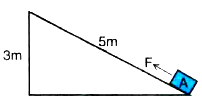
A block A, whose weight is 100 N, is pulled up a slope of length 5 m by means of a constant force (= 100 N) as illustrated in the following figure.

  1. What is the work done by force F in moving block A, 5 m along the slope?
  2. What is the increase in potential energy of the block A?
  3. Account for the difference in work done by the force and the increase in potential energy of the block.
Differentiate between Uniform linear motion and Uniform circular motion.
State a relation between electrical power, resistance and potential difference in an electrical circuit.
A convex lens forms an image of an object equal to the size of the object.draw a diagram to illustrate it.
An electrical appliance is rated 1500 W, 250 V. This appliance is connected to 250 V mains. Calculate:
(i) the current drawn,
(ii) the electrical energy consumed in 60 hours,
(iii) the cost of electrical energy consumed at Rs. 2.50 per kWh.
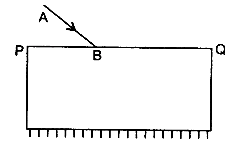
The diagram on right shows a ray of white light AB incident on a rectangular glass block, which is silvered at the lower surface. This ray is partly reflected and partly refracted.

(i) Copy the diagram and trace the path of the refracted and reflected ray. Show at least two rays emerging from the surface ‘PQ’
(ii) How many images are formed in the above case? Which image is the brightest?
If the power of a motor is 40 KW, at what speed can it raise a load of 20,000 N?