Question
Explain abnormal molar Tasses. Also explain association and dissociation of Solute.
Answer

$\rightarrow$ Ionic compounds when dissolved in water dissociate into cations and anions.
$\rightarrow$ For example, if we dissolve one mole of $\text{KCI} (74.5 g)$ in water, we expect one mole each of $K^+$ and $Cl^-$ ions to be released in the solution. If this happens, there would be two moles of particles in the solution.
$\rightarrow $ one mole of $\text{KCl}$  in one $\ kg$ of water would be expected to increase the boiling point by $2 x \ 0.52 K = 1.04 Κ$
$\rightarrow$ If we did not know about the degree of dissociation, we could be led to conclude that the mass of $2$ mol particles is $74.5 g$ and the mass of one mole of $\text{KCl}$ would be $37.25 g$.
$\rightarrow$ When there is dissociation of solute into ions, the experimentally determined molar mass is always lower than the true value.
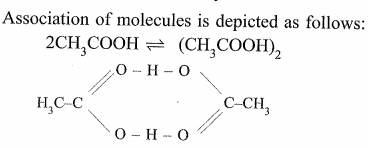
$\rightarrow$ Molecules of ethanoic acid $($acetic acid$)$ dimerise in benzene due to hydrogen bonding.
This normally happens in solvents of low dielectric constant. In this case the number of particles is reduced due to dimerisation.
Image
$\rightarrow$  It can be undoubtedly stated here that if all the molecules of ethanoic acid associate in benzene, then $\Delta T _{ b }$ or $\Delta T _{ f }$ for ethanoic acid will be half of the normal value.
$\rightarrow$ The molar mass calculated on the basis of this $\Delta T_b$ or $\Delta T_f$ will, therefore, be twice the expected value.
Such a molar mass that is either lower or higher than the expected or normal value is called as abnormal molar mass.

Need a full question paper?

Generate a complete, print-ready paper with questions like this in minutes — across 16+ boards, with answer keys.

Start Generating Free

Similar questions

Explain Crystal field splitting in tetrahedral complax.
What is the difference between Galvanic cell (Electrochemical cell) and Electrolytic cell.
Give reasons$:$
  1. $Mn$ shows the highest oxidation state of $+7$ with oxygen but with fluorine it shows the highest oxidation state of $+4.$
  2. Transition metals show variable oxidation states.
  3. Actinoids show irregularities in their electronic configurations.
Vapour pressures of pure acetone and chloroform at $328\ K$ are $741.8\ mm\ Hg$ and $632.8\ mm\ Hg$ respectively. Assuming that they form ideal solution over the entire range of composition, plot $p_{total}, p_{chloroform},$ and $p_{acetone}$ as a function of $x_{acetone}.$ The experimental data observed for different compositions of mixture is:
$100 \times x_{acetone}$ $0$ $11.8$ $23.4$ $36.0$ $50.8$ $58.2$ $64.5$ $72.1$
$p_{acetone}/ mm\ Hg$ $0$ $54.9$ $110.1$ $202.4$ $322.7$ $405.9$ $454.1$ $521.1$
$p_{chloroform}/ mm\ Hg$ $632.8$ $548.1$ $469.4$ $359.7$ $257.7$ $193.6$ $161.2$ $120.7$
Plot this data also on the same graph paper. Indicate whether it has positive deviation or negative deviation from the ideal solution.
Compare the following complexes with respect to structural shapes of units, magnetic behaviour and hybrid orbitals involved in units:$\ce{[Co(NH_3)_6]^{3+}, [Cr(NH_3)_6]^{3+}, Ni(CO)_4}. ($At. Nos.$:\ce{ Co = 27, Cr = 24, Ni = 28)}.$
How would you account for the following?
$[Ti(H_2O)_6]^{3+}$ is coloured while $[Sc(H_2O)_6]^{3+}$ is colourless.
Give the products of following carbonyl compounds when oxidised with acidic $KMnO _4$ or acidic $K _2 Cr _2 O _7$.
(i) $CH _3 CHO$
(ii) $CH _3 COCH _3$
Image
Predict the order of reactivity of the following compounds in $S_N1$ and $S_N2$ reactions: $\ce{C_6H_5CH_2Br, C_6H_5CH(C_6H_5)Br, C_6H_5CH(CH_3)Br, C_6H_5C(CH_3)(C_6H_5)Br}.$
Explain the reactions of ethanal with the following :
(i) $C _2 H _5 NH _2$ (ii) Phenyl hydrazine (iii) Semicarbazide.
Answer the following question:$An$ organic compound A having molecular formula $\ce{C_6H_6O}$ gives a characteristic colour with aqueous $\ce{FeCl_3}$ solution. A on treatment with $\ce{CO_2}$ and $\ce{NaOH}$ at $400K$ under pressure gives $B$ which on acidification gives a compound $C.$ The compound $C$ reacts with acetyl chloride to give D which is a popular pain killer. Deduce the structure of $A, B, C$ and $D.$