Questions

3 Marks Question

Take a timed test

8 questions · self-marked practice — reveal the answer and mark yourself.

Question 13 Marks
What is Solubility? Explain Solubility of a solid in a liquid.
Answer
→ Solubility of a substance is its maximum amount that can be dissolved in a specified amount of solvent at a specified temperature.
→ Solubility depends upon
(1)  Nature of Solvent
(2) Nature of Solute
(3) Temperature
(4) Pressure
(1)Nature of Solute and Solvent:
→ Every solid does not dissolve in a given liquid. While sodium chloride and sugar dissolve readily in water, naphthalene and anthracene do not. On the other hand, naphthalene and anthracene dissolve readily in benzene but sodium chloride and sugar do not.
→ It is observed that polar solutes dissolve in polar solvents and non polar solutes in non-polar solvents.
→ In general, a solute dissolves in a solvent if the intermolecular interactions are similar in the two or we may say like dissolves like.
(2) Effect of Temperature :
→ The solubility of a solid in a liquid is significantly affected by temperature changes.
Solute + Solvent $\rightleftharpoons$ Solution
→ This, being dynamic equilibrium, must follow Le Chateliers Principle.
→ if in a nearly saturated solution, the dissolution process is endothermic $(\Delta$ sol $H >0)$, the solubility
→ if it is exothermic $(\Delta$ sol $H <0)$ the solubility should decrease.
(3) Effect of Pressure :
→ Pressure does not have any significant effect on solubility of solids in liquids.
→ It is so because solids and liquids are highly incompressible and practically remain unaffected by changes in pressure.
View full question & answer
Question 23 Marks
Explain vapour pressure of solutions of solids in liquids.
Answer
→ Liquids at a given temperature vapourise and under equilibrium conditions the pressure exerted by the vapours of the liquid over the liquid phase is called vapour pressure
Image
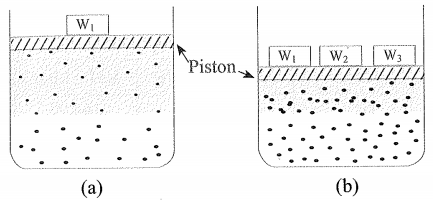
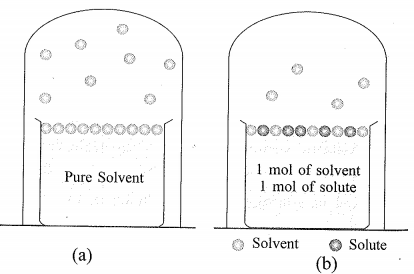
Decrease in the vapour pressure of the solvent on account of the presence of solute in the solvent (a) evaporation of the molecules of the solvent from its surface is denoted by 〇, (b) in a solution, solute particles have been denoted by ⚫ and they also occupy part of the surface area.
→ In a pure liquid [Fig. a] the entire surface is occupied by the molecules of the liquid. If a non-volatile solute is added to a solvent to give a solution [Fig. b] the vapour pressure of the solution is solely from the solvent alone.
→ This vapour pressure of the solution at a given temperature is found to be lower than the vapour pressure of the pure solvent at the same temperature.
→ In the solution, the surface has both solute and solvent molecules thereby the fraction of the surface covered by the solvent molecules gets reduced. Consequently, the number of solvent molecules escaping from the surface is correspondingly reduced, thus, the vapour pressure is also reduced.
→ The decrease in the vapour pressure of solvent depends on the quantity of non-volatile solute present in the solution, irrespective of its nature.
→ For example, decrease in the vapour pressure of water by adding 1.0 mol of sucrose to one kg of water is nearly similar to that produced by adding 1.0 mol of urea to the same quantity of water at the same temperature.
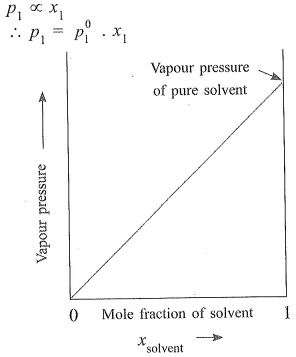
→ Raoult's law:
→ "Any solution the partial vapour pressure of each volatile component in the solution is directly proportional to its mole fraction."
→ In Binary solution $p_1$ is vapour pressure of the solvent and $x_1$ is mole-fraction.
Image
→ The proportionality constant is equal to the vapour pressure of pure solvent, $p_1^0$
→ A plot between the vapour pressure and the mole fraction of the solvent is linear
View full question & answer
Question 33 Marks
Explain Van't Hoff factor.
Answer
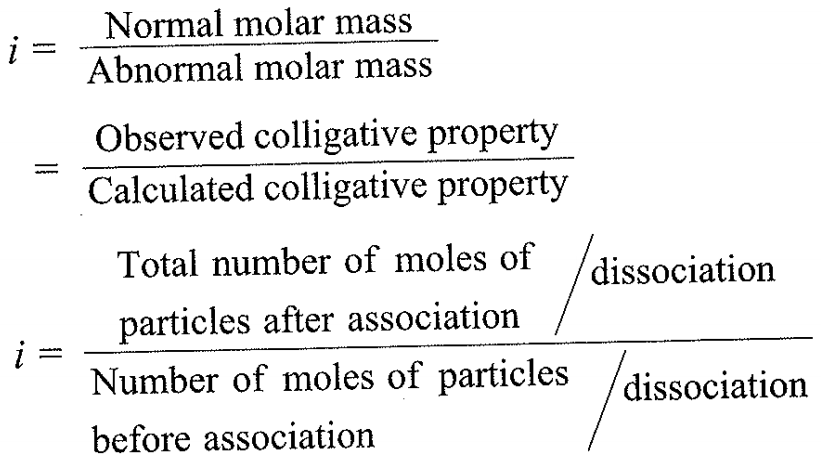
→ Van't Hoff introduced a factor i, known as the Van't Hoff factor, to account for the extent of dissociation or association. This factor i is defined as:
Image
→ Here abnormal molar mass is the experimentally determined molar mass and calculated colligative properties are obtained by assuming that the non-volatile solute is neither associated nor dissociated.
→ In case of association, value of i is less than unity while for dissociation it is greater than unity.
→ Inclusion of van't Hoff factor modifies the equations for colligative properties as follows:
→Relative lowering of vapour pressure of solvent,
$\frac{p_1^0-p_1}{p_1^0}= i \cdot \frac{n_2}{n_1}$
Elevation of Boiling point, $\Delta T_b=i K_b m$
Depression of Freezing point, $\Delta T_f=i K_f m$
Osmotic pressure of solution, $\pi=i n_2 R T / V$
→ $i$ for several strong electrolytes. For $KCI , NaCl$ and $MgSO _4, i$ values approach 2 as the solution becomes very dilute. As expected, the value of $i$ gets close to 3 for $K _2 SO _4$.
Salt* Values of i van't Hoff Factor
i for complete
dissociation of
solute
0.1 m0.01 m0.001 m
NaCl1.871.941.972.00
KCl1.851.941.982.00
$MgSO_{4}$1.211.531.822.00
$K_{2}SO_{4}$2.322.72.843.00
View full question & answer
Question 43 Marks
What is Isotonic, hypertonic and hypotonic Solution?
Answer
→ Isotonic Solution:
→Two solutions having same osmotic pressure at a given temperature are called isotonic solutions.
→ When such solutions are separated by semipermeable membrane no osmosis occurs between them.
→ For example, the osmotic pressure associated with the fluid inside the blood cell is equivalent to that of 0.9% (mass/volume) sodium chloride solution,
→ Hypertonic Solution:
→ The solution which possess more osmotic pressure with respect to other solution is known as hypertonic solution.
→ e.g. if we place the cells in a solution containing more than 0.9% (mass/volume) sodium chloride, water will flow out of the cells and they would shrink. Such a solution is called hypertonic.
Hypotonic Solution:
→ The solution which possess less osmotic pressure with respect to other solution is known as hypotonic solution.
→ e.g. If the salt concentration is less than 0.9% (mass/volume), the solution is said to be hypotonic. In this case, water will flow into the cells placed in the solution and they would swell.
View full question & answer
Question 53 Marks
Explain solubility of gas in a liquid solvent.
View full question & answer
Question 63 Marks
What is azeotropes? Explain it's Types.
Answer
→ "Some liquids on mixing, from azeotropes which are binary mixtures having the same composition in liquid and vapour phase and boil at a constant temperature."
→ In such cases, it is not possible to separate the components by fractional distillation.
→ There are two types of azeotropes
(1) Minimum boiling azeotrope :
→ "The solutions which show is large positive deviation from Raoult's law form minimum boiling azeotrope at a specific composition."
→ For example, ethanol-water mixture (obtained by fermentation of sugars) on fractional distillation gives a solution containing approximately 95% by volume of ethanol. Once this composition, known as azeotrope composition, has been achieved, the liquid and vapour have the same composition, and no further separation occurs.
(2) Maximum boiling azeotrope:
→ "The solutions that show large negative deviation from Raoult's law form maximum boiling azeotrope at a specific composition."
→ Nitric acid and water is an example of this class of azeotrope. This azeotrope has the approximate composition, 68% nitric acid and 32% water by mass, with a boiling point of 393.5 K
View full question & answer
Question 73 Marks
Explain abnormal molar Tasses. Also explain association and dissociation of Solute.
Answer
$\rightarrow$ Ionic compounds when dissolved in water dissociate into cations and anions.
$\rightarrow$ For example, if we dissolve one mole of $\text{KCI} (74.5 g)$ in water, we expect one mole each of $K^+$ and $Cl^-$ ions to be released in the solution. If this happens, there would be two moles of particles in the solution.
$\rightarrow $ one mole of $\text{KCl}$  in one $\ kg$ of water would be expected to increase the boiling point by $2 x \ 0.52 K = 1.04 Κ$
$\rightarrow$ If we did not know about the degree of dissociation, we could be led to conclude that the mass of $2$ mol particles is $74.5 g$ and the mass of one mole of $\text{KCl}$ would be $37.25 g$.
$\rightarrow$ When there is dissociation of solute into ions, the experimentally determined molar mass is always lower than the true value.
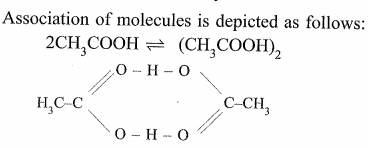
$\rightarrow$ Molecules of ethanoic acid $($acetic acid$)$ dimerise in benzene due to hydrogen bonding.
This normally happens in solvents of low dielectric constant. In this case the number of particles is reduced due to dimerisation.
Image
$\rightarrow$  It can be undoubtedly stated here that if all the molecules of ethanoic acid associate in benzene, then $\Delta T _{ b }$ or $\Delta T _{ f }$ for ethanoic acid will be half of the normal value.
$\rightarrow$ The molar mass calculated on the basis of this $\Delta T_b$ or $\Delta T_f$ will, therefore, be twice the expected value.
Such a molar mass that is either lower or higher than the expected or normal value is called as abnormal molar mass.
View full question & answer
Question 83 Marks
What is ideal Solution? Explain with examples.
Answer
→ "The solutions which follows Raoult's law over the entire range of concentration are known as ideal solutions."
→ The enthalpy of mixing of the pure components to form the solution is zero and the volume of mixing is also zero,
$\Delta_{\text {mix }} H =0 \quad \Delta_{\text {mix }} V =0$
→ It means that no heat is absorbed or evolved when the components are mixed.
→ The volume of solution would be equal to the sum of volumes of the two components.
→ At molecular level, ideal behaviour of the solutions can be explained by considering two components A and B. In pure components, the intermolecular attractive interactions will be of types A-A and B-B, where as in the binary solutions in addition to these two interactions, A-B type of interactions will also be present.
→ If the intermolecular attractive forces between the A-A and B-B are nearly equal to those between A-B, this leads to the formation of ideal solution.
→ Example of ideal solution:
→ n-hexane and n-heptane, bromoethane and chloroethane, benzene and toluene, etc.
View full question & answer