Question
Explain about crystal field theory.

Answer

1. Crystal field theory assumes that the bond between the ligand and the central metal atom is purely ionic, i.e., the bond is framed due to the electrostatic attraction between the electron rich ligand and electron deficient metal.
2. In the coordination compounds, the central metal atom/ion and the ligands are considered as point charges (or) electric dipoles.
3. cording to crystal field theory, the complex formation is considered as the following series of hypothetical steps.
Step 2:
The ligands are approaching the metal atom in actual bond directions. Consider an octahedral field, in which the central metal ion is located at the origin and six ligands are coming from the $+x,-x,+y,-y,+z$ and $-z$ directions. The orbitals lying along the axes $d x^2-y^2$ and $d z^2$ orbitals will experience strong repulsion and raise in energy to a greater extent than the orbitals with lobes directed between the axes ( $d x y, d y z$ and $d x z$ ). Thus the degenerate d orbitals now split into two sets and the process is called crystal field splitting.
Step 3: Upto this point the complex formation would not be favoured. However when the ligands approach further, there will be an attraction between the negatively charged electron and the positively charged metal ion that results in a net decrease in energy. This decrease in energy is the driving force for the complex formation.

Need a full question paper?

Generate a complete, print-ready paper with questions like this in minutes — across 16+ boards, with answer keys.
Start Generating Free

Similar questions

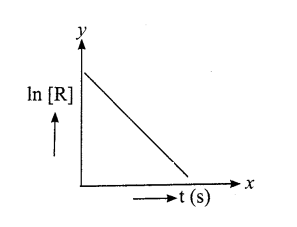
For a certain chemical reaction variation In concentration, In IRI Vs time (s) plot is given below.
For this reaction write/draw:
1. What is the order of the reaction?
2. What is the units of rate constant ( k $)$ ?
3. Give the relationship between k and $t _{1 / 2}$ (half-life period).
4. What does the slope of above line indicate?
5. Draw the plot of $\log \left[R_0\right] /[R]$ vs time (s)

Image
Convert aniline into the following compounds.
(i) N – phenyl benzamide
(ii) Phenyl isothiocyanate
(iii) 2, 4, 6 – tribromo aniline
(iv) Sulphanilinic acid
(v) Phenyl isocyanide
Explain the observations from the Ellingham diagram.
What is corrosion? Explain about the electrochemical mechanism of corrosion.
An organic compound $( A )$ of molecular formula $CH _6$ reacts with $Br _2$ in the presence of $FeCl _3$ gives $( B )$ of formula $C _6 HBr$. B on treatment with mg in the presence of dry ether gives $( C )$ compound $( C )$ on treatment with dry ice followed by hydrolysis gives a compound (D) of molecular formula $C _7 H _6 O _2$. Identify $A, B, C, D$ and explain the reactions involved.
What are the biological importance of proteins?
Convert the following.
(i) Nitro benzene → Benzene
(ii) Benzene → Benzoic acid
An organic compound $(A)$ of molecular formula $C _4 H _{10} O$ gives no colouration in Victor Meyer's test. (A) on reaction with $P / I _2$ gives (B) of formula $C _4 H _9$ I. (B) on treatment with nitrous acid gives (C) of formula $C _3 H _9 NO _2$. (C) does not react with KOH . Identify $A , B , C$ and explain.
Give reasons for each of the following :
  1. Bleaching of flowers by $Cl_2$ is permanent while by $SO_2$ is temporary.
  2. Molten aluminium bromide is a poor conductor of electricity.
  3. Nitric oxide becomes brown when released in air.
  4. $PCl_5$ is ionic in nature in the solid-state.
  5. Ammonia is a good complexing agent.
Describe briefly allotropism in p-block elements with specific reference to carbon.