Question
Explain addition of vectors.

Answer

  1. The addition of two or more vectors of same type gives rise to a single vector such that the effect of this single vector is the same as the net effect of the original vectors.
  2. It is important to note that only the vectors of the same type (physical quantity) can be added.
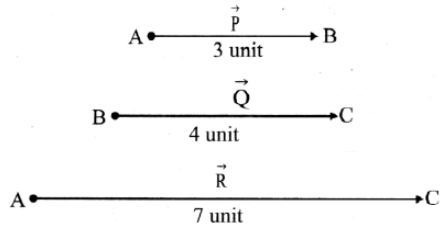
    For example, if two vectors, $\overrightarrow{ P }$ = 3 unit and $\overrightarrow{ Q }$ = 4 unit are acting along the same line, then they can be added as, $|\overrightarrow{ R }|=|\overrightarrow{ P }|+|\overrightarrow{ Q }|$
    $|\overrightarrow{ R }|=3+4=7$

Image
[Note: When vectors are not in the same direction, then they can be added using triangle law of vector addition.]

Need a full question paper?

Generate a complete, print-ready paper with questions like this in minutes — across 16+ boards, with answer keys.
Start Generating Free

Similar questions

A car travels at a speed of 50 km/hr for 30 minutes, at 30 km/hr for next 15 minutes and then 70 km/hr for next 45 minutes. What is the average speed of the car?
If the formula for a physical quantity is $X=\frac{a^4 b^3}{c^{1 / 3} d^{1 / 2}}$ and if the percentage error in the measurements of $a, b, c$ and $d$ are $2 \%, 3 \%, 3 \%$ and $4 \%$ respectively. Calculate percentage error in $X$.
The critical velocity of a satellite revolving around the Earth is $10 \ km/s$ at a height where $g_h = 8 \ m/s ^2.$ Calculate the height of the satellite from the surface of the Earth. $(R = 6.4 \times 10^6 m)$
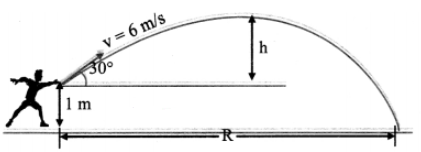
A bowler throws the ball up to correct distance by controlling his velocity and angle of throw, as shown in the figure given below
Image
i) What will be the range of the projectile?
ii) What will be the height of the projectile from ground?
An electron with charge e enters a uniform. magnetic field $\vec{B}$ with a velocity $\vec{v}$. The velocity is perpendicular to the magnetic field. The force on the charge $e$ is given by $|\vec{F}|=$ Bev Obtain the dimensions of $\vec{B}$.
State the expression for apparent frequency when source of sound and listener are
i) moving towards each other
ii) moving away from each other
What will be the change in potential energy of a body of mass $m$ when it is placed on the surface of the Earth from height $R$ above the Earth’s surface?
What will be the change in potential energy of a body of mass $m$ when it is raised from height $R_E$ above the Earth’s surface to $5/2 R_E$ above the Earth’s surface? $R_E$ and $M_E$ are the radius and mass of the Earth respectively.
A transmitting antenna at the top of a tower has a height $32\ m$ and that of the receiving antenna is $50\ m$. What is the maximum distance between them for satisfactory communication in line of sight mode? Given radius of Earth is $6.4 \times 10^6 m$.
If the velocity of sound in air at a given place on two different days of a given week are in the ratio of $1 : 1.1.$ Assuming the temperatures on the two days to be same what quantitative conclusion can your draw about the condition on the two days?