Question 13 Marks
Given: L.C. = 0.01 cm
To measure external diameter of hollow cylinder readings are taken as follows:
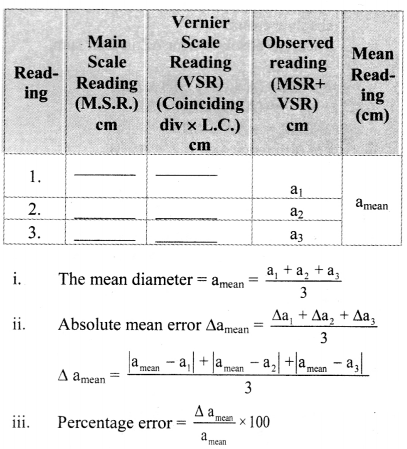
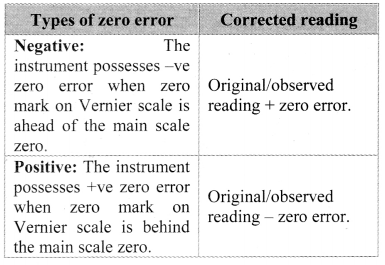
[Note: The above table is made assuming zero error in Vernier callipers. If calliper has positive or negative zero error, the zero error correction needs to be introduced into observed reading.]
Answer| No. | Scalars | Vectors |
| i. | It has magnitude only | It has magnitude as well as direction. |
| ii. | Scalars can be added or subtracted according to the rules of algebra. | Vectors are added or subtracted by geometrical (graphical) method or vector algebra. |
| iii. | It has no specific representation. | It is represented by symbol (→) arrow. |
| iv. | The division of a scalar by another scalar is valid. | The division of a vector by another vector is not valid. |
| | Example:
Length, mass, time, volume, etc. | Example:
Displacement, velocity, acceleration, force, etc. |
View full question & answer→Question 23 Marks
Using the rule for differentiation for quotient of two functions, prove that $\frac{d}{d x}\left(\frac{\sin x}{\cos x}\right)=$ $\sec ^2 x$
AnswerUsing,
$
\frac{d}{d x}\left[\frac{f_1(x)}{f_2(x)}\right]=\frac{1}{f_2(x)} \frac{d f_1(x)}{d x}-\frac{f_1(x)}{f_2^2(x)} \frac{d f_2(x)}{d x}
$
For $f_1(x)=\sin x$ and $f_2(x)=\cos x$
$
\begin{array}
\frac{ d }{ dx }\left(\frac{\sin x}{\cos x}\right) & =\frac{1}{\cos x} \times \frac{ d (\sin x)}{ dx }-\frac{\sin x}{\cos ^2 x} \times \frac{ d (\cos x)}{ dx } \\
& =\frac{1}{\cos x} \times \cos x-\frac{\sin x}{\cos ^2 x} \times(-\sin x) \\
& =1+\frac{\sin ^2 x}{\cos ^2 x}=\frac{\cos ^2 x+\sin ^2 x}{\cos ^2 x} \\
\therefore \quad \frac{ d }{ dx }\left(\frac{\sin x}{\cos x}\right) & =\frac{1}{\cos ^2 x} \quad \ldots .\left(\sin ^2 x+\cos ^2 x=1\right)
\end{array}
$
$=\sec ^2 x \quad \ldots\left(\because \frac{1}{\cos x }=\sec x \right)$
View full question & answer→Question 33 Marks
Given $\bar{v}_1=5 \hat{i}+2 \hat{j}$ and $\bar{v}_2= a \hat{i}-6 \hat{j}$ are perpendicular to each other, determine the value of $a$.
AnswerAs $\bar{v}_1$ and $\bar{v}_2$ are perpendicular to each other, $\theta=90^{\circ}$
$ \overrightarrow{ v _1} \cdot v _2=0$
$\therefore \quad(5 \hat{ i }+2 \hat{ j }) \cdot( a \hat{ i }-6 \hat{ j })=0$
$\therefore \quad(5 \hat{ i } \cdot a \hat{ i })+(2 \hat{ j } \cdot 6 \hat{ j })=0 \quad \ldots .(\because \hat{ i } \cdot \hat{ j }=\hat{ j } \cdot \hat{ i }=0)$
$\therefore \quad 5 a +(-12)=0 \quad \ldots .(\because \hat{ i } \cdot \hat{ i }=\hat{ j } \cdot \hat{ j }=1)$
$ \therefore 5 a=12$
$\therefore a=\frac{12}{5}$
Value of a is $\frac{12}{5}$.
View full question & answer→Question 43 Marks
Determine the vector product of $\overrightarrow{ v _1}=2 \hat{i}+3 \hat{j}-\hat{k}$ and $\overrightarrow{ v _2}=\hat{i}+2 \hat{j}-3 \hat{k}$ are perpendicular to each other, determine the value of $a$.
AnswerAs $\vec{A} \times \vec{B}=\left|\begin{array}{ccc}\hat{i} & \hat{j} & \hat{k} \\ A_x & A_y & A_z \\ B_x & B_y & B_z\end{array}\right|$
Using determinant to find vector product,
$\therefore \overrightarrow{v_1 \times v_2}=\left|\begin{array}{ccc}\hat{i} & \hat{j} & \hat{k} \\ 2 & 3 & -1 \\ 1 & 2 & -3\end{array}\right|$
$=[(3 \times-3)-(-1 \times 2)] \hat{i}+[(-1 \times 1)-(2 \times-3)] \hat{j}+[(2 \times 2)-(3 \times 1)] \hat{k}$
$ =[-9+2] \hat{i}+[-1+6] \hat{j}+[4-3] \hat{k}$
$ =-7 \hat{i}+5 \hat{j}+\hat{k}$
Required vector product is $-7 \hat{i}+5 \hat{j}+\hat{k}$
View full question & answer→Question 53 Marks
Show that vectors $\overrightarrow{ a }=2 \hat{ i }+3 \hat{ j }+6 \hat{ k }, \overrightarrow{ b }=3 \hat{ i }-6 \hat{ j }+2 \hat{ k }$ and $\overrightarrow{ c }=6 \hat{ i }+2 \hat{ j }-3 \hat{ k }$ are mutually perpendicular.
AnswerAs dot product of two perpendicular vectors is zero. Taking dot product of $\vec{a}$ and $\vec{b}$
$\overrightarrow{ a } \cdot \overrightarrow{ b }=(2 \hat{ i }+3 \hat{ j }+6 \hat{ k }) \cdot(3 \hat{ i }-6 \hat{ j }+2 \hat{ k })$
$ =(2 \hat{ i }+3 \hat{ i })+(3 \hat{ j } \times-6 \hat{ j })+(6 \hat{ k } \times 2 \hat{ k })$
$\ldots(\because \hat{ i } \cdot \hat{ j }=\hat{ j } \cdot \hat{ k }=\hat{ k } \cdot \hat{ i }=0)$
$=6-18+12 \quad \ldots(\because \hat{ i } \cdot \hat{ j }=\hat{ j } \cdot \hat{ k }=\hat{ k } \cdot \hat{ i }=1)$
$=0$
$\text { Similarly, } \vec{b} \cdot \vec{c}=(3 \hat{i}-6 \hat{j}+2 \hat{k}) \cdot(6 \hat{i}+2 \hat{j}-3 \hat{k})$
$=(3 \hat{ i } \times 6 \hat{ i })+(-6 \hat{ j } \times 2 \hat{ j })+(2 \hat{ k } \times-3 \hat{ k })$
$\ldots(\because \hat{ i } \cdot \hat{ j }=\hat{ j } \cdot \hat{ k }=\hat{ k } \cdot \hat{ i }=0)$
$=18-12-6 \quad \ldots(\because \hat{ i } \cdot \hat{ i }=\hat{ j } \cdot \hat{ i }=\hat{ k } \cdot \hat{ k }=1)$
$=0$
Combining two results, we can say that given three vectors $\vec{a}, \vec{b}$, and $\vec{c}$ are mutually perpendicular to each other.
View full question & answer→Question 63 Marks
Determine $\vec{a} \times \vec{b}$, given $\vec{a}=2 \hat{ i }+3 \hat{ j }$ and $\vec{b}=3 \hat{ i }+5 \hat{ j }$
AnswerUsing determinant for vectors in two dimensions,
$\overrightarrow{ a } \times \overrightarrow{ b }=\left|\begin{array}{cc}\hat{ i } & \hat{ j } \\ a _x & a _y \\ b _x & b _y\end{array}\right|=\left|\begin{array}{cc}\hat{ i } & \hat{ j } \\ 2 & 3 \\ 3 & 5\end{array}\right|$
$
=[(2 \times 5)-(3 \times 3)] \hat{ k }=(10-9) \hat{ k }=\hat{ k }
$$
\vec{a} \times \vec{b} \text { gives } \hat{ k }
$
View full question & answer→Question 73 Marks
Show that vectors $\vec{a}=2 \hat{ i }+5 \hat{ j }-6 \hat{ k }$ and $\vec{b}=\hat{ i }+\frac{5}{2} \hat{ j }-3 \hat{ k }$ are parallel.
AnswerLet angle between two vectors be $\theta$.
$ \therefore \cos \theta \ =\frac{\vec{a} \cdot \vec{b}}{|\overrightarrow{ a }||\vec{b}|}$
$ =\frac{(2 \hat{ i }+5 \hat{ j }-6 \hat{ k }) \cdot\left(\hat{ i }+\frac{5}{2} \hat{ j }-3 \hat{ k }\right)}{\sqrt{2^2+5^2+(-6)^2} \times \sqrt{1^2+\left(\frac{5}{2}\right)^2+(-3)^2}} $
$ =\frac{2+\frac{25}{2}+18}{\sqrt{65} \times \sqrt{65 / 4}}$
$=\frac{65 / 2}{65 / 2}=1$
$\Rightarrow \quad \theta=\cos ^{-1}(1)=0^{\circ}$
Alternate method:
$\vec{a}=2\left(\hat{ i }+\frac{5}{2} \hat{ j }+\hat{ k }\right)=2 \vec{b}$
Since $\vec{a}$ is a scalar multiple of $\vec{b}$, the vectors are parallel.
View full question & answer→Question 83 Marks
For $\overline{ v _1}=2 \hat{i}-3 \hat{j}$ and $\overline{ v _2}=-6 \hat{i}+5 \hat{j}$, determine the magnitude and direction of $\overline{ v _1}+\overline{ v _2}$.
Answer$\overline{ v _1}+\overline{ v _2}=(2 \hat{i}-3 \hat{j})+(-6 \hat{i}+5 \hat{j})$
$=(2 \hat{i}-6 \hat{i})+(-3 \hat{j}+5 \hat{j})$
$=-4 \hat{i}+2 \hat{j}$
$\therefore\left|\overline{ v _1}+\overline{ v _2}\right|=\sqrt{(-4)^2+2^2}=\sqrt{20}=\sqrt{4 \times 5}=2 \sqrt{5}$
$\text { Comparing } \overline{ v _1}+\overline{ v _2}, \text { with } \overrightarrow{ R }= R _{ x } \hat{i}+ R _{ y } \hat{j}$
$\Rightarrow R _{ x }=-4 \text { and } R _{ y }=2$
$\text { Taking } \theta \text { to be angle made by } \overrightarrow{ R } \text { with X-axis, }$
$\therefore \quad \theta=\tan ^{-1}\left(\frac{ R _{ y }}{ R _{ x }}\right)=\tan ^{-1}\left(\frac{2}{-4}\right)$
$=\tan ^{-1}\left(-\frac{1}{2}\right) \text { with } X-\text { axis }$
Magnitude and direction of $\overline{ v _1}+\overline{ v _2}$, is respectively $2 \sqrt{5}$ and and $\tan ^{-1}\left(-\frac{1}{2}\right)$ with $X$ - axis.
View full question & answer→Question 93 Marks
If $\overrightarrow{ v _1}=3 \hat{i}+4 \hat{j}+\hat{k}$ and $\overrightarrow{ v _2}=\hat{i}-\hat{j}-\hat{k}$, determine the magnitude of $\overrightarrow{ v _1}+\overrightarrow{ v _2}$
Answer$ \overrightarrow{ v _1}+\overrightarrow{ v _2}=(3 \hat{i}+4 \hat{j}+\hat{k})+(\hat{i}-\hat{j}-\hat{k})$
$=3 \hat{i}+3 \hat{i}+4 \hat{j}-\hat{j}+\hat{k}-\hat{k}$
$=4 \hat{i}+3 \hat{j}$
$\therefore \text { Magnitude of }\left(\overrightarrow{ v _1}+\overrightarrow{ v _2}\right),$
$\left|\overrightarrow{ v _1}+\overrightarrow{ v _2}\right|=\sqrt{4^2+3^2}=\sqrt{25}=5 \text { units. } $
Answer:
Magnitude of $\overrightarrow{ v _1}+\overrightarrow{ v _2}=5$ units.
View full question & answer→Question 103 Marks
Show that $\vec{A}=\frac{\hat{i}-\hat{j}}{\sqrt{2}}$ is a unit vector.
AnswerLet $\hat{a}$ be unit vector of $s \vec{a}$.
$\therefore \quad \hat{a}=\frac{\vec{a}}{|\vec{a}|}$
Now, $|\vec{a}|=\sqrt{a_x^2+a_y^2}=\sqrt{\left(\frac{1}{\sqrt{2}}\right)^2+\left(\frac{-1}{\sqrt{2}}\right)^2}=1$
$\therefore \quad \hat{a}=\frac{\vec{a}}{1} \Rightarrow \vec{a}$ itself is a unit vector.
View full question & answer→Question 113 Marks
A lady dropped her wallet in the parking lot of a super market. A boy picked the wallet up and ran towards the lady. He set off at $60^\circ$ to the verge, heading towards the lady with a speed of $10 \ m s^{-1},$ as shown in the diagram.
Find the component of velocity of boy directly across the parking strip.
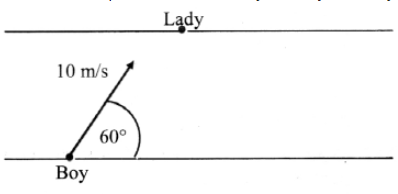
AnswerThe angle between velocity vector and the direction of path is $60^\circ .$
$\therefore$ Component of velocity across the parking strip
$= v \times \cos 60^\circ$
$= 10^{-1} \times \cos 60^\circ$
$= 5 \ m s^{-1}$
View full question & answer→Question 123 Marks
A man applies a force of 10 N on a garbage crate. If another man applies a force of 8 N on the same crate at an angle of 60° with respect to previous, then what will be the resultant force and direction of the crate, if crate is stationary.
Answer$\begin{aligned} R & =\sqrt{ F _1^2+2 F_1 F_2 \cos \theta+ F _2^2} \\ & =\sqrt{10^2+2 \times 10 \times 8 \times \cos 60^{\circ}+8^2} \\ & = 1 5 . 6 2 ~ N \\ \alpha & =\tan ^{-1}\left(\frac{ F _2 \sin \theta}{ F _1+ F _2 \cos \theta}\right) \\ & =\tan ^{-1}\left(\frac{8 \sin 60^{\circ}}{10+8 \times \cos 60^{\circ}}\right)\end{aligned}$
$\begin{aligned} & \approx \tan ^{-1}(0.5) \\ \alpha & = 2 6 . 5 6 ^ { \circ } \end{aligned}$
A resultant force of 15.62 N is applied on a crate at an angle of 26.56°.
View full question & answer→Question 133 Marks
Find the derivatives of the functions, $i. f(x) = x^8 \ \ \ \ \ ii. f(x) = x^3 + \sin x$
Answer$i.$ Using $\frac{ dx }{ dx }=n x^{ n -1}$
$\frac{d\left(x^8\right)}{d x}=8 x ^7$
$ii.$ For $f_1(x)=x^3$ and $f_2(x)=\sin x$
Using $\frac{d}{d x}\left[f_1(x)+f_2(x)\right]=\frac{d f_1(x)}{d x}+\frac{d f_2(x)}{d x}$,
$\frac{d}{d x}\left(x^3+\sin x\right)=\frac{d\left(x^3\right)}{d x}+\frac{d(\sin x)}{d x}$
$=3 x^2+\cos x$
$\cdots\left[\because \frac{d(\sin x)}{d x}=\cos x\right]$
View full question & answer→Question 143 Marks
Find the area of a triangle formed by $\overrightarrow{ A }=\hat{3} \hat{ i }-4 \hat{ j }+2 \hat{ k }$ and $\overrightarrow{ B }=\hat{ i }+\hat{ j }-2 \hat{ k }$ as adjacent sides measure in metre.
AnswerGiven: Two adjacent sides of triangle,
$\overrightarrow{ A }=3 \hat{ i }-4 \hat{ j }+2 \hat{ k }, \overrightarrow{ B }=\hat{i}+\hat{j}-2 \hat{k}$
To find: Area of triangle
Formula: Area of triangle $ = \frac{1}{2} \times \mid \text { cross product of two adjacent sides } \mid$
Calculation:
Cross product of $\vec{A}$ and $\vec{B}$ is given by, $\vec{A} \times \vec{B}$
$=\left|\begin{array}{ccc} \hat{i} & \hat{ j } & \hat{ k } \\3 & -4 & 2 \\ 1 & 1 & -2\end{array}\right|$
$=\underset{}{[(-4 \times-2)-(2 \times 1) \hat{ i }}$
$+[(2 \times 1)-(3 \times-2)] \hat{ j }+[(3 \times 1)-(-4 \times 1)] \hat{ k } \\ =(8-2) \hat{ i }+(2+6) \hat{ j }+(3+4) \hat{ k }=6 \hat{ i }+8 \hat{ j }+7 \hat{ k } \\ |\overrightarrow{ A } \times \vec{B}|=\sqrt{6^2+8^2+7^2}$
$=\sqrt{36+64+49}=\sqrt{149}$
$=12.2 \ \text{unit}$
From formula,
Area of triangle $=\frac{1}{2} \times|\overrightarrow{ A } \times \overrightarrow{ B }|=\frac{1}{2} \times 12.2=6.1 m^2$
Area of the triangle is $6.1 m^2.$
View full question & answer→Question 153 Marks
If $\overrightarrow{ A }=2 \hat{ i }-\hat{ j }+\hat{ k }$ and $\overrightarrow{ B }=\hat{ i }+2 \hat{ j }-\hat{ k }$ are two vectors, find $|\overrightarrow{ A } \times \overrightarrow{ B }|$
Answer$\vec{A} \times \vec{B}=\left|\begin{array}{ccc}\hat{i} & \hat{j} & \hat{k} \\ A_x & A_y & A_z \\ B_x & B_y & B_z\end{array}\right|$
$\therefore \quad \overrightarrow{ A } \times \overrightarrow{ B }=\left|\begin{array}{ccc}\hat{ i } & \hat{ j } & \hat{ k } \\ 2 & -1 & 1 \\ 1 & 2 & -1\end{array}\right|$
$\begin{aligned}= & {[(-1) \times(-1)-(2 \times 1) \hat{ i }]+[(1 \times 1)} \\ & -(2 \times-1)] \hat{ j }+[(2 \times 2)-(-1) \times 1)] \hat{ k } \\ = & (1-2) \hat{ i }+(1+2) \hat{ j }+(4+1) \hat{ k } \\ = & -\hat{ i }+3 \hat{ j }+5 \hat{ k }\end{aligned}$
$\begin{aligned} & |\overrightarrow{ A } \times \overrightarrow{ B }|=\sqrt{(-1)^2+(3)^2+(5)^2} \\ \therefore \quad & |\overrightarrow{ A } \times \overrightarrow{ B }|=\sqrt{35}= 5 . 9 1 \end{aligned}$
The value of $|\vec{A} \times \vec{B}|$ is 5.91
View full question & answer→Question 163 Marks
The angular momentum $\vec{L}=\vec{r} \times \vec{p}$, where $\vec{r}$ is a position vector and $\vec{p}$ is linear momentum of a body.
If $\vec{r}=4 \vec{i} \times 6 \vec{j}-3 \hat{k}$ and $\vec{p}=2 \vec{i} \times 4 \vec{j}-5 \hat{k}$, find $\vec{L}$
Answer$\vec{A} \times \vec{B}=\left|\begin{array}{ccc}\hat{i} & \hat{j} & \hat{k} \\ A_x & A_y & A_z \\ B_x & B_y & B_z\end{array}\right|$
Using determinant to find cross-product
$
\overrightarrow{ L }=\overrightarrow{ r } \times \overrightarrow{ p }=\left|\begin{array}{ccc}
\hat{ i } & \hat{ j } & \hat{ k } \\
4 & 6 & -3 \\
2 & 4 & -5
\end{array}\right|
$
$\begin{aligned} \therefore \quad \overrightarrow{ L } & =[(6 \times(-5)-(-3) \times 4] \hat{ i } \\ & +[(-3) \times 2-4 \times(-5)] \hat{ j }+[4 \times 4-6 \times 2] \hat{ k } \\ & =(-30+12) \hat{ i }+(-6+20) \hat{ j }+(16-12) \hat{ k } \\ & =- 1 8 \hat{ i }+ 1 4 \hat{ j }+ 4 \hat{ k }\end{aligned}$
$L$ is $- 1 8 \hat{ i }+ 1 4 \hat{ j }+ 4 \hat{ k }$
View full question & answer→Question 173 Marks
If $\overrightarrow{ A }=2 \hat{ i }+7 \hat{ j }+3 \hat{ k }$ and $\vec{B}=3 \hat{ i }+2 \hat{ j }+ 5 \hat{ k }$, find the component of $\overrightarrow{ A }$ along $\overrightarrow{ B }$.
AnswerLet component of $\vec{A}$ along $\vec{B}$ be $A \cos \theta$.
As $\overrightarrow{ A } \cdot \overrightarrow{ B }= AB \cos \theta= B ( A \cos \theta)$
$\therefore \quad A \cos \theta=\frac{\overrightarrow{ A } \cdot \overrightarrow{ B }}{|\overrightarrow{ B }|}$
$\begin{aligned} \overrightarrow{ A } \cdot \overrightarrow{ B } & =(2 \hat{ i }+7 \hat{ j }+3 \hat{ k }) \cdot(3 \hat{ i }+2 \hat{ j }+5 \hat{ k }) \\ & =(2 \times 3)+(7 \times 2)+(3 \times 5) \\ & =6+14+15 \\ & =35\end{aligned}$
$\begin{aligned}|\overrightarrow{ B }| & =\sqrt{3^2+2^2+5^2} \\ & =\sqrt{9+4+25} \\ & =\sqrt{38}\end{aligned}$
$\therefore \quad A \cos \theta=\frac{35}{\sqrt{38}}$
The component of $\vec{A}$ along $\vec{B}$ is $\frac{35}{\sqrt{38}}$.
View full question & answer→Question 183 Marks
Find the angle between the vectors $\overrightarrow{ A }=\hat{ i }+2 \hat{ j }-\hat{ k }$ and $\overrightarrow{ B }=-\hat{ i }+\hat{ j }- 2 \hat{ k }$
AnswerLet angle between the vectors be $\theta$
$\therefore \cos \theta=\frac{\vec{A} \cdot \vec{B}}{|\overrightarrow{ A }||\overrightarrow{ B }|}$
$|\overrightarrow{ A }|=\sqrt{1^2+2^2+(-1)^2}=\sqrt{6}$
$|\overrightarrow{ B }|=\sqrt{(-1)^2+1^2+(-2)^2}=\sqrt{6}$
$\overrightarrow{ A } \cdot \overrightarrow{ B }=1 \times(-1)+2 \times 1+(-1) \times(-2)$
$\quad=-1+2+2=3$
$\therefore \cos \theta=\frac{\vec{A} \cdot \vec{B}}{|\vec{A}||\vec{B}|}=\frac{3}{\sqrt{6} \times \sqrt{6}}$
$ \cos \theta=\frac{3}{6}=\frac{1}{2}$
$\therefore \theta=\cos ^{-1}\left(\frac{1}{2}\right)=60^{\circ}$
$\therefore \theta=60^{\circ}$
The angle between the vectors is $60^\circ .$
View full question & answer→Question 193 Marks
If $\overrightarrow{ A }=5 \hat{ i }+6 \hat{ j }+4 \hat{ k }$ and $\overrightarrow{ B }=2 \hat{ i }-2 \hat{ j }+3 \hat{ k }$ determine the angle between and.
AnswerIf $\overrightarrow{ A }=5 \hat{ i }+6 \hat{ j }+4 \hat{ k }$ and $\overrightarrow{ B }=2 \hat{ i }-2 \hat{ j }+3 \hat{ k }$ determine the angle between and.
$\begin{aligned} \vec{A} \cdot \vec{B} & =A B \cos \theta=A_x B_x+A_y B_y+A_z B_z \\ \therefore \quad \cos \theta & =\frac{A_x B_x+A_y B_y+A_z B_z}{|\vec{A}||\vec{B}| \quad }\end{aligned}$
$\cos \theta=\frac{ A _{ x } B _{ x }+ A _{ y } B _{ y }+ A _{ z } B _{ z }}{\sqrt{ A _{ x }{ }^2+ A _{ y }{ }^2+ A _z^2} \times \sqrt{ B _{ x }{ }^2+ B _{ y }{ }^2+ B _{ z }{ }^2}}$
$\begin{aligned} \cos \theta & =\frac{(5)(2)+(6)(-2)+(4)(3)}{\sqrt{25+36+16} \times \sqrt{4+4+9}} \\ & =\frac{10}{\sqrt{77} \times \sqrt{17}}=0.2764\end{aligned}$
$\theta=\cos ^{-1}(0.2764)=73^{\circ} 5 7$'
Angle between two vectors is $7 3 { }^{\circ} 57^{\prime}$
View full question & answer→Question 203 Marks
Find 'a' if $\overrightarrow{ A }=3 \hat{ i }-2 \hat{ j }+4 \hat{ k }$ and $\overrightarrow{ B }= a \hat{ i }+2 \hat{ j }-\hat{ k }$ are perpendicular to one another.
AnswerSince $\vec{A}$ and $\vec{B}$ are perpendicular to one another,$\theta=90^{\circ}$
$\begin{array}{ll}\therefore & \text { From formula, } \vec{A} \cdot \vec{B}=0 \\ \therefore & (3 \hat{i}-2 \hat{j}+4 \hat{k}) \cdot(a \hat{i}+2 \hat{j}-\hat{k})=0 \\ \therefore & (3 \times a)+[(-2) \times 2]+[4 \times(-1)]=0 \\ \therefore & 3 a-4-4=0 \\ \therefore & 3 a-8=0 \\ \therefore & 3 a=8 \\ \therefore & a=\frac{8}{3}\end{array}$
The value of $a$ is $\frac{8}{3}$.
View full question & answer→Question 213 Marks
A force $\overrightarrow{ F }=4 \hat{ i }+6 \hat{ j }+3 \hat{ k }$ acting on a particle produces a displacement of $\overrightarrow{ S }=$ $\overrightarrow{ s }=2 \hat{ i }+3 \hat{ j }+ 5 \hat{ k }$ where $F$ is expressed in newton and $s$ in metre. Find the work done by the force.
AnswerGiven: $\quad \overrightarrow{ F }=4 \hat{ i }+6 \hat{ j }+3 \hat{ k }, \vec{s}=2 \hat{ i }+3 \hat{ j }+5 \hat{ k }$
To find: $\quad$ Work done (W)
Formula: $\quad W =\overrightarrow{ F } \cdot \overrightarrow{ s }$
Calculation: From formula,
$
\begin{aligned}
W =\overrightarrow{ F } \cdot \overrightarrow{ s } & =(4 \hat{ i }+6 \hat{ j }+3 \hat{ k }) \cdot(2 \hat{ i }+3 \hat{ j }+5 \hat{ k }) \\
& =(4 \times 2)+(6 \times 3)+(3 \times 5) \\
& =8+18+15 \\
\therefore \quad W & = 4 1 J
\end{aligned}
$
The work done by the force is 41 J.
View full question & answer→Question 223 Marks
Find the scalar product of the two vectors $\overrightarrow{ v }_1=\hat{ i }+2 \hat{ j }+ 3 \hat{ k }$ and $\overrightarrow{ v }_2=3 \hat{ i }+4 \hat{ j }- 5 \hat{ k }$
AnswerFor $\begin{aligned} \vec{A} & =A_x \hat{i}+A_y \hat{j}+A_z \hat{k} \text { and } \\ \vec{B} & =B_x \hat{i}+B_y \hat{j}+B_z \hat{k}\end{aligned}$
$\vec{A} \cdot \vec{B}=A_x B_x+A_y B_y+A_z B_z$
Applying it to $\overrightarrow{ v }_1$ and $\overrightarrow{ v }_2$,
$
\begin{aligned}
\overrightarrow{ v }_1 \cdot \vec{v}_2 & =(\hat{ i }+2 \hat{ j }+3 \hat{ k }) \cdot(3 \hat{ i }+4 \hat{ j }-5 \hat{ k }) \\
& =1 \times 3+2 \times 4+3 \times(-5) \\
& =-4
\end{aligned}
$
Scalar product of two given vectors is – 4.
View full question & answer→Question 233 Marks
Given $\overrightarrow{ P }=4 \hat{ i }-\hat{ j }+8 \hat{ k }$ and $\overrightarrow{ Q }=2 \hat{ i }- m \hat{ j }+4 \hat{ k }$ find m if $\overrightarrow{ P }$ and $\overrightarrow{ Q }$ have the same direction.
AnswerSince $\overrightarrow{ P }$ and $\overrightarrow{ Q }$ have the same direction, their corresponding components must be in the same proportion, i.e.,
$\frac{P_x}{Q_x}=\frac{P_y}{Q_y}=\frac{P_z}{Q_z}$
$\frac{4}{2}=\frac{-1}{-m}=\frac{8}{4}$
$\therefore m=\frac{1}{2}$
Value of $m$ is $\frac{1}{2}$
View full question & answer→Question 243 Marks
Distinguish between scalar product (dot product) and vector product (cross product).
Answer| No | Scalar product | Vector product |
| i. | The magnitude of a scalar product is equal to the product of the magnitudes of the two vectors and the cosine of the angle between them.
$|\overrightarrow{ P } \| \overrightarrow{ Q }|= PQ \cos \theta$ | equal to the product entor product is of the magnitude of the two vectors and sine of small angle $(\theta)$ between them.
$|\overrightarrow{ P }| \times|\overrightarrow{ Q }|= PQ \sin \theta$ |
| ii. | It has no direction. | Its direction is perpendicular to the plane of the twovectors, i.e. in the of sense advancement of a right-handed screw. |
| iii. | It obeys the commutative law of vector multiplication. | It does not obey the commutative law of
vector multiplication. |
| iv. | It is zero if the two vectors are mutually perpendicular to each other. | It is zero if the two vectors are parallel or antiparallel to each other. |
| v. | The self dot- product of a vector is equal to the square of its
magnitude. | The self cross - product of a vector is zero. |
View full question & answer→Question 253 Marks
If $\overrightarrow{ A }=3 \hat{i}+4[$ [latex] $=3 \hat{j}$ and $\overrightarrow{ B }=7 \hat{i}+24 \hat{j}$, find a vector having the same magnitude as $\overrightarrow{ B }$ and parallel to $\overrightarrow{ A }$.
AnswerThe magnitude of vector $\vec{A}$ is $|\vec{A}|$
$=\sqrt{(3)^2+(4)^2}=\sqrt{9+16}=\sqrt{25}=5$
The unit vector $\hat{A}$ parallel to $\vec{A}$ is
$\frac{\vec{A}}{|\vec{A}|}=\frac{3 \hat{i}+4 \hat{j}}{5}$
The magnitude of vector $B$ is $|\vec{B}|$
$=\sqrt{7^2+24^2}=\sqrt{49+576}=\sqrt{625}=25$
Let $\vec{P}$ be the required vector, then $\frac{\vec{P}}{P}=\hat{P}$ or $\vec{P}=P \hat{P}$
Substituting $P=|\vec{B}|$ and $\hat{P}=\hat{A}$, we get,
$\therefore \quad \overrightarrow{ P }=25\left(\frac{3 \hat{ i }+4 \hat{ j }}{5}\right)=15 \hat{ i }+20 \hat{ j }$
The required vector is $15 \hat{ i }+20 \hat{ j }$.
View full question & answer→Question 263 Marks
In a cartesian co-ordinate system, the co-ordinates of two points $P$ and $Q$ are $(2, 4, 4)$ and $(-2, -3, 7)$ respectively, find $\overrightarrow{ P Q }$ and its magnitude.
AnswerGiven: Position vector of $P = (2,4,4)$
$\therefore \overrightarrow{ OP }=2 \hat{ i }+4 \hat{ j }+4 \hat{ k }$
Position vector of $Q=(-2,-3,7)$
$\overrightarrow{ OQ }=-2 \hat{i}-3 \hat{j}+7 \hat{k}$
As, $\overrightarrow{ PQ }=\overrightarrow{ OQ }-\overrightarrow{ OP }$
$\therefore \overrightarrow{ PQ }=(-2 \hat{ i }-3 \hat{ j }+7 \hat{ k })-(2 \hat{ i }+4 \hat{ j }+4 \hat{ k })$
$\therefore \overrightarrow{ PQ }=-4 \hat{ i }-7 \hat{ j }+3 \hat{ k } $
$\text { Magnitude of } \overrightarrow{ PQ },$
$|\overrightarrow{ PQ }|=\sqrt{(-4)^2+(-7)^2+(3)^2}$
$=\sqrt{16+49+9}=\sqrt{74}$
$\therefore|\overrightarrow{ PQ }|=8.6$ units
Vector $\overrightarrow{ PQ }$ is $-4 \hat{ i }-7 \hat{ j }+3 \hat{ k }$ and its magnitude is $8.6$ units.
View full question & answer→Question 273 Marks
Find the vector drawn from the point (-4, 10, 7) to the point (3, -2, 1). Also find its magnitude.
AnswerIf $\vec{A}$ is a vector drawn from the point $\left(x_1, y_1, z_1\right)$ to the point $\left(x_2, y_2, z_2\right)$, then
$\vec{A}=\left(x_2-x_1\right) \hat{i}+\left(y_2-y_1\right) \hat{j}+\left(z_2-z_1\right) \hat{k}$
Here,
$
\begin{array}{ll}
& x _1=-4, y _1=10, z _1=7, x _2=3, y _2=-2, z _2=1 \\
\therefore & \overrightarrow{ A }=[3-(-4)] \hat{ i }+(-2-10) \hat{ j }+(1-7) \hat{ k }
\end{array}
$
$\begin{array}{ll}\therefore \quad & \vec{A}= 7 \hat{ i }- 1 2 \hat{j}- 6 \hat{ k } \\ & \text { If } \vec{A}=A_x \hat{i}+A_y \hat{j}+A_z \hat{k} \text {, then magnitude of } \\ & \vec{A} \text { is given by, } A=\sqrt{A_x{ }^2+A_y{ }^2+A_z{ }^2} \\ & \text { Here } A_x=7, A_y=-12, A_z=-6 \\ \therefore \quad & A=\sqrt{7^2+(-12)^2+(-6)^2} \\ & =\sqrt{49+144+36}=\sqrt{229}= 1 5 . 1 3 \text { units }\end{array}$
The vector drawn is $7 \hat{ i }- 1 2 \hat{ j }- 6 \hat{k}$ and its magnitude is $1 5 . 1 3$ units.
View full question & answer→Question 283 Marks
What are components of a vector?
Answer$1.$ The given vector can be written as sum of two or more vectors along certain fixed directions. The vectors into which the given single vector is splitted are called components of the vector.
$2.$ Let $\overrightarrow{ A }= A _1 \hat{\alpha}+ A _2 \hat{\beta}+ A _3 \hat{\gamma}$ where, $\hat{\alpha}, \hat{\beta}$ and $\hat{\gamma}$ are unit vectors along chosen directions. Then, $A_1, A_2$ and $A_3$ are known as components of $\overrightarrow{ A }$ along three directions $\hat{\alpha}, \hat{\beta}$ and $\hat{\gamma}$.
$3.$ It two vectors are equal then, their corresponding components are also equal and vice$-$versa.
If $\vec{A}=\vec{B}$
i.e., if $A_x \hat{i}+A_y \hat{j}+A_z \hat{k}=B_x \hat{i}+B_y \hat{j}+B_z \hat{k}$, then $A_x=B_x, A_y=B_y$ and $A_z=B_z$
$[$Note: The magnitude of a vector is a scalar while each component of a vector is always a vector.$]$
View full question & answer→Question 293 Marks
Rain is falling vertically with a speed of 35 m/s. Wind starts blowing at a speed of 12 m/s in east to west direction. In which direction should a boy waiting at a bus stop hold his umbrella? (NCERT)
AnswerLet the velocity of rain and wind be $\overrightarrow{ V _{ R }}$ and $\overrightarrow{ V _{ W }}$, then resultant velocity $\overrightarrow{ v }$ has magnitude of
$\begin{aligned}|\vec{v}| & =\sqrt{v_{ R }^2+v_w^2} \\ & =\sqrt{35^2+12^2} \\ & =37 m / s \end{aligned}$
If $\vec{v}$ makes an angle $\theta$ with vertical then, from the figure
$\begin{aligned} \tan \theta & =\frac{ v _{ w }}{ v _{ R }}=\frac{12}{35}=0.343 \\ → \theta & =\tan ^{-1}(0.343) \\ & \approx 19^{\circ}\end{aligned}$
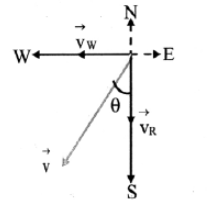
The boy should hold his umbrella in vertical plane at an angle of about 19° with vertical towards the east. View full question & answer→Question 303 Marks
Find unit vector parallel to the resultant of the vectors $\overrightarrow{ A }=\hat{ i }+4 \hat{ j }-2 \hat{ k }$ and $\overrightarrow{ B }=3 \hat{ i }-5 \hat{ j }+\hat{ k }$
AnswerThe resultant of $\vec{A}$ and $\vec{B}$ is,
$
\begin{aligned}
\vec{R} & =\vec{A}+\vec{B}=(\hat{i}+4 \hat{j}-2 \hat{k})+(3 \hat{i}-5 \hat{j}+\hat{k}) \\
& =(1+3) \hat{i}+(4-5) \hat{j}+(1-2) \hat{k}
\end{aligned}
$
$=4 \hat{i}-\hat{j}-\hat{k}$
$
\begin{aligned}
|\vec{R}| & =\sqrt{4^2+(-1)^2+(-1)^2} \\
& =\sqrt{16+1+1}=\sqrt{18}=3 \sqrt{2}
\end{aligned}
$
The unit vector parallel to $\vec{R}$ is,
$\hat{R}=\frac{\vec{R}}{|\vec{R}|}=\frac{1}{3 \sqrt{2}}(4 \hat{i}-\hat{j}-\hat{k})$
The required unit vector is $\frac{1}{3 \sqrt{2}}(4 \hat{ i }-\hat{ j }-\hat{ k })$
View full question & answer→Question 313 Marks
If $\overrightarrow{ P }=2 \hat{ i }+3 \hat{ j }-\hat{ k }$ and $\overrightarrow{ Q }=2 \hat{ i }-5 \hat{ j }+2 \hat{ k }$. Find
$i. \overrightarrow{ P }+\overrightarrow{ Q }$
$ii. 3 \overrightarrow{ P }-2 \overrightarrow{ Q }$
AnswerGiven $\overrightarrow{ P }=2 \hat{ i }+3 \hat{ j }-\hat{ k }, \overrightarrow{ Q }=2 \hat{ i }-5 \hat{ j }+2 \hat{ k }$
To find:
$i. \overrightarrow{ P }+\overrightarrow{ Q }$
$ii. 3 \overrightarrow{ P }-2 \overrightarrow{ Q }$
Calculation:
$\text { i. } \overrightarrow{ P }+\overrightarrow{ Q }=(2 \hat{ i }+3 \hat{ j }- k )+(2 \hat{ i }-5 \hat{ j }+2 k)$
$=(2+2) \hat{ i }+(3-5) \hat{ j }+(-1+2) \hat{ k }$
$=4 \hat{ i }-2 \hat{ j }+\hat{ k }$
$\text { ii. } 3 \overrightarrow{ P }=3(2 \hat{ i }+3 \hat{ j }-\hat{ k })=6 \hat{ i }+9 \hat{ j }-3 \hat{ k }$
$2 \overrightarrow{ Q }=2(2 \hat{ i }-5 \hat{ j }+2 \hat{ k })=4 \hat{ i }-10 \hat{ j }+4 \hat{ k }$
$ \therefore 3 \overrightarrow{ P }-2 \overrightarrow{ Q } =(6 \hat{ i }+9 \hat{ j }-3 \hat{ k })-(4 \hat{ i }-10 \hat{ j }+4 \hat{ k })$
$ =6 \hat{ i }+9 \hat{ j }-3 \hat{ k }-4 \hat{ i }+10 \hat{ j }-4 \hat{ k }$
$\therefore 3 \vec{P}-2 \vec{Q}=2 \hat{i}+19 \hat{j}-7 \hat{k}$
i. $ \vec{P}+\vec{Q}$ is $4 \hat{i}-2 \hat{j}+\hat{k}$
ii. $ 3 \vec{P}-2 \vec{Q}$ is $2 \hat{i}+19 \hat{j}-7 \hat{k}$.
View full question & answer→Question 323 Marks
Find the vector that should be added to the sum of $(2 \hat{ i }-5 \hat{ j }+3 \hat{ k })$ and $(4 \hat{ i }+7 \hat{ j }-4 \hat{ k })$ to give a unit vector along the X-axis.
AnswerLet vector $\overrightarrow{ p }$ be added to get unit vector $(\hat{ i })$ along X -axis.
Sum of given vectors is given as,
$(2 \hat{ i }-5 \hat{ j }+3 \hat{ k })+(4 \hat{ i }+7 \hat{ j }-4 \hat{ k })=6 \hat{ i }+2 \hat{ j }-\hat{ k }$
According to given condition, $(6 \hat{ i }+2 \hat{ j }-\hat{ k })+\hat{ P }=\hat{ i }$
$\therefore \overrightarrow{ P }=\hat{ i }-(6 \hat{ i }+2 \hat{ j }-\hat{ k })=\hat{ i }-6 \hat{ i }-2 \hat{ j }+\hat{ k }=-5 \hat{ i }-2 \hat{ j }+\hat{ k }$
The required vector is $-5 \hat{ i }-2 \hat{ j }+\hat{ k }$.
View full question & answer→Question 333 Marks
If $|\overrightarrow{ A }+\overrightarrow{ B }|=|\overrightarrow{ A }-\overrightarrow{ B }|$ then what can be the angle between $\overrightarrow{ A }$ and $\overrightarrow{ B }$ ?
AnswerLet $\theta$ be the angle between $\overrightarrow{ A }$ and $\overrightarrow{ B }$, then $|\vec{A}+\vec{B}|^2=A^2+B^2+2 A B \cos \theta$
Also the angle between $\vec{A}$ and $-\vec{B}$ is $\left(180^{\circ}-\theta\right)$
Hence $|\vec{A}+\vec{B}|^2=A^2+B^2+2 A B \cos \left(180^{\circ}-\theta\right)$
$=A^2+B^2-2 A B \cos \theta$
As $|\vec{A}+\vec{B}|=|\vec{A}-\vec{B}|$, we can equate above 'two equations, $2 AB \cos \theta=-2 AB \cos \theta$
$ → 4 AB \cos \theta=0$
Assuming $\vec{A}$ and $\vec{B}$ as non-zero vector, we get, $\cos \theta=0$
$→ \theta=90^{\circ}$
Thus, if $|\vec{A}+\vec{B}|=|\vec{A}-\vec{B}|$, then vectors $\vec{A}$ and $\vec{B}$ must be at right angles to each other.
View full question & answer→Question 343 Marks
Complete the table for two vectors $\overrightarrow{ P }$ and $\overrightarrow{ Q }$ inclined at angle θ.
| | $\theta$ | Resultant
vector
$(\vec{R})$ | Direction of
resultant
vector with
$\vec{P}(\alpha)$ |
| i. | 0^(@) | ----------- | ---------- |
| ii. | 90^(@) | ----------- | --------- |
| iii. | 180^(@) | ----------- | --------- |
Answer| | $\theta$ | Resultant
vector
$(\vec{R})$ | Direction of
resultant
vector with
$\vec{P}(\alpha)$ |
| i. | 0^(@) | $P+Q$ | 0 |
| ii. | 90^(@) | $\sqrt{ P ^2+ Q ^2}$ | $\tan^{-1}\left(\frac{Q}{P}\right)$ |
| iii. | 180^(@) | $P - Q$ | 0 |
View full question & answer→Question 353 Marks
Using triangle law of vector addition, explain the process of adding two vectors which are not lying in a straight line.
Answeri. Two vectors in magnitude and direction are drawn in a plane as shown in figure (a)
Let these vectors be $\overrightarrow{ P }$ and $\overrightarrow{ Q }$
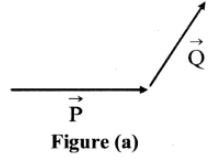
ii. Join the tail of $\vec{Q}$ to head of $\vec{P}$ in the given direction. The resultant vector will be the line which is obtained by joining tail of $\vec{P}$ to head of $\vec{Q}$ as shown in figure (b).
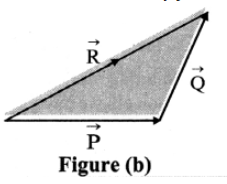
iii. If $\vec{R}$ is the resultant vector of $\vec{P}$ and $\vec{Q}$ then using triangle law of vector addition, we have, $\vec{R}=\overrightarrow{ P }+\overrightarrow{ Q }$ View full question & answer→Question 363 Marks
What is triangle law of vector addition?
AnswerTriangle law of vector addition:
If two vectors describing the same physical quantity are represented in magnitude and direction, by the two sides of a triangle taken in order, then their resultant is represented in magnitude and direction by the third side of the triangle drawn in the opposite sense, i.e., from the starting point (tail) of the first vector to the end point (head) of the second vector.
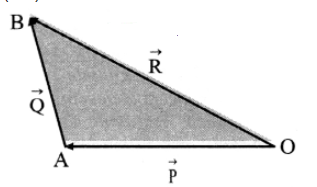
Let $\overrightarrow{ P }$ and $\overrightarrow{ Q }$ be the two vectors of same type taken in same order as shown in figure.
$\qquad$ $\therefore$ Resultant vector will be given by third side taken in opposite order, i.e., $\overline{ OA }+\overline{ AB }=\overline{ OB }$
$\therefore \overrightarrow{ P }+\overrightarrow{ Q }=\overrightarrow{ R }$ View full question & answer→Question 373 Marks
Explain subtraction of vectors.
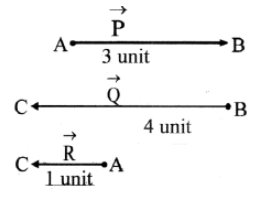
Answer- When two vectors are anti-parallel (in the opposite direction) to each other, the magnitude
- It is important to note that only vectors of the same type (physical quantity) can be subtracted.
- For example, if two vectors $\overrightarrow{ P }$ = 3 unit and $\overrightarrow{ Q }$ = 4 unit are acting in opposite direction,they are subtracted as,$|\overrightarrow{ R }|=\|\overrightarrow{ P }|-| \overrightarrow{ Q }\|$
$=|3-4|=1$ unit, directed along $\overrightarrow{Q}$
View full question & answer→Question 383 Marks
Explain addition of vectors.
Answer- The addition of two or more vectors of same type gives rise to a single vector such that the effect of this single vector is the same as the net effect of the original vectors.
- It is important to note that only the vectors of the same type (physical quantity) can be added.
For example, if two vectors, $\overrightarrow{ P }$ = 3 unit and $\overrightarrow{ Q }$ = 4 unit are acting along the same line, then they can be added as, $|\overrightarrow{ R }|=|\overrightarrow{ P }|+|\overrightarrow{ Q }|$
$|\overrightarrow{ R }|=3+4=7$
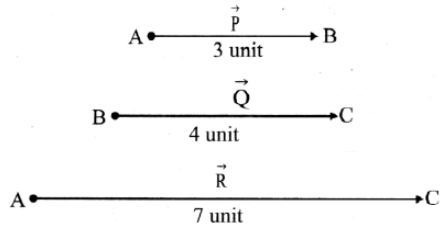
[Note: When vectors are not in the same direction, then they can be added using triangle law of vector addition.] View full question & answer→Question 393 Marks
Define unit vector and give its physical significance.
AnswerUnit vector: A vector having unit magnitude in a given direction is called a unit vector in that direction.
If $\vec{p}$ is a non zero vector $(P \neq 0)$ then the unit vector $\hat{ u }_{ p }$ in the direction of $\overrightarrow{ P }$ is given by,
$\hat{ u }_{ p }=\frac{\overrightarrow{ P }}{ P }$
$\therefore \overrightarrow{ P }=\hat{u}_p P$
Significance of unit vector:
$i.$ The unit vector gives the direction of a given vector.
$ii.$ Unit vector along $X, Y$ and $Z$ direction of a rectangular (three dimensional) coordinate is represented by $\hat{ i }, \hat{ j }$ and $\hat{ k }$ respectively Such that $\hat{ u }_x=\hat{ i }, \hat{ u }_y=\hat{ j }$ and $\hat{ u }_z=\hat{ k }$
This gives $\hat{i}=\frac{\vec{X}}{X}, \hat{j}=\frac{\vec{Y}}{X}$ and $\hat{k}=\frac{\vec{Z}}{Z}$
View full question & answer→Question 403 Marks
A vector has both magnitude and direction. Does it mean that anything that has magnitude and direction is necessarily a vector?
Answer- For a physical quantity, only having magnitude and direction is not a sufficient condition to be a vector.
- A physical quantity also has to obey vectors law of addition to be termed as vector.
- Hence, anything that has magnitude and direction is not necessarily a vector.
Example: Though current has definite magnitude and direction, it is not a vector.
View full question & answer→