Question
Explain aldol condensation with suitable example. ### Write a short note: Aldol condensation.

Answer

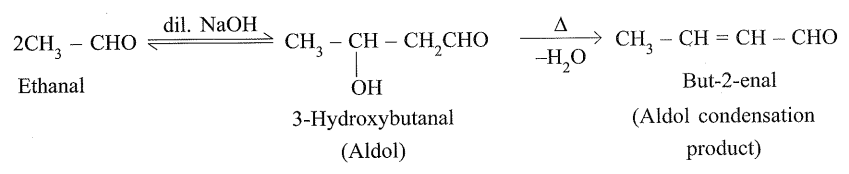
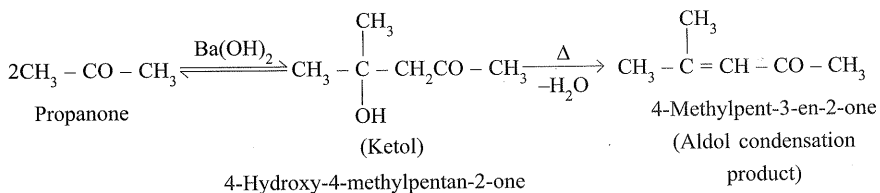
→ Aldol condensation: "Aldehydes and ketones having at least one a-hydrogen undergo a reaction in the presence of dilute alkali as catalyst to form ẞ-hydroxy aldehydes (aldol) or ẞ-hydroxy ketones (ketol), respectively. This is known as Aldol reaction."
Image
Image
→ The name aldol is derived from the names of the two functional groups, aldehyde and alcohol, present in the products. The aldol and ketol readily lose water to give $\alpha$, ẞ-unsaturated carbonyl compounds which are aldol condensation products and the reaction is called Aldol condensation. Though ketones give ketols (compounds containing a keto and alcohol groups), the general name aldol condensation still applies to the reactions of ketones due to their similarity with aldehydes.

Need a full question paper?

Generate a complete, print-ready paper with questions like this in minutes — across 16+ boards, with answer keys.
Start Generating Free

Similar questions

How will you convert bromobenzene to benzoic acid?
Write the reaction of methyl amine with the following :
(i) $HAuCl _4$
(ii) $H _2 PtCl _6$
(iii) $CH _3 COCl$
(iv) $C _6 H _5 COCl$
Account for the following:
  1. $CuCl_2$ is more stable than $Cu_2Cl_2.$
  2. Atomic radii of $4d$ and $5d$ series elements are nearly same.
  3. Hydrochloric acid is not used in permanganate titrations.
What happens when D-glucose is treated with the following reagents?
(i) HI, (ii) Bromine water.
Lanthanum, gadolinium and lutetium are extraordinarily stable in $+3$ oxidation state. Explain. $($Atomic number$: La = 57, Gd = 64, Lu = 71)$
The rate constant for the decomposition of ethyl iodide $\ce{C_2H_5l(g) \rightarrow C_2H_4(g)+Hl(g)}$
at $600K$ is $1.60 \times 10^{-5} s^{-1} .$ Its energy of activation is $\ce{209 kJ/mol}.$ Calculate the rate constant of the reaction at $700K.$
Give information about $\ce{C-O-H}$ bond angle in alcohol, phenol and ether with suitable example.
Explain dehydration of alcohols with chemical equations. And also give the order for relative ease of dehydration of alcohols.
The decomposition of A into product has value of k as $4.5\times10^{3}s^{-1}$ at $10^{\circ}C$ and energy of activation $60~kJ~mol^{-1}$. At what temperature would k be $1.5\times10^{10}s^{-1}$?
Complete the following giving the structures of major organic products.
$(\text{CH}_3)_3-\text{C}-\text{CH}_2-\text{Br}\xrightarrow[\Delta]{\text{C}_2\text{H}_5\text{ONa}/\text{C}_2\text{H}_5\text{OH}}\ ........$