Question
Give information about $\ce{C-O-H}$ bond angle in alcohol, phenol and ether with suitable example.
Answer

$\rightarrow$ In alcohols, the oxygen of $-OH$ group is attached to carbon by a sigma $(\sigma)$ bond formed by the overlap of an $sp^3$ hybridised orbital of carbon with $sp^3$ hybridised orbital of oxygen.
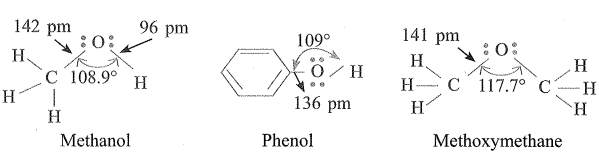
$\rightarrow $ Figure depicts structural aspects of methanol, phenol and methoxymethane.
Image
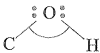
$\rightarrow$ The bond angle​​​​​​​ Imagein alcohols is slightly less than the tetrahedral angle $(109^\circ -28\ ').$
$\rightarrow$ It is due to the repulsion between the unshared electron pairs of oxygen.
$\rightarrow$ In phenols, the $OH$ group is attached to $sp^2$ hybridised carbon of an aromatic ring.
$\rightarrow$ The carbon$-$oxygen bond length $\ce{(136 pm)}$ in phenol is slightly less than that in methanol.
$\rightarrow$ This is due to
$(i)$ partial double bond character on account of the conjugation of unshared electron pair of oxygen with the aromatic ring and
$(ii) sp^2$ hybridised state of carbon to which oxygen is attached.
$\rightarrow$ In ethers, the four electron pairs, i.e., the two bond pairs and two lone pairs of electron on oxygen are arranged approximately in a tetrahedral arrangement.
$\rightarrow$ The bond angle is slightly greater than the tetrahedral angle due to the repulsive interaction between the two bulky $(-R)$ groups.
$\rightarrow$ The $C-O$ bond length $\ce{(141 pm)}$ is almost the same as in alcohols.

Need a full question paper?

Generate a complete, print-ready paper with questions like this in minutes — across 16+ boards, with answer keys.

Start Generating Free

Similar questions

Give Uses of aldehydes and ketones
After 24 hrs. Only 0.125gm out of the initial quantity of 1gm of a radioactive isotope remains behind. What is its half life period?
The first order rate constant for the decomposition of ethyl iodide by the reaction
$C_2H_5I(g) \rightarrow C_2H_4(g) + HI(g)$
at $600\ K$ is $1.60 \times 10^{-2} s^{-1}$. Its energy of activation is $209\ kJ/mol.$ Calculate the rate constant of the reaction at $700 Κ.$
How would you achieve the following conversions:
  1. Nitrobenzene to aniline.
  2. An alkyl halide to a quaternary ammonium salt.
  3. Aniline to benzonitrile.
Write the chemical equation with reaction conditions in each case.
Following compounds are given to you:
$2-$Bromopentane, $2-$Bromo$-2-$methylbutane, $1-$Bromopentane
  1. Write the compound which is most reactive towards $S_N2$ reaction.
  2. Write the compound which is optically active.
  3. Write the compound which is most reactive towards $\beta-$elimination reaction.
Define the term solution. How many types of solutions are formed? Write briefly about each type with an example.
  1. Write the structural difference between starch and cellulose.
  2. What type of linkage is present in Nucleic acids?
  3. Give one example each for fibrous protein and globular protein.
Predict the order of reactivity of the following compounds in $S_N1$ and $S_N2$ reactions: $\ce{C_6H_5CH_2Br, C_6H_5CH(C_6H_5)Br, C_6H_5CH(CH_3)Br, C_6H_5C(CH_3)(C_6H_5)Br}.$
How many electrons flow through a metallic wire if a current of 0.5 A is passed for 2 hours.
The rate constant for the decomposition of ethyl iodide $\ce{C_2H_5l(g) \rightarrow C_2H_4(g)+Hl(g)}$
at $600K$ is $1.60 \times 10^{-5} s^{-1} .$ Its energy of activation is $\ce{209 kJ/mol}.$ Calculate the rate constant of the reaction at $700K.$