Question
Explain any two X-linked recessive disorder?

Answer

X-Linked recessive disorder:
→ (i) colourblindness, (ii) Haemophilia.
→ (i) Colour Blindness:
→ It is a sex-linked recessive disorder due to defect in either red or green cone of eye resulting in failure do discriminate between red and green colour.
→ This defect is due to mutation in certain genes present in the X-chromosomes.
→ It occurs in about 8 per cent of males and only about 0.4 per cent of females.
→ This is because the genes that lead to red-green colour blindness are on the X-chromosomes. Males have only one X-chromosomes and females have two.
→ The son of a woman who carries the gene has a 50 per cent chance of being colour blind.
→ The mother is not herself colour blind because the gene is recessive. That means that its effect is suppressed by her matching dominant normal
gene.
→ A daughter will not normally be colour blind, unless her mother is a carrier and her father is colour blind.
→ (ii) Haemophilia:
→ This sex linked recessive disease, which shows its transmission from unaffected carrier female to some of the male progeny has been widely studied.
→ In this disease, a single protein that is a part of the cascade of proteins involved in the clotting of blood is affected.
→ Due to this, in an affected individual a simple cut will result in non-stop bleeding.
→ The heterozygous female (carrier) haemophilia may transmit the disease to sons.
→ The possibility of a female becoming a haemophilic is extremely rare because mother of such a female has to be at least a carrier and the father should be haemophilic (unviable in the later stage of life.)
→ The family pedigree of Queen Victoria shows a number of haemophilic descendents as she was a carrier of the disease.

Need a full question paper?

Generate a complete, print-ready paper with questions like this in minutes — across 16+ boards, with answer keys.
Start Generating Free

Similar questions

Explain packaging of DNA Helix###Explain the formation of nucleosome in Eukaryotic cell
Loss of habitat and fragmentation leads to loss in biodiversity. Explain with example.
Microbes are useful in household products. Explain this with suitable examples
Explain the life cycle of Plasmodium (with diagram).
Read the following and answer any four questions from (i) to (v) given below:

Pollen-pistil interaction is the group of events that occur from the time of pollen deposition over the stigma to the time of pollen tube entry into ovule. It is a dynamic process which has checks at several places for promotion or inhibition of pollen growth. Pollen-pistil interaction is a safety measure to ensure that illegitimate crossings do not occur. Compatibility and incompatibility of the pollen-pistil is determined by special proteins. The compatible pollens are able to absorb water and nutrients from the surface of the stigma. They germinate and produce pollen tubes. Pollen tubes grow into the style. Their growth and path through the style are also determined by specific chemicals.

  1. Which of the following parts of gynoecium determines the compatible nature of pollen?
  1. Stigma.
  2. Style.
  3. Ovary.
  4. Thalamus.
  1. In Triforium, which type of self-incompatibility is found?
  1. Gametophytic self-incompatibility (GSI).
  2. Sporophytic self-incompatibility (SSI).
  3.  Both GSI and SSI.
  4. None of these.
  1. Select the incorrect statement.
  1. In Asteraceae, incompatibility is due to the genotype of the sporophytic stigmatic tissues.
  2. In members of Brassicaceae, incompatibility is due to the genotype of the pollen.
  3. Nature has imposed self-incompatibility to avoid highly homozygous individuals, which have a very low survival value.
  4. None of these.
  1. Which of the following are examples of self incompatibility?
  1. Tobacco.
  2. Potato.
  3. Crucifers.
  4. All of these.
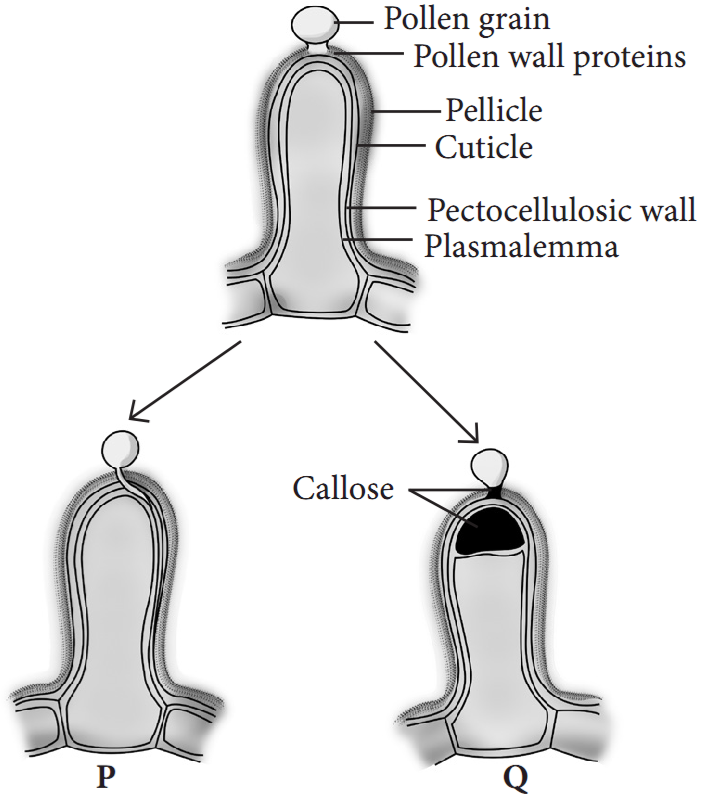
  1. Given figures show the pollen-stigma interaction, where pollen wall proteins are released onto the pellicle of stigmatic papillae, where a recognition reaction occurs.

Which of the following statements drawn from given figures is incorrect?

  1. P indicates compatible reaction in which the pollen tube penetrates the cuticle and grows down the papilla.
  2. Development of callose plug between the plasma membrane and pectocellulosic layer of stigmatic papillae results in the incompatibility reaction in Q.
  3. A callose plug, which appears at the tip of pollen in Q, is dissolved by callase enzyme secreted by stigma resulting in compatibility reaction.
  4. Deposition of callose can be employed as a reliable bioassay to detect compatibility or incompatibility reactions of pollen and stigma.
Read the following and answer any four questions from (i) to (v) given below:

Rohan, a 13 year old school student, has been diagnosed with AIDS. He often complains of fever, nausea, headache and lethargy. Doctor advised some drugs to prolong his life.

  1. What could be the most likely mode of transmission of disease to Rohan?
  1. Artificial insemination.
  2. Sexual intercourse with infected partner.
  3. Sexual intercourse with infected partner.
  4. Use of contaminated blade.
  1. Name the drug prescribed for treatment of this disease.
  1. Zidovudine.
  2. Taxol.
  3. Vinblastine.
  4. Both (a) and (c).
  1. Assertion: AIDS is an incurable STD.

Reason: AIDS virus attacks helper T-lymphocytes.

  1. Both assertion and reason are true, and reason is the correct explanation of assertion.
  2. Both assertion and reason are true, but reason is not the correct explanation of assertion.
  3. Assertion is true, but reason is false.
  4. Both assertion and reason are false.
  1. AIDS cannot be diagnosed by:
  1. ELISA.
  2. PCR.
  3. Western blotting.
  4. VDRL.
  1. AIDS can be transmitted by:
  1. Sharing towels.
  2. Kissing.
  3. Sharing contaminated needles.
  4. All of these.
Read the following and answer any four questions from (i) to (v) given below:
Wetlands are called Ramsar sites because the first international convention on their conservation was held in Ramsar in Iran in 1971. Wetlands or Ramsar sites are low lying marshy areas which get filled up during rains due to runoff and overflow from other water bodies. They are often considered to be waste lands which are used as dumping areas and filled up to recover land for various constructions activities. As a result, a large number of wetlands have disappeared.
  1. Select the incorrect match of wetland and its location.
 
Wetland
Location
(a)
Harike
Punjab
(b)
Chandra Tai
H.P.
(c)
Bhoj
M.P.
(d)
Ashtamudi
Odisha
  1. Migratory bird flamingo breeds in which of the following wetlands?
  1. Bhitarkanika Mangroves.
  2. Rann of Kutch.
  3. Harike.
  4. Chandra Tal.
  1. Which of the following is not an importance of wetlands?
  1. They are an important source of recharging groundwater.
  2. They provide protection from floods.
  3. They are good source of siltation and purification of water.
  4. None of these.
  1. Which of the following wetland ecosystem is highly acidic and has a accumulation of decomposed plants known as peat?
  1. Bog
  2. Mangrove
  3. Estuary
  4. Watershed
  1. The mangroves of Bhitarkanika are famous for:
  1. Rare migratory waterbirds.
  2. Nesting sites for endangered olive ridley turtles.
  3. Prawn cultivation.
  4. All of these.
Read the following and answer any four questions from (i) to (v) given below:

Age sex structure of a population can be depicted in the form of a pyramid by plotting the percentage of population of each sex in each age class. Two age sex pyramids are as follows.

  1. Which of the following is correct regarding pyramid B?
  1. It represents stable population.
  2. It represents expanding population.
  3. It represents declining population.
  4. Both (a) and (b).
  1. Total number of individuals of a species per unit area per unit time is called.
  1. Population size.
  2. Population density.
  3. Demography.
  4. Population dynamics.
  1. Which of the following is correct regarding age sex pyramid A and B?
  1. A represents the age sex pyramid of developed country.
  2. B represents the age sex pyramid of developing country.
  3. A represents rapidly growing population.
  4. Both (a) and (b).
  1. A population with a large proportion of older individuals than younger ones will likely to:
  1. Grow larger first and then decline.
  2. Continue to grow indefinitely.
  3. Decline.
  4. None of these.
  1. Assertion: Bell shaped age pyramid represents a stable population.

Reason: ln a stable population, proportion of individuals in reproductive age group is higher than the individuals in pre reproductive age group.

  1. Both assertion and reason are true and reason is the correct explanation of assertion.
  2. Both assertion and reason are true but reason is not the correct explanation of assertion.
  3. Assertion is true but reason is false.
  4. Both assertion and reason are false.
Read the following and answer any four questions from (i) to (v) given below:

Study the given table and answer the questions based on it.

 
Hormone
Source
Function
(A)
Oxytocin
W
Ejection of milk
(B)
X
Anterior lobe of pituitary gland
Stimulates secretion of ABP from Sertoli cells
(C)
Y
Placenta
Maintains corpus luteum to secrete progesterone
(D)
Relaxin
Ovary
Z
  1. Identify the hormones X and Y, respectively.
  1. Testosterone, FSH.
  2. LH, hPL.
  3. FSH, hCG.
  4. ICSH, hCG.
  1. W in the given table is:
  1. Hypothalamus.
  2. Posterior lobe of pituitary.
  3. Placenta.
  4. Ovary.
  1. Which of the following is correct for Z?
  1. Dilation of uterine cervix during labour pains.
  2. Stimulates the growth of the mammary glands during pregnancy.
  3. Supports the fetal growth and prevents desiccation.
  4. Forms protective plug in cervix of uterus during pregnancy.
  1. Which set of hormones is secreted only during pregnancy?
  1. Human chorionic gonadotropin, relax in and human placental lactogen.
  2. Human placental lactogen, estrogen and chorionic thyrotropin.
  3. Human chorionic gonadotropin, human placental lactogen and progesterone.
  4. Chorionic thyrotropin, chorionic gonadotropin and estrogen.
  1. Assertion: Follicle stimulating hormone controls the maintenance and functions of male reproductive organs.

Reason: FSH acts directly on spermatogonia to stimulate sperm production.

  1. Both assertion and reason are true, and reason is the correct explanation of assertion.
  2. Both assertion and reason are true, but reason is not the correct explanation of assertion.
  3. Assertion is true, but reason is false.
  4. Both assertion and reason are false.
Read the following and answer any four questions from (i) to (v) given below:
RNA or ribonucleic acid is a single chain polyribonucleotide which functions as carrier of coded genetic or hereditary information from DNA to cytoplasm for taking part in protein and enzyme synthesis. Six types of RNAs are ribosomal, transfer, messenger, genomic, small nuclear and small cytoplasmic RNA. Out of these, rRNA, mRNA and tRNA are major classes of RNAs that are involved in gene expression.
  1. Which one is referred to a soluble RNA?
  1. mRNA
  2. tRNA
  3. rRNA
  4. hnRNA
  1. The RNA that picks up specific amino acid from amino acid pool in the cytoplasm to ribosome during protein synthesis is?
  1. rRNA
  2. hnRNA
  3. mRNA
  4. tRNA
  1. Which of the following is found in both DNA and messenger RNA?
  1. Double helix structure
  2. Ribose
  3. Sugar-phosphate chain
  4. Thymine
  1. Which of the following statements regarding RNA is correct?
  1. Messenger RN As carries coded information for synthesis of polypeptide.
  2. Ribosomal RNAs bind with tRNA to catalyse the formation of phosphodiester bonds.
  3. Genomic RNA is always single stranded.
  4. Synthesis of rRNA occurs in cytoplasm by RNA polymerase III
  1. In studying a virus, you find the following proportions of nitrogenous bases present: adenine 23%, guanine 37%, cytosine 23% uracil 17%. Which of the following statement(s) regarding this virus is/are correct?
  1. It probably uses RNA as its genetic material.
  2. The genetic material of this virus is probably single stranded.
  3. Base pairing rules in virus in this virus include adenine: cytosine.
  1. I only
  2. I and II only
  3. II and III only
  4. All of these.
