Question
Explain the life cycle of Plasmodium (with diagram).

Answer

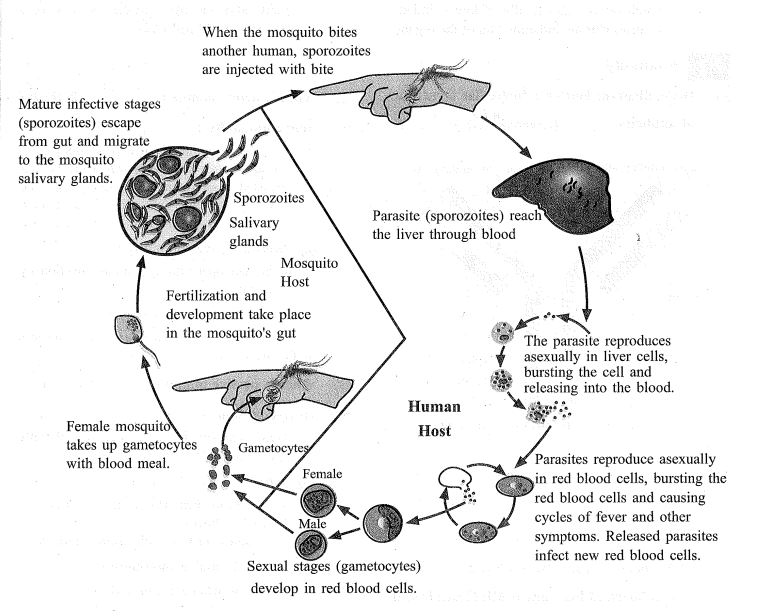
Plasmodium enters the human body in the form of sporozoites when an infected female Anopheles mosquito bites a human.
→Initially this parasite multiplies in the liver cells and then invades the blood cells causing RBC's to rupture.
→Rupture of RBC releases a toxic substance called hemozoin, which causes chills and high fever for 3 to 4 days.
→At this stage, when a female Anopheles mosquito bites an infected person, the parasite enters the mosquito's body, where it develops further.
→There they multiply and form sporozoites.
→This sporozoite is stored in the salivary gland of the mosquito.
When this infected female mosquito bites a person, the parasite enters her body and develops.
→Malaria parasite requires two hosts to complete its life cycle,
(1) Man,(2) Mosquitoes.
→Reproduction in Plasmodium
Asexual reproduction in humans:
→The parasite reproduces in the human RBC and destroys the RBC.
→In RBC the sexual stage (germ cells) develop male and female germs (male- microgamete, female-mega gamete).
→These genes enter mosquitoes from humans through mosquito bites.
Sexual reproduction in mosquito:
→The sexual genes (Gametes) entered into the mosquito from the human being are fertilized in the intestine of the mosquito and induce development.
→In order to develop, the sporozoite stage is stored in the salivary gland of the mosquito.
→Malaria is a disease caused by Plasmodium- like parasites in humans.
→Different species of Plasmodium like (Plasmodium falciparum, Plasmodium vivax, Plasmodium ovale) are responsible for different types of malaria.
Image

Need a full question paper?

Generate a complete, print-ready paper with questions like this in minutes — across 16+ boards, with answer keys.

Start Generating Free

Similar questions

Draw a schematic diagram of typical anatropous ovule and describe structure of megasporangium in detail.###With a neat, labelled diagram, describe the parts of a typical angiosperm ovule.
Read the following text carefully and answer the questions that follow:
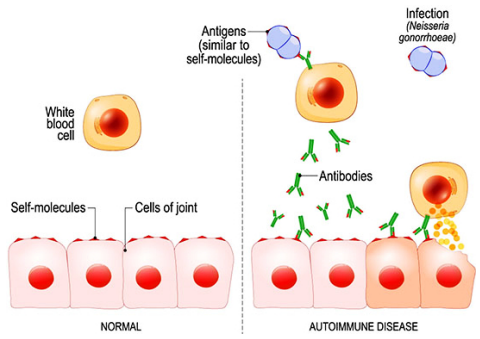
A healthy immune system defends the body against disease and infection. But if the immune system malfunctions, it mistakenly attacks healthy cells, tissues, and organs. Called autoimmune disease, these attacks can affect any part of the body, weakening bodily function and even turning life-threatening.
Image
i. Why are autoimmune diseases called degenerative diseases? (1)
ii. Name the autoimmune disease of body muscles. (1)
iii. Which types of immunity is provided by T-lymphocytes? (2)
OR
Which immune cells form humoral immune system? (2)
Read the following and answer any four questions from (i) to (v) given below:

In prokaryotes, DNA is circular and present in the cytoplasm but in eukaryotes, DNA is linear and mainly confined to the nucleus. DNA or deoxyribonucleic acid is a long polymer of nucleotides. In 1953, the first correct double-helical structure of DNA was worked out by Watson and Crick. Based on the X-ray diffraction data produced by Maurice Wilkins and Rosalind Franklin. It is composed of three components, i.e., A phosphate group, a deoxyribose sugar and a nitrogenous base. Different forms of DNA are B-DNA, Z-DNA, A-DNA, C-DNA and D-DNA.

  1. Name the linkage present between the nitrogen base and pentose sugar in DNA.
  1. Phosphodiester bond
  2. Phosphodiester bond
  3. Hydrogen bond
  4. None of these
  1. The double helix structure of DNA was proposed by.
  1. James Watson and Francis Crick.
  2. Earwin Chargaff
  3. Federick Griffith
  4. Hershey and Chase.
  1. The double chain of B-DNA is coiled in a helical fashion. The spiral twisting of B-DNA duplex produces.
  1. Right and left part.
  2. Major and minor grooves.
  3. Upper and lower side.
  4. Linear and circular part.
  1. Assertion: The two strands of DNA helix have uniform distance between them.

Reason: A large sized purine always paired opposite to a small sized pyrimidine.

  1. Both assertion and reason are true and reason is the correct explanation of assertion.
  2. Both assertion and reason are true but reason is not the correct explanation of assertion.
  3. Assertion is true but reason is false.
  4. Both assertion and reason are false.
  1. Which of the following describes the structure of B-DNA?
S.no
Polynudeotide chains
(a)
Parallel
5
(b)
Anti-parallel
10
(c)
Parallel
15
(d)
Anti-parallel
20
Read the following and answer any four questions from (i) to (v) given below:

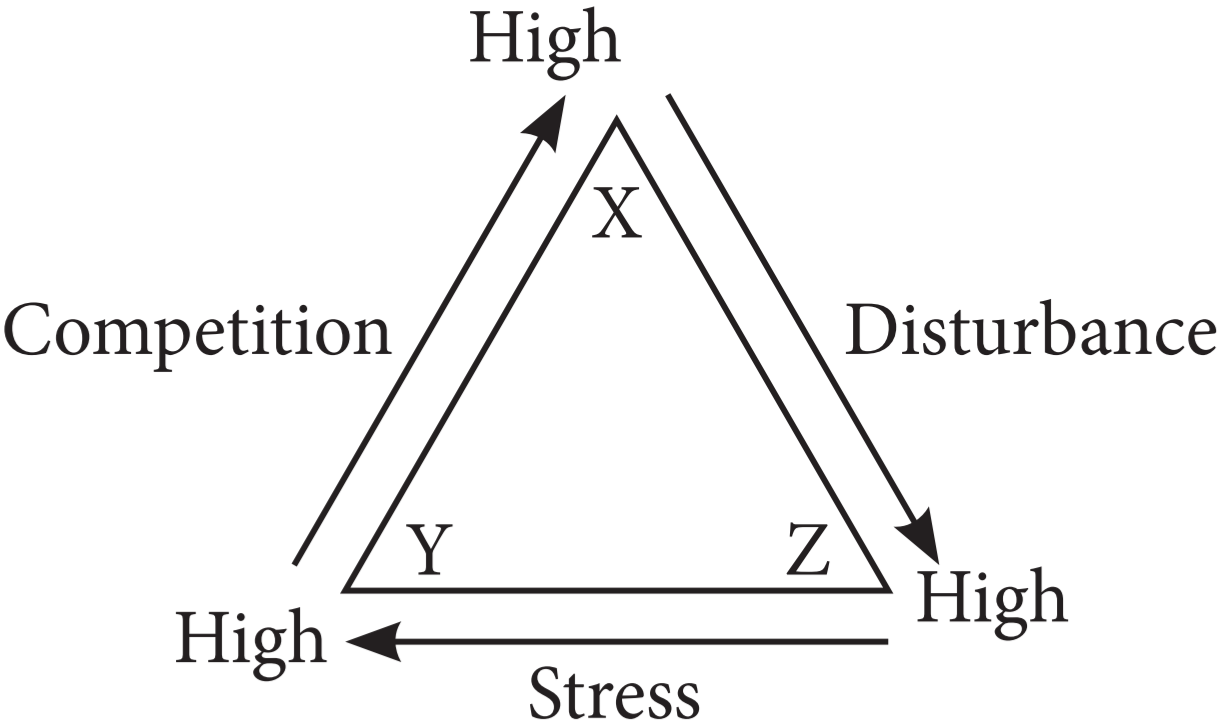
During teaching about various environmental factors, a teacher draw a figure that depicts like history strategies for three plant species (X, Y and Z) along 3 axes - strength of competition with other organisms, level of disturbance in the habitat and level of environmental stress in the habitat. Species X grows in habitats where competition among species is high but disturbance and stress are low. Species Y grows in habitats with high environmental stress but with low intraspecies competition. Species Z grows in highly disturbed habitats with low environmental stress.

  1. Which of the following is correct regarding plant type X?
  1. It has slow growth rate.
  2. It lives in area with high probability of severe environmental changes.
  3. It has good competitive ability at low population densities near the carrying capacity.
  4. None of these.
  1. Environmental stress occurs through.
  1. Very low temperature.
  2. Drought.
  3. Nutrient deficiency.
  4. All of these.
  1. Select the correct option regarding plant type X, Y and Z.
  1. X type of plants are likely to be trees.
  2. Y type of plants could be desert plants.
  3. Z type of plants could be herbaceous plant.
  4. All of these.
  1. Y type of plants grow under high stress and:
  1. Produce large number of seeds in a short time after rains.
  2. Have rapid growth.
  3. Produce less number of seed in a long time after rain.
  4. Both (a) and (b).
  1. Assertion: Plant growth rate is high in area of high stress and high disturbance.

Reason: High stress and high disturbance promote breeding capacity in plants.

  1. Both assertion and reason are true and reason is the correct explanation of assertion.
  2. Both assertion and reason are true but reason is not the correct explanation of assertion.
  3. Assertion is true but reason is false.
  4. Both assertion and reason are false.
Read the following and answer any four questions from (i) to (v) given below:
Translation is the process of polymerisation of amino acids to form a polypeptide. The order and sequence of amino acids are defined by the sequence bases in the mRNA. The amino acids are joined by a bond called peptide bond. Ribosome is the site of protein synthesis.
  1. Which ion is essential for association of both units of ribosome at the time of protein formation?
  1. Mg2+
  2. Mn2+
  3. CI-
  4. Ca2+
  1. During translation, how many initiation factors are required in eukaryotes for initiation reactions?
  1. 3
  2. 6
  3. 7
  4. 9
  1. Which part of mRNA contains untranslated regions (UTR)?
  1. 3' end
  2. 5' end
  3. Either 3' or 5' end
  4. Both 5' end and 3' end
  1. Name the enzyme that helps in combining amino acid to its particular tRNA?
  1. Activating enzyme
  2. Amino-acyl tRNA-synthetas
  3. PeptidyI transferase
  4. Both (a) and (b)
  1. From the given list, select the translation machinery.
  1. mRNA
  2. Ribosomes
  3. Amino acids
  4. tRNAs
  5. Peptidyl transferase
  6. Amino acyl tRNA synthetase
  7. Pyrophosphatase
  1. (1), (2), (3), (4) and (6)
  2. (1), (2), (3), (4) and (5)
  3. (1), (2), (3), (4), (5) and (6)
  4. (1), (2), (3), (4), (5), (6) and (7)
Origin and Evolution of Man:
What is the mechanism by which the AIDS virus causes deficiency of immune system of the infected person?
Read the following and answer any four questions from (i) to (v) given below:

Intrauterine devices are most widely accepted methods of contraception. These are used by females and are inserted by doctor or nurses in the uterus through vagina. However, these devices are not recommended for those who eventually intend to conceive.

  1. How does CuT prevent conception?
  1. Cu ions make uterus unsuitable for implantation.
  2. Cu ions make cervix hostile to the sperms.
  3. Cu ions suppress sperms motility.
  4. Cu ions inhibit ovulation.
  1. Which of the following IUDs makes uterus unsuitable for implantation?
  1. LNG-20.
  2. Multiload 375.
  3. Cu7.
  4. Lippes loop.
  1. Identify the correct statement for IUDs.
  1. They slowly release synthetic progesterone in the body.
  2. They increase phagocytosis of sperms within the uterus.
  3. They block entry of sperms through the cervix.
  4. Both (b) and (c).
  1. Select the correct matched pair.
  1. Hormone releasing IUD - LNG-20.
  2. Non-medicated IUD - Progestasert.
  3. Copper releasing IUD - Lippes loop.
  4. None of these.
  1. Assertion: IUDs can cause excess menstrual bleeding and pain.

Reason: IUDs can perforate uterus.

  1. Both assertion and reason are true, and reason is the correct explanation of assertion.
  2. Both assertion and reason are true, but reason is not the correct explanation of assertion.
  3. Assertion is true, but reason is false.
  4. Both assertion and reason are false.
Explain packaging of DNA Helix###Explain the formation of nucleosome in Eukaryotic cell
Explain innate immunity in detail