Question
Explain asymmetrical flow of current in $p-n$ junction diode in detail.

Answer

Image

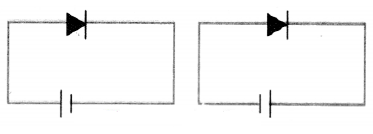
$i.$ The barrier potential is reduced in forward biased mode and it is increased in reverse biased mode.
$ii.$ Carriers find it easy to cross the junction in forward bias and contribute towards current because the barrier width is reduced and they are pushed towards the junction and gain extra energy to cross the junction.
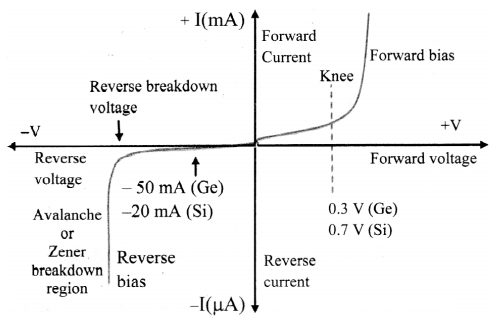
$iii.$ The current through the diode in forward bias is large and of the order of a few milliamperes $(10^{-3} A)$ for a typical diode.
$iv.$ When connected in reverse bias, width of the potential barrier is increased and the carriers are pushed away from the junction so that very few carriers can cross the junction and contribute towards current.
$v.$ This results in a very small current through a reverse biased diode. The current in reverse biased diode is of the order of a few microamperes $(10^{-6} A).$
$vi.$ When the polarity of bias voltage is reversed, the width of the depletion layer changes. This results in asymmetrical current flow through a diode as shown in figure.
Image

Need a full question paper?

Generate a complete, print-ready paper with questions like this in minutes — across 16+ boards, with answer keys.
Start Generating Free

Similar questions

What are the limitations in increasing the magnifying powers of (i) simple microscope (ii) compound microscope (iii) astronomical telescope?
Find a vector which is parallel to $\overrightarrow{ v }=\hat{i}-2 \hat{j}$ and has a magnitude $10.$
The acceleration due to gravity is determined by using a simple pendulum of length $l = (100 ± 0.1) \ cm$. If its time period is $T = (2 ± 0.01) s$, find the maximum percentage error in the measurement of g.
Explain in detail the distribution of electron energy levels in an isolated atom with the help of an example.
A wire of circular cross$-$section and $30$ ohm resistance is uniformly stretched until its new length is three times its original length. Find its resistance.
Discuss the variation of acceleration due to gravity at poles and equator due to latitude of the Earth.
Explain the concept of electrical conduction in a conductor.
State the main characteristics of EM waves.
Water is flowing in a stream with velocity $5 \ km/hr$ in an easterly direction relative to the shore. Speed of a boat relative to still water is $20 \ km/hr.$ If the boat enters the stream heading north, with what velocity will the boat actually travel?
On an open ground, a biker follows a track that turns to his left by an angle of $60^\circ$ after every $600 m.$ Starting from a given turn, specify the displacement of the biker at the third and sixth turn. Compare the magnitude of the displacement with the total path length covered by the motorist in each case.