Question
Explain : Bar magnet as an equivalent solenoid.

Answer

Image

Every current loop acts as a magnetic dipole. (In the previous chapter we have explained). We mentioned in Ampere's hypothesis that all magnetic phenomena can be explained in terms of circulating current.
The resemblance of magnetic field lines for a bar magnet and a solenoid suggest that a bar magnet may be thought of as a large number of circulating currents in analogy with a solenoid.
Cutting a bar magnet in half is like cutting a solenoid. We get two smaller solenoids with weaker magnetic properties. The field lines remain continuous, emerging from one face of the solenoid and entering in to the other face.
One can test this analogy by moving a small compass needle in the neighbourhood of a bar magnet and a current carring finite solenoid and nothing that the deflections of the needle are similar in both cases.
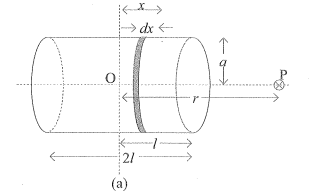
To make this analogy more firm we calculate the axial field of a finite solenoid depicted in fig. We shall demonstrate that at large distance this axial field resembles that of a bar magnet.
Magnetic field on axis of solenoid is
$B =\frac{\mu_0}{4 \pi} \cdot \frac{2 m}{r^3}$
This is also the far axial magnetic field of a bar magnet which one may obtain experimentally. Thus a bar magnet and a solenoid produce a similar magnetic field. The magnetic moment of a bar magnet and a solenoid produce similar magnetic field. The magnetic moment of a bar magnet is thus, equal to magnetic moment of an equivalent solenoid that produces the same magnetic field.

Need a full question paper?

Generate a complete, print-ready paper with questions like this in minutes — across 16+ boards, with answer keys.
Start Generating Free

Similar questions

$a.$ Write the relationship between mobility and drift velocity in a current carrying conductor.
$b.$ Two aluminium wires have their lengths in the ratio $2 : 3$ and radii in the ratio $1 : 3.$ These are connected in parallel across a battery of emf $E$ and of negligible internal resistance. Find the ratio of drift velocities of the electrons in the two wires.
The kinetic energy of a charged particle decreases by 10J as it moves from a point at potential 100V to a point at potential 200V. Find the charge on the particle.
Define the term self-inductance. Write its SI unit. Give two factors on which self inductance of an air-core coil depends.
A hypothetical magnetic field existing in a region is given by $\overrightarrow{\text{B}}=\text{B}_0\overrightarrow{\text{e}}_\text{r},$ where $\overrightarrow{\text{e}}_\text{r}$ denotes the unit vector along the radial direction. A circular loop of radius a, carrying a current i, is placed with its plane parallel to the x-y plane and the centre at (0, 0, d). Find the magnitude of the magnetic force acting on the loop.
A convex lens produces a double size real image when an object is placed at a distance of 18cm from it. Where should the object be placed to produce a triple size real image?
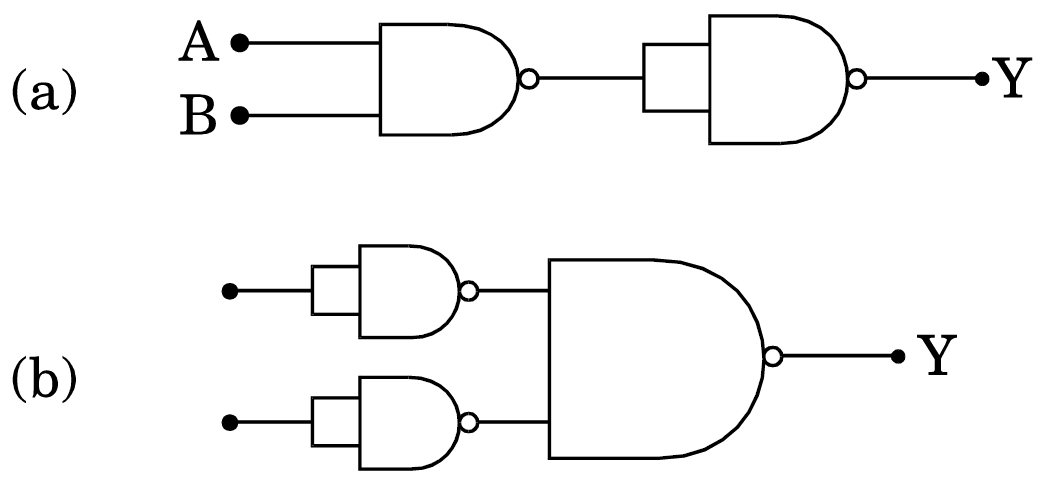
You are given two circuits (a) and (b) as shown in the figures, which consist of NAND gates. Identify the logic operation carried out by the two. Write the truth tables for each. Identify the gates equivalent to the two circuits.
Show that the radius of the orbit in hydrogen atom varies as $n^2,$ where n is the principal quantum number of the atom.
Get the electric field due to a uniformly charged infinite plane sheet.
A straight wire of length l can slide on two parallel plastic rails kept in a horizontal plane with a separation d. The coefficient of friction between the wire and the rails is $\mu.$ If the wire carries a current i, what minimum magnetic field should exist in the space in order to slide the wire on the rails?
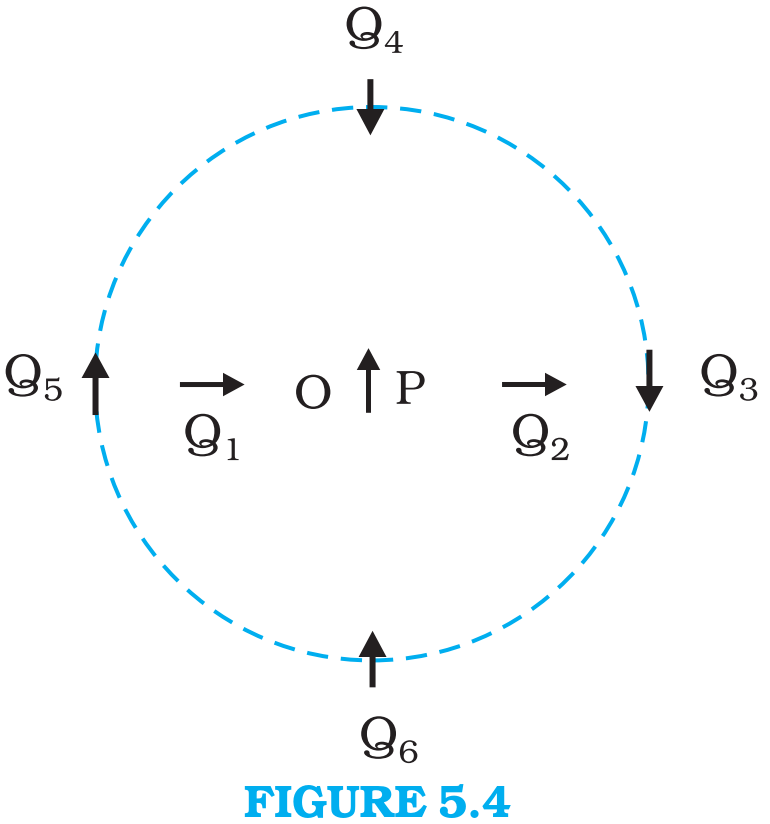
Figure 5.4 shows a small magnetised needle $P$ placed at a point $O$. The arrow shows the direction of its magnetic moment. The other arrows show different positions (and orientations of the magnetic moment) of another identical magnetised needle $Q$.
(a) In which configuration the system is not in equilibrium?
(b) In which configuration is the system in (i) stable, and (ii) unstable equilibrium?
(c) Which configuration corresponds to the lowest potential energy among all the configurations shown?
Image