Question 13 Marks
Explain : Bar magnet as an equivalent solenoid.
Answer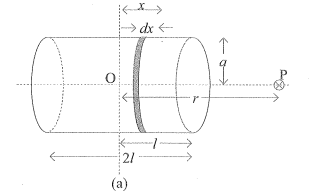
→Every current loop acts as a magnetic dipole. (In the previous chapter we have explained). We mentioned in Ampere's hypothesis that all magnetic phenomena can be explained in terms of circulating current.
→The resemblance of magnetic field lines for a bar magnet and a solenoid suggest that a bar magnet may be thought of as a large number of circulating currents in analogy with a solenoid.
→Cutting a bar magnet in half is like cutting a solenoid. We get two smaller solenoids with weaker magnetic properties. The field lines remain continuous, emerging from one face of the solenoid and entering in to the other face.
→One can test this analogy by moving a small compass needle in the neighbourhood of a bar magnet and a current carring finite solenoid and nothing that the deflections of the needle are similar in both cases.
→To make this analogy more firm we calculate the axial field of a finite solenoid depicted in fig. We shall demonstrate that at large distance this axial field resembles that of a bar magnet.
→ Magnetic field on axis of solenoid is
$B =\frac{\mu_0}{4 \pi} \cdot \frac{2 m}{r^3}$
→This is also the far axial magnetic field of a bar magnet which one may obtain experimentally. Thus a bar magnet and a solenoid produce a similar magnetic field. The magnetic moment of a bar magnet and a solenoid produce similar magnetic field. The magnetic moment of a bar magnet is thus, equal to magnetic moment of an equivalent solenoid that produces the same magnetic field.
View full question & answer→→Every current loop acts as a magnetic dipole. (In the previous chapter we have explained). We mentioned in Ampere's hypothesis that all magnetic phenomena can be explained in terms of circulating current.
→The resemblance of magnetic field lines for a bar magnet and a solenoid suggest that a bar magnet may be thought of as a large number of circulating currents in analogy with a solenoid.
→Cutting a bar magnet in half is like cutting a solenoid. We get two smaller solenoids with weaker magnetic properties. The field lines remain continuous, emerging from one face of the solenoid and entering in to the other face.
→One can test this analogy by moving a small compass needle in the neighbourhood of a bar magnet and a current carring finite solenoid and nothing that the deflections of the needle are similar in both cases.
→To make this analogy more firm we calculate the axial field of a finite solenoid depicted in fig. We shall demonstrate that at large distance this axial field resembles that of a bar magnet.
→ Magnetic field on axis of solenoid is
$B =\frac{\mu_0}{4 \pi} \cdot \frac{2 m}{r^3}$
→This is also the far axial magnetic field of a bar magnet which one may obtain experimentally. Thus a bar magnet and a solenoid produce a similar magnetic field. The magnetic moment of a bar magnet and a solenoid produce similar magnetic field. The magnetic moment of a bar magnet is thus, equal to magnetic moment of an equivalent solenoid that produces the same magnetic field.