Question
Explain : Bar magnet as an equivalent solenoid.

Answer

Image

Every current loop acts as a magnetic dipole. (In the previous chapter we have explained). We mentioned in Ampere's hypothesis that all magnetic phenomena can be explained in terms of circulating current.
The resemblance of magnetic field lines for a bar magnet and a solenoid suggest that a bar magnet may be thought of as a large number of circulating currents in analogy with a solenoid.
Cutting a bar magnet in half is like cutting a solenoid. We get two smaller solenoids with weaker magnetic properties. The field lines remain continuous, emerging from one face of the solenoid and entering in to the other face.
One can test this analogy by moving a small compass needle in the neighbourhood of a bar magnet and a current carring finite solenoid and nothing that the deflections of the needle are similar in both cases.
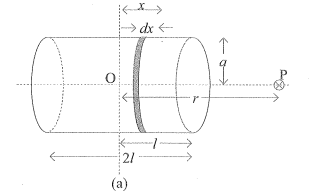
To make this analogy more firm we calculate the axial field of a finite solenoid depicted in fig. We shall demonstrate that at large distance this axial field resembles that of a bar magnet.
Magnetic field on axis of solenoid is
$B =\frac{\mu_0}{4 \pi} \cdot \frac{2 m}{r^3}$
This is also the far axial magnetic field of a bar magnet which one may obtain experimentally. Thus a bar magnet and a solenoid produce a similar magnetic field. The magnetic moment of a bar magnet and a solenoid produce similar magnetic field. The magnetic moment of a bar magnet is thus, equal to magnetic moment of an equivalent solenoid that produces the same magnetic field.

Need a full question paper?

Generate a complete, print-ready paper with questions like this in minutes — across 16+ boards, with answer keys.
Start Generating Free

Similar questions

A long cylindrical wire of radius b carries a current i distributed uniformly over its cross-section. Find the magnitude of the magnetic field at a point inside the wire at a distance a from the axis.
Draw a labelled ray diagram of a refracting telescope. Define its magnifying power and write the expression for it.
Write two important limitations of a refracting telescope over a reflecting type telescope.
A cube of ice of edge 4cm is placed in an empty cylindrical glass of inner diameter 6cm. Assume that the ice melts uniformly from each side so that it always retains its cubical shape. Remembering that ice is lighter than water, find the length of the edge of the ice cube at the instant it just leaves contact with the bottom of the glass.
$(a)$ Obtain the expression for the magnetic energy stored in a solenoid in terms of magnetic field $B,$ area $A$ and length $l$ of the solenoid. $(b)$ How does this magnetic energy compare with the electrostatic energy stored in a capacitor?
  1. Which segment of electromagnetic waves has highest frequency? How are these waves produced ? Give one use of these waves.
  2. Which em waves lie near the high-frequency end of visible part of em spectrum? Give its one use. In what way this component of light has harmful effects on humans?
  1. Define torque acting on a dipole of dipole moment $\overrightarrow{p}$ placed in a uniform electric field $\overrightarrow{\text{E}}$. Express it in the vector form and point out the direction along which it acts
  2. What happens if the field is non-uniform?
  3. What would happen if the external field $\overrightarrow{\text{E}}$ is increasing (i) parallel to $\overrightarrow{p}$ and (ii) anti-parallel to $\overrightarrow{p}$?
The electric field in a region is given by $\overrightarrow{\text{E}}=\frac{3}{5}\text{E}_0\overrightarrow{\text{i}}+\frac{4}{5}\text{E}_0\overrightarrow{\text{j}}$ with $\text{E}_0=2.0\times10^3\text{NC}^{-1}.$ Find the flux of this field through a rectangular surface of area $0.2m^2$ parallel to the $y-z$ plane.
An ac circuit is made from series combination of components of circuits X and Y . Current is ahead of voltage by $\frac{\pi}{4}$. If component $X$ is pure resistor whose value is $100 \Omega$ then (i) what is the name of component $Y$ ? (ii) If root mean square value of voltage is 141 V , then find the root mean square value of the current.
A 12.9 eV beam of electrons is used to bombard gaseous hydrogen at room temperature. Upto which energy level the hydrogen atoms would be excited?
Calculate the wavelength of the first member of Paschen series and first member of Balmer series.
  1. Draw a labelled ray diagram showing the formation of a final image by a compound microscope at least distance of distinct vision.
  2. The total magnification produced by a compound microscope is 20. The magnification produced by the eye piece is 5. The microscope is focussed on a-certain object. The distance between the objective and eyepiece is observed to be 14 cm. If least distance of distinct vision is 20 cm, calculate the focal length of the objective and the eye piece.